Marie-Claire Messouma Manlanbien
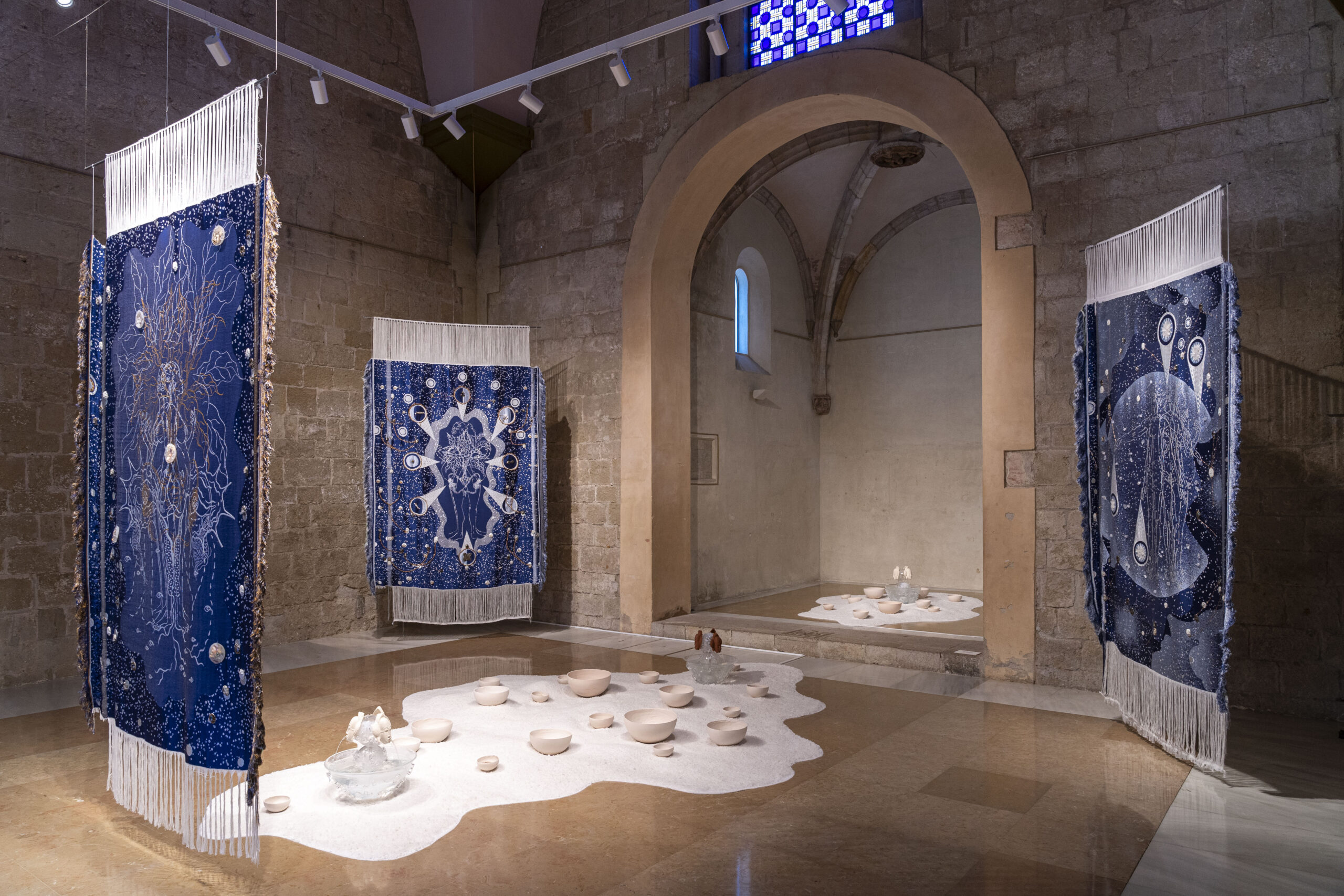
Marie-Claire Messouma Manlanbien
Bringing Together the Living
In an essay exploring a paradigm shift in our understanding of classical anthropology, the philosopher and researcher Mohamed Amer Meziane refers to ‘a way of thinking about what lies at the edge of worlds1’. Through this work, he analyses the possibility of decolonising the construction of knowledge and encourages a way of thinking situated at the threshold of several regimes of reality. This way of navigating between different universes – both tangible and intangible – without ranking them, resonates with the syncretic practice of the artist Marie-Claire Messouma Manlanbien. In her composite installations, the artist forges bridges between different mythologies, bodies of knowledge and practices, which come together both in her textile works and in the accompanying poetic writings. The components of her cosmogonic ensembles draw on her knowledge of the living world, tales and legends, rituals, and both philosophical and spiritual thought, without distinction between the cultures from which they originate. Often interactive, Marie-Claire Messouma Manlanbien’s installations can be compared with the research developed by the theatre director Frédérique Aït-Touati in the book Trilogie terrestre, which aims to ‘bring non-humans to the fore, to give a voice to beings who cannot speak2’. In an effort to reveal the state of the world we inhabit and the multiplicity of beings and agents that make up the earthly realm, the artist uses her voice, various instruments and her woven pieces to establish a connection between our bodies and their surroundings. During a performance at the Villa Medici in 2026, Marie-Claire Messouma Manlanbien manipulated crystal bowls to create a sensation of vibration intended to be experienced. In line with the idea put forward by Frédérique Aït-Touati—that the world is not to be viewed from the outside, but rather quivers within each and every one of us— the artist seeks to foster interactions between bodies through shared moments of activation, which are as much a matter of ritual as they are a desire to rethink the connections between humans and what she terms ‘the other3’.
Mental cartographies and bodily territories
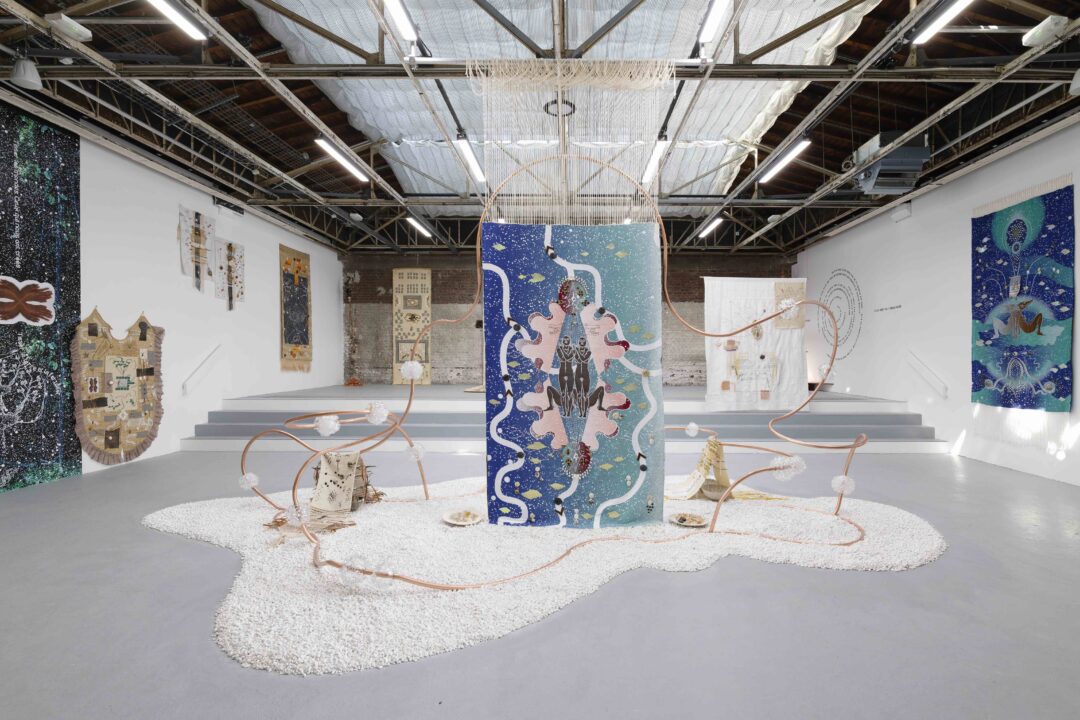
Marie-Claire Messouma Manlanbien’s work finds its anchor in her weaving practice – both manual and digital – which she constructs from a multitude of elements embedded within her more or less monumental tapestries. Raffia, cotton, vegetable-tanned leather, glass, shells, hair and plant essences coalesce in textile works whose manufacturing techniques have their origins in Akan societies4. The artist removes, adds or adapts elements to these existing objects to propose alternative ways of interpreting them. Whilst the designs that emerge resemble mental projections of different territories, these works also evoke a psychological landscape that highlights possible correlations between the inner and the outer worlds. Constantly inspired by various systems for representing physical and mental states – such as the chakras – which permeate her practice, Marie-Claire Messouma Manlanbien renders the notions of scale and boundaries between segmented spaces porous. Adopting a topographical approach, she creates maps, conceived as symbolic cartographies that can be likened to astral projections carrying an augural dimension.
Archipelagic Thought
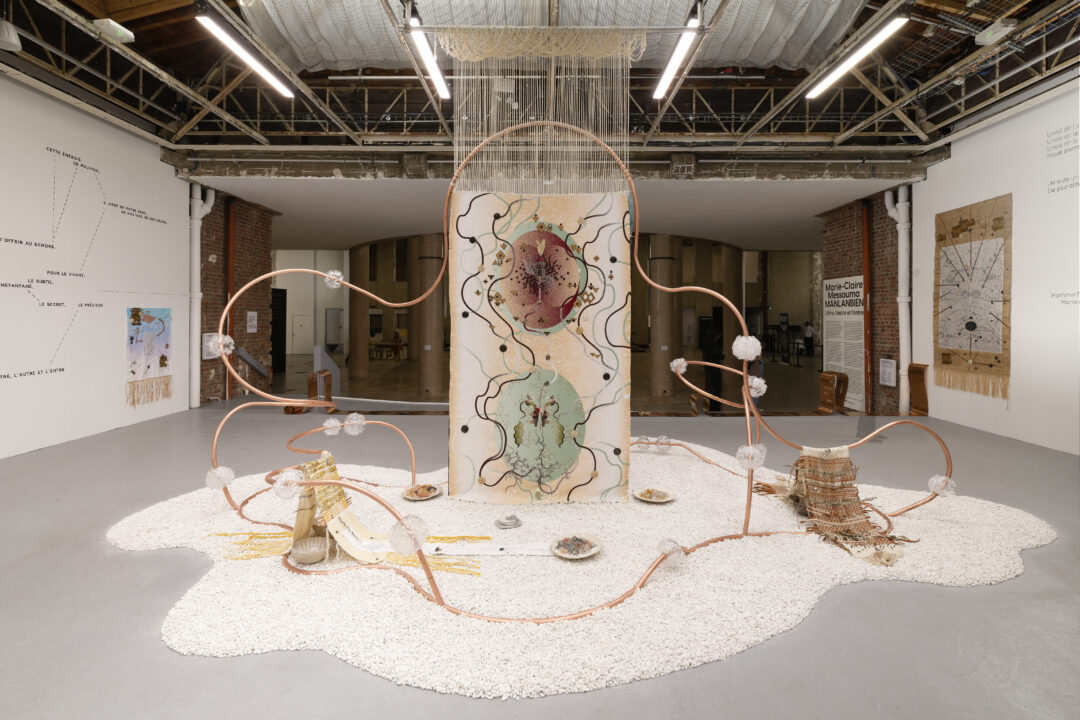
Marie-Claire Messouma Manlanbien’s work is conceived as a network of narratives that intersect within composite environments. She creates systems of correspondences between continents, cultures and languages to form constellations that set new geographies in motion. Drawing on the concept of ‘crossing5’ – of borders and ideas – championed by the historian Achille Mbembe, the artist seeks to respond to a logic of decolonisation of thought, identity and territories. From this perspective, Marie-Claire Messouma Manlanbien’s practice explores the breaking down of barriers between the knowledge and heritage drawn upon in her work. Having grown up in Guadeloupe, mainland France and Côte d’Ivoire, the artist draws on a multitude of traditions and ancestral knowledge acquired from generation to generation and passed down by the women in her family, who hail from matrilineal Akan societies. This notion of an archipelago is also explored in the book Venise, millefleurs by the author Ryōko Sekiguchi. In it, she draws parallels between territories, eras and the various manifestations of life, and observes that ‘plants can cross the boundaries between the past and the present, bridge the temporal gap, exchange pollen and let their vines creep along one another’s stems6’. The focus on plants, which runs throughout this book, recalls the way in which Marie-Claire Messouma Manlanbien strives to establish networks of knowledge and bridges between beings and things—particularly plants, which are at the heart of her residency at the Villa Medici.
From the Enclosed Universe to the Infinite World7
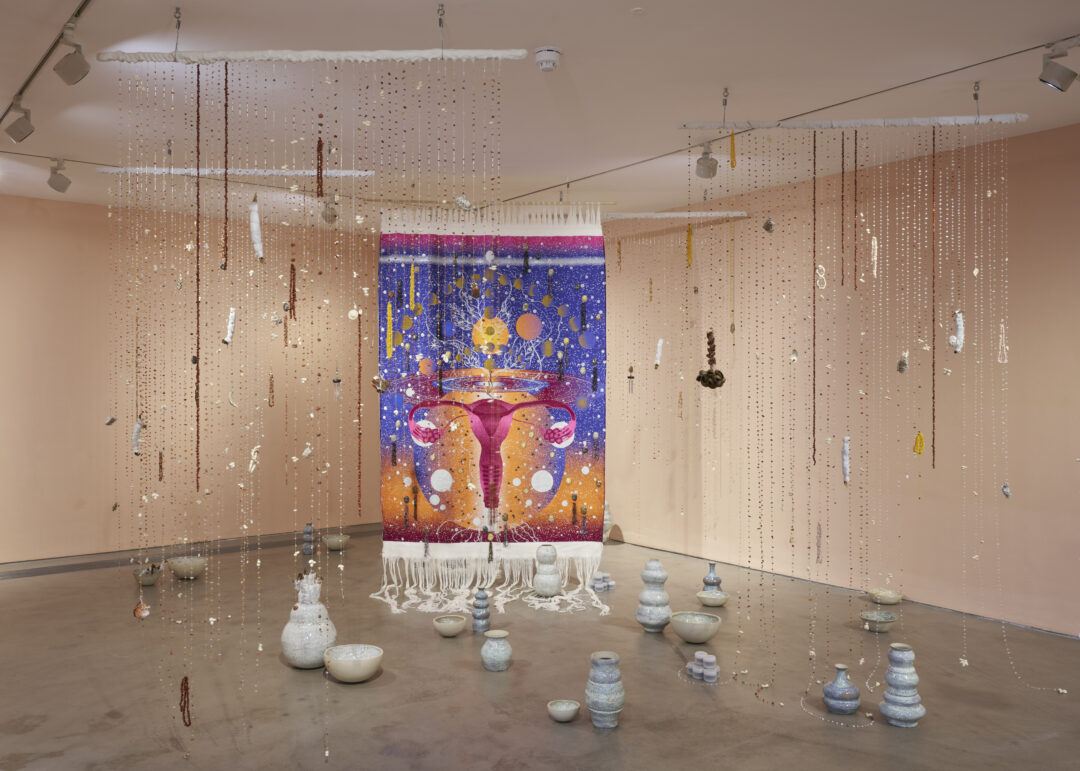
In her book devoted to various ecofeminist writings, the philosopher Émilie Hache explores the idea that renewing our imaginations offers a possible way of inhabiting a finite world. By raising awareness of the growing scarcity of resources and the need to construct speculative narratives to counter a future based solely on the notion of progress, she invites us, conversely, to redefine the boundaries of the world in which we live—with its infinite possibilities—without participating in a dynamic of extractivist exploitation. In her own way, she also examines the notion of ‘edges’ to encourage a broadening of our perception of the visible world. In a similar vein, Marie-Claire Messouma Manlanbien seeks to uncover and share the hidden powers of certain elements, as well as the knowledge associated with them. Following research into helichrysum, conducted in particular during her year-long residency at the Villa Medici, the artist reveals some of its properties linked to the tradition of Italian pharmacopoeia. Incorporated into her practice in various ways, this plant—also known as ‘immortelle’ and renowned for its regenerative qualities—becomes here a healing element that is integrated into her work in multiple forms. From this plant essence, the artist creates various macerates arranged on the floor in bowls that allow their fragrances to waft out. She also uses helichrysum in her weaving practice to create ‘textile balms’ that serve this same restorative function. Also employed in culinary performances, her research here echoes a therapeutic approach that involves highlighting the properties of various living elements, much like lithotherapy – the powers attributed to stones and crystals – which is central to her practice. The elements that inform her work stem from a desire to celebrate various craft traditions, ancestral knowledge and rituals that are gradually disappearing in certain societies. For the philosopher Byung-Chul Han, this gradual erosion stems from a world increasingly devoid of symbols, which favours a productivist system over sustainability. In opposition to this neoliberal logic, which breeds isolation and a ‘community without communication8’, Marie-Claire Messouma Manlanbien’s work, on the contrary, seeks to rethink the question of connection, networks and possible intersections, and to blur the boundaries between living beings.
Camille Velluet
1. Mohamed Amer Meziane, Auborddesmondes. Towards a Metaphysical Anthropology, Brussels, Vues de l’esprit, 2023, p. 76.
2. Frédérique Aït-Touati and Bruno Latour, Trilogie terrestre, Paris, B42, 2022, p. 5.
3. Interview conducted on the occasion of the exhibition ‘L’être, l’autre et l’entre ’ (16 June 2023–10 September 2023) at the Palais de Tokyo [palaisdetokyo.com/ressource/entretien-avec-marie-claire-messouma-manlanbien/].
4. Akan matriarchal societies of Ghana and Côte d’Ivoire.
5. Achille Mbembe, Emerging from the Great Night: An Essay on Decolonised Africa, Paris, La Découverte, 2013, p. 257.
6. Ryōko Sekiguchi, Venice, Millefleurs, Paris, P.O.L, 2026, p. 27.
7. Émilie Hache (ed.), From the Enclosed Universe to the Infinite World: Cosmopolitical Essays, Bellevaux, Éditions Dehors, 2024.
8. Byung-Chul Han, The Disappearance of Rituals: Towards a Topology of the Present, trans. Olivier Mannoni, Arles, Actes Sud, 2025.
his article was published with support from the ¡Viva Villa! fund, a network of French artist-in-residence programs abroad.
Head image : Installation view Marie-Claire Messouma Manlanbien, Temple du soin (Temple of Care), 2024. Manifesta 15 Barcelona Metropolitana. Photo Helena Roig
- Share: ,
- By the same author: Louise Mutrel, Anne Le Troter,
Related articles
Francisco Tropa
by Agnès Violeau
Nicolas Daubanes
by Guillaume Lasserre
Pauline Curnier Jardin
by Sarah Matia Pasqualetti