Francisco Tropa
Francesco Tropa
The Tragedy of the Landscape1
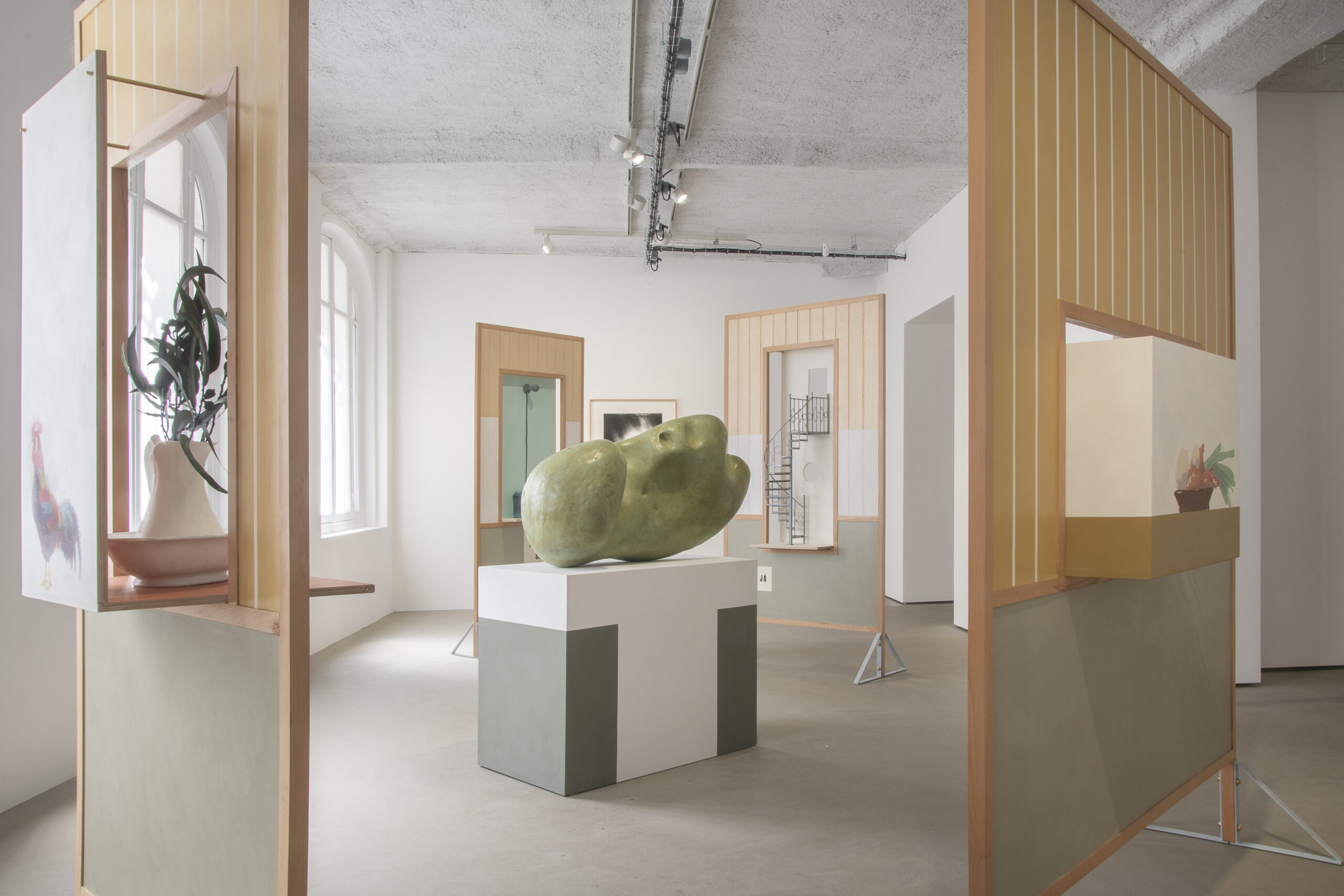
Francisco Tropa (born in 1968, lives and works in Lisbon) has been developing a practice of site-specific sculpture since the 1990s. Through the use of objects, images and representations often sourced from excavations, he transforms the installation into a phenomenological space, within which ancient and aquatic, metaphysical and literary narratives are explored. The Jocelyn Wolff Gallery presents his work under the title “MISS AMERICA”. Following on from the exhibition “O Pirgo de Chaves2”, shown in 2019 at the Gulbenkian Foundation in Lisbon, the project draws on the playfulness and torments of the soul. It recounts one of the topoi of art history—that of the shipwreck—here associated with landscape painting and the myth of America, as imagined and portrayed by cinema and fiction.
Miss America is the name of a fictional ship invented by the artist, and of the narrative that carries it. Through the story of a ship bearing a woman’s name, Francisco Tropa takes us out to sea. Whilst the artist explores in his work the manner in which images emerge, the exhibition is conceived as an archaeological excavation, reinforcing his favoured themes of science, creation and the notion of representation. The term naufragium refers to a shipping accident (literal sense) or total ruin (figurative sense). Among the Romans, it was used to denote both the sinking of ships and chariot accidents in the arena. Here, the encounter between the work and the public takes place in the manner of Ulysses, who writes his journey as he progresses. But what shipwreck are we talking about: pride, as in the novel Moby Dick3? That of modernity or of Western imperialism?
The exhibition as structure and as event
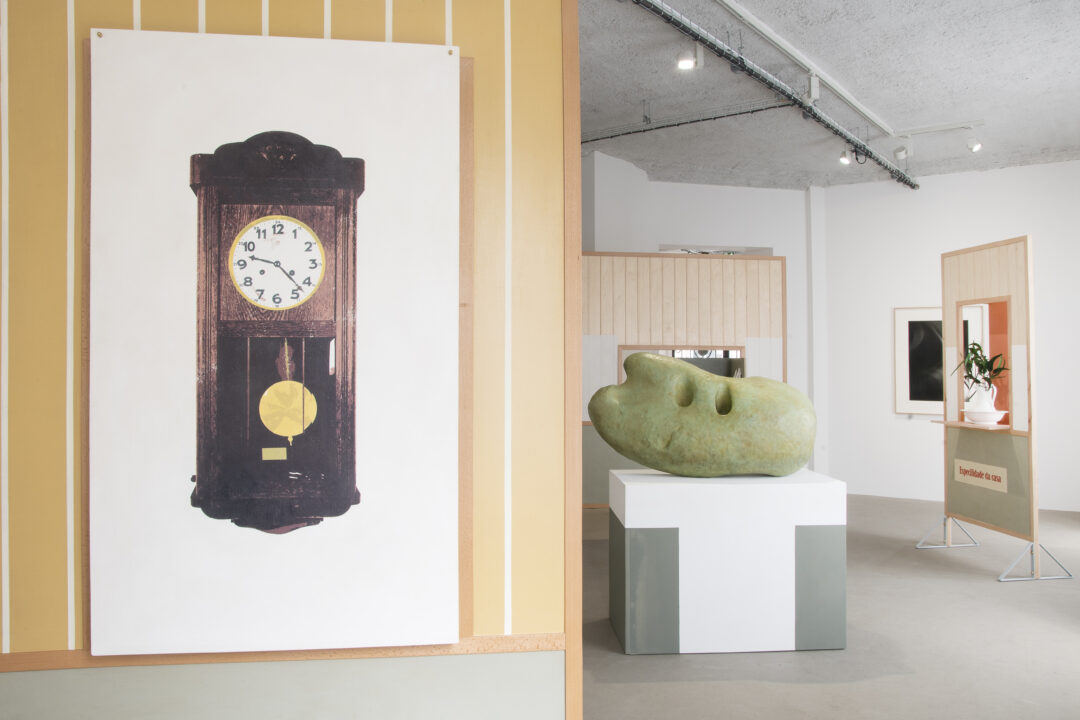
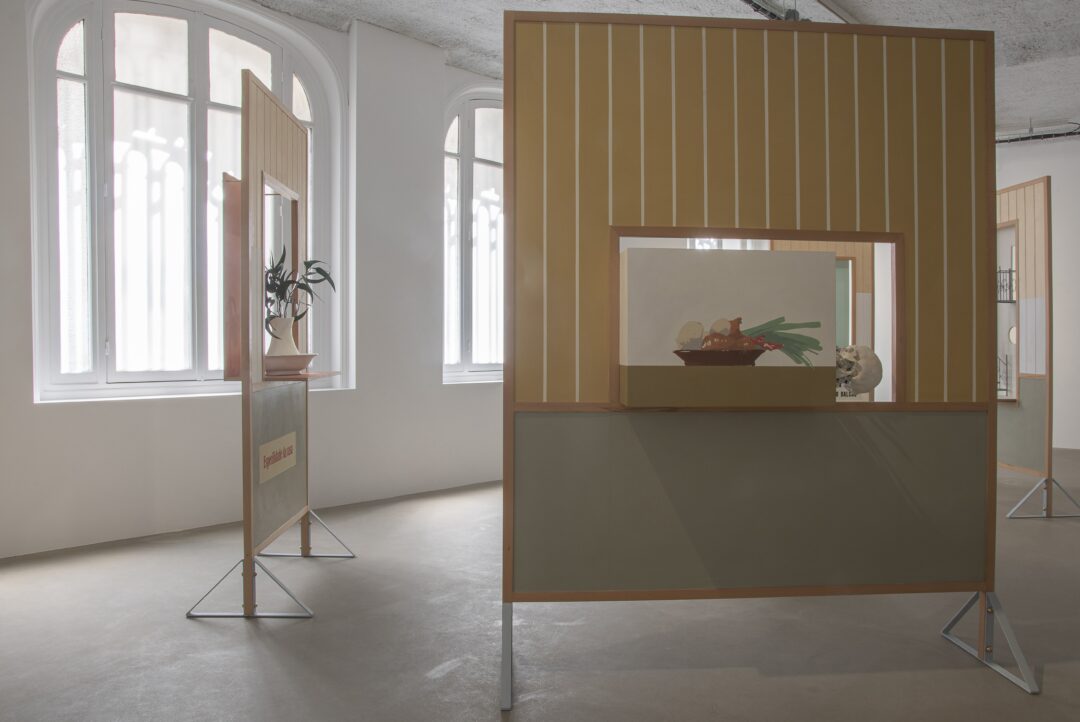
The central installation, consisting of four partitions flanking an enlarged pebble, demonstrates the artist’s remarkable skill in the use of space. Visitors pass through it to discover the bronze pieces and the series of murals installed at the back of the gallery. A symbolic cabin from the ship Miss America, the installation is based on a situation whose obvious transitivity invites visitors to let their imaginations run wild. Who is steering the ship? The partitions bear signs and images drawn from various sources: a human skeleton, a clock, a kerosene lamp, steps and food shop signs lend the whole a feel reminiscent of a domestic setting. These elements and representations convey a romantic narrative, where the transience of things forms the landscape. A key aspect of postmodern sensibility lies in a fascination with the fractal, in an enthusiasm for a discontinuous mental landscape more sensitive to disturbances. Here, the work exhibits a polygraphy, in the sense of a piece that aims not for linearity but for a form of disorder into which one can insert oneself. By employing various topographical systems, Francisco Tropa turns the fragment into a device that disrupts narrative duration. The fragmentary requirement, regarded by Barthes as the locus of precarious writing, is by definition continually deferred. Borrowing does not incorporate determinism. Here, the visitor traverses the space just as the sailor crosses the ocean: a postmodern predilection for wandering and the unexpected.
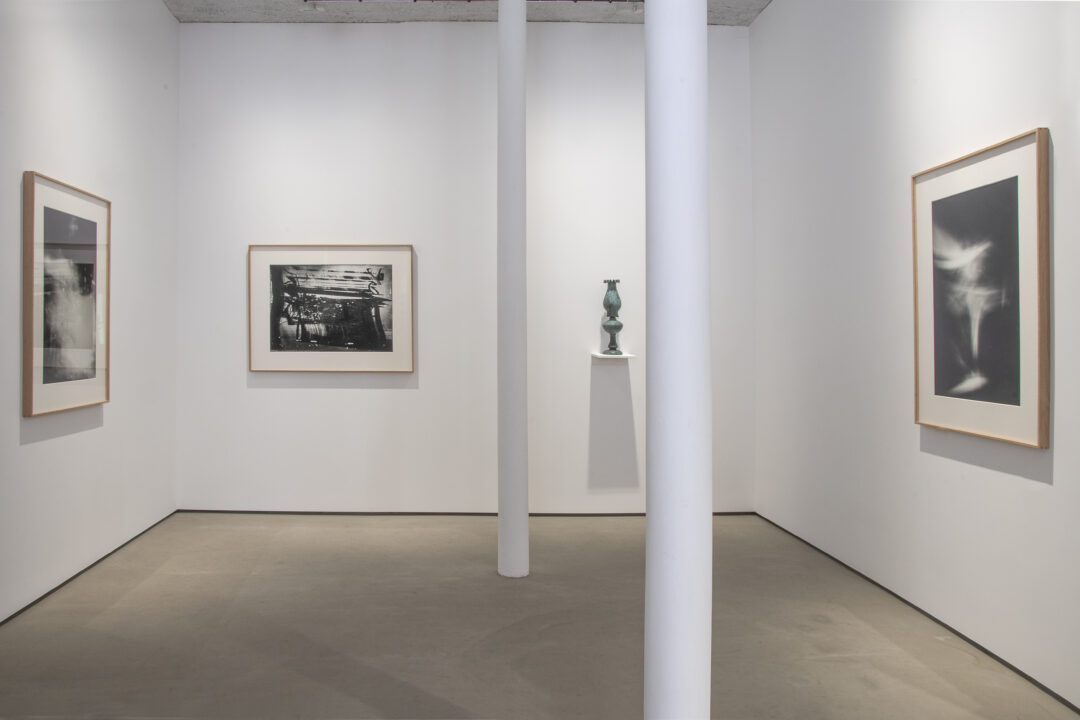
The idea of apparition is also central to the wall works. A set of five glass plates entitled Naufrage, produced using a technique akin to cyanotype that leaves room for the imperfections of reality (hair, dust), depicts spectral forms. A final series evokes, through its compositions, Chinese philosophical painting and its mental landscapes to be traversed along the water’s flow. This aesthetic dismantles systems associated with a logocentric truth, in favour of an open work, in the manner of a Sebaldian journey (which relishes digression and travel without a precise itinerary). Should we see in this an evocation of today’s migrations, linked to war, mineral extraction and climate change? The sea is also the expanse of all our knowledge. In cultures colonised by capitalism, it represents the site of a possible other world, where the system of white domination is replaced by an aquatic universe and where the points of reference are entirely different. It is the site of a hierarchical reversal.
The Shipwreck of Hope
Let us return to Homer, where the sea is the scene of shipwrecks and dire omens. The danger of storms is symbolised there by sea monsters or deities. Among the Romans, the naumachiae, spectacular aquatic battles, gave rise to architectural installations, not all of which have been excavated. It was in the context of these archaeological excavations that the pirgo was discovered, a bronze game in the form of a tower with stairs, from the top of which dice were thrown. Once at the bottom, the dice would pop out and free the player from the wishes dictated by the Oracle. Much later, in 1824, the German Romantic painter Caspar David Friedrich produced The Sea of Ice (or The Wreck of the Hope). The painting depicts a three-masted ship trapped in the ice during an expedition to the North Pole. It is interpreted as the painter’s inner landscape and a model for representing inner torment. The Espérance in question is the name of the ship, which the artist remembered as vividly as the drowning of his brother during a skating session on frozen water. The subject of a metaphorical nature of our impulses is found in “MISS AMERICA”: if we view chaos as a whole that rests on no foundation, which denies authority, we see in the exhibited works the image of a valiant crew. Francisco Tropa creates a landscape of signs, painting the human condition in its fragile incompleteness.
From life (4)
In W. G. Sebald’s novel The Rings of Saturn, a fusion takes place between the narrator’s identity and that of the main character (both are German writers who have come to England, the hero’s identity merging with that of the German Romantic poet Friedrich Hölderlin). In the same way that Sebald does not use quotation marks for quotations in his text, ‘MISS AMERICA’ integrates narratives from the past into the situation. Here, the visitor is at the centre of the exhibition’s framework; through the same process, they become the narrator of the present. Whilst the exhibition opens up an anthropological space, it also refers to the notion of ruin. This is the remnant of a structure (in both the literal and figurative senses), degraded by time or by human action. The contemporary ruin (distinct from the ancient ruin, which is imbued with history) manifests a need, as a social body, to understand the present and its obsolescence. “To step out of time and into eternity,” writes Immanuel Kant5. It is also an allegory of a decomposed body – whether individual or collective.
In 2026, navigators are more at home on the Internet. Just as the lexical field of the ‘cyberflâneur’ – a neologism modelled on Baudelaire’s flâneur – is that of the sea: we surf on streams, we navigate through pages, we drown in the tides of emails. These expressions are taken verbatim from Californian tech pioneers. Ubimedia revisits the ocean, that landscape conducive to losing oneself. But from navigation with an exploratory origin, we have moved to a circular movement, like the economy, driven by algorithms.
The Tropa Show
But what does America have to do with this story? In the film The Truman Show (1998), the main character leads an artificial life, broadcast in real time on television and sponsored by the government. The main character, Truman, realises, through regular flashes of reality (product placements, adverts…), that he is living in a fabricated world. The final scene shows the determined hero, on a boat braving the storm, reaching the ends of the earth. Truman touches a canvas serving as a backdrop and climbs a staircase leading to a door. A very similar staircase forms part of the installation, signifying the passage of time but also our freedom. What freedom do we have when faced with a work of art? It is here, through the transitivity of the work—involving reality but also its double—that the artist draws us into the narrative he constructs.
The sirens of 2026 may no longer be the same as in Ulysses’s time. Today’s technocapitalism has seized the stage to take the place of the living. US imperialism may be seeing its end in the current conflicts. Here, the exhibition installation stages the ballet of our obsolescence, but also that of the pragmatic drive to create an ‘event’ together. ‘The end is in the beginning, and yet we carry on,’ said Beckett in Endgame (1957).
‘MISS AMERICA’ aims to be a model of a possible social form conceived on the principle of happy coexistence. Through an arrangement of eclectic objects and narratives, it establishes a shared living space.
Agnès Violeau, May 2026
Exhibition presented at the Jocelyn Wolff Gallery from 20 April to 20 June 2026.
1. The sculptor David d’Angers said of Friedrich that he was the ‘only landscape painter who had hitherto had the power to stir all the faculties of my soul, the one who created a new genre: the tragedy of the landscape’.
2. Taking its title from the discovery of a major Roman thermal complex located in Chaves, in northern Portugal.
3.Melville’s novel explores, through a ship with a crew of diverse origins, questions of class and social status, of good and evil, and of the existence of God.
4.Borrowed from From Nature. An Elementary Poem, an essay by Sebald (1988).
5.Immanuel Kant, The End of All Things, Arles, Actes Sud, 1999 (1794).
- Share: ,
- By the same author: Larissa Fassler, Carole Douillard, Chantal Akerman,
Related articles
Nicolas Daubanes
by Guillaume Lasserre
Pauline Curnier Jardin
by Sarah Matia Pasqualetti
Larissa Fassler
by Agnès Violeau