Pauline Curnier Jardin
“If art has the power to collectively overturn the frameworks of legality, then I continue to believe in it very strongly,” says Pauline Curnier Jardin. The artist is interested in the interstices where dissident forms of solidarity can evade the social, moral or political laws that determine what a body may desire, do or be. Her films and installations depict anarchic and resistant desires, capable of cracking the structures of power. In the face of the control mechanisms and administrative contradictions that govern our lives, she proposes celebratory communities, whose outlaw nature becomes as much a survival strategy as a form of shared joy.
Somewhere between documentary cinema and dreamlike fiction, her female characters undergo metamorphoses in baroque epics populated by saints and prostitutes, goddesses and prisoners, madwomen and heroines, mothers and witches. Theatrical performance, caustic humour and eroticism intermingle to bring forth bodies that disguise themselves, find pleasure, scream and transform their vulnerability and anger into collective power. It is no coincidence that the M HKA in Antwerp has titled its 2025 retrospective, dedicated to the last twenty years of the artist’s work, ‘The Associations of Pauline Curnier Jardin’: for her, art is constructed above all as a collective practice, much like the processions, carnivals or popular and religious rituals that form the subject of her research. Spirituality, folklore and camp aesthetics fuel burlesque narratives in which archetypal figures are constantly renewed, subverted and corrupted.
The carnivalesque atmosphere that pervades Pauline Curnier Jardin’s work offers laughter as a tool for critical subversion, blurring hierarchies and allowing her to mock both the narratives that have shaped female stereotypes and the very idea of a supposed feminine essence. This logic is powerfully evident in Jeanet Film Adulte (2025), filmed in Aalst following three years of collaboration with the city’s residents and produced as part of the exhibition “Dress to Kill” at NW – Open House for Contemporary Art and Film (Aalst, Belgium). The film takes the local carnival—as famous as it is controversial—as its starting point. The artist focuses on the third day of the festivities, the Vuil Jeanet, when men dress up as caricatures of women, particularly unworthy mothers, homeless women and prostitutes. The film blends the grotesque with the outrageous: prosthetic genitals and plastic breasts form a crude and brutal spectacle revealing the violence of social clichés which, during the carnival, are both re-enacted and taken to extremes.
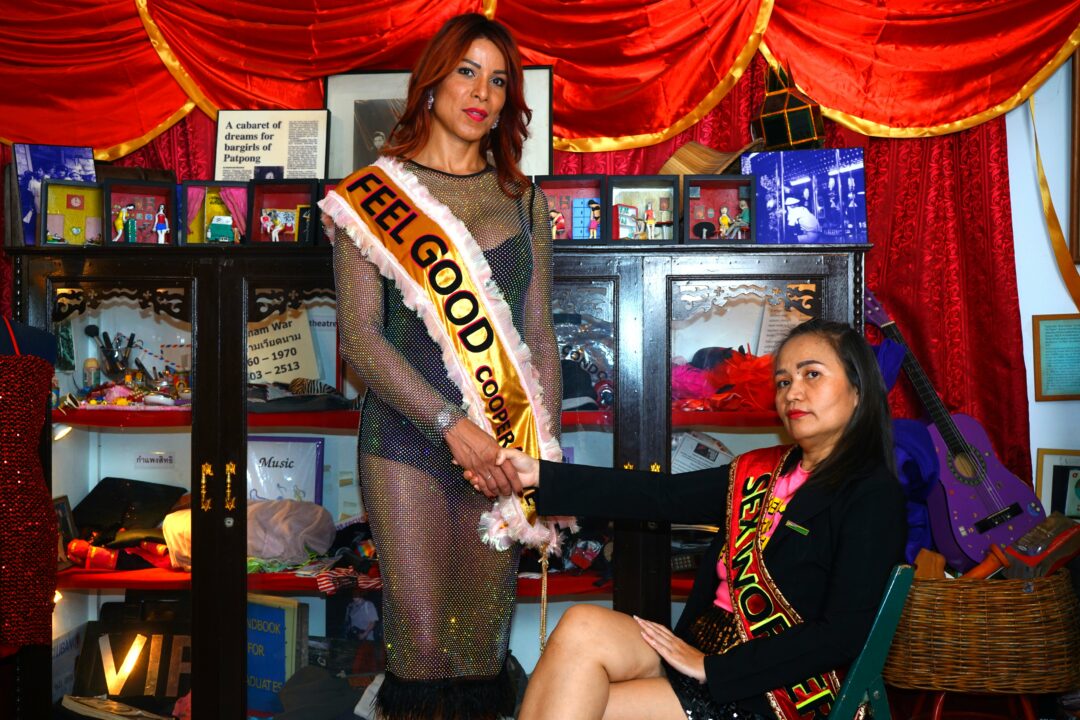
Among the organisations supporting Pauline Curnier Jardin’s work, the Feel Good Cooperative collective plays a significant role. Founded in Rome with an urban planner and Colombian trans sex workers, it considers that sex work involves genuine artistic expertise in make-up, lighting, costume and the staging of the self. Invited to the Thailand Biennale (Phuket, 2025), the group envisions a diplomatic alliance with the activist organisation EMPOWER. The meeting of the “United Nations of Sex Work and Art” is staged by re-enacting the protocol codes of official representations of state and royal power (complete with sashes, floral arrangements and official portraits), performed by ambassadors Liu and Giuliana, the latter having had to endure months of bureaucratic procedures to obtain Italian citizenship, which allowed her to travel. Somewhere between parody and political statement, the work demonstrates how art can shift legal frameworks, subvert institutional symbols and open up new spaces for alliance.
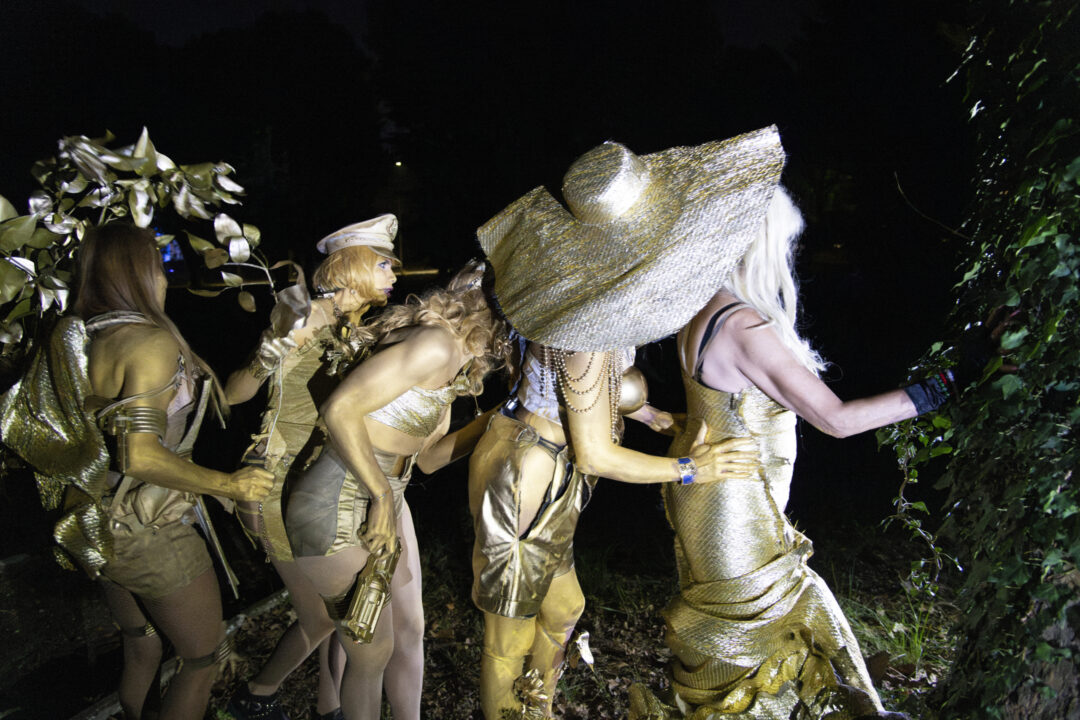
With Fireflies (Lucciole) (2021), the first film directed by the Feel Good Cooperative collective and screened at the Thailand Biennale, Pauline Curnier Jardin transforms a nocturnal scene glimpsed around a bend into an erotic cabaret of go-go dancers amidst wild vegetation. On the outskirts of Rome, the bodies of sex workers appear fleetingly in the headlights of cars, then, illuminated by torches or fluorescent paint, vanish into the undergrowth. Masters of their own coming and going, they evoke nocturnal creatures—animal, magnificent and sensual. The film captures this luminous choreography in which torches become both tools of seduction and a secret language, also serving to signal the presence of the police or one’s own location.
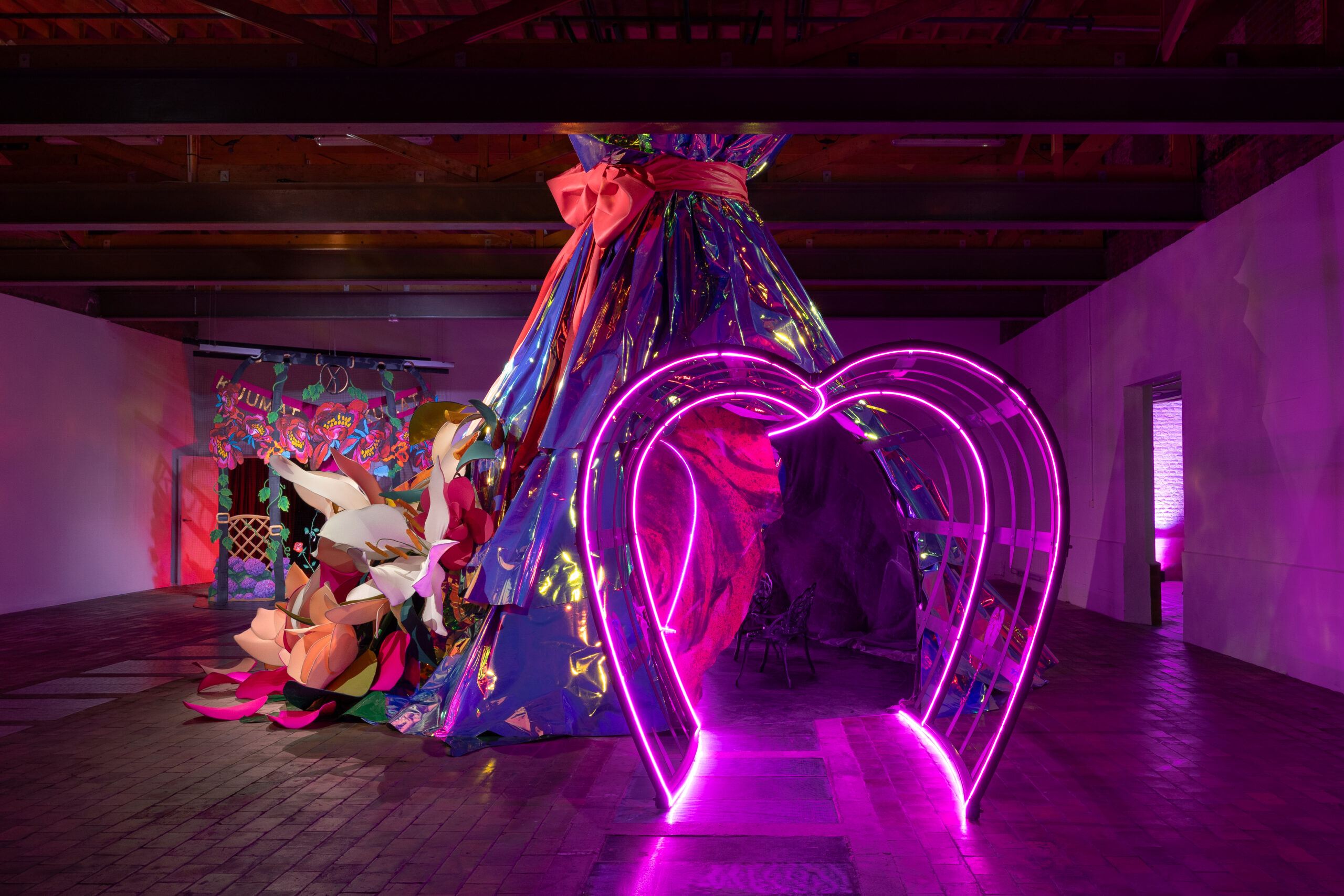
This nocturnal shift thus brings to the fore the irony of the exhibition title “Virages Vierges”, currently on display at the Palais de Tokyo1, which links the patriarchal idea of virginity – as purity or a supposedly unexplored territory – to marginalised bodies and deviant trajectories, turning the colonial logic of conquest against itself. The exhibition is structured as a narrative whose chapters must be physically traversed. Designed with Rachel Garcia, the artist’s collaborator for the past fifteen years, the immersive sets function for Pauline Curnier Jardin like “fairground simulators: small heterotopic enclosures capable of materialising the film’s dreams and beliefs in three dimensions”.
Set within a structure inspired by the Colosseum, the film Fat to Ashes (2021) confronts the audience with a monumental architecture covered in wool evoking both candyfloss and streams of fat. A vestige of institutions adrift, the amphitheatre here becomes both a venue for spectacle and for slaughter, a memory of ancient battles as well as the bullfights the artist witnessed during her childhood in Arles.
The audience enters through openings reminiscent of female genitalia, before discovering a red, carnal interior, whilst the metal structures and hay place us in the midst of a livestock pen. Drawing on documentary footage – of the Catanaise procession for Saint Agatha (a martyr whose body was mutilated), the Cologne carnival and the traditional pig slaughter – reworked through a hallucinatory montage, Pauline Curnier Jardin constructs a cosmogony where human bodies, animal flesh, religious rituals and carnivalesque excesses merge. By revealing how celebration and sacrifice are intimately linked through the horrific beauty of spectacularised violence, Fat to Ashes raises the question of the “collective pleasure of the gaze” upon the atrocities of the past and present.
With Il Paravento (2024), Pauline Curnier Jardin examines the conditions of visibility for marginalised bodies. As curator Daria de Beauvais points out, the English word screen “simultaneously refers to the screen that shows and the screen that hides”; it therefore allows both exposure and concealment. A sensual and ambiguous object, the screen displays the costumes used in Le Colonne della Colombo (2026), the latest film by the Feel Good Cooperative collective, which restores the power to decide on their appearance to bodies constantly reduced to the gaze of the other: “You are only visible to those who want to harm you,” says sex worker Alexandra Lopez. Along with her colleagues, on 12 October – Columbus Day – she took to Via Cristoforo Colombo, a monumental avenue dedicated to “that idiot who thought he’d arrived in Asia” and a legacy of the fascist urban planning of Rome’s EUR2 district: the neighbourhood, which symbolises the regime’s ideology and colonial expansion, is also known as a hub for night-time prostitution. For the first time in their lives, the group’s members were given permission to work (artistically) at their place of work. Reinterpreting Curnier Jardin’s idea that “to perform in a space is to transform it”, this anti-fascist and anti-colonial counter-narrative opens up the possibility for bodies rendered invisible and expelled from public space to finally become the authors of their own representation.
The film is screened in a crypt inspired by an underground cinema discovered beneath the Trocadéro. This subterranean space, reminiscent of a cave, a nightclub and a bunker, is conceived as the negative of the Colosseum: whereas the arena exposes and asserts power, the crypt conceals a secret space of reappropriation and freedom.
The exhibition finally draws us into a contemporary forest tale, where the transformations are not those of little girls or princesses, but of the old Peaux de Dame (2018), which evoke deflated inflatable dolls and haunt the trees, like flags paying homage to the physical and symbolic transition of the menopause.
The irreverent joy of these dancing, relaxed and wrinkled figures is the same as that of the protagonists of Qu’un sang impur (2019), a reinterpretation of Jean Genet’s Un chant d’amour, a 1950 short film censored for its explicit depiction of homosexual desire between inmates under the voyeuristic gaze of a guard. The young prisoners of the original film are succeeded here by elderly women whose desire manifests itself through flowing blood, despite the supposed cessation of their menstruation. Filmed in a former prison used by the Nazis, then by the Stasi, the film brings together German women who grew up in the shadow of these regimes. The artist thus plays on the ambivalence between prison cells and biological cells: the story circulates from cell to cell and permeates the bodies. As if to purify themselves of the ghosts with which they were forced to live and to define themselves, these women first give themselves pleasure, then they escape to the Teufelsberg, an artificial hill3 in Berlin associated with feminist and witchcraft rituals, where their cries burst into a collective clamour of anger and liberation.
Pauline Curnier Jardin’s works delve into the bowels, the refuse, the margins and the murky zones of the collective unconscious to bring forth rebellious forms of life and death. The energy of an “id” more Dionysian than Freudian is unleashed: it flows, it screams, it overflows, it laughs, it drips, it sweats, it slips, it melts, it dances, it sticks, it skids, it cries, it spins, it can no longer hold. Her works thus function as spaces of overflow for a formless and excessive matter – that of desires, dreams and rages – which stubbornly refuses any form of restraint, to the point of shattering the very frameworks that sought to confine it.
1. Pauline Curnier Dujardin, “Virages Vierges”, curated by Daria de Beauvais, Paris, Palais de Tokyo, 3 April to 13 September 2026.
2. The EUR (Esposizione Universale di Roma) is a district in south-west Rome that was intended to serve as an architectural showcase for the fascist regime; today it is the business and government district.
3. The Teufelsberg was built by the Allies after the Second World War using rubble from Berlin during the city’s twenty-year reconstruction.
- Share: ,
- By the same author: Bharti Kher, Agnieszka Kurant , Tschabalala Self, Shio Kusaka, Jeanne Vicerial,
Related articles
Marie-Claire Messouma Manlanbien
by Camille Velluet
Francisco Tropa
by Agnès Violeau
Nicolas Daubanes
by Guillaume Lasserre