Nicolas Daubanes
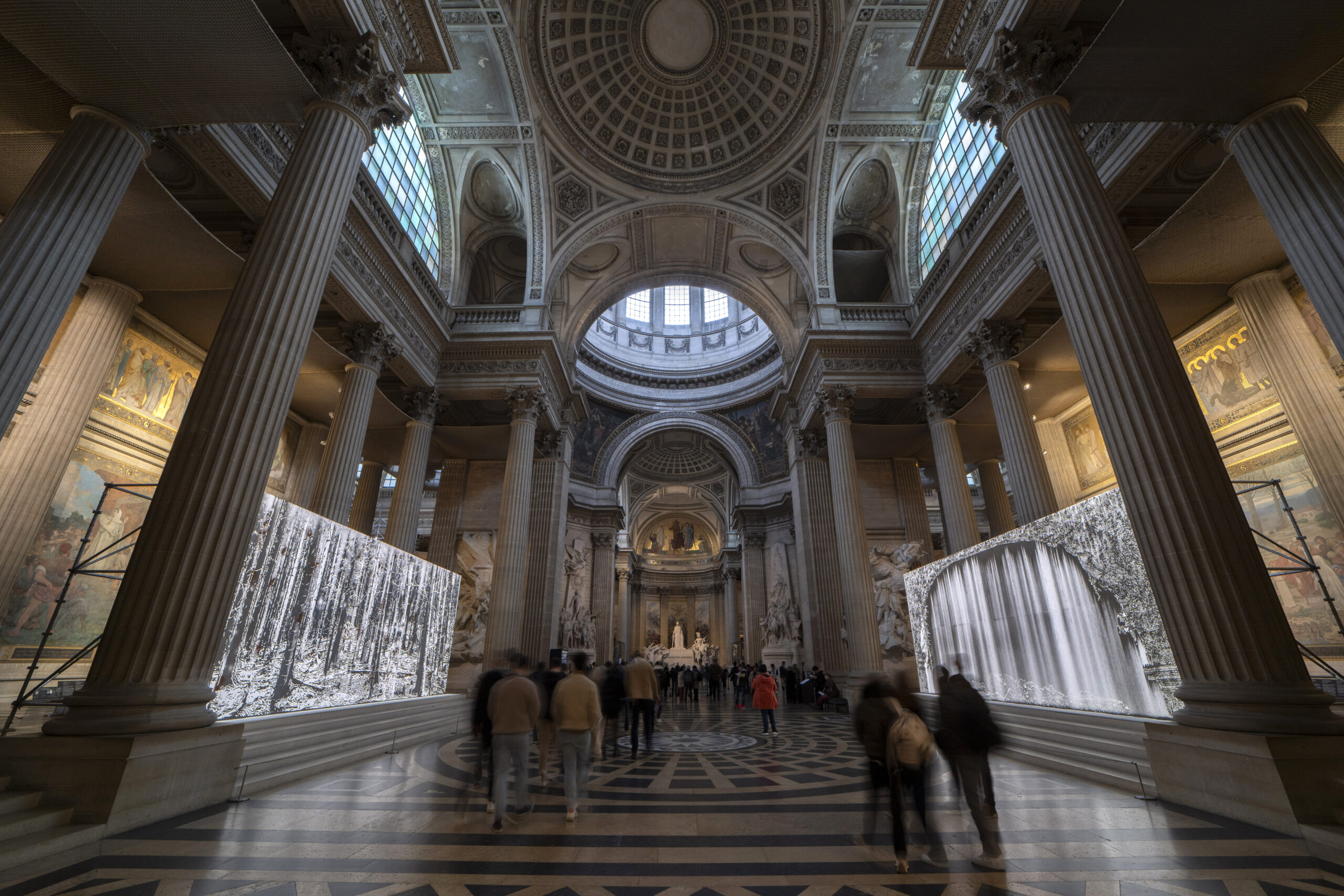
Nicolas Daubanes: an Art of Metal Particles and Revolt
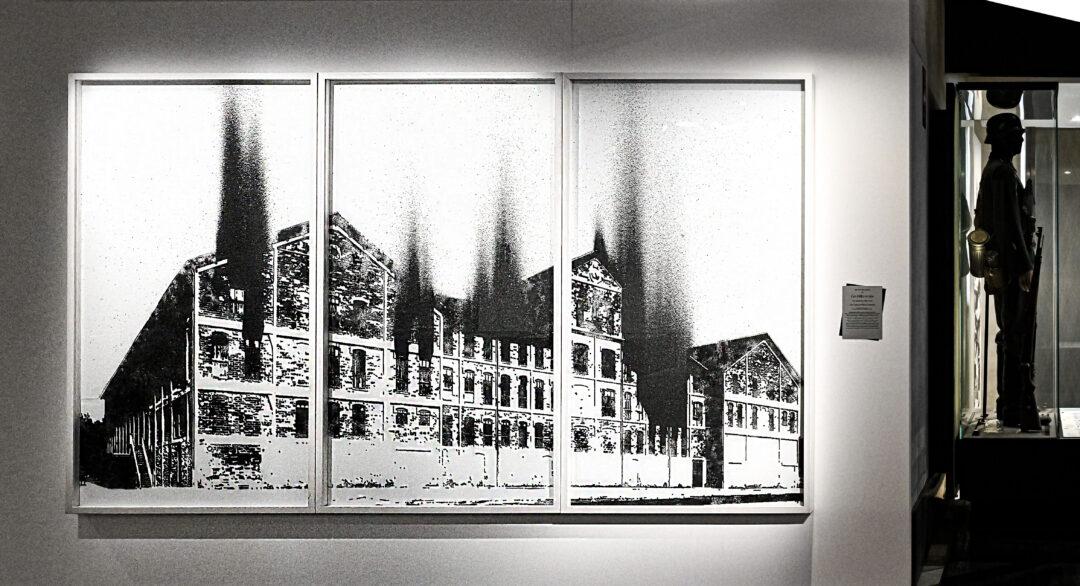
Nicolas Daubanes does not paint. He does not make engravings or etchings in the conventional sense indicating a masterful progress carried out on a docile surface. Instead, the artist scatters iron particles onto magnetic paper from varying heights which are never the same, in a technical yet ritualistic manner. The shavings fall, are drawn to a surface where they are magnetised, then stuck—or almost, the ‘almost’ being the operative word here. The resulting drawing is precise, clear, often monumental, yet fundamentally unstable and subject to alteration due to vibrations, air currents, and the passing of time. A prison building, the burnt facade of the Hôtel de Ville in 1871, a prison yard in Nice; all are subject to an equilibrium with no guarantees. For Daubanes, memory has the same consistency as metal particles: a hard materiality, a volatility of form.
Based in Perpignan, the artist—who was born in 1983—attended the École des Beaux-Arts there and received his diploma in 2010 having earned honorable mention by the jury. He began his career as an amateur draftsman and sculptor, having had a revelation regarding his career following a visit to a Joël Hubaut exhibition at the Abattoirs[1] in Toulouse—a slight shock for someone who had never before considered painting with watercolour. Daubanes cites his working-class roots and the fact that his father was a carpenter when discussing his passion for exploring a variety of materials. The artist deploys a hands-on process while in immersive residencies, using materials like concrete and iron which inform a practice which rejects idealistic concepts like the White Cube and conceptual distance.
Obstacle as Material
A workshop developed for a youth penitentiary group in 2008, in Lavaur (Tarn region) established what turned out to be the central tenet of Daubanes’ oeuvre. The artist—who was 25 years old at the time—stepped foot into the prison as neither sociologist nor activist, but rather as an artist in search of a bit of transcendence, in order to lose himself, he claims, then finding himself again, by becoming interested in someone other than himself in the same way one might search for answers. “Confinement as a theme brings up notions of freedom, of resistance, of existential questions that are linked to our human condition and which resonate with my personal history but also potentially with each and every one of us,[2] he explained. “The materials I use are explicitly chosen to remain relevant to this discourse.” This initiatory phase paved the way for everything that came next: the immersive residencies at the Maison Centrale in Ensisheim, at the Nice penitentiary, at the Charles III prison in Nancy, and at the Baumettes. Drawings were made at each location, on walls, oftentimes taking on monumental proportions, depicting architectural elements at each site—facades, courtyards, passageways, hallways—all made with steel particles on surfaces which, like the spaces they occupy, are both constricted and fragile.
For Daubanes, the prison context does not so much represent horror in a spectacular sense, nor does it exemplify human suffering in order to convey some moral message. Instead, the artist seeks out forms of resistance, ingenious hacks such as the moonshine liquor produced through diy methods[3], the online avatar created by a prisoner who is freed virtually for a short time in Society, You Can’t Have Me![4], the tiny spoon used to dig into expanding foam in an absurd and essential escape. This tropism demonstrates a biographical dimension that the artist has only vaguely referenced, and which his 2020 exhibition at the Palais de Tokyo[5] revealed partially: an organ transplant which took place eleven years prior and caused physical impairment which—to cite the artist—became a material in and of itself. The autoportrait revealed a freezer mounted on a pole at visitor eye-level, balanced precariously, indicated that Nicolas Daubanes himself is also a survivor; that resilience in confined spaces was not an abstract concept for the artist.
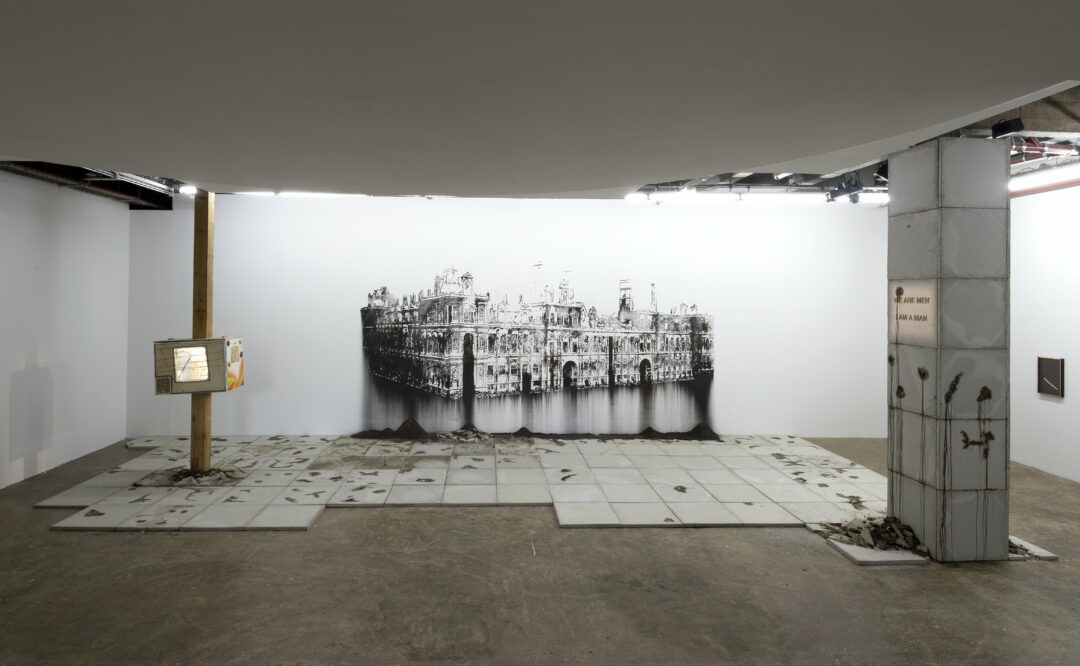
L’huile et l’eau, Palais de Tokyo, Paris, 2020 Crédit M. Domage
Sweetened Concrete, Hot-Short Steel
Daubanes’s visual vocabulary is highly consistent in terms of both its materials and political logic. Sweetened concrete is a technique inherited by World War Two French résistants which consisted in adding sugar to the concrete mixture used to pour and then construct German bunkers, causing them to weaken from the inside, and eventually crumble. Daubanes uses a similar sabotage technique in order to produce sculptures that contain their own programmed decline. Solidity and vulnerability are present here in one single structure. Hot-short steel mounted on glass or porcelain, photographs of sparks, burns that are also drawings, are a kind of archive of the violence contained within these metals. There are also masking tape drawings on glass[6], in which the adhesive paper reproduces the technique used by shopkeepers in Lyon to barricade their display windows during bombings. In Daubanes’s works, the glass panes end up falling at random, shattering on the ground and creating discreet disturbances. The material moves, comes apart, allowing time to take its toll.
The artist’s body of work as a whole is an art of lines, and also of threats. Whether prisons, burnt monuments, complexes of confinement or deportation landscapes, the images depicted here run the risk of becoming an art of solemn eyewitness accounts meant to commemorate. Daubanes’s works do not operate like this, because they contribute to their own progressive process of weakening. There is urgency to their very existence; memory is never a given, its fixity like that of the iron particles—remaining fixed only until a breeze changes the situation.
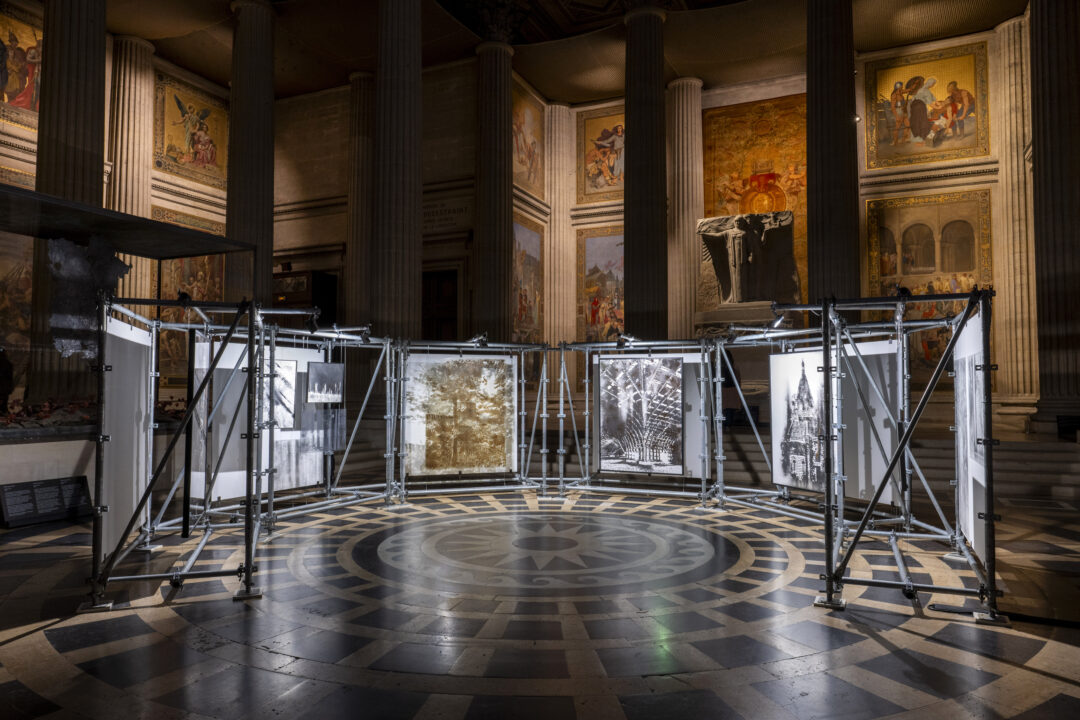
Drawings, magnetised steel powder, inlays of incandescent steel on non-oxidised glass. Photograms on matt baryta silver paper developed using steel sparks, inlays of oxidised and non-oxidised steel on glass. 2019-2025
“Ombre est lumière” Panthéon, Paris © Adagp, Paris. Crédit photo : Didier Plowy – CMN
Memory as Battlefield
Nicolas Daubanes has defined a trajectory for himself in direct relationship to the institution; an occasionally uncomfortable position. The exhibition L’Huile et l’Eau at the Palais de Tokyo in 2020—resulting from a 2018 prize awarded by the Friends of the Museum—is exemplary from this point of view. Here, the Paris Commune, the Attica Prison uprising, and identity wars are all convened within the walls of an institution which simultaneously hosts, in a way that nearly resembles a face-off, an exhibition from Qatar on conflict in the Arab world, without mention of the fact that in this Gulf State, homosexuality can result in prison time, or that migrant workers live here in near slave-like conditions.[7] Although Daubanes never explicitly states any of this here, the artist has installed an image of the Hôtel de Ville in flames, drawn with iron particles. The clamour is understated, but complete.
Daubanes’s ability to create a profoundly high-stakes body of work without ever veering into didacticism sets him apart. His literary and musical references are carefully considered, including Piranesi’s Imaginary Prisons—realistically sinister[8] according to Marguerite Yourcenar—and Sartre’s Dirty Hands, shouted into the main hall of the Palais de Tokyo by Akhenaton—I AM’s lead singer—giving the habitually contained rowdiness of the street a point of entry into this temple of contemporary art. Daubanes experiments with the combination of different registers which do not habitually coexist: sociological history with rigorous formal elements, popular culture with personal stories.
Daubanes’s institutional reputation has grown steadily since 2020[9], which has added to a greater understanding of the artist’s work—a fact that is not without a touch of the kind of irony one can only imagine the artist savouring. He has not altered his discourse in order to be admitted to these spaces. Both the Abbaye de Fontevraud—formerly a royal detention centre—and the Panthéon, with its roots in resistance and martyrdom, have found a singular relevance in Daubanes’s oeuvre. For one, there is the drawing of the Montluc prison—where Jean Moulin was held—made with steel particles, as well as a depiction of Mont-Valérien de Manouchian and his friends, allowing them to introduce the violent by-product the Republican temple was founded on.
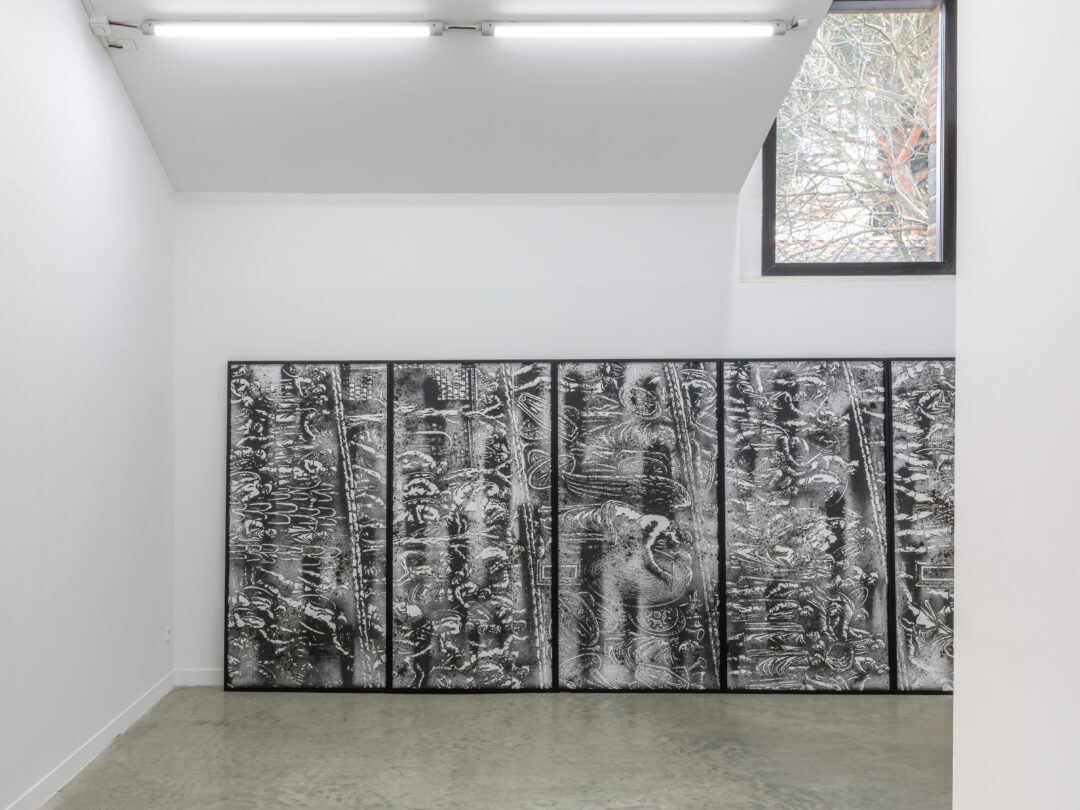
Sur le fait par erreur et au hasard. Maison Salvan, Labège, 2026. Crédit photo V. Boutin
At the Nouveau Printemps of Toulouse where Daubanes is currently carrying out a residency, two exhibitions featuring the artist’s works about the memory of place, confinement and resistance are being presented. In the exhibitions, two sites are confronted with one another: the Villa Médicis, Académie of France in Rome—the oldest residency in the world—and one he recently participated in—and another artist residency, the ex-village cottage Maison Salvan[10], which is the continuation of the project he began at the Villa Médicis. There is also an art parcours in the Saint-Michel ex-prison in Toulouse and, in the observatory garden in Jolimont, a permanent sculpture made of sweetened concrete, in homage to the acts of sabotage discussed earlier.
This memorial turn runs another risk that others have not necessarily managed to avoid—that of the spectacular commemoration—one where homages reassure rather than disturb consciences. Daubanes avoids this possibility because the materials he uses avoid monumentality: steel particles do not last and sweetened concrete will disintegrate. Fire Without Ash, the exhibition catalog published to accompany, “Nicolas Daubanes, a Contemporary Artist,” at the Musée de l’Armée, succinctly explains this elemental paradox: a combustion leaving nothing behind, a presence which is a disappearance. What memory leaves behind is not ashes, but rather incertitude about what has been left behind, along with the necessity to start over, nonetheless. This carpenter’s son who scatters iron particles onto prison or museum walls in order to make drawings of things the world would like to forget, is a résistance artist, not in order to make a political gesture, but as a practice: of the daily, material sort, which remains exposed to passing breezes.
head image : exhibition view “Ombre est lumière”, Nicolas Daubanes, Panthéon, Paris. 2025-2026. © Adagp, Paris. Crédit photo : Didier Plowy – CMN
[1] Joël Hubaut, Le Psyclom-clom épidémik, Les Abattoirs Museum, Frac Occitanie, Toulouse, 6 April through 19 August 2001, https://www.lesabattoirs.org/Expositions/joel-hubaut-le-psyclom-clom-epidemik/
[2] Maëva Robert, « Nicolas Daubanes. Constraint Born of Creativity », interview, Ramdam, n°180, May-June 2026.
[3] Prohibition, V.R.A.C (Vitrine régionale d’art contemporain), Millau, 2016.
[4] Société, tu m’auras pas !, 2022 Vidéo, sound, 7’18 “.
[5] Guillaume Lasserre, « Nicolas Daubanes Invades the Palais », Un certain regard sur la culture/ Le Club de Mediapart, 5 avril 2020, https://blogs.mediapart.fr/guillaume-lasserre/blog/050420/la-prise-du-palais-par-nicolas-daubanes
[6] NWAR, Nicolas Daubanes solo exhibition, Chapelle du Quartier Haut, Sète, 2019.
[7] Guillaume Lasserre, op. cit.
[8] Marguerite Yourcenar, The Black Brain of Piranèse, Pagine d’Arte, Collection Mots et Images, 2016 (1959), 96 p.
[9] Drawing Lab in 2021, Centre Pompidou-Metz in 2022, series of residencies and exhibitions at the Abbaye de Fontevraud (2023-2025), artist program at the Villa Médicis (2024-2025), twin exhibitions at the Panthéon and Musée de l’Armée at Invalides (2025-2026).
[10] Nicolas Daubanes. Sur le fait, par erreur et au hasard, Maison Salvan, Labège, 11 March – 2 May, 2026.
Head Image : exhibition view “Ombre est lumière”, Nicolas Daubanes, Panthéon, Paris. 2025-2026 © Adagp, Paris. Crédit photo : Didier Plowy – CMN
- Share: ,
- By the same author: David Claerbout, Biennale Son, Walter Swennen, Laurent Proux, Josèfa Ntjam,
Related articles
Francisco Tropa
by Agnès Violeau
Pauline Curnier Jardin
by Sarah Matia Pasqualetti
Larissa Fassler
by Agnès Violeau