Larissa Fassler
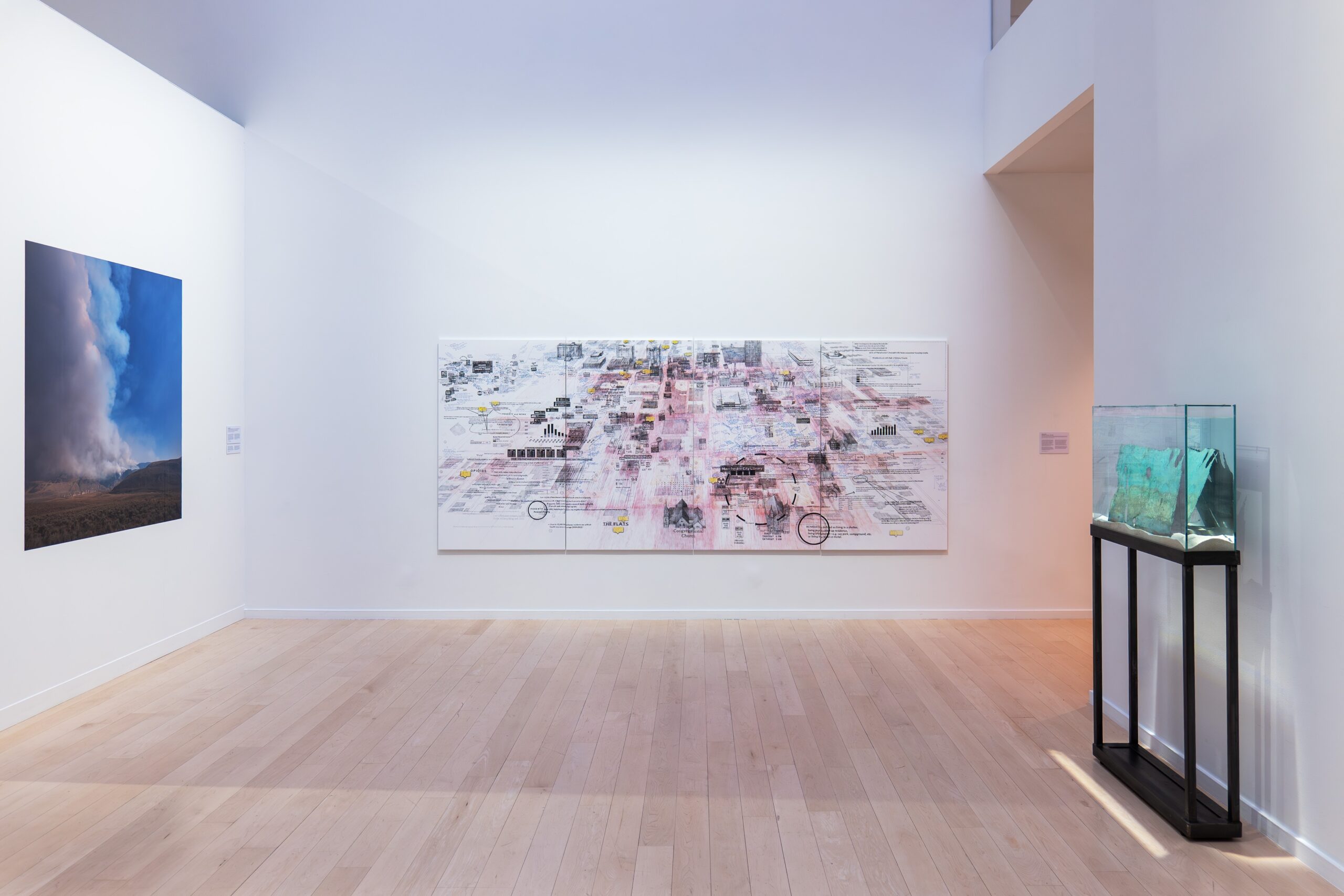
“The State of Things”, musée d’Orsay 6 January – 22 March, 2026. Curated by Sylvain Amic and Nicolas Gausserand
“Contrast and Indifference”, Canadian Cultural Centre, 12 February – 16 May 2026. Curated by Catherine Bédard
Berlin-based Canadian artist Larissa Fassler (b. 1975, Vancouver) develops a practice which consists of an empirical cartography of public space. During an artist residency at the Musée d’Orsay in the lead-up to large-scale renovations meant to fluidify circulation within the museum, Fassler spent three consecutive months analysing the premises using her body as a tool for measurement. The results of the foot traffic and situations created by visitors, experienced first-hand by the artist, are presented in four large graphic compositions and a group of drawings. Several works by the artist are presented in parallel at the Canadian Cultural Centre in the group exhibition, “Contrast and Indifference”. Influenced by surveys, social studies as well as urbanism, these projects reveal much more than mere physical displacements.
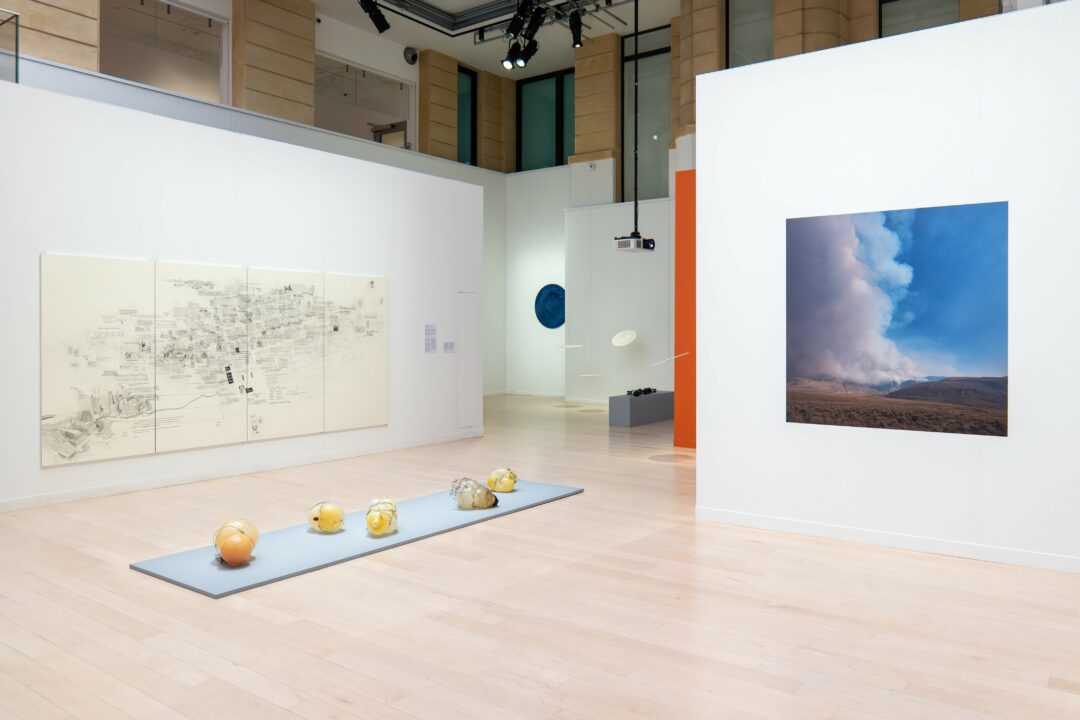
Contraste et indifférence, Centre culturel canadien, 2026, exhibition view. Photo Vincent Royer, Open Up Studio. Copyright Open Up Studio/Centre culturel canadien
Social vs Decisional Spaces
The works take the form of series conceived around urban sites such as Regent Street (London, 2009) or Alexanderplatz (Berlin, 2006). The artist transposes these sites by producing ink sketches of each space. Architectural themes appear only indirectly, something like the stave on a sheet of music in a social score. Rather than using the usual references as the point of departure (male, white, average height, the golden ratio or the Modular scale as standard), the artist uses the measurements of the female body to define an active perimeter. Here, both hierarchies and colonial authority are toppled in this institution-as-host.
Like traditional history paintings, the large-format drawings are living cartographies, floor plans where artworks—along with those who view them—are situated. The depicted narratives are devoid of victories, wars and heroes—reality is the backdrop. Here, the space becomes phenomenal, affect acts as GPS. Lines drawn in blue pencil designate visitors’ steps; red lines indicate emotional variations noted by the artist (tensions related to long wait times for accessing the galleries, surprised reactions to an artwork). The life of a given space is transmitted by these reports—conversations, pauses, disorientation that may also take place in the streets of any city or on train platforms. The title of the series, Dress the Monster with Ornaments, is taken from a 1986 press clipping, published at the time of the opening of the Musée d’Orsay. Larissa Fassler is as interested in the building’s interior as its exterior, which had been dressed up for the occasion. Do the artworks meld with the decor, like ornaments for a “monster”-like architecture?
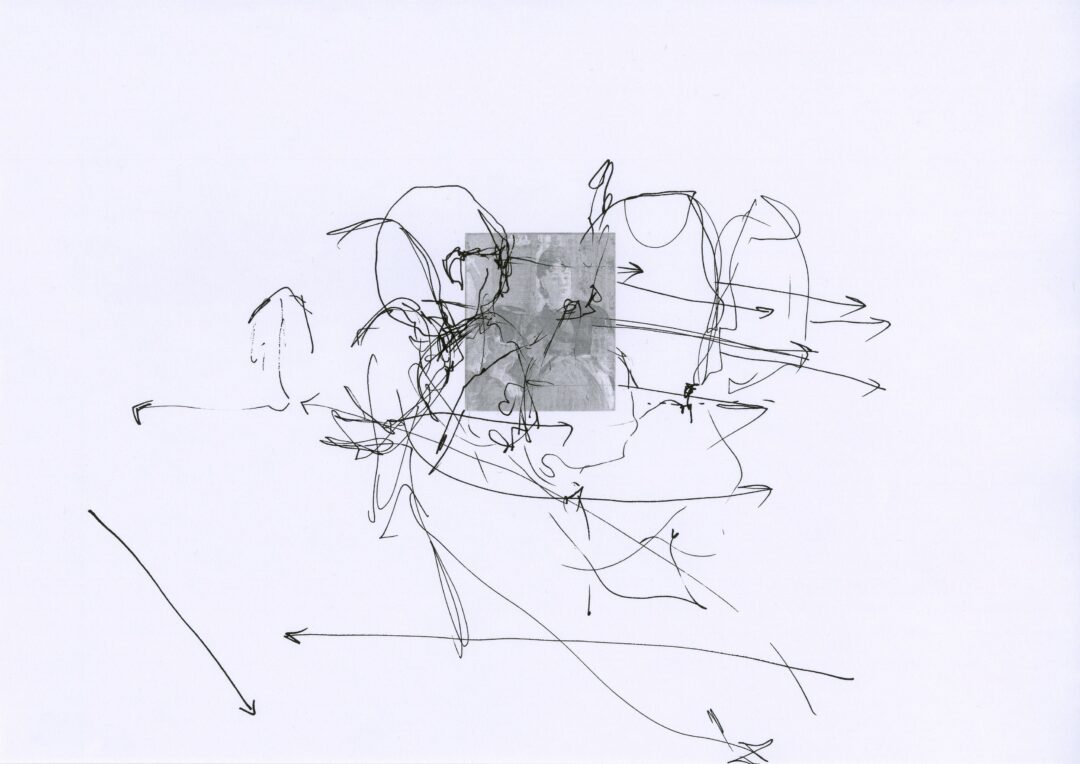
Larissa Fassler, Manet – La Serveuse de bocks II, 2023. Pen on laser print.
Courtesy Galerie Poggi, Paris © Adagp, Paris, 2026
A Choreography of Affect
Orsay therefore becomes the setting for a stock-taking of heritage (some of the works have been sketched in-situ, as they once were by copyists in the 19th century); it is also the stage for a choreography of affect. The following is an excerpt of the artist’s notes; they include itineraries and comments made by visitors.
Monday, museum closed.
A cleaner with a vacuum strapped onto her back, climbs the Statue of Liberty
to brush it,
dust it
and vacuum it.
Knitted jumper with an American flag.
Let’s do it!
I don’t know if we are allowed to touch. Can we touch, you think?
A woman is doing a short series of stretches
near the toilets.
The works re-enact the categorisation of knowledge by taking both our impulses and our constraints (visiting hours are defined by working hours) into account; the museum is thus transformed into a somatic apparatus. While the drawn lines do not indicate gender, they coexist with a reproduction of two famous passive nudes from the modern period: Cabanel’s The Birth of Venus and Manet’s Olympia. The two masterpieces were produced in the same year (1863) and share a similar aura; they do not attract the same amount of visitor attention, however. Has the artist discerned a preference among these visitor habits (modernity vs academic), creating a new kind of advisory board?
The fact that Fassler uses her own bodily proportions as a unit of measurement introduces subjectivity to the floor plans. The body is essential, its diversity central for humanity. It is shaped by cultural differences which give rise to its subjectivity; it also symbolises power (clothing, attitudes, language…). The artist’s situated depictions—rooted in corporal and temporal reality as they are (the artist spent many hours observing Orsay’s visitors as well as in the archives)—give visibility to current economic disparities: who considers themselves legitimate enough to visit museums? Who is there by obligation (security guards, cleaners…)? In addition, they express a polarising effect, one which is founded on gender and social milieux; conflictual dynamics and violence that our society is currently grappling with. In the opening wall text, a “hesitant museum” is referenced, with Masterpieces on one side, and the masses on the other (Millet, Courbet…). Taken together, the drawings of Larissa Fassler form a rhizomatic ensemble that is infinitely rich and cannot be reduced to a group of statistics or administrative data.
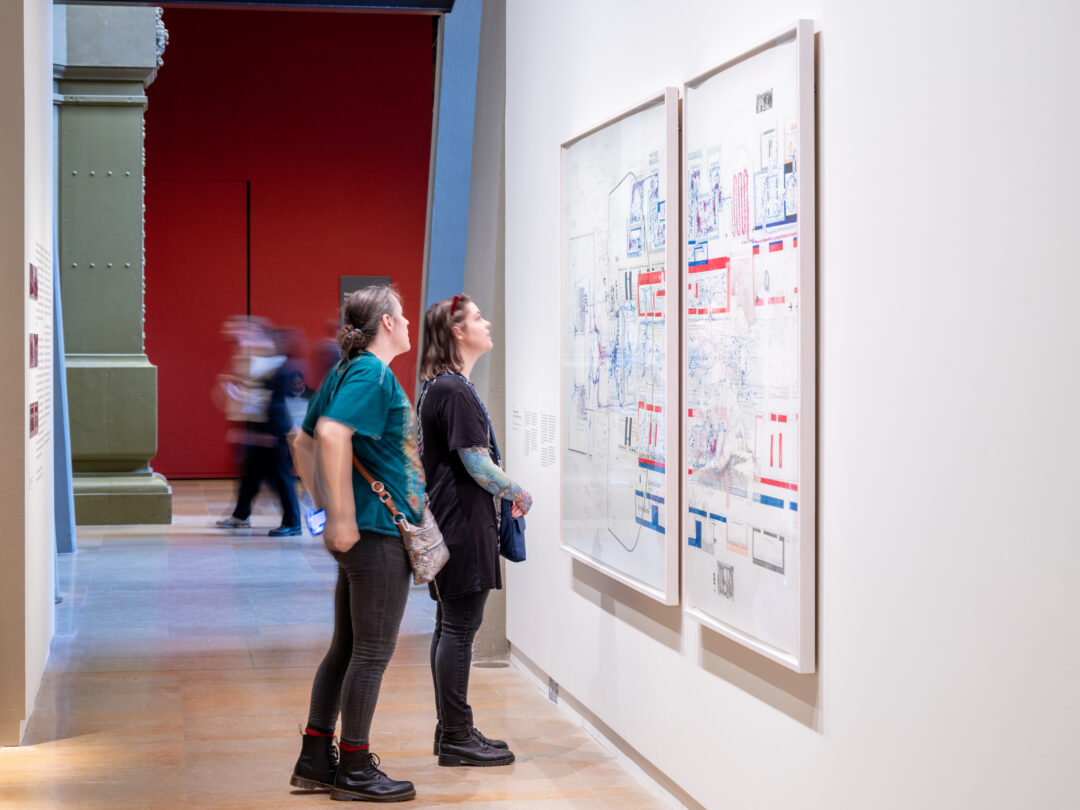
Exposition Larissa Fassler. Etat des lieux, Paris © Adagp, Paris, 2026 © Musée d’Orsay / Laëtitia Striffling-Marcu
Psychogeography
Just as institutions have begun to question the traceability of artworks, in Fassler’s work museum visitors are also traced, the multiplicity of their movements archived. The term psychogeography—a neologism created by Guy Debord1, in the context of the Lettrist International (an early precursor to the Situationists)—is defined as “the study of the precise effects of a geographical milieu (…) directly impacting the affective behaviour of individuals.2” According to the Situationist International, cities which have been built on functionalist and productivist principles lead to isolation, exclusion and a lack of imagination. This leads to the establishment of a status quo which leaves no room for inhabitant desires. According to Jean-Luc Godard, “The margins are what hold the pages in place.” Fassler brings cities back into focus, producing spaces for the imagination divorced from an everyday existence which has been defined by someone other than its inhabitants. In this story, architecture is not the star of the show—it serves as a backdrop for a series of events.
A female embodiment
Gender is a lens through which the performative nature in which bodies occupy public space can be viewed. Larissa Fassler is not the only artist to highlight the way that public space is organized by a gendered hierarchy; in ORLAN’s MesuRage performances, the artist used her body as a tool to measure with. Between 1968 and 2017, ORLAN surveyed the length of streets and major cultural institutions named after famous men (the Guggenheim in New York, Georges-Pompidou Centre…), calling into question Protagoras’s claim stating that “man is the measure of all things.” Through the drawings, the notion of colonial desire is illustrated through copies of works belonging to schools of realism (Manet) or Orientalism (Ingres). The body-instrument becomes that which ordains, as opposed to being ordained. The philosopher Iris Marion Young conceives of the female body through lived experience—female embodiment—allowing for an encounter between subjective freedom and the constraints of women’s everyday lives. Young associates phenomenology with social critique, both of which are pivotal themes in the works of Larissa Fassler.
At the Canadian Cultural Centre—a site of diplomatic representation—the artist presents her work alongside that of Cécile Hartmann, Isabelle Hayeur and Capucine Vever in a dialogue that raises questions about territorial issues and field surveys. While the exhibition does address issues regarding territories from the point of view of four artists—none of who are French—its main concern is to create common ground, a discreet landscape of acts.
Circulations, restitutions
Orsay creates a new dynamic by entrusting the analysis of its audiences to an artist. To study visitor foot traffic as well as the movements of the objects it houses echoes the periodicity of exhibitions. The drawings reference repatriation and involuntary migrations (refugees, those displaced by climate change), city planning and war maps. Marxist theories on unitary urbanism3 underscore the fact that urban political institutions are part and parcel of the State. Cities are therefore indissociable from their role as part of the State and of the capital, “the disappearance of any chance at insurrection or encounter.4” At the Canadian Centre, are we playing a video game, where the “gamification” of movements has become a libertarian projection? If Fassler explores the map in its intersectional sense, as well as the process by which its users construct meaning, what imprint does the exhibition visit leave behind?
Larissa Fassler opens up new possibilities for museums and for cities to become places which can be discovered together. Her works are a testimony to a social polyphony which cannot be analysed by computer programs. Indeed, the artist’s intentions can be resumed by the following: to reintroduce togetherness and performativity to the grand design of our lives.
Agnès Violeau, March 2026
1. Guy Debord, « Introduction à une critique de la géographie urbaine », in Les lèvres nues, no 6, Bruxelles, 1955 [online, La Revue des Ressources (2011) : https://www.larevuedesressources.org/introduction-a-une-critique-de-la-geographie-urbaine,033.html].
2. In the inaugural issue of Internationale situationniste, June, 1958.
3. At the risk of perpetuating « des divisions artificielles de la culture bourgeoise à l’intérieur de la culture ou entre la culture et la vie », in Internationale situationniste (I.S.), no 3, 1959.
4. Guy Debord, « Les gratte-ciel par la racine », in Internationale lettriste, Potlach, 1954.
Head image : Larissa Fassler, Vancouver DTES, 2021-2022; Larissa Fassler, Vancouver Glass Objects, 2023. Contraste et indifférence, Centre culturel canadien, 2026, vue d’installation. Photo Vincent Royer, Open Up Studio. Copyright Open Up Studio / Centre culturel canadien
- Share: ,
- By the same author: Carole Douillard, Chantal Akerman,
Related articles
Pauline Curnier Jardin
by Sarah Matia Pasqualetti
Nicolas Momein
by Patrice Joly
Jean-Alain Corre
by Vanessa Morisset