Jean-Alain Corre
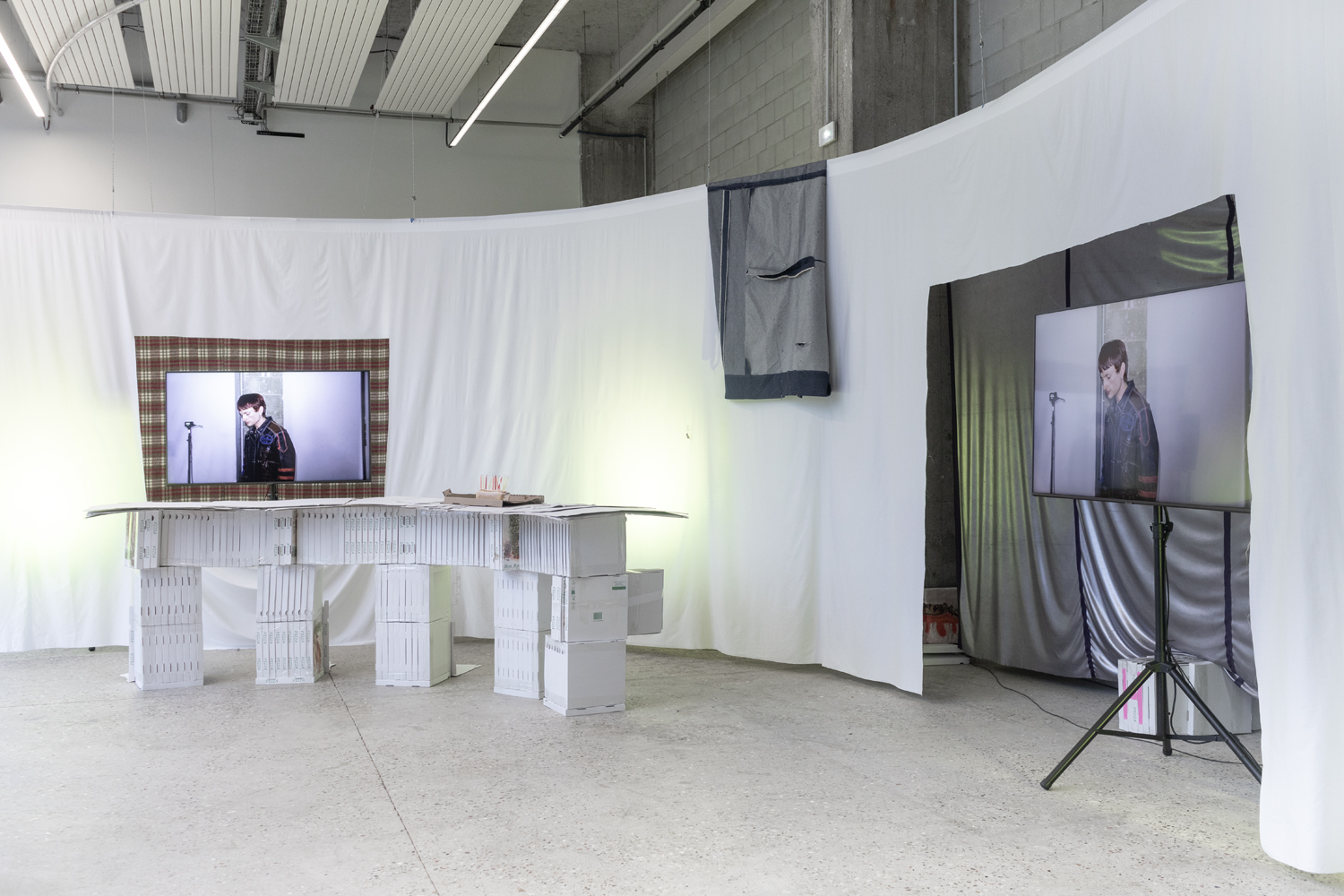
Jean-Alain Corre in collaboration with Gaëlle Obiégly, Hibou TV Show, Bétonsalon, February 6–April 18, 2026
Curated by: Vincent Enjalbert, Elena Lespes Muñoz, Émilie Renard
Words and expressions, fragments of overheard speech, linger in the mind upon leaving the exhibition, whether they take the form of a surprising observation, “when the tooth becomes textile,” sound advice, “breathe more, crawl less,” a statement, “I observe the world from a ‘waste-oriented’ perspective ,” or even introspection, “what if I prefer cigarettes to vegetables? .” They encapsulate the multifaceted experience we’ve just had—a journey through an installation featuring drawings, paintings, sculptures, and videos, in short, the components of a multifaceted exhibition, as is often the case with Jean-Alain Corre, but here immersive in a very particular way, evoked by the title:
one gets the impression of having wandered through the spatial equivalent of a TV program guide1.
Several layers overlap and interfere (the magic of the airwaves?!). We are in an art center. We are in an exhibition. We are in a TV studio set. We are watching the broadcast of a show previously recorded right where we are standing. Everything is clear, and yet everything is in such flux that nothing is clear anymore. We see owls everywhere. In the midst of it all, we ask ourselves: “Am I an exhibition visitor, am I a performer, am I a TV viewer… or am I a fan?” To untangle the situation, it may be helpful to situate the “Hibou TV Show” within the history of its protagonists: the art center, the artist, the owl, and, of course, the intern.
For several years now, one of the main areas of focus at Bétonsalon (which is an “art and research center”) has been a reflection on the performativity of the art center itself—that is, the way in which everyone within the institution, by assuming their respective roles, constructs a context for the reception of works, for exhibition, and for experimentation. One source of inspiration is institutional therapy2, which was the subject of a lecture focused on one of its inventors, François Tosquelles, given by Joana Masò and Florian Fouché during the latter’s exhibition in early 20253. Previously, in 2023, there had been an exhibition dedicated to the American composer Pauline Oliveros, which also superimposed several layers or possible approaches, notably through installations (works by Konstantinos Kyriakopoulos) that constituted as much an exhibition as a setting to be activated during gatherings and listening experiences4. And two years before that, the group exhibition “The Body Goes on Strike” explored the vulnerability of bodies as well as that of the art center5. Echoing this self-reflection by the institution, as a visitor, one is led to wonder what role one prefers to play when spending time in an exhibition: are we seeking to cut ourselves off from the world, as an aesthete admiring a finished work, or, on the contrary, are we trying to better understand it through a sort of “laboratory-work”?
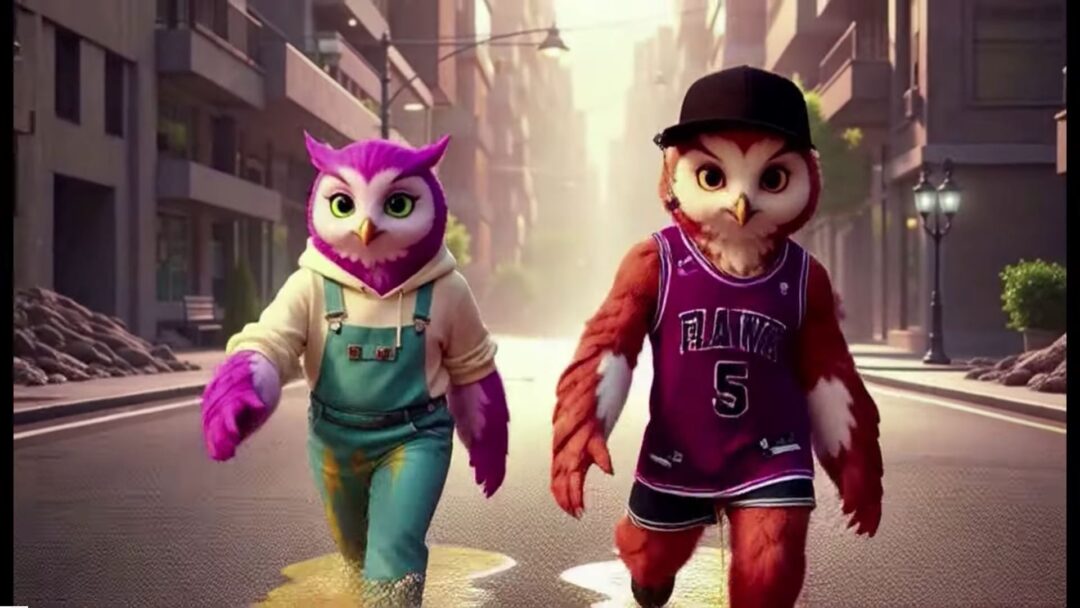
Well, these considerations seem rather serious for an exhibition whose mascot is a cartoon owl. Indeed, one of the first videos we encounter upon entering is an episode of Hibou TV titled “Birthday Party” (2026). In the form of an animation (assisted by AI), the artist depicts two owls landing in front of the art center and taking us along with them on a stroll through the 13th arrondissement (in search of what? I won’t say any more…).
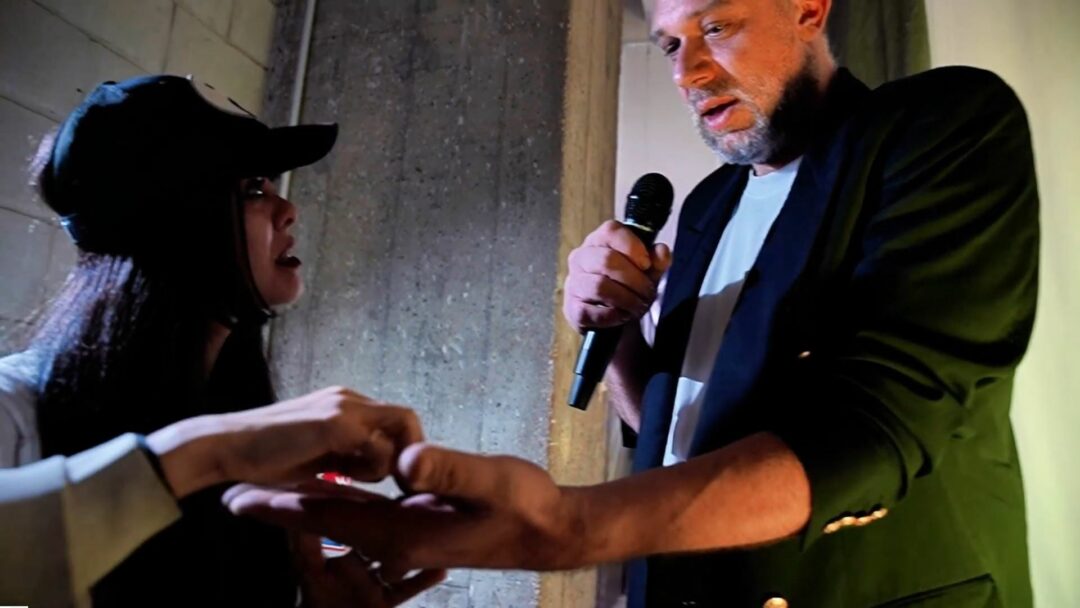
But the heart of the exhibition is the recording set for what is referred to as the “prime,” a talk show recorded right here, in this art center set divided by panels of fabric and furnished with a counter made of pizza boxes (you’ll understand why when you hear the show’s host), with a control room that looks improvised but is well-equipped and fully functional. To tell the truth, everything gives the impression of improvisation, yet at the same time of a very meticulous installation, thought through down to the smallest detail. In this respect, the exhibition belongs to a genre where “the making is the show6,” a work whose outcome is perpetually in the making—it brought to mind the memory of Liv Schulman’s series, Brown, Yellow, White and Dead7, in which, within a cardboard set, a crew struggles to make a horror film (we’ll encounter the Argentine artist again a little further on, in another section of the exhibition). In other words, the essence of what is presented to be seen and felt resides in a temporality that is not closed; rather, it is marked by events, such as the live filming of the prime, the upcoming public gatherings, but also my/your visit to the venue. Which, once again, does not mean that it was constructed haphazardly: the fabrics structuring the space hang well, the furniture made of pizza boxes holds up, and the prime is conducted almost like a real one (punctuated, for example, by “stay with us, we’re live”).
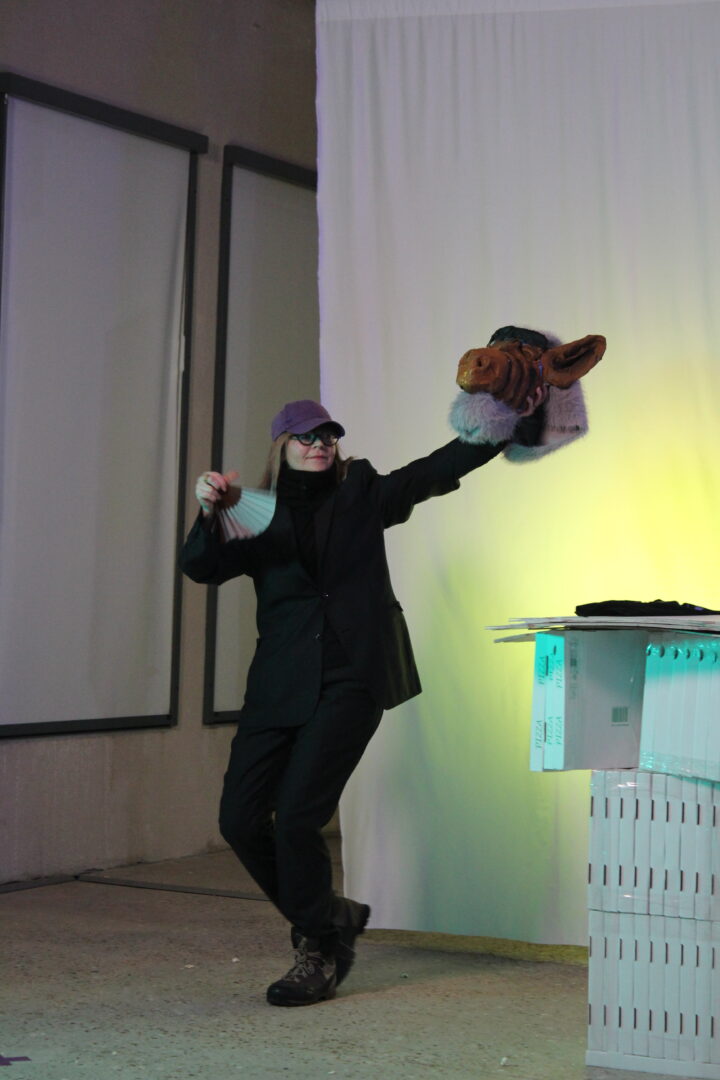
On two screens, you can watch it on delay (52 minutes, exactly), starting with the arrival of host Philip, followed by other characters: a philosopher-garbage collector who is already there or still there, sweeping the floor while chatting, Alf8 (who will lose his costume), his grandmother (who will leave the set), right up to the news bulletin, including a song contest inspired by a real Chilean TV show.
Fiction and reality overlap, with well-known references from the entertainment industry brought in to create something poetic, childlike, and for some, melancholic, evoking a mythical age of television when artists and creators could produce original programs featuring a host of funny or endearing characters, from Shadocks to Sesame Street9. This show also evokes amateur or participatory TV, or simply the fantasy of a media project cobbled together with friends in one’s bedroom or garage—a concept that, to some extent (and one worth studying closely, particularly regarding the implications of technical resources), has been revived through platforms like YouTube or Twitch. As Jean-Alain Corre explains in an interview: “The work progresses […] with world-materials that are more or less raw or already shaped, determined by an industry […] If I use something that already exists, it is to get closer to it or to obtain familiar expressions that I cannot achieve otherwise10. ” Thus, I envision Alf or the Pink Panther from the first version, the owl, or even the character of Johnny from a previous series of works and exhibitions—entities that allow for the aggregation around them of the personal and the collective, of media, formats, and heterogeneous references, to create a work. The collective dimension is worth emphasizing, as it is constitutive of the prime and contagious, since in another space, one can watch programming from another collective artistic initiative, Poissy TV, consisting of episodes filmed with teams from the Cergy art school and inmates from the Poissy prison—one of which features Liv Schulman.
But undoubtedly the most remarkable aspect of the “Hibou TV Show,” in terms of the richness of collaborative sharing, is the “complicity ” (a term used in the exhibition’s presentation) in the preparatory work—from writing to production—by Jean-Alain Corre and Gaëlle Obiégly, a writer who appears in the prime episode as the presenter’s assistant intern. For while the attention paid to the set design and spatial installation was evident, the same holds true for the texts spoken by the characters or written, notably, on the windows of the art center. The result of a massive undertaking (spanning over a year), the lines come across as both vivid and carefully considered, filtered through the attitudes of the characters who embody them—the presenter’s stress, the garbage collector’s nonchalance, Alf’s seriousness… One of the highlights is the “news segment,” narrated by Alf himself (his head resting beside him), where elements of social news are rephrased and interwoven—“special edition, the social fabric is tearing […] the mouth becomes the very site of social injustice”—to create a fake news report that is a true piece of literature, “a dentist, a psychoanalyst, and a language prefect will tear into each other before your eyes to make you understand that it’s hopeless: that it’s dead.” And then everything blends together again, right up to the account of a performance by an artist who chews on threads, a work within the work (completely fictional this time)11.
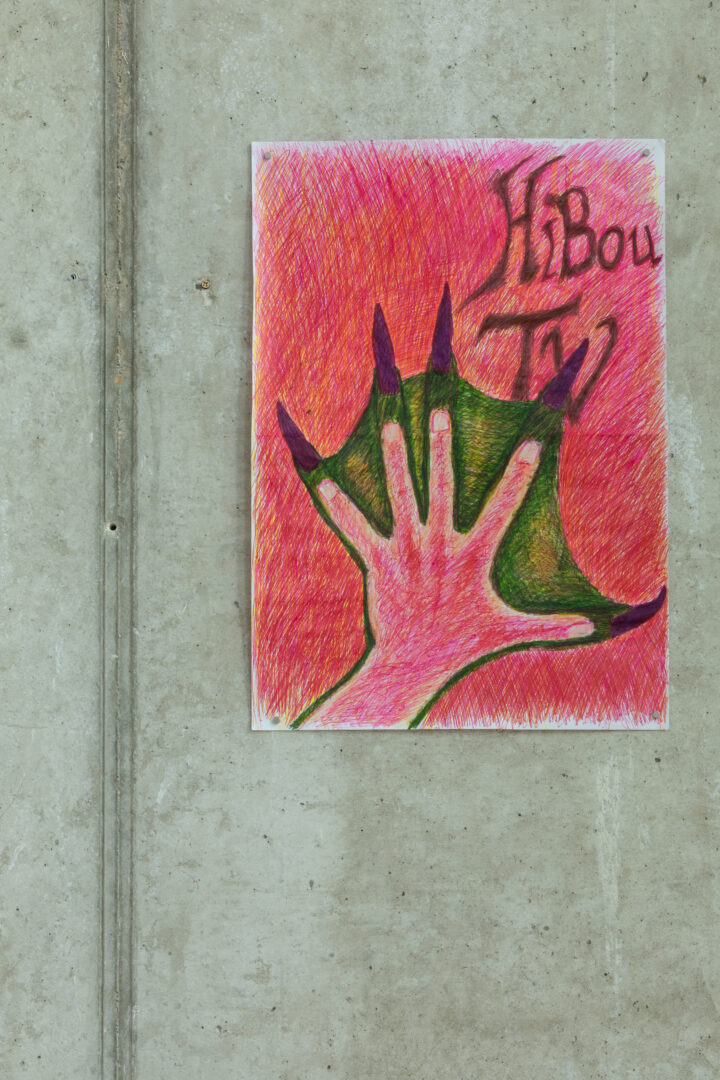
Against the backdrop of the Hibou TV set, we witness a beautiful staging of a writing project that plays with and on the language of the media; conversely, we navigate a visual installation enriched by a dimension of literary inquiry thanks to the attention paid to words. It is also proof that literature can emerge right in the midst of pizza boxes.
1 An initial experimental version was presented at the Valeria Cetraro Gallery during the “Hibou d’Espelette” exhibition in December 2023: it was a more or less improvised talk show in the gallery, featuring guests, the gallery owner as host assisted by the Pink Panther, and the running gag of a birthday whose celebration was in question. A Pink Panther mask sculpture and a cake with candles here recall this first attempt (but even if you don’t know that, it works just as well).
2. Discussion between the author and Émilie Renard.
3. Lecture “Hospital Museum / Antidote Museum,” April 5, 2025, as part of Florian Fouché’s exhibition, “SOCIAL SECURITY PRELUDE – Institutional Lives,” Bétonsalon, January 24–April 19, 2025, curated by Émilie Renard.
4. “Un·Tuning Together. Practicing Listening with Pauline Oliveros,” group exhibition, Bétonsalon, September 20–December 2, 2023, curated by Maud Jacquin and Émilie Renard.
5. “The Body Goes on Strike,” group exhibition, Bétonsalon, May 20–July 24, 2021, curated by Émilie Renard.
6. The expression is used in the exhibition booklet.
7. A two-season series, 2020 and 2022, with the second season more accurately titled Brown, Yellow, White and Dead Dead.
8. Alf is a famous puppet from the eponymous sitcom, created by Paul Fusco and Tom Patchett for NBC, which left its mark on American television in the late 1980s.
9. In her book Video: A Contemporary Art, Paris, Éditions du Regard, 2001, Françoise Parfait devotes a chapter to artists who developed projects for television during what she calls a “utopian moment.” She mentions, among others, Nam June Paik, Jean-Christophe Averty, Chris Burden, and even Matthieu Laurette. In the same vein, it is also worth noting that Robert Filliou’s short films, One Minute Scenarios (1968), were originally intended for television (now in the film collections of the MNAM).
10. Interview with Guillaume Benoit for Slash, December 2023 [online: https://slash-paris.com/articles/jean-alain-corre-interview-galerie-valeria-cetraro].
11 Discussion between the author and Gaëlle Obiégly.
- Share: ,
- By the same author: Alicja Kwade, Lucas Arruda, Lou Masduraud, Diego Bianchi, Sean Scully,
Related articles
Larissa Fassler
by Agnès Violeau
Nicolas Momein
by Patrice Joly
Louise Mutrel
by Camille Velluet