Louise Mutrel
Louise Mutrel
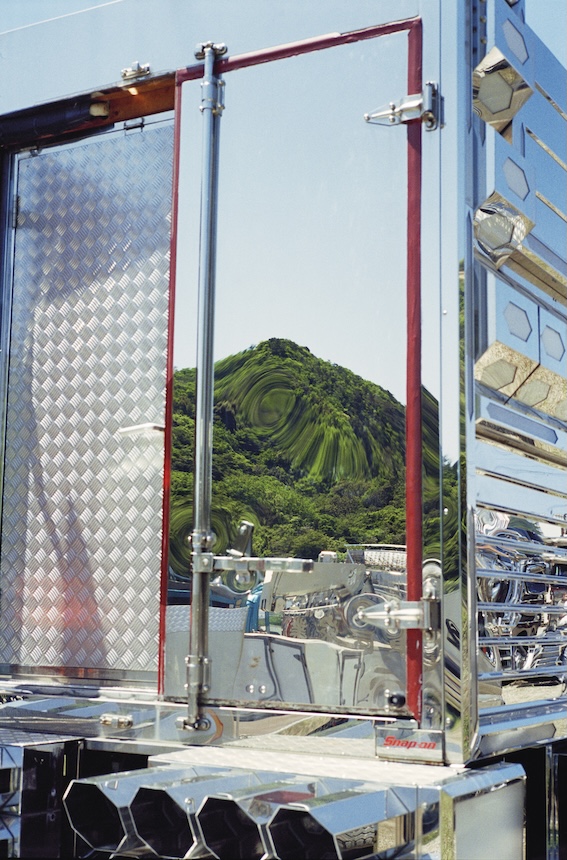
Louise Mutrel encountered her first dekotora during an improvised, one-year sabbatical in Japan. The photgrapher discovered the modified 18-wheeler in the heart of Tsukiji Market, where it was used to transport cargo such as seafood from coastal towns to the centre of Tokyo—utilitarian during the week become object to be paraded around once its duties are fulfilled. Dekotora became a motif, a cultural sign and vector for historical narratives representative of a communal way of living which has since remained a constant thread in the artist’s practice. Dekotora are plural in nature, hyperbolic. In the daytime, their chrome-covered appearance allows them to almost meld with the landscapes they traverse; their nighttime versions reaching paroxysms of brilliance. Featuring built-in lighting systems, they embark upon an animated nightlife full of contrast. Absorbed into their surroundings when on the road, when in darkness, the dekotora lose their reflective capacities only to gain a host of shimmering, colourful neon lights. The origins of these ultra-customised vehicles can be traced to the postwar period; rumour has it that they formed part of a shipment of trucks originating from the United States, arriving via cargo ship following conflict in order to aid in the reconstruction of the country. Their new owners then decided to rebuild the machines using different elements in order to camouflage any damages to the body and give them new life. Decorated trucks are therefore the result of art and craftsmanship; they include DIY creations as well as complex electronic systems which have been expertly integrated into a system of references which fuse together in a non-hierarchical fashion. Mutrel uses this as a starting point for a visual investigation which has taken place over the course of nearly a decade.
Parading
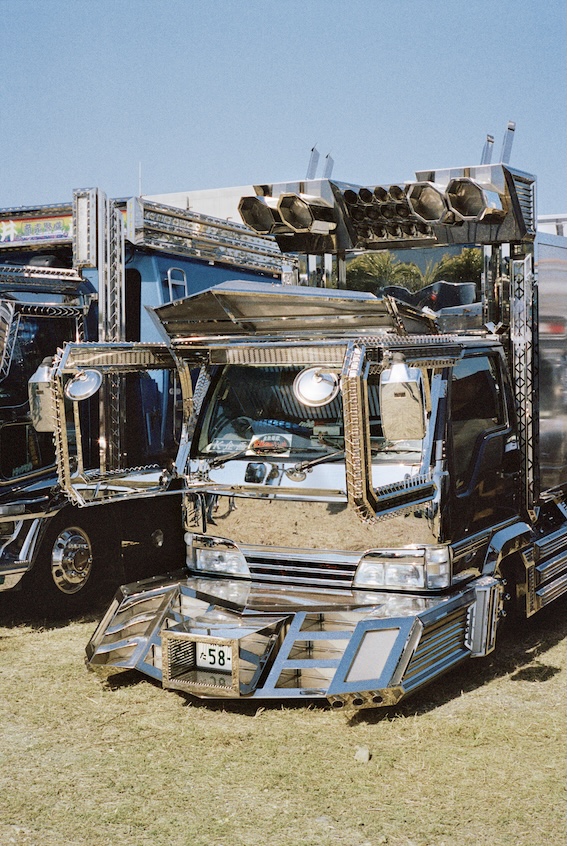
An obsession resulting from this first trip to Japan eventually became a need to infiltrate an underground scene. Despite several unsuccessful attempts at initiating contact, some months later Mutrel managed to obtain details regarding a future gathering for enthusiasts of this art form wishing to share their creations with others. The event was slated to take place in a far-flung locale, and would prove to be an initiation to a community which exists on the margins of Japanese society. Dekotora gatherings represent a unique opportunity to admire the vehicles when fully illuminated since they are otherwise not legally allowed on the road while lit. Festive and spectacular, these events are reserved strictly for members of this close-knit community; they highlight technique and craftsmanship which has been transmitted from generation to generation. The co-creation of these motorized decors is the result of the centralization of advice and trade secrets originating in various professional milieux, including trompe l’oeil painting and electronics. The collaborative approach found at the heart of this cultural phenomenon led the artist to consider the dekotoras as a form of collective experimentation. In 2022, following this embedded experience among the truckers, Louise Mutrel’s practice took an anthropological turn. This shift took the form of discussions with various families which are currently ongoing. Similarities can be found between Mutrel’s work and certain highly-saturated images by Daidō Moriyama—both photographers have produced images which bear witness to the links between postwar Japan’s past and its present, with the former’s work laying bare the paradoxes present in this society under north-American influence.
Circulating
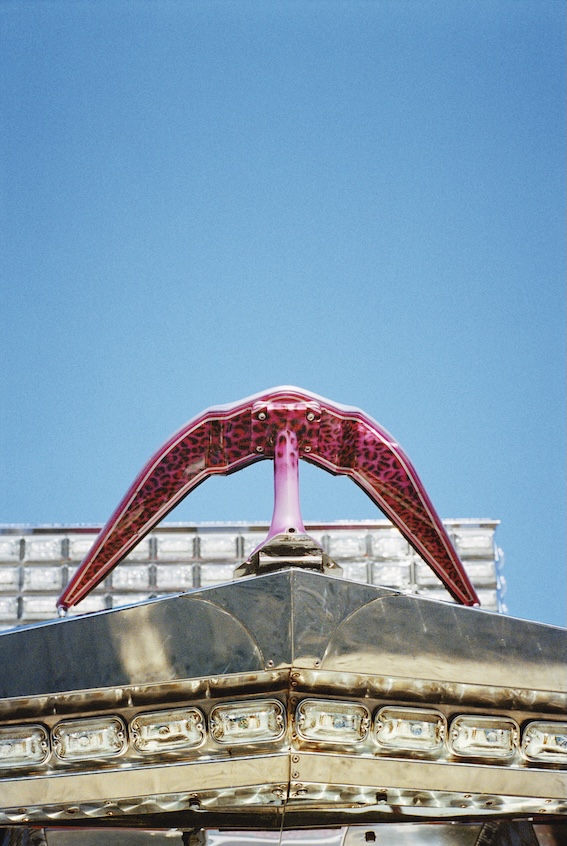
In 2024, while in residency at the Villa Kujoyama, Louise Murtrel accompanied a family on a six-month-long excursion aboard a dekotora. During this trip, glimpses of spiritual aspects of this way of life came to the fore through the low-relief sculptures which cover the vehicles, evoking various religious references. The photographer also became acquainted with notable Shinto temples believed to bring luck to travellers as well as ward off evil spirits while on the road. These moments of ritual brought to light through Murtrel’s lens are an integral part of life in these microsocieties; they are a testimony to the fusion of vernacular traditions with popular superstitions. Furthermore, the way in which the dekotoras can be interpreted as elevated altars is what feeds the photographer’s obsession with her chosen subject. Through close-ups of specific details paired with hi-powered zooms which produce a kind of abstraction, the photographer chooses to highlight this syncretic dimension. While owners of dekotora may consider them to be a type of personalised self-portrait, these avatars also convey residual aspects of the 1970s-era American culture that swept Japan, direct references to Kabuki theatre as well as to manga culture and ancestral pictural iconography. The layering of these visual signs creates a background for complex and rich imagery. Murtrel embraces this intensified aestheticization through an ensemble of photographic fragments which only serves to drive home the impossibility of transcribing these fantastical structures. Through the installations, the dekotoras are transformed into cultural objects charged with mysticism, catalysers of collective beliefs.
Simulating
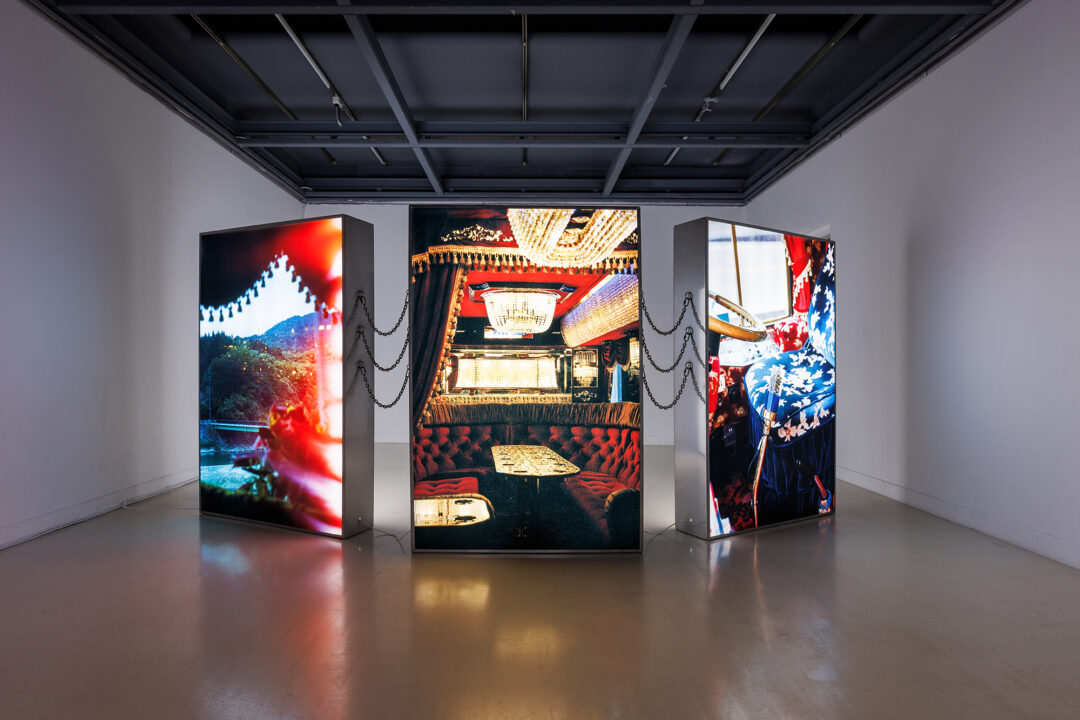
For several decades, fairground architecture—the ultimate context for experimental aesthetics—only lasted in one given place for a given amount of time. The transhumance of these ephemeral infrastructures was designed to support a short duration and most of this architecture only exists today in the form of archival photographic documentation. Dekotoras can be interpreted as the transposition of a certain type of freewheeling, devil-may-care attitude exemplified by over-the-top cities such as Las Vegas at the height of the postmodern era. The dekotoras echo an aesthetic vocabulary developed by the architect Robert Venturi in the 1970s—known for his “less is a bore” concept—and are not without similarities to casinos. Loosely related to decorated sheds—structures that exist more through their brightly-lit facades than through the building they have been designed to camouflage—dekotoras are an example of a culture which has merged with an American variety which has been engulfed by pure excess. For the exhibition “Starlight Express Club”, which was held at the Édouard-Manet gallery in Gennevilliers, Louise Mutrel questions the longevity of these perpetually reconfigurable objects and the need to understand them. These open-air exhibition venues demonstrate a radical inversion of traditional forms of display. While the interior of the vehicles remain extremely codified, all stakes are riding on the surface level. This can also be observed in the way that the photographer conceives the physical display of her works. Custom display cases with built-in lighting mirror the dekotora aesthetic, with the chrome material adding a similarly indexical reflective element. Within the exhibition, the galleries light up with rows of neon lighting like road signs, indicating a suggested path to visitors. The front and back of the frame suggest an instruction manual which might make it possible to re-create one of these structures, on a life-size scale.
Rayonner
Over the years, Louise Mutrel’s practice has evolved through this endless exploration which has taken on various visual and sociological forms that have proven to be continual. The photographer’s body of work has thus served to further a more global type of research in its attempt to portray a singular community whose chosen way of living challenges the status quo. Rather than simply producing images, the photographer’s visual language incorporates a documentary dimension with an occasional abstract bent in order to produce a body of work with holistic tendencies. Mutrel’s approach seeks to create a unified whole by portraying these object-worlds; difficult to perceive as they are in their entirety and whose complexity resides in the interweaving of motifs, codes and desires as well as in the search for freedom they embody. The photographer’s work highlights the ostentatious and irreverent nature of dekotoras, bearing witness to an infatuation with joyful expression as well as with the owners themselves. Mutrel therefore focuses on describing the vision of these magical objects, which reveal themselves to us before disappearing into the landscape, mirage-like.
This article was published with support from the ¡Viva Villa! fund, a networ of French artist-in-residence programs abroad.
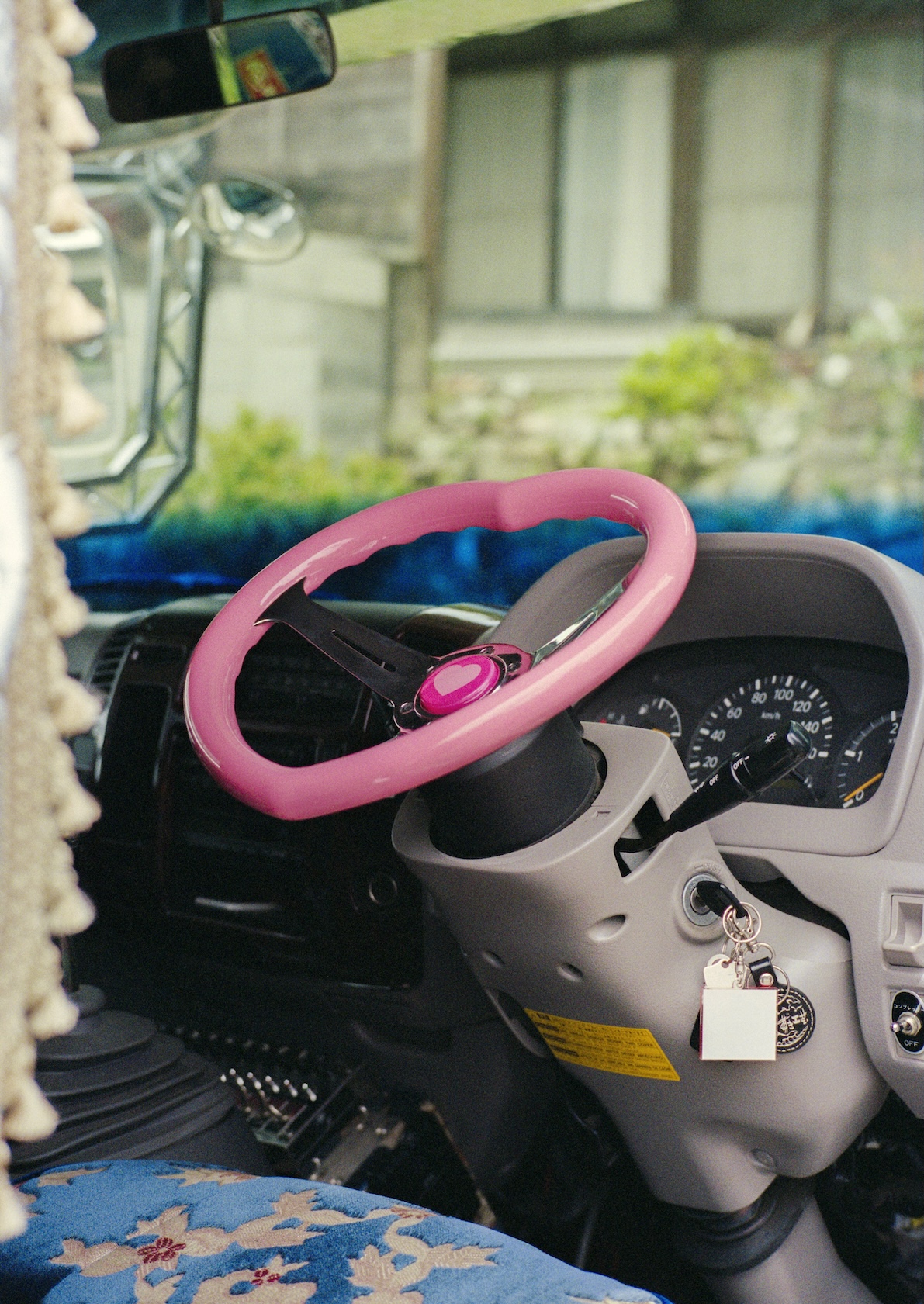
Head image : Truck steering wheel D’okita Koji, garage owner of dekotora, Hiroshima, 2024, © Louise Mutrel
- Share: ,
- By the same author: Anne Le Troter,
Related articles
Pauline Curnier Jardin
by Sarah Matia Pasqualetti
Larissa Fassler
by Agnès Violeau
Nicolas Momein
by Patrice Joly