Art-O-Rama 2026
Art-O-Rama, the Marseille art fair held from 28 to 30 August 2026, has reached its twentieth edition — although 2027 will be the year in which the actual twentieth anniversary is celebrated — and runs alongside the Saison Méditerranée festival (15 May – 31 October 2026).
Fræme, the organisation behind the fair, has also committed to exploring this theme through the exhibition Sur les ruines, les pierres fleurissent by Abdessamad El Montassir.
Art-O-Rama seems to defy the conventions of typical art fairs; many Italian collectors, for example, chose to travel by car to Marseille, avoiding the only direct flight available, operated by Ryanair.
La Friche la Belle de Mai is an unpretentious, extremely multi-ethnic setting where diverse social forces coexist. The low prices and the desire to support emerging artists and galleries (around 40 from 18 different countries), half of which were established less than five years ago, are a major draw. Five booths showcased collaborations between pairs of galleries, whilst 19 galleries were taking part for the first time.
Among the most interesting sections of the fair were the area dedicated to contemporary design and the section reserved for the Region Sud Awards, which saw the participation of many students from art schools in the Region Sud (which includes Provence, the Alps and the Côte d’Azur). The selection of the four artists — who will be offered residencies with certain partners — was curated by Pierre-Antoine Lalande, and the prize was won by Louise Belin, who presented a project entirely dedicated to the dreamlike realm. The artist will have an entire booth dedicated to her next year at the Cartonnerie at Art-o-rama 2027.
A selection of booths
The winner of the ‘Because of many suns’ prize from the Taurisano collection was Cecilia Mentasti of FRENCH PLACE. The founder, Marta Orsola Sironi, speaking on her first appearance at a trade fair, revealed the strong connection she shares with the artist.
Winning the prize entailed the acquisition of two drawings (pen, marker and sticker on paper) which replicate – whilst adding dysfunctional alterations – the exhibition centre’s evacuation plans, part of the series on museum escape routes entitled “Ovunque ma non qui” (Anywhere but here).
With irony and autobiographical sensitivity, the artist explores the relationship between memory, provincial life, the art world and everyday life. Among her most distinctive works is a series of soap bars containing photographs, which are not purchased with money but exchanged for 40 hours’ work for the artist, thereby transforming the buyer’s time and skills into the value of the work, as collector Giovanni Scibilia explains.
Opposite, the 22.48 m² gallery showcases Jonathan Bréchignac, an artist who uses pine pollen as both a material and a pigment, transforming it into sculptures, surfaces and installations inspired by forms visible under a microscope and the natural processes of water.
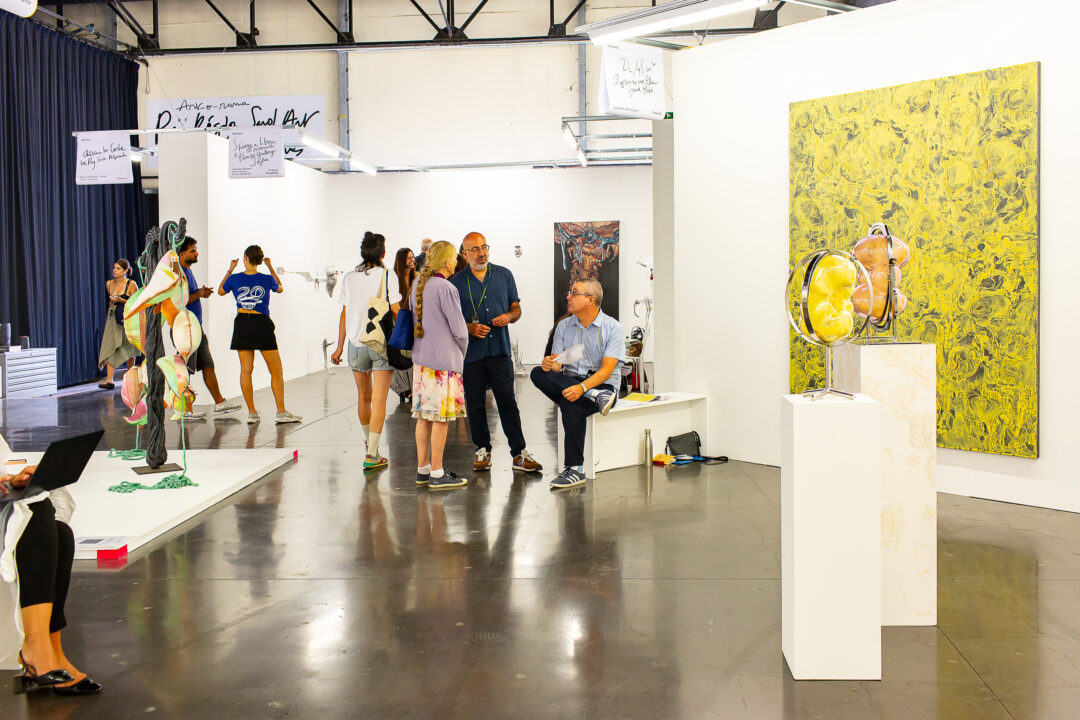
Among the Italian galleries, we find Triangolo from Cremona, which is sharing a stand with Sophie Tappeiner.
Both galleries have made sales. Triangolo is exhibiting a single work by Daniel Graham Loxton on its stand, though other works by the artist have also been sold —: he is an American artist whose work will be featured more extensively at the next edition of Artissima. Jala Wahid, represented by Sophie Tappeiner, presents a series of 54 papers depicting Mesopotamian artefacts held in museums all over the world except in their regions of origin. The artist also aims to evoke the maps that the US army issued to soldiers during the wars in Afghanistan and Iran.
Among the galleries worth mentioning is Gallery Hayashi from Tokyo. It brought a single large installation that piqued the public’s curiosity: Anew by ENTERPRISE. ‘The artist found some hollow high-voltage cables. They used to supply the city of Basel but, having been decommissioned, have lost their purpose. For ENTERPRISE, this bundle of electrical cables continues to provide a link between people and society.’.
The all-female stand by Spiaggia Libera – founded by Sacha Guedj Cohen in the Malmousque area, where the people of Marseille go for a swim – and the Bulgarian gallery Punta Gallery (Sofia)were also very well received.
Tout doit disparaître takes its cue from a shared theme: soap and rose oil, ancestral artisanal products that are nevertheless undergoing widespread industrialisation. Drawing on the soap-making tradition of Marseille and the Valley of the Roses in Bulgaria, the artists explore the metamorphosis of materials, their sensuality, and industrialisation. The female body is broken down into fragments of aluminium and glass — Veronika Desova & Slava George, represented by Punta; whilst Elvire Ménétrier uses silicone, soap, as well as oil on canvas and metal to depict insects and hybrid creatures.
This isn’t Cable Depot’s first time at the fair; we caught up with gallery assistant Tiziano Tancredi, who explained: ‘As with the other four editions we’ve taken part in, this year’s Art-o-rama fair and the lively atmosphere that has brought Marseille to life during this busy week have once again proved to be a great hub for exchange and dialogue with curators, museum directors and collectors.’
The fair also stands out from others due to the variety of media on display across the stands and dedicated exhibition spaces: painting, sculpture, photography, installation and design. Thus, Royal Lodge Book invites the public to discover gold as a vehicle for memory, transformation and resonance.
DITTRICH & SCHLECHTRIEM from Berlin, for its part, is showcasing a series of photographs by Lukas Städler taken in Marseille during the artist’s stay there.
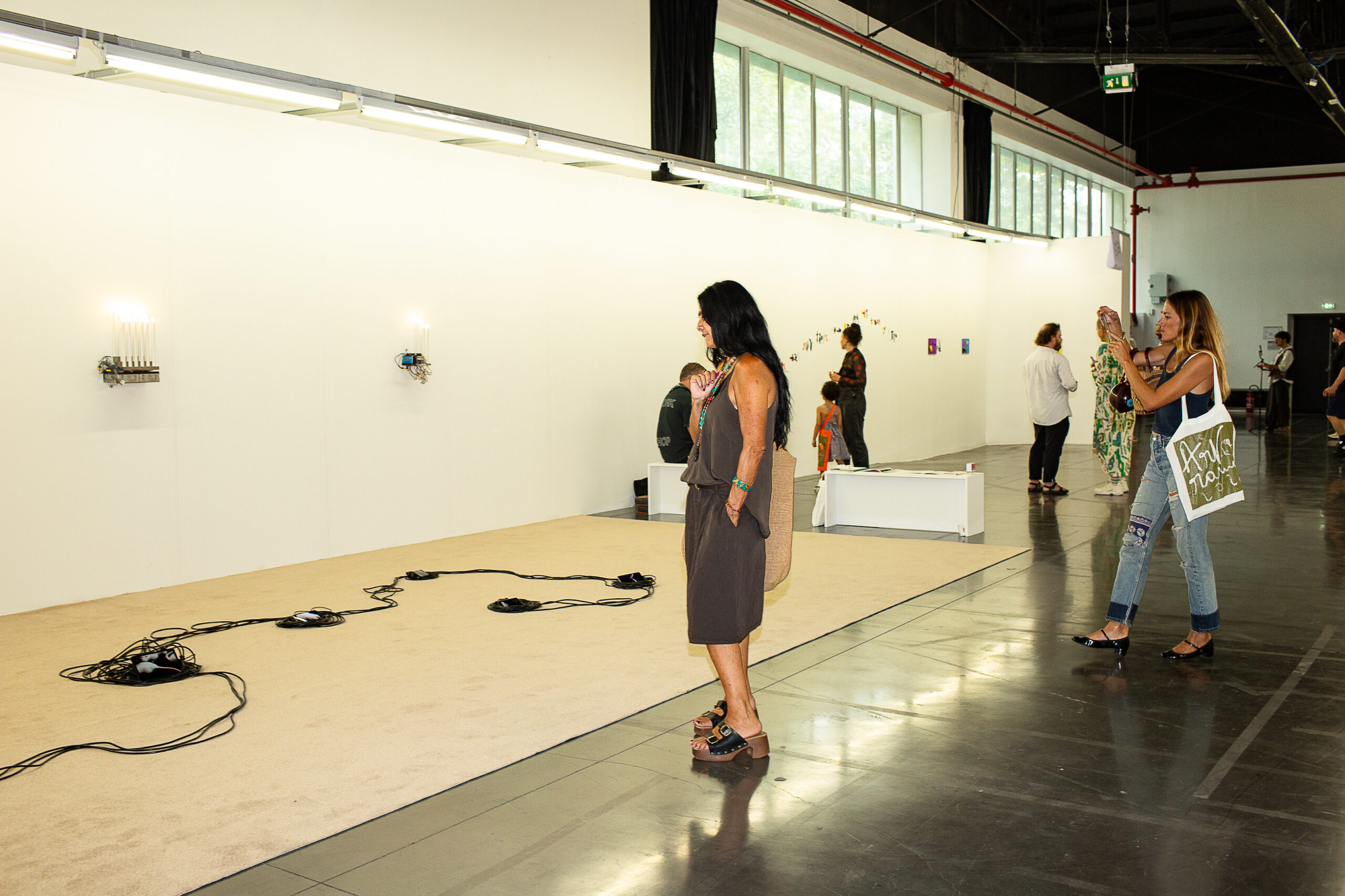
SEASON 4 EPISODE 6 + LAILA presents a duo show: Michael Sandford, an Australian artist based in London, and Christina May Carey, an Australian artist based in Melbourne. The gallery owner explains: ‘Michael’s work reflects on the mechanisation of hope. It consists of votive candles. The battery system is, in some ways, like walking a tightrope. On the one hand, it allows the prayer to last forever as it is powered solely by batteries. But the flip side is that the wiring is such that the batteries are too powerful for the lights. So, occasionally, a light goes out and needs repairing.”
Christina May Carey’s Rattails (2024), created using a carpet of threads and videos streamed from iPhones and iPads. “Christina’s work, on the other hand, focuses on the infrastructure of surveillance. Each of the seven screens shows the same video but out of sync. However, it is impossible to grasp the essence of the video in its entirety because you cannot watch it all at once. Similarly, one might think of surveillance systems or the intimate situations we experience daily within these systems, particularly public surveillance systems.”
Sissi Club, founded by Anne Vimeux in Marseille, is staging a solo exhibition by Joshua Merchan Rodriguez, born in 1996 in Bogotá.
In Panmetallism (2025–2026), the artist evokes the workshop he built during his residency at Ojalà, where galvanising tanks contain various materials that are transformed through the electrolysis of copper.
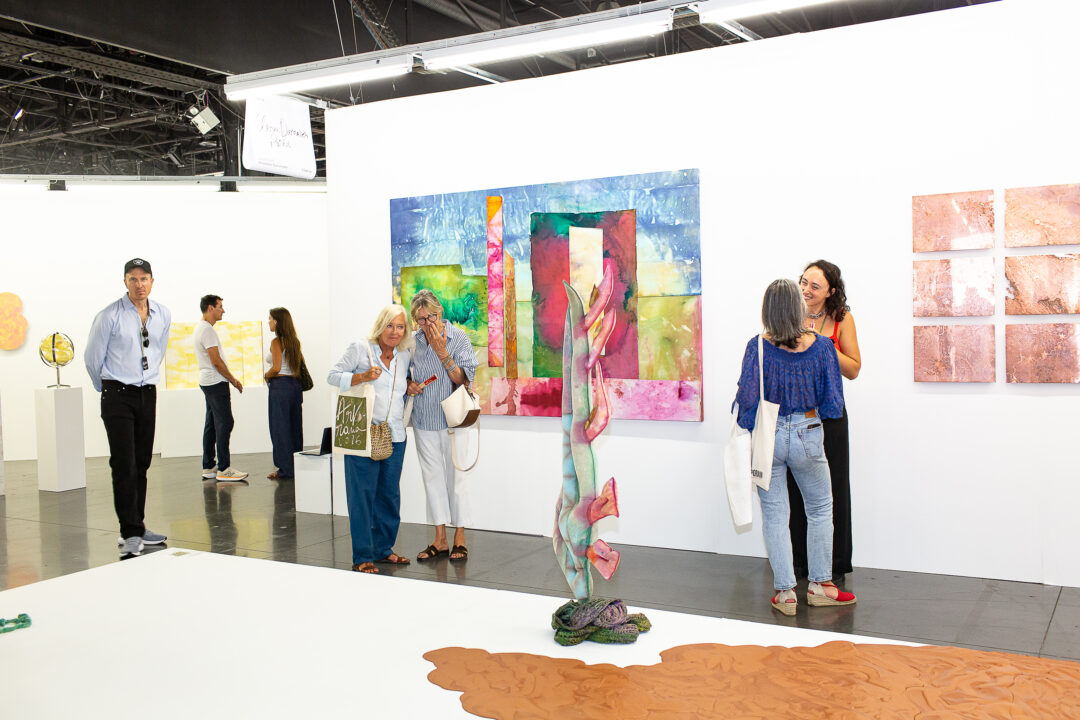
The Clara Darrason Gallery opened in 2024 in a Parisian flat, following the gallerist’s experience in New York with the space known as The Chimney. The stand, inspired by the dioramas of natural history museums, resembles a landscape deconstructed and transformed by a fire or a freak wave. Julia Gault’s work focuses more on earth and water; she has created an installation using poured clay that dried out over the three days of the fair. Amandine Guruceaga — one of the first winners of the LVMH Prize — is interested in pyrophytes, plants that can benefit from or thrive thanks to fire; she therefore creates sculptures from recycled PVC, fabric and burnt copper.
We return to The Bridge Gallery in Paris, founded by the two young artists Alexandre Fabry and Vianney Salzac, which specialises in contemporary African artists and those from the diaspora. It is presenting an elegant solo exhibition by the South African artist Dale Lawrence (1988), featuring conceptual works that explore visual poetry, repetition and layering.
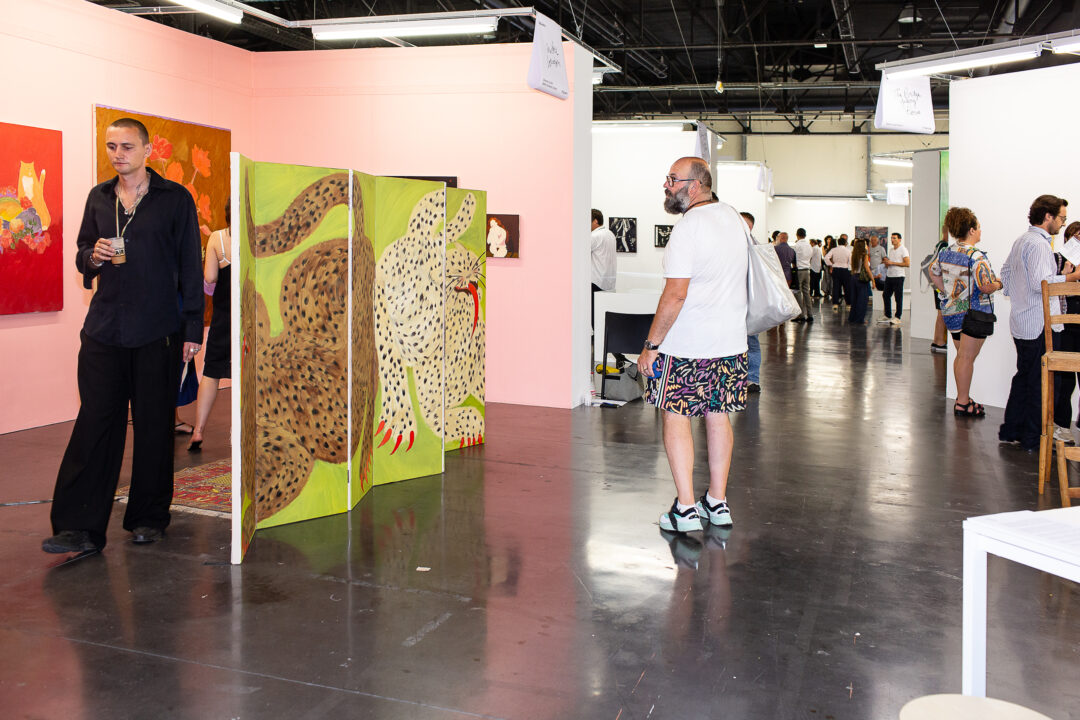
The same applies to the London-based Milość, opened by the Polish artist Aleksandra, which presents the works of two painters, husband and wife: Sophie Vallance Cantor and Douglas Cantor. The stand is incredibly colourful, dominated by human figures alternating with wild creatures and flowers, on canvases, screens and a video — Madre De Perla — created collaboratively.
Leaving the fair, the city – a crossroads of the Mediterranean – is brought to life by a constellation of events, exhibitions and studio visits. Among the unmissable venues is the third edition of Artagon Marseille, a space hosting artists and creatives at affordable prices, where you can discover young talents such as Maymouna Baradji, who reworks photographs of her own family in search of her origins.
Still at Mucem, the much-discussed exhibition on motherhood (that is now closed), alongside two new permanent exhibitions on Folk Art and the Mediterranean, and the solo exhibition by Clément Cogitore. Ferdinandea, l’île éphémère, running until 20 September 2026, explores the disappearance of the volcanic island of Ferdinandea.
head image : SEASON 4 EPISODE 6 + LAILA Michael Sandford,and Christina May Carey