18th Lyon Biennale
Curator: CatherineNichol
Whilst the art world continues to lament the destruction of life and to denounce (neo)colonialism, Catherine Nichols, curator of the 18th Lyon Biennale, finally pinpoints the root cause of these grand causes: the economy. The intention is sound, and the execution is subtle and often eloquent. That said, the argument is not without its blind spots and does not escape a rather hackneyed trope: setting the ruins of Western modernity against songs and rituals from elsewhere.
Crash Park
The aim, then, is to ‘move from one dream to another’ or, rather, drawing on Walter Benjamin and Robert Filliou as points of reference, to move from the mirages of the market economy – which is ecocidal and unequal – to a ‘poetic economy’ in harmony with nature. That is to say, the transition from one system of values to another, shifting from a financial to a relational framework. This quest is divided into three intertwined themes: industrial, service-sector and financial capitalism at the Grandes Locos; being-together at the Musée des Tissus; and the legacy of colonialism and its transcendence through ancient forms of connection to the Earth at macLYON.
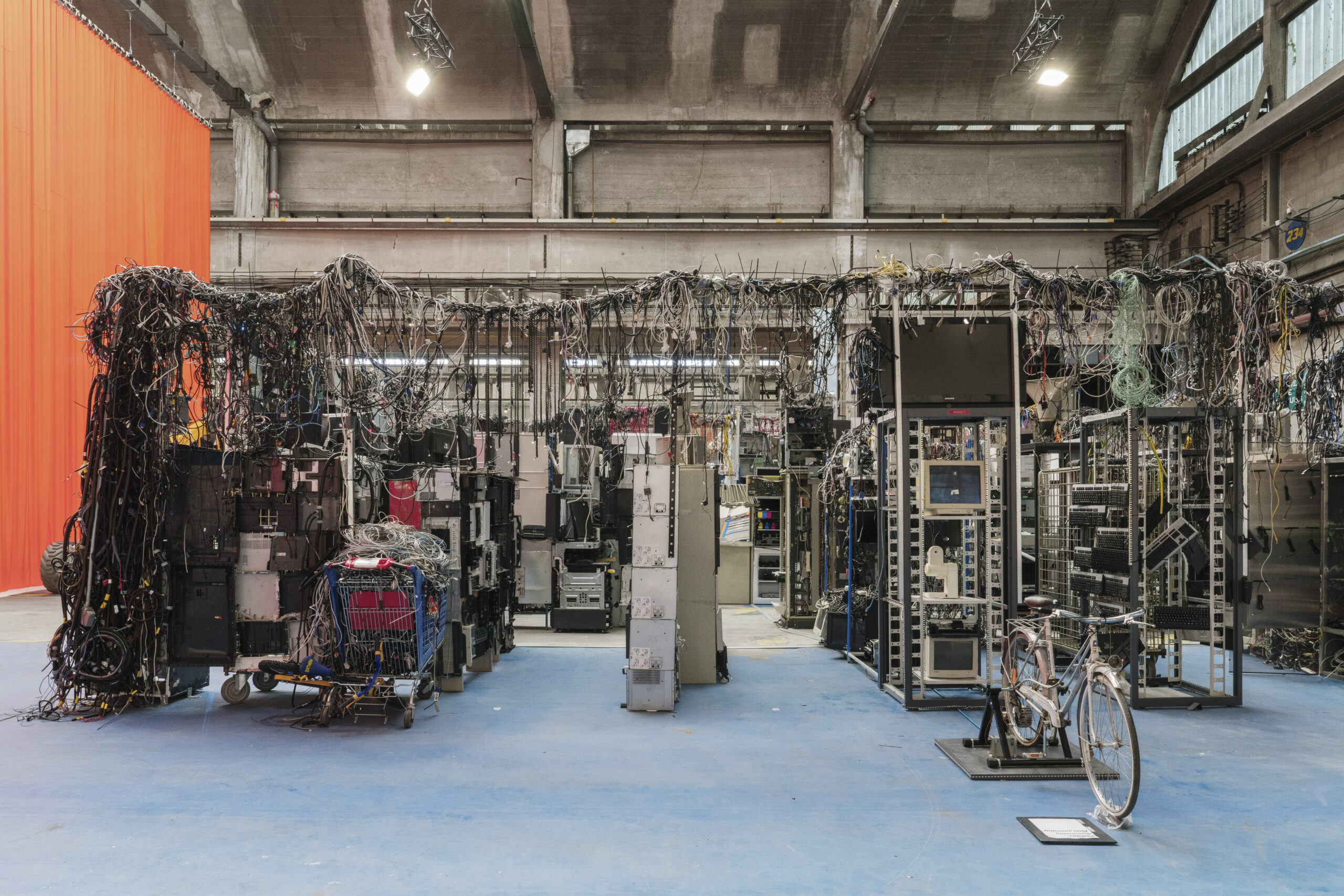
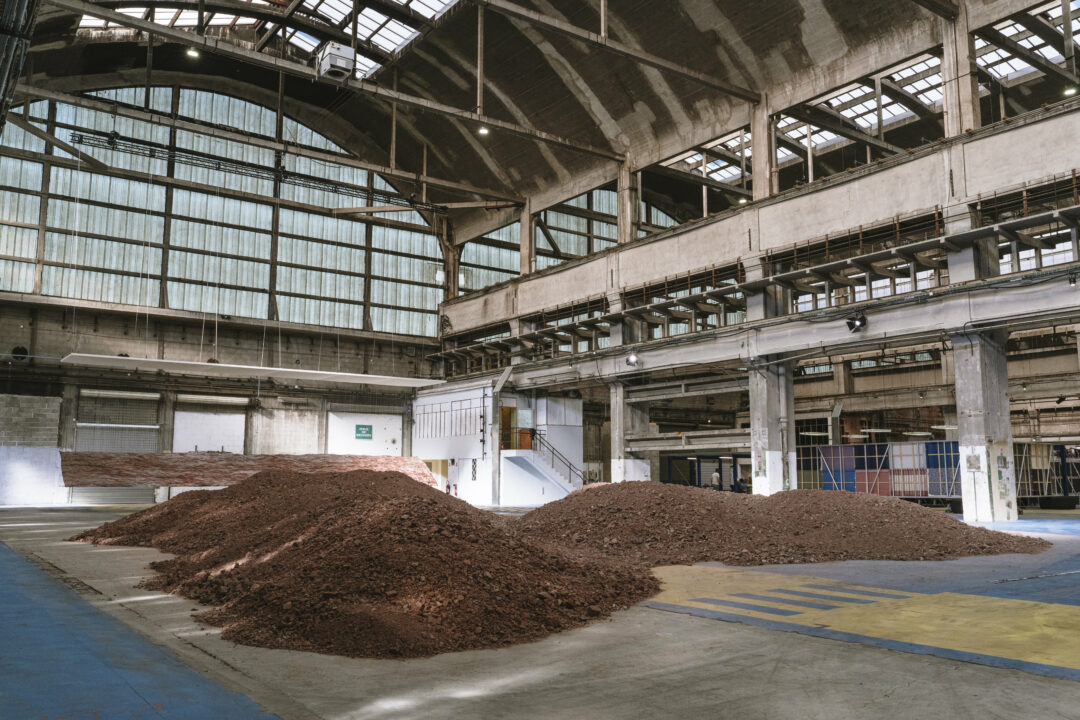
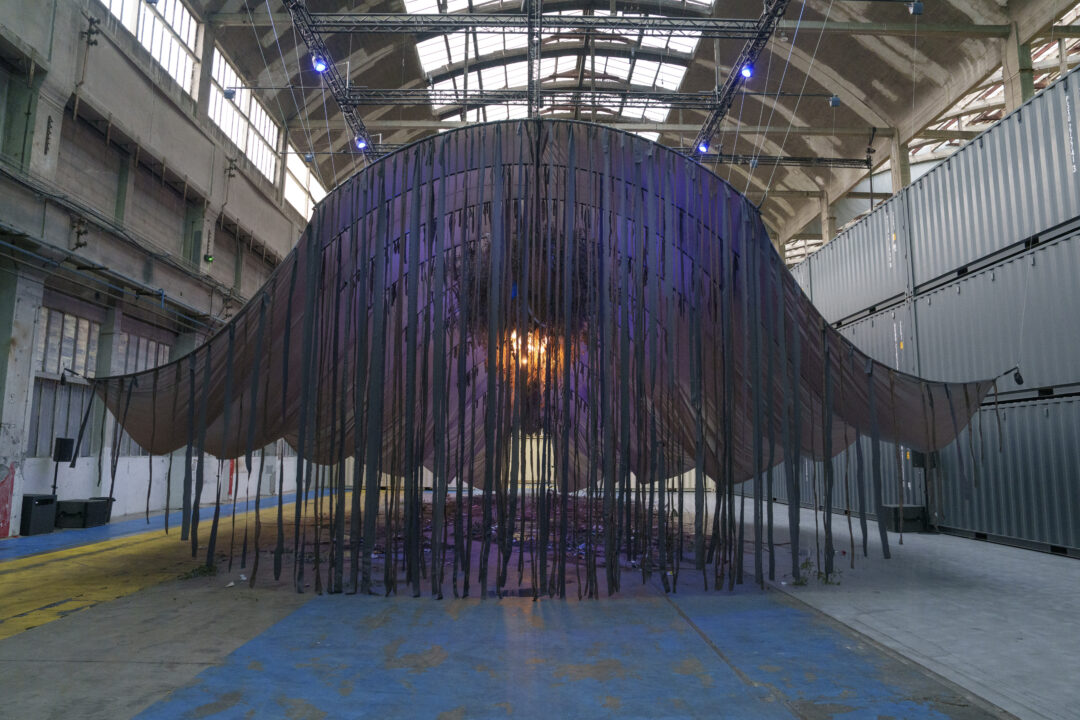
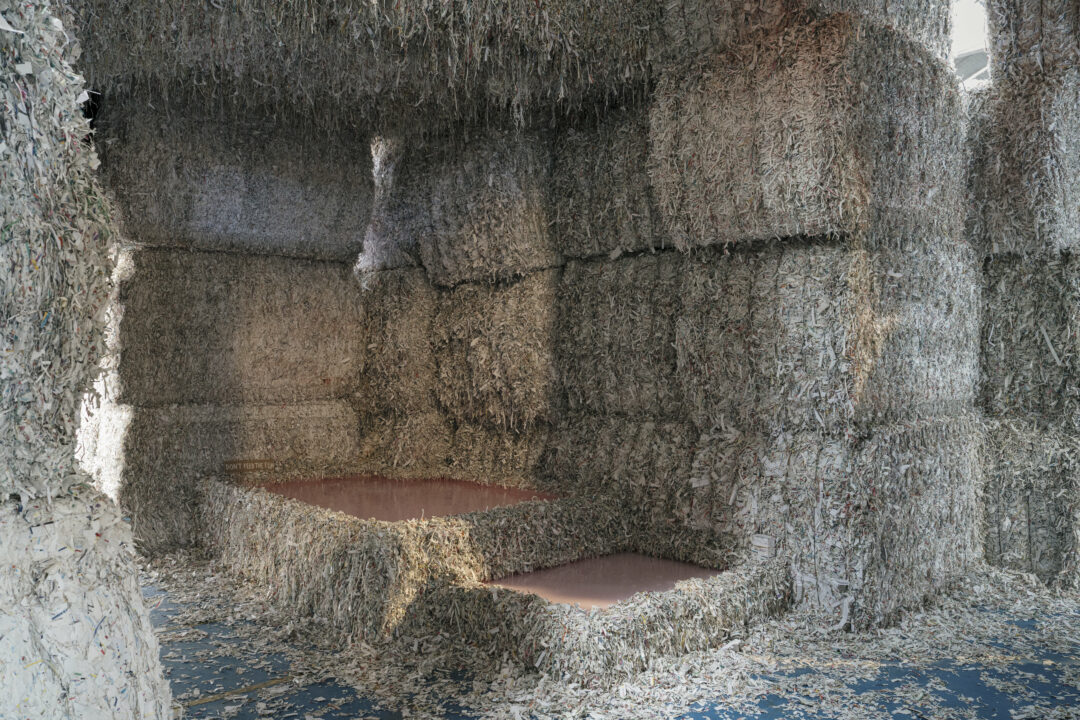
The first stage is as colossal as it is masterful. It opens with visions of devastation, featuring a vast fabric organism floating above the remnants of a party, like the belly of a whale filled with the waste of consumer society (Laure Prouvost). These are all fetishised objects which the curator re-situates within their extractivist and imperialist production chains. Thus, the halls of the Grandes Locos are obstructed by mountains of red shale (Lara Almacergui), caves of compressed paper harbouring pink lakes (raumlaborberlin), or inflatable structures with marble patterns (Lúa Coderch). These are the residues of industrial activities whose primary victims are colonised, exploited, battered yet resilient bodies, as evidenced by Leilah Babirye’s burnt wooden masks adorned with ropes and metal, or Serwah Attafuah’s Afrofuturist Valkyrie set against a backdrop of devastated, digitised landscapes. Victims whose main beneficiaries lie in the flow of resources – both material and financial. The latter are embodied, notably, in a gore film by Josefin Arnell, as vampires speculating on property overrun by zombies, or, in Igor Simić’s video game, as a golfer exploiting legal systems to his advantage to grow his assets. Meanwhile, service-sector workers search for the meaning of life and lose their minds – their heads reduced to balls of plastic wire – to the point of turning their offices into rally circuits (Mette Sterre). Somewhere between trash and burlesque, this first section has something of the disaster films such as The Poseidon Adventure (1972) or The Towering Inferno (1974), where capitalist greed leads to tragicomic disasters.
Re-enchanting the world
A change of atmosphere at the Musée des Tissus. Here, small labyrinthine rooms seek to reweave the lost threads of a wandering humanity. Set against the homo economicus—fixated on calculating his own self-interest—are rhythmic unions and communions. Thus, young adults filmed in black and white rub their hands together, snap their fingers and tap their thighs with their palms, gradually building up the sound of a storm (Angelica Mesiti). Further on, a multi-screen installation shows teenagers singing in unison of their desire to ‘be together’ for ‘a better world ’ (Mikhail Karikis); texts printed on the walls urge us to ‘put ourselves in the other’s shoes’ (Luz Broto); and human figures made of beeswax, in precarious poses, invite us to embrace our vulnerabilities (Gideon Horváth). These are just a few of the many works united by a philosophy of unanimity – the totality of life connects every individual in its movement – free from any conflict. Conflict, however, is a far more prominent theme at macLYON, a multi-layered exploration of decolonial proposals. Maori people voice their claims to sovereignty and their songs of collective unity in a trilogy by Luke Willis Thompson; Asian shamanic rituals resist Dutch imperialism in a video installation by Sara Sejin Chang; and traditional whale-bone sculptures by Rangi Kipa assert their presence in New Zealand in the face of legislation that shows little respect for indigenous practices. These are all ways of countering colonial exploitation with alternative ways of relating to the world. This involves the revival of ancient cults and mythologies, as also suggested by Egyptian cat mummies from the collections of the Musée des Confluences, hybrid ceramic figures inspired by Vietnamese traditions (Mai Nguyễn-Long), or even a vortex of water surrounded by birds’ feathers, evoking the bonds that unite humans and non-humans (Ngahina Hohaia).
Without class struggle
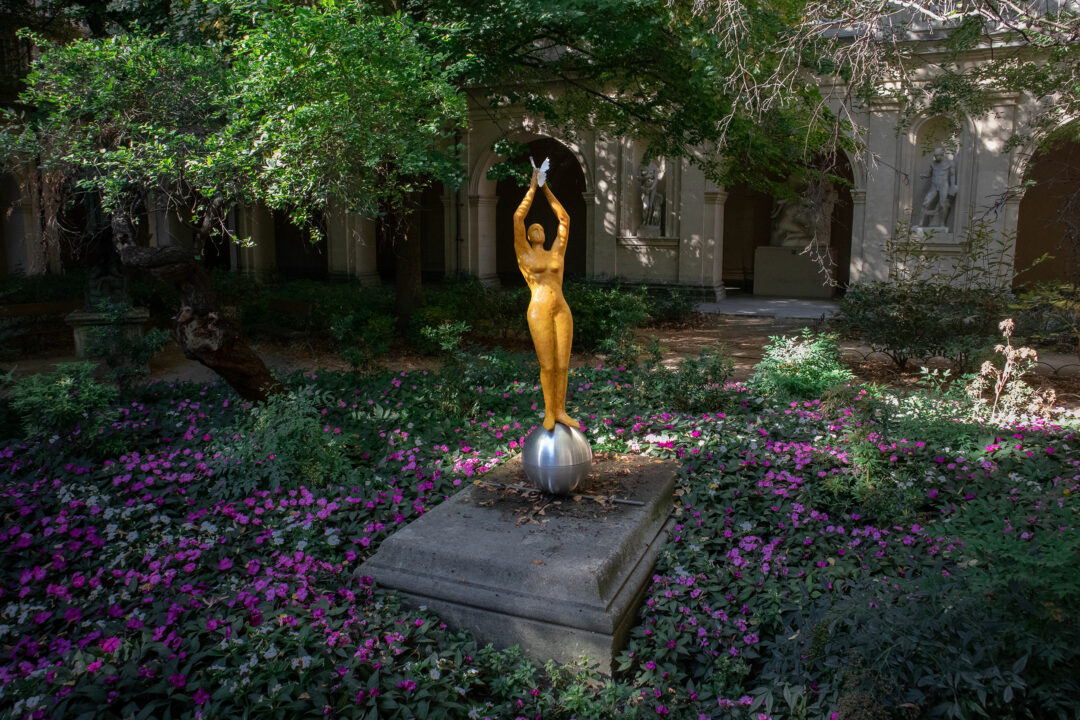
In short, for the curator of this Biennale, the solution to the human and environmental ravages of capitalism lies in the realm of symbolic systems. The aim is to counter the Western, rationalist and instrumental conception of the world—which reduces all living things to exploitable objects—with non-Western and pre-modern cultures capable of healing the Earth and reconnecting with it. This is something one can only hope for, but which, at heart, is an old modernist refrain. The rejection of modern society and the project of its reinvention through the ‘other’ were already the hallmarks of historical avant-garde movements, such as the Blaue Reiter or Surrealism. There is, however, one major difference: the 120 artists featured in this edition, representing 42 nationalities, draw upon their own cultural heritages and cannot therefore be accused of cultural appropriation. Be that as it may, in a certain sense, this opposition of the West to its ‘Other’ re-enacts a ‘clash of civilisations’ whilst sidestepping the crux of the matter: social conflict understood in terms of class struggle. It is indeed surprising that a biennial focused on the economy and its potential revolution should devote so little space to works that explicitly refer to the world of work and class antagonisms. We count four or five out of more than four hundred and twenty. And even then, two of them are situated outside the main exhibition venues: a ‘chant des canuts’ reimagined by Susan Philipsz is played in the cloister of the Musée des Beaux-Arts and in Lyon’s famous traboules, whilst a choir of miners filmed by Mikhail Karikis appears in an underground car park. This may well be the blind spot of this event. Following on from the 2026 Venice Biennale, it encapsulates the mindset of a certain cultural milieu. For this milieu, the function of art lies more in reconciliation than in mobilisation. Or, in other words, art as a social lubricant.
Head image : 18th Lyon Biennale of Contemporary Art, Les Grandes Locos. AkwasiBediakoAfrane, detail from *CERBERUS T-26: Dance of Dialogue*, 2026. Courtesy of the artist. Credits: Blandine Soulage