Bianca Bondi
Casino Luxembourg – Forum d’art contemporain
1st March 2026 – 3 January 2027.
Bianca Bondi (born in 1986 in Johannesburg, South Africa; lives and works in Paris) shapes her works as one might conduct an experiment: over the long term, paying close attention to the transformations that occur. Her installations combine salt, copper, water and organic materials. They corrode, crystallise and continue to mutate after being exhibited. Her work blends alchemy and ritual practices (divination, scrying) into a minimalist, almost meditative aesthetic. Bianca Bondi creates environments where one observes a living process that embraces transformation, rather than inert objects.
Bianca Bondi, Notes on Weathering, 2026. © ADAGP, Paris. Photos : Marc Domage.
B like Bianca
Bianca Bondi has developed her practice through residencies, site-specific projects – The Sacred Spring and Necessary Reservoirs (Fagor factories, Lyon Biennale, 2026) – and major exhibitions – “A Preservation Method” (Dallas Contemporary, 2023). In 2025, she was nominated for the Marcel Duchamp Prize (MAM, Paris) and was a resident at the Villa Medici (Rome). The artist constructs each project by starting from a given situation, then installing her observations of the chemical and hygroscopic changes in both the contents and the containers. In art centres and galleries, her installations transform the space into a laboratory in which the public becomes a witness to a slow process.
The artist works as one might keep watch. Present on site before the projects open, she conducts research into the history of the venues and their uses. Her pieces then take shape as experiments – baths, reactions, deposits – nourished by the stories she has uncovered, where salt, copper, resin and gum become the letters of a visual grammar.
I as in inanimate
The passage of time runs through the work, but so does alchemy, in both its biological and esoteric senses. The works, which reflect actions applied to living things as well as to the setting, carry an initiatory charge: the laboratory, the garden and the altar echo one another.
‘Notes on Weathering’ is the title of Bianca Bondi’s solo exhibition, inaugurating the new FORA programme, which celebrates the thirtieth anniversary of the Casino Luxembourg. The Forum d’art contemporain has invited the artist to create a new work. Begun in the basement, it unfolds across spaces and time, much like a plant taking root.
A for apparition
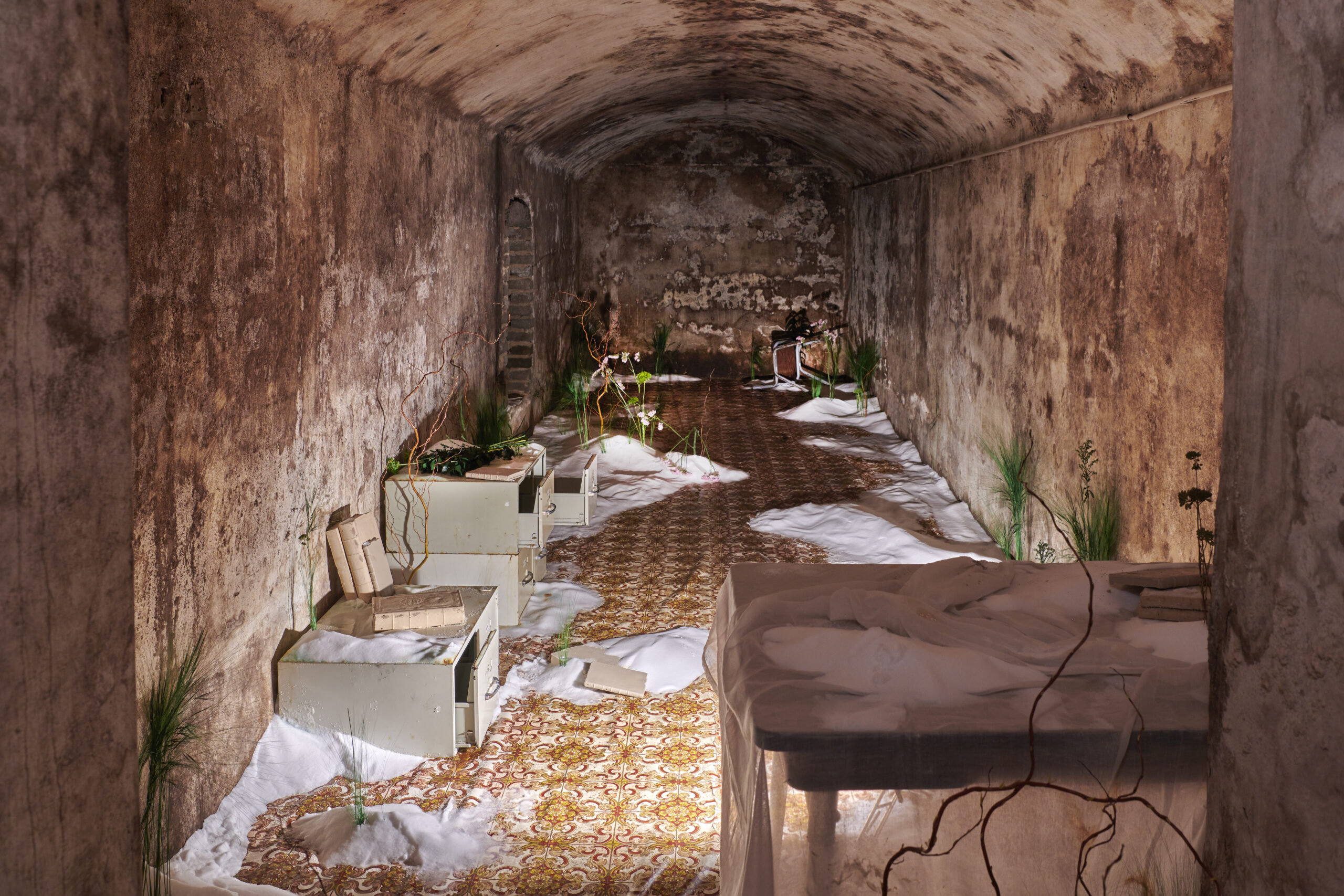
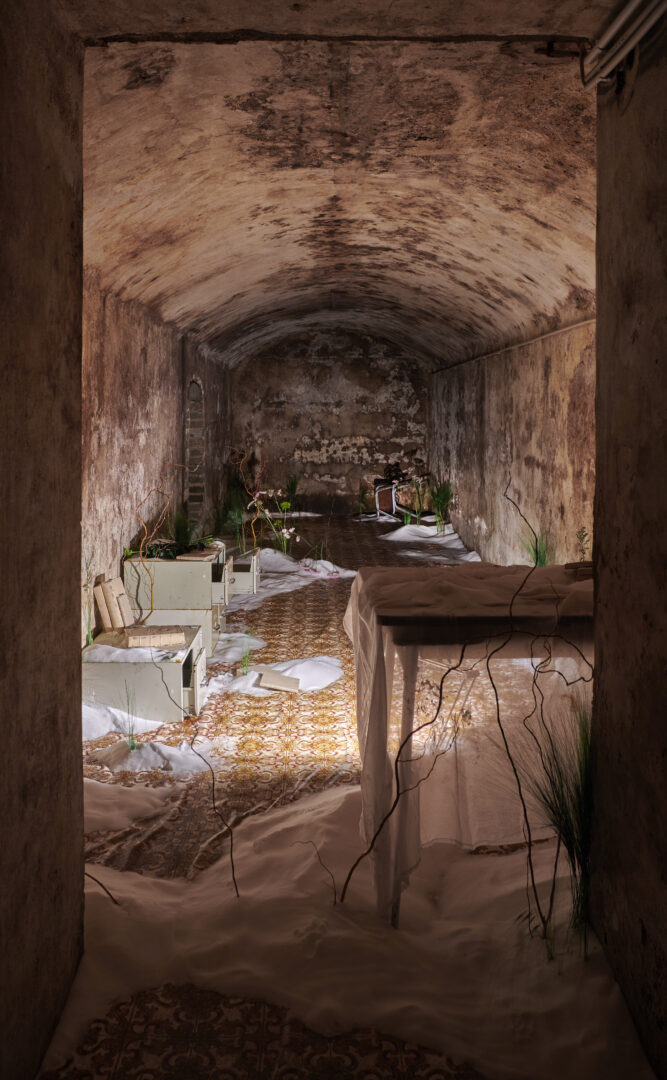
The tour begins in the art centre’s cellars – usually closed to the public due to humidity and temperature levels that prevent the installation of artworks. As the perfect guest in a space and under structural conditions where no stable artwork could be installed, Bianca Bondi unfolds a genealogy of forms and installations. The standard conditions for exhibition – 50% humidity, 22 degrees Celsius, no living organisms – are contradicted in a basement where the atmosphere is unhealthy. The work takes the opposite approach: the artworks arise from the deterioration of the foundations, from the building’s porous stones which absorb moisture and bring it back inside.
C for control
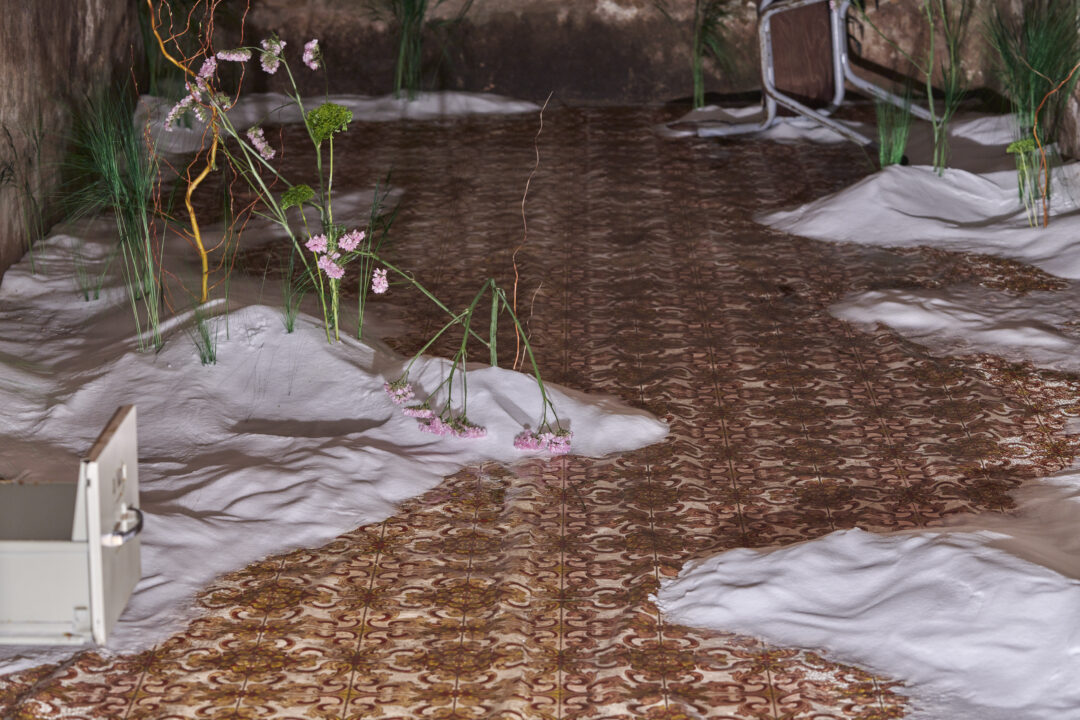
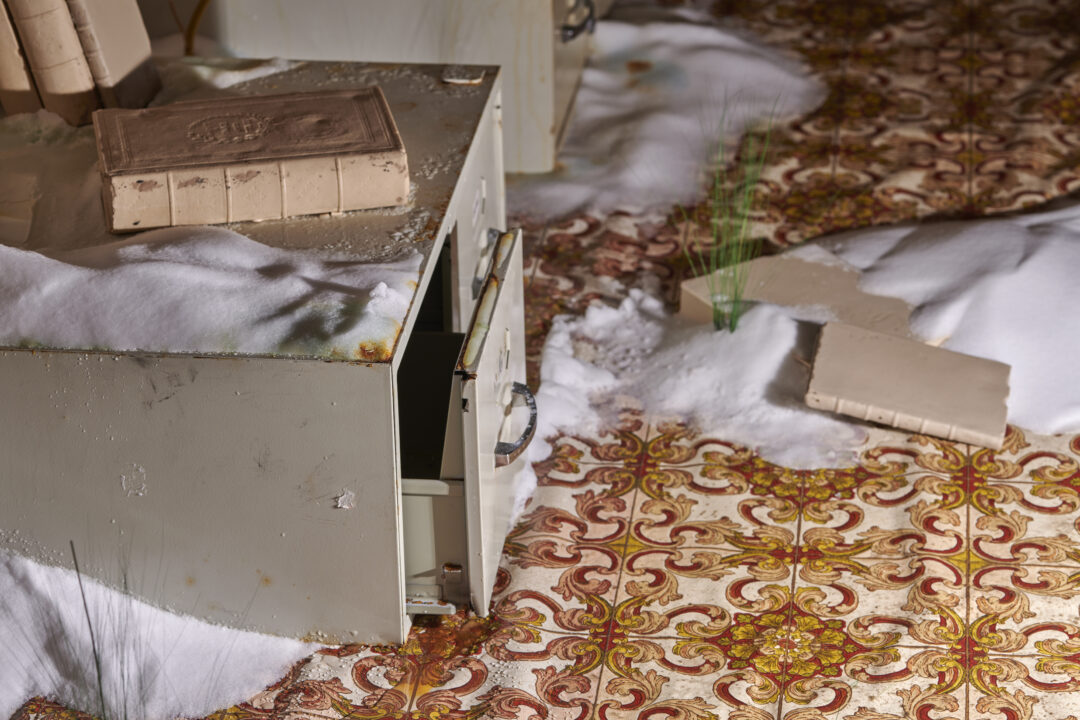
Pools of rust form very quickly in the first installation, composed of furniture and found objects, plaster books and vegetation. In the drawers, as on the existing, weathered wallpaper on the floor, changes in the material’s state become visible; growths and decay form a micro-organism. One of the chairs, previously cleaned with a sanitiser, retains invisible chemical residues that have gradually migrated into the salt, causing a reaction that stains it blue. Saltpetre accumulates on the walls, much like bacteria. Thus, the building’s structure and its human activity support the artist’s work: form emerges from the situation. The artist takes elements of the site’s infrastructure and, exceptionally, deliberately causes them to deteriorate. In the spaces occupied by the artist, salt appears as a central material, a recurring tool that anchors and structures his installations. Used for its multiple symbolic, chemical and preservative properties, it has the capacity to literally absorb its environment, capturing the moisture, traces and invisible transformations that surround it. The artist speaks of a liminal space, a place of in-between and a threshold to an invisible world, where transformations take place.
A for agency
Bianca Bondi, Notes on Weathering, 2026. © ADAGP, Paris. Photos : Marc Domage
The building was previously a place of social gathering, housing a community united around practices linked to leisure, play and performance. In a second space, fragments occupy the structure in a completely different way. On the walls, erosion traces layers, creating a landscape. The artist transforms two basins, reminiscent of ancient troughs for extinct animals, into saltwater baths intended for dyeing silk. They become receptacles for offerings gathered during her travels – an earring, a token, shells or coins – composing a sort of homage to the subterranean Styx. A series of dead birds, in copper patinated by salt, are arranged in shrouds. While the work speaks of rebirth, embalming or care, one might even see in it a reminder of a post-pandemic world, where our relationship to health and cleanliness shapes our actions. The notion of agency is frequently evoked by the artist, who associates it with the landscape in its transformation. But she also links it to the public, who are invited to walk through the work and activate it (triggering the light, wearing down the floor as they walk…). Acts usually prohibited by the authority of the art venue. Are we being invited to protest, or to commit an act of vandalism with her permission?
B as a biotope
To grasp the extent of the environment that the artist makes both blossom and die at the same time, the tools used are the same as those employed to detect occult presences. Paranormal activities, like radioactivity, are documented in the same way, which interests the artist. The rooms of the Casino accumulate voices and lived experiences, which she herself pursues by documenting the whole ensemble. The space between ecology and the occult is easily traversed: both speak of the unsaid, of a transformative hidden truth. Each requiring a specific arrangement and activation, these devices are all ways of acting upon reality. The work and its relational spaces, linked to rituals, open up forms of dialogue.
O for organic
In Bianca Bondi’s work, the pieces are not static: they evolve, crystallise, run across the walls; corrosion draws out cartographic patterns. Like ivy or climbing plants that spread their roots wherever they cling, the signs are in motion, like a biological organ. The Casino building would become a space of flux, an organic space, a living body throughout the project. To document it, the venue commissioned the critic Benjamin Bianciotto, to whom it sends a daily photo of a room detail as material for writing. Once the exhibition is over, the texts will be compiled into an illustrated publication, giving the work a second life. Here too, a form of living, open and shared writing.
N for nature
Occult practices1, often linked to the feminist figure of the witch, maintain a relationship with nature that is as much mystical as it is epistemological: they assume that the living world is not something to be dominated, but a network of signs, correspondences and powers with which humans remain in constant negotiation. They perhaps arise where the forest ceases to be a backdrop, to become once more a language that certain women learn to listen to. Moreover, nature in ‘Notes on Weathering’ does not merely evoke non-human life. It concerns the nature of things, as they appear before us. It is about the nature of a place, the nature of a work of art, human nature in the face of the setting that gives it space.
D for divination
Birds are useful in the study of climate change, but also in wartime, as they stop singing when they sense toxic gases or when oxygen runs low. Through her arrangement of corpses draped in shrouds, Bianca Bondi also speaks to us of genocide and extermination. Affirming a slow, subterranean temporality, as in fairy tales, the work takes its time to cover the ground. It is by nature inclined to hide (Hansel and Gretel), to get lost (Tom Thumb) or to protect (Sleeping Beauty). In esoteric literature, the exhortation to keep the contents of knowledge secret aims to preserve the power of the elite and the initiated. Medieval thought reminds us that ‘this articulation of secrecy and nature rests on a logic: just as in medieval thought the ars (the technè) imitates natura […] the concealment of natural truth respects a profound intention of nature2’. In Bianca Bondi’s work, we see a boomerang thrown back at a civilisation brought to its knees by nature and the occult sciences2.
Bianca Bondi, Notes on Weathering, 2026. © ADAGP, Paris. Photos : Marc Domage.
I as in impermanence
A re-envisioning of the conditions of exhibition takes place through this very installation, which unfolds from the vaulted ceiling of the basement, gradually taking over the entire cellar (by January 2027, the space will be fully occupied). It is thus through alteration, erosion and the use of the space alongside living organisms (the chemical effect of flowering) that Bianca Bondi conceives of the space and its occupation. She allows the public to observe with confidence what she calls the ‘gestures that begin’. The objects making up the installations (some are brought in what the artist calls her ‘suitcase of symbolic objects’, others consist of items found locally) are then recycled; sometimes they join other works – here too playing on the sacred. The works thus form a flow, organic and living, rather than a material and static accumulation. Contrary to a form of capitalism that assumes that what cannot be seen does not exist, we might navigate a social architecture where the event is not necessarily visible. The unfinished would become an educational lever, the genesis of a more responsible agency to be established.
Artists have always questioned the museum and its permanence. Bianca Bondi reintroduces an art of patience. Her work teaches us to watch the unstable, the clandestine and the latent grow.
Agnès Violeau, May 2026
Exhibition at the Casino Luxembourg – Forum d’art contemporain, from 1st March 2026 to 3 January 2027.
1. Occult practices refer to that which remains definitively beyond the reach of human knowledge.
2. Nicolas Weill-Parot, ‘Silence of the author or of nature? The occult and the secret in medieval science (13th–15th centuries)’, in Marie Blaise and Anita Gonzalez-Raymond, A Time for Everything, Montpellier, Presses universitaires de la Méditerranée, 2019.