Utopia: Three Centuries of Sexuality in American Cults and Communes
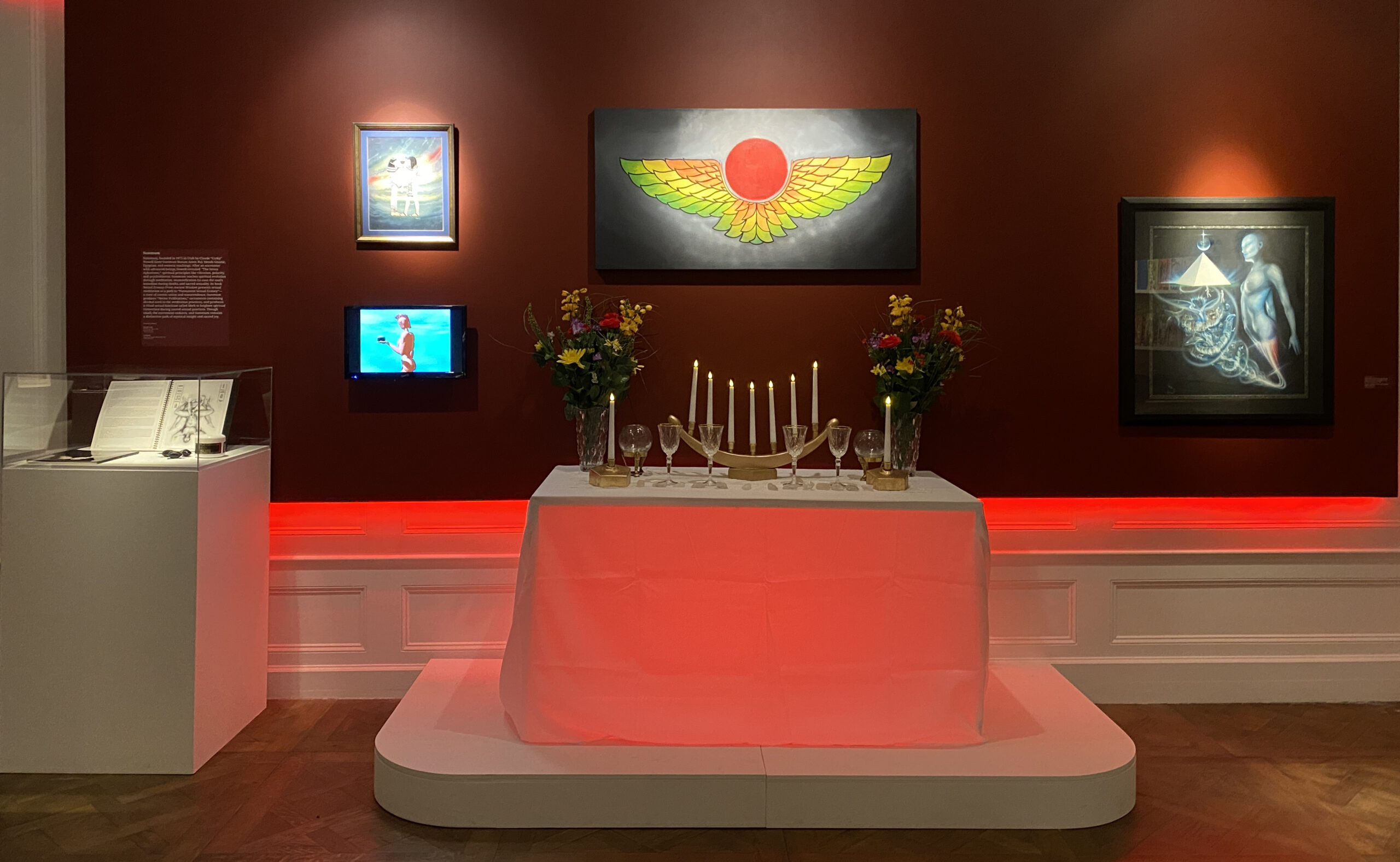
Museum of Sex Manhattan, until april 12 2026
Museum of Sex Miami, from may 7 until november 2026
Commissariat : Jodi Wille
For viewers willing to spend thirty bucks, Manhattan’s Museum of Sex offers the opportunity to explore in public things that generally remain under the covers, or in your pants. Organizer Jodi WIlle’s exhibit Utopia: Three Centuries of Sexuality in American Cults and Communes chronicles, with artifacts and artworks, the country’s keening edge of morality and sexuality by way of a history of cults and communes. We’re reminded of Onieda in Upstate New York, today famous for silver spoons, it was originally premised on group marriage. With a circus poster and issues of Neopagan Green Egg magazine we recall that the Church of All Worlds is both responsible for coining the phrase polyamory and getting Ringling Brothers & Barnum Bailey Circus to stage their one horned goat as a unicorn. And with outrageous films, the members of the communal troupe the Cockettes, played non-binary theatrics decades before the liberation of the word queer. At a time when the US federal government is insisting on a simple story of what constitutes our nation’s sexual expression, the exhibit reminds us that the Unted States has always been a place where communities seek freedom and distinct ways to get with each other.
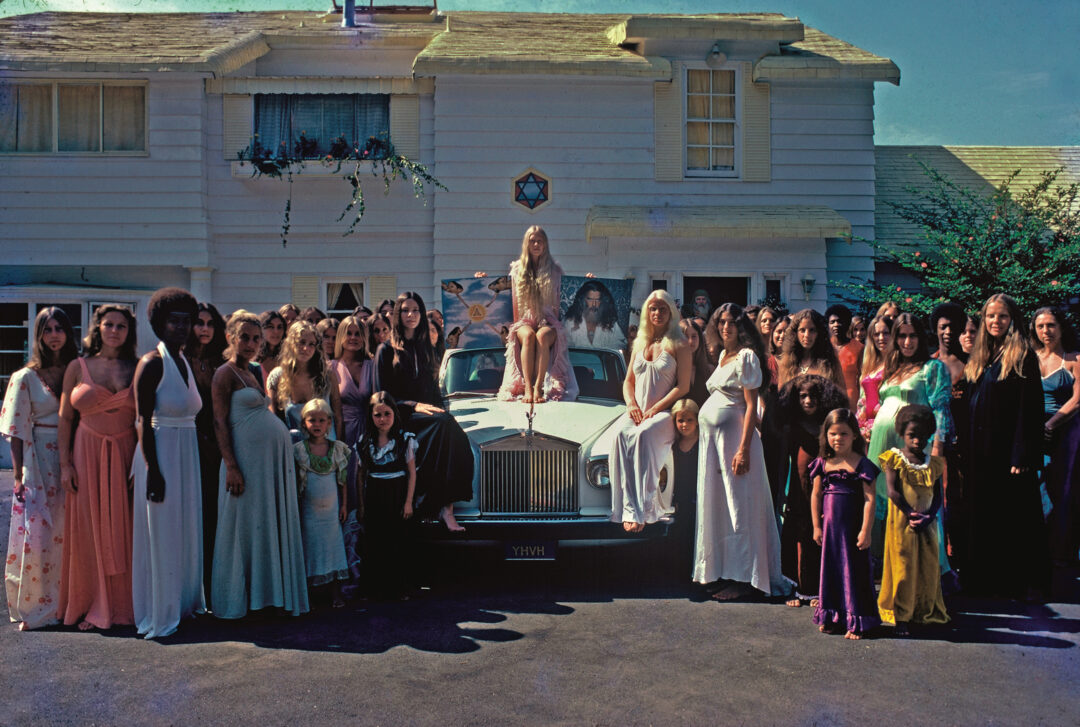
The exhibit, representing 20 intentional communities, begins in the past during the United States’ Colonial era with spare but telling artifacts. It meanders through the Civil War to the near present. This span is meaningful, implicitly it makes an argument that the search for the language of freedom that’s the project of “the New World,” has often meant the tension between the libertarian impulse and the developing institutions that maintain it; church and state. A handcrafted chair is the object here representing the Shaker Community. A schismatic Protestant faith, led by matriarch Ann Lee, that came to the States via England at the dawn of the American Revolution. They are a curious but proper foundation for this sex-based show. Shakers didn’t fuck. They declared their celibacy as a mark of faith. Instead, we understand they ground their desires into community, communal-labor, and ecstatic worship. The Shaker’s atypical approach to social organization (female leadership, communalism, anti-nuclear family) developed a social structure which labeled them as oddities, if not heretics. Coincidently, because of their unity of purpose they made fantastic chairs, baskets, brooms, and buildings. Today, highly regarded, these things are at the core of the American folk tradition.
Across from the Shaker’s straight back chair is a display containing Oneida’s cutlery. They’re another community that practiced faith, industry, and non-conforming sexuality on shared property. Pairing communities characterized by unique, if not “naughty”, sexual practice with unique forms of labor is a real sub-theme of the exhibit. Yet perverts beware, there is no stag films nor American Karma-sutra at this Sex exhibit. There’s some nudity but more industry, social experiments, artworks, and print ephemera. Curator Wille’s depth with the Source Family (she co-directed a documentary of them in 2012), is on display here. Their presence defined by natural foods, music, and colorful artworks takes up the most real estate. They hold a full third of one of the two floors in the show.
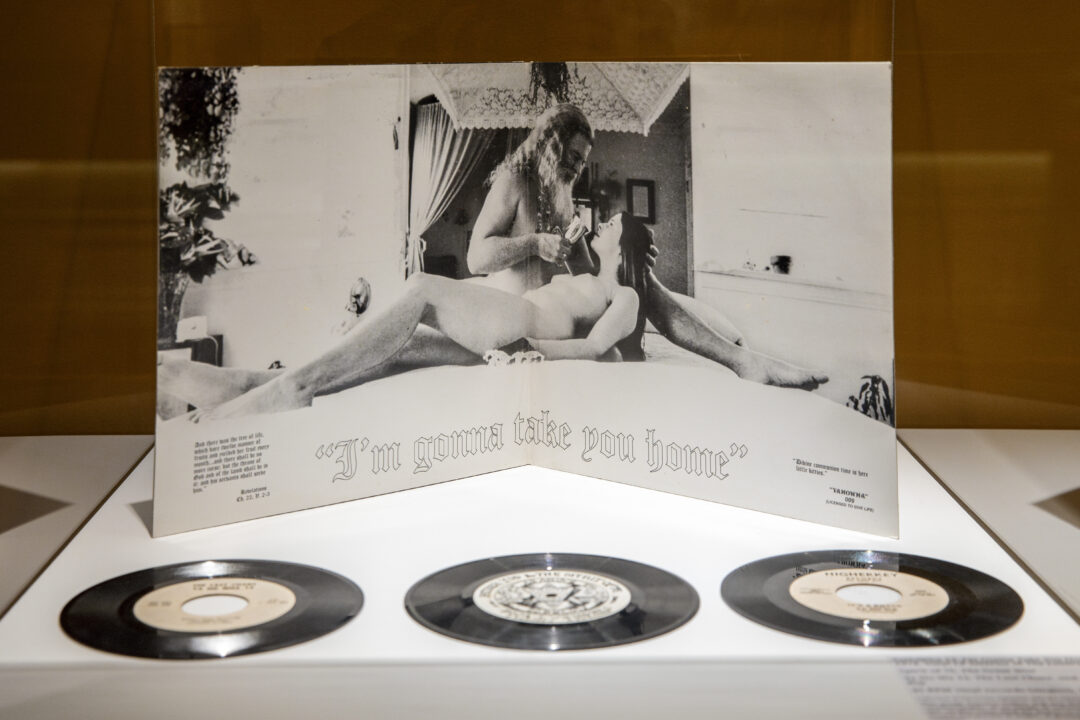
Led by a charismatic guru/rock musician/health food pioneer named Father Yod, the Source Family was an attractive and industrious group in Los Angeles during the late Sixties to the mid Seventies. Yod’s cult, the Source Family, practiced an esoteric Eastern tinged faith prospered by a free-love idea of sexuality. Yod’s persona as the frontman for the experimental rock band Ya Ho Wha 13, a hirsute virile rockstar, is complimented by the harem of California kissed, long-haired, berobed women that lived along with him (and other men) in their Hollywood Hills estate. Along with their music, sexual, and spiritual practices, together they ran a popular and influential Sunset Strip vegetarian restaurant “The Source,” and made hippie-like crafts. These artifacts, including a tarot deck, are on display in the museum. The attractiveness of father Yod’s utopia is as shiny as the gold and silver in the Source Family jewelry on display. The moral panic their free-love bohemian-capitalism produced is also on display in a contemporaneous television broadcast covering the group. The Source Family gave up its cutting-edge Hollywood lifestyle, moving to properties in Hawaii to escape the prying eyes of authorities. Characteristically the community dissolved in 1975 after Yod plummeted to his death in a hang glider accident. The story of Father Yod is like Ann Lee’s, and many of the figures in Wille’s exhibition. They sought a kind of industry at the far end of laissez-faire American independence – developing an American kind of spiritual communal-capitalism, often without or perhaps in reaction to its Calvinism, at times minus the racism or sexism.
I talked with a high volume of museum goers during my Utopia’s visit, as if the Venn diagram of people who are social and people who’d go to the Musuem of Sex collide. We laughed together at the Unarian’s delightful celestial public-access televisual pageants. We awed in wonder at the swinging Kerista’s successful foray into the computer business as Abacus, in the early Nineteen Eighties. The thing about American cults and commune’s is they’re distinct distillations of America itself. I was struck by this at the exhibit. You may code the communities on display at the Sex Musuem as on the left of our politics but you might be mistaken. Some of the groups here followed a political ideology: the Cockette’s Kaliflower Commune likely had an anarcho-pacifist-materialist analysis along with their gender-fuck; Victoria Woodhull was a champion of women’s suffrage along with sexual freedom. But belief and spirituality is the wild free wheel of American society, often superseding the old world’s “enlightened” political theory. This fact drives the occasional “horseshoe” nature of our counterculture. Afterall the Constitution has enshrined the freedom of belief, not a freedom from want.
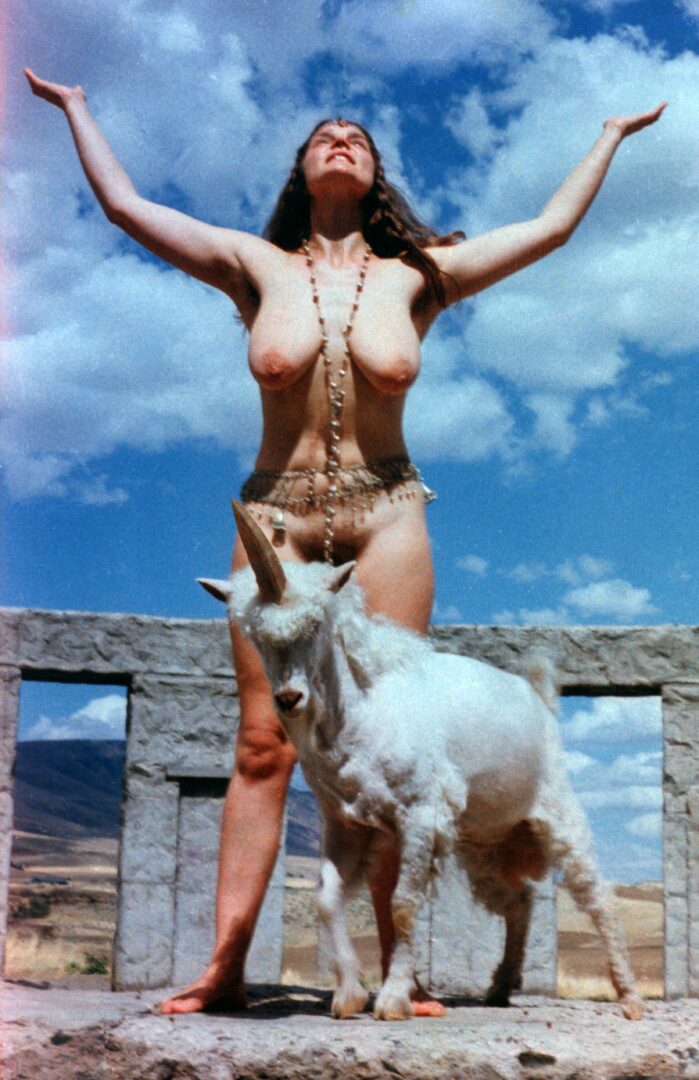
Digital file. Image Courtesy of Oberon Zell
A jarring object on display sat next to a set of wooden prayer beads. It’s a machine sewn patch worn by a member of the Rajneeshee Peace Force. Practitioners of a sacred tantric sexuality, garbed in orange, and followers of the Indian born guru known as OSHO, the Rajneeshee’s lived communally in Eastern Oregon during the early 1980s. Not ascetics, they prospered a materialist faith of earthly fulfillment. OSHO’s influence and spiritual wealth was made evident to his followers through his collection of Rolls Royce automobiles. The Peace Force badge displays a white bird in flight over a blue sky and a golden sun. Not every experiment need ends this way, but the bird’s bright flight masks the accusations of murder and fraud which brought this communal experiment down.
Related articles
Bianca Bondi
by Agnès Violeau
Explorers of the Pluriverse
by Rachael Woodson
Red Herring in the Venetian Lagoon
by Gabriela Anco