Explorers of the Pluriverse
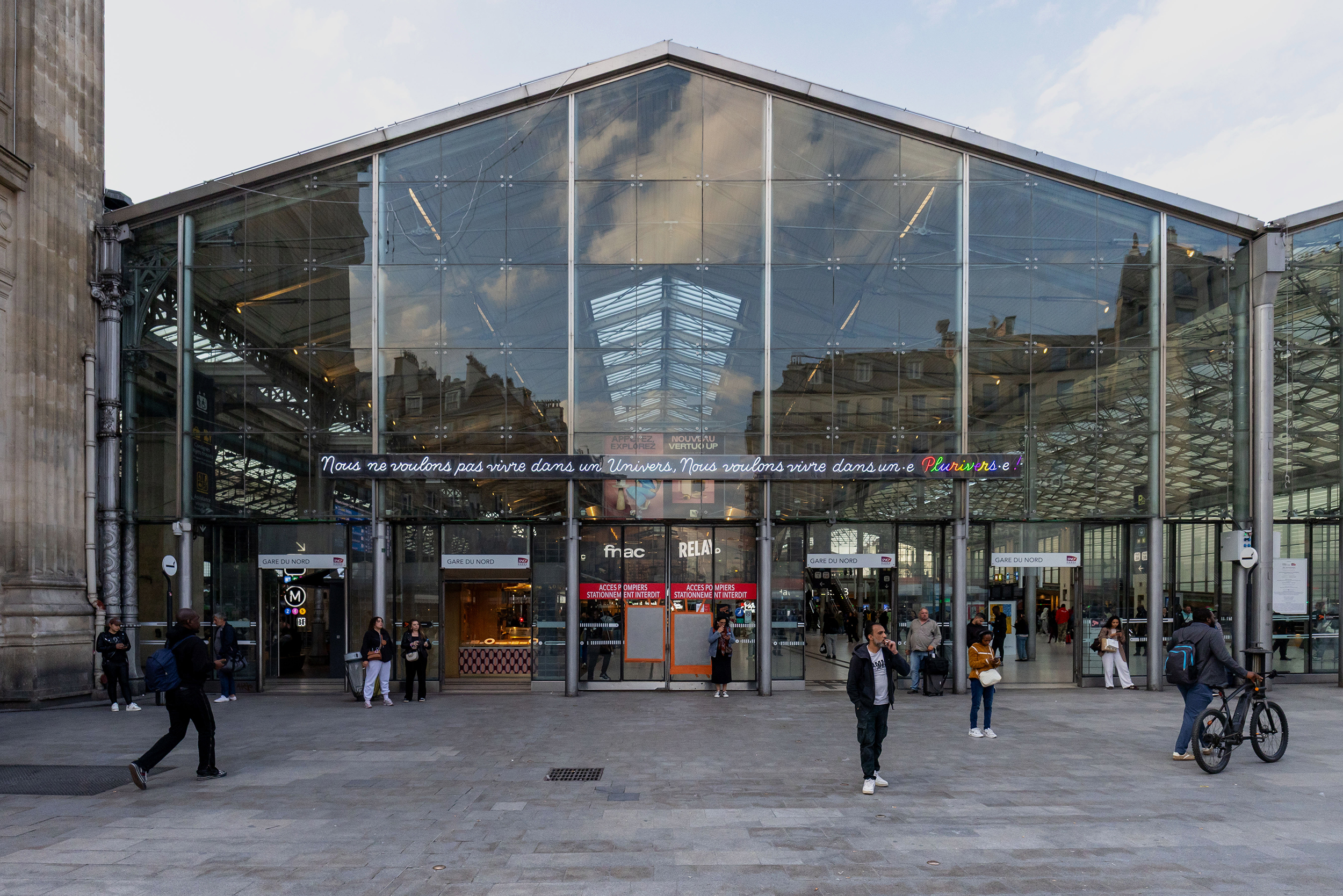
Warren Neidich at the Gare du Nord
Warren Neidich’s public artwork Nous ne voulons pas vivre dans un Univers, Nous voulons vivre dans un·e Plurivers·e ! [We don’t want to live in a Universe, We want to live in a Pluriverse!] was presented at the Gare du Nord in the spring of 2026, bringing with it a new source of light and meaning. Described as Europe’s busiest train station, with an estimated 700,000 people passing through each day, the site is a dense environment of movement and information, where signs, advertisements, commerce, and surveillance systems all overlap. Installed on the glass façade of the station’s eastern hall, the work entered this field of circulation, addressing travellers and passersby.
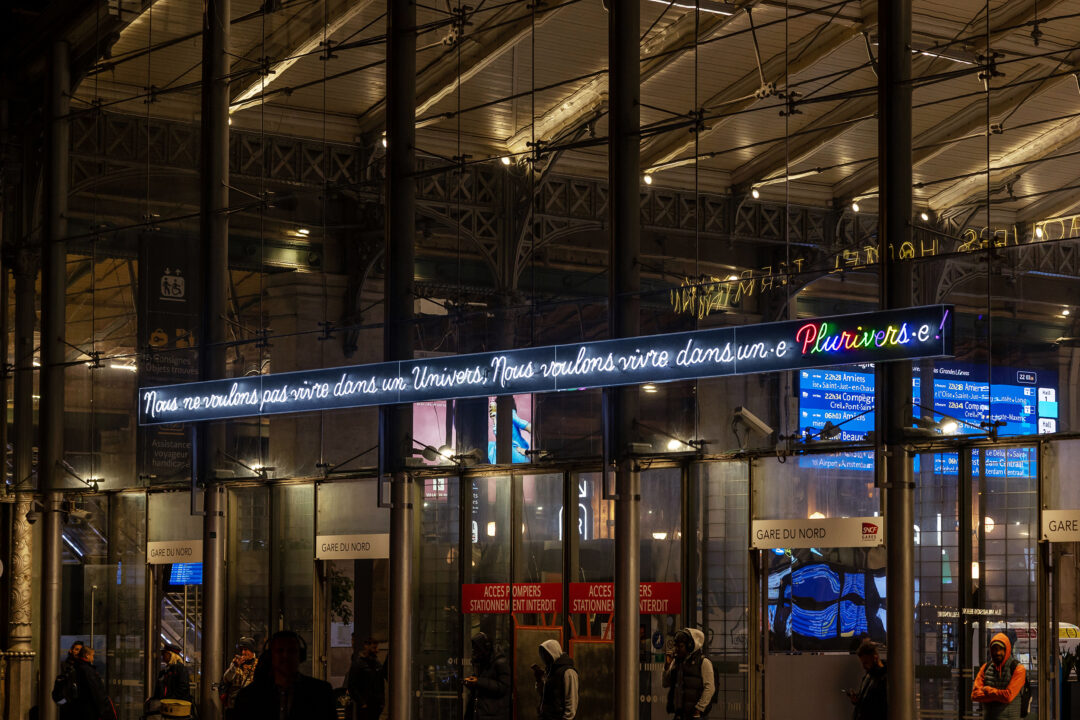
The installation consists of a phrase crafted in neon light, conceived by the artist, presenting a binary structure made up of the universe on one hand and the pluriverse on the other. A comma separates the two, acting as a conceptual break. The words are rendered in white, except the final letters which shift kaleidoscopically from red to green to blue to pink, emphasizing diversity in what might otherwise appear as a uniform statement. The work opens a space where meaning is not singular or resolved, but multiple and exploratory.
This text takes its title from the essay Explorers of the Pluriverse (1), published on the occasion of the 1942 exhibition First Papers of Surrealism in New York which brought together a group of avant-garde artists, some of whom had recently fled Europe. The text looks back to earlier forms of pluriversal thinking through references to 19th century visionaries such as William James and Benjamin Paul Blood. This line of thought was later reactivated in contemporary philosophy through the work of Étienne Souriau, reinterpreted by Bruno Latour (2), who developed the idea of multiple modes of existence and plural ontologies. In recent writing, the pluriverse is understood as a framework for imagining alternative forms of social justice and ecological coexistence grounded in multiple ways of knowing and being (3).
Warren Neidich’s practice can be situated within this trajectory, linking visual art, writing, and neuroscience, and exploring how images and information shape attention and perception. In one of his earliest works, TV Portraits (1985–1988), he examined how viewers process mediated events such as televised footage of the Vietnam War. More recent installations like The Statisticon Neon (2016), an hommage to Joseph Beuys’ work Das Kapital Raum 1970-1977 (1980), and A Proposition for an Alt–Parthenon Marbles Recoded (2023), which combines references to Enlightenment thinking and ancestral knowledge, use light and text to create high-intensity semiotic systems that reflect on contemporary information culture. These works can be understood as a response to cognitive capitalism, in which the brain becomes a site of production and governance (4).
For Neidich, art has a powerful capacity to generate poetic alternatives to systems of control. He refers to this idea as the “brain without organs,” in reference to the “body without organs,” first articulated by Antonin Artaud and later developed by Gilles Deleuze and Félix Guattari. The term suggests a way of understanding the mind as a malleable material that evolves in relation to shifting external environments, while retaining a degree of autonomy from them.
The glass hall of the Gare du Nord that housed the installation can be read as an infrastructural “brain”: a space composed of many interconnected zones shaped by different temporalities. Its transparent architecture exposes continuous exchanges between internal and external flows of communication. This reflects how presence and movement are monitored and controlled, how processes of social inclusion and exclusion are produced, but also how space is appropriated in ways that circumvent a programmed logic (5).
Earlier histories of illuminated public space in Paris create certain parallels with Neidich’s new work. At the Musée Carnavalet, Auguste Roux’s large-scale painting Illumination de l’Hôtel de Ville pour la fête du roi, 1er mai 1847 depicts the Paris town hall lit up at night for a royal celebration, with crowds of onlookers dwarfed by the building’s monumental presence. Painted just before the fall of the July Monarchy, during a period of economic crisis and social unrest, these civic spectacles can be understood as a form of soft power, in which the staging of the city became a way of displaying authority and order.
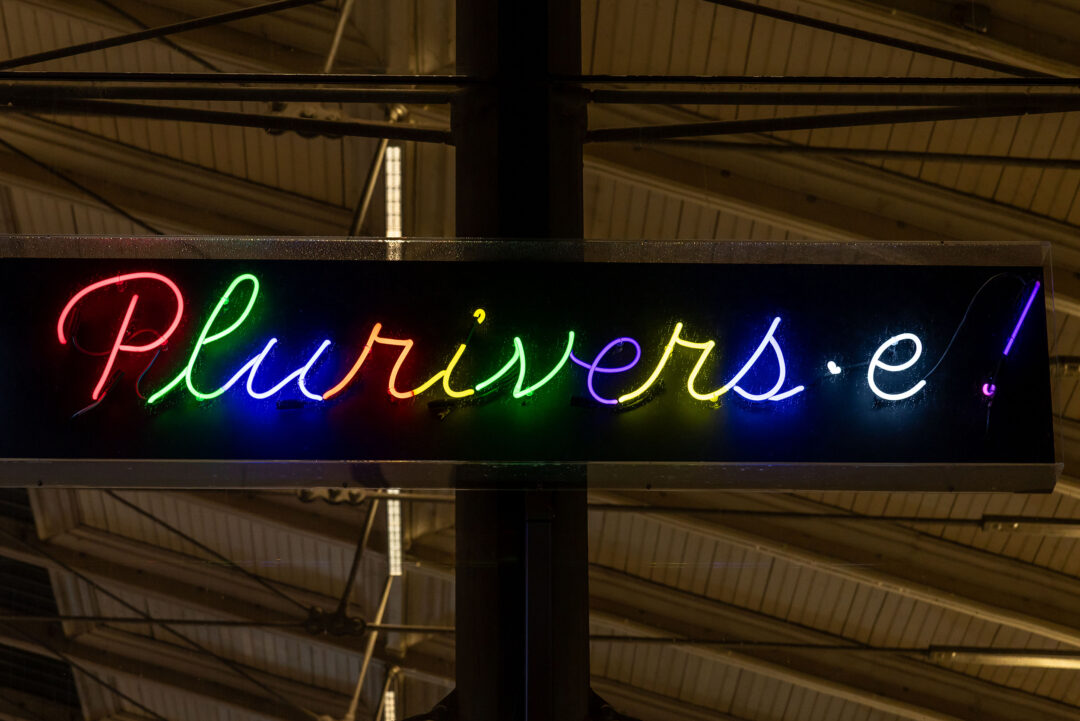
With the installation’s final words – un·e Plurivers·e ! – Neidich introduces a linguistic variation. This modification, inspired by inclusive writing (l’écriture inclusive), reflects the artist’s broader interest in language as something unstable and adaptable rather than regulated. By opening grammatical form, the work resists closure and invites imagination, recalling conceptual traditions in art and literature where text or instructions activate the viewer as participant rather than passive observer. Nous ne voulons pas vivre dans un Univers, Nous voulons vivre dans un·e Plurivers·e ! reactivates histories of language and illumination, rerouting them to engage in an open-ended reflection on divergence and possibility.
——
Nous ne voulons pas vivre dans un Univers, Nous voulons vivre dans un·e Plurivers·e ! was originally presented at the Gare du Nord from May 12 to June 10, 2026, in collaboration with Nuit Blanche 2026 and SNCF Gares & Connexions
1 R. A. Parker, « Explorers of the Pluriverse», 1942.
2 Bruno Latour, « Sur un livre d’Étienne Souriau : Les différents modes d’existence », 2006.
3 Arturo Escobar, Designs for the Pluriverse: Radical Interdependence, Autonomy, and the Making of Worlds, 2018. ; Martin Savransky, Around the Day in Eighty Worlds: Politics of the Pluriverse, 2021.
4 Warren Neidich. “Art in the Age of Cognitive Capitalism.” January 2026.
5 Julie Kleinman, “The Gare du Nord: Parisian Topographies of Exchange.” In Ethnologie française, Vol. 42, 2012/3.
Head image : Warren Neidich, Plurivers·e, Photo © Romain Darnaud