Joana Hadjithomas & Khalil Joreige
MAMCO x SaSA, Genève
5 September – 15 November 2026
Curation : Lionel Bovier
Joana Hadjithomas & Khalil Joreige
In Search of Lost Time
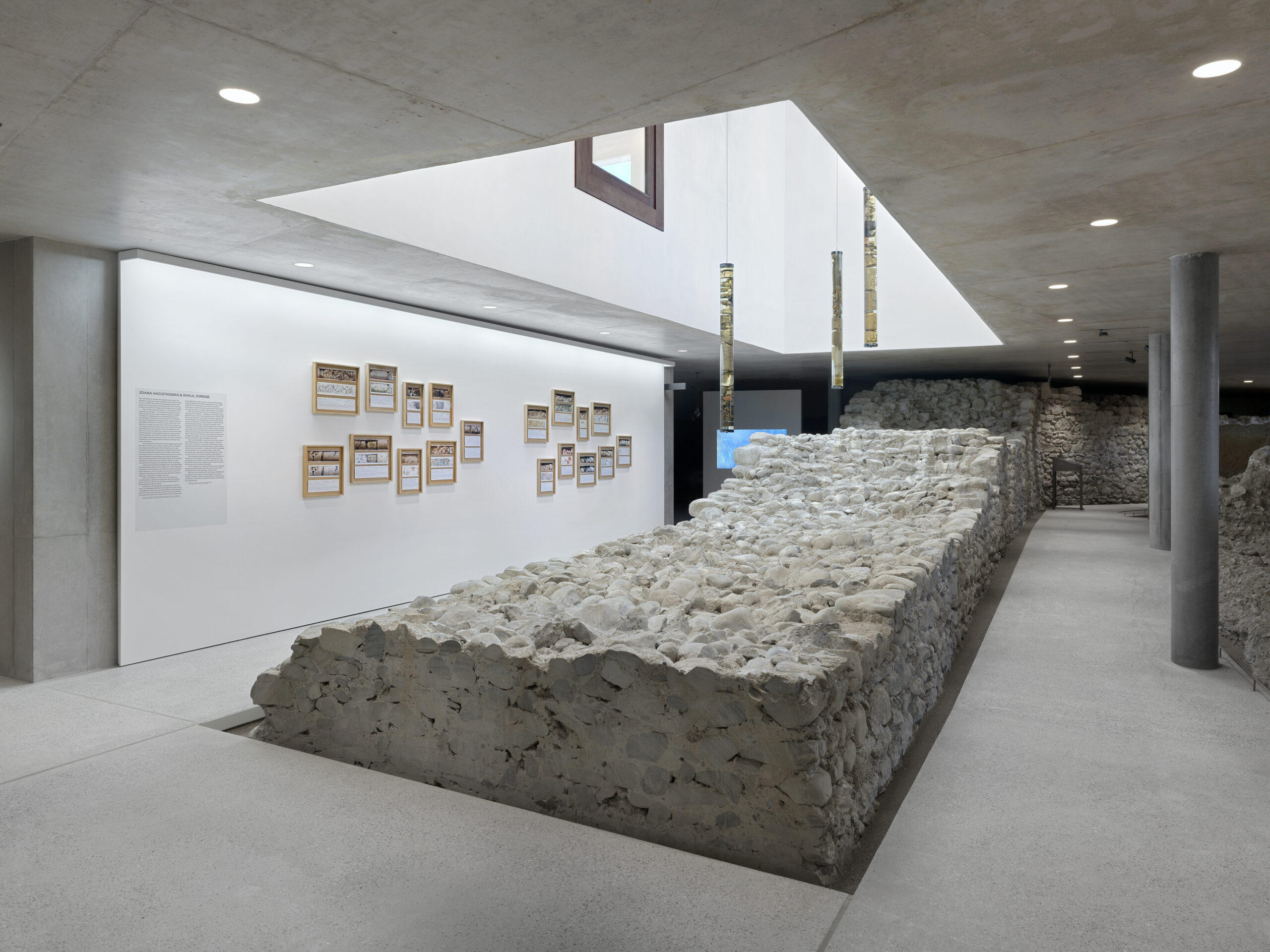
Artist duo Joana Hadjithomas and Khalil Joreige are currently getting situated along the fortification walls of the ruins of Saint-Antoine cemetery as part of a dialogue between MAMCO Geneva and the Saint-Antoine archeological site (SaSA) organised on the occasion of the latter institution’s reopening following fourteen years of closure due to on-site excavation. A state of affairs on the way narratives are formed, the duo’s work is an inquiry into what qualifies as heritage while also giving visibility to the role played by human beings in a world built on extractivist models. The project was conceived as part of MAMCO’s pop-up museum program during renovations. What aspects of history do we choose to focus on? What can archeology tell us—if anything—about the future? Can an artwork carry out actual work in our shared reality?
Paris-based artists Joana Hadjithomas and Khalil Joreige (born in Beirut, 1969) explore memory’s processes and forms of disappearance that link shared narratives. Through the use of traces, archives, first-person accounts and fictions, the duo create a fragile equilibrium between what remains, what is erased, what can be documented and that which resists all forms of representation. Rather than telling a story, the duo’s practice focuses on highlighting lacunae, the silenced or suppressed narratives inherent in a story. The artists work within a Lebanese context—a country that has been severely impacted by war, exile and loss. They address the mechanisms through which memory is constructed, transmitted or recomposed. Rather than representing emptiness, absence becomes an active material. Recent major institutional exhibitions the two have participated in include “Se souvenir de la lumière” (Remembering the Light) at Paris’s Jeu de Paume (2016), “Two Suns in a Sunset” at the United Arab Emirates’ Sharjah Art Foundation and Munich’s Haus der Kunst (also in 2016) as well as “Remembering the Light) at Beirut’s Sursock Museum (2025). Joana Hadjithomas and Khalil Joreige were the recipients of the Marcel Duchamp prize in 2017.
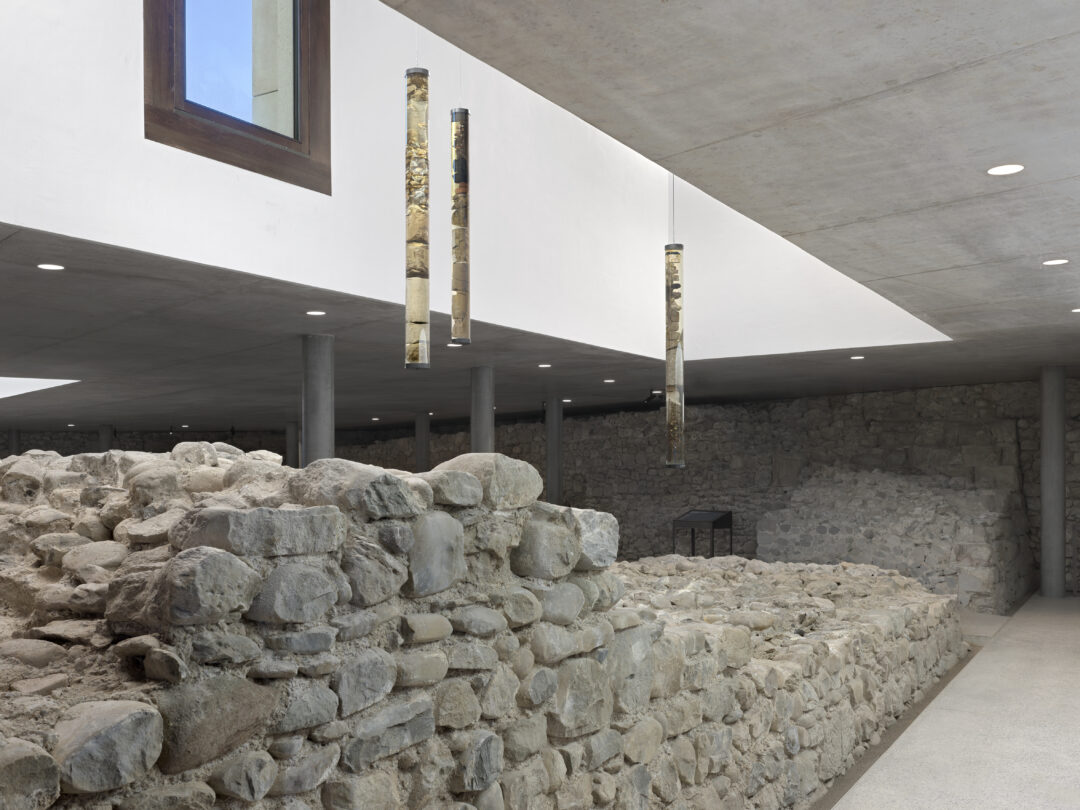
The duo’s approach over the course of nearly thirty years has avoided any sort of continuity, instead relying on a process of layering, interruption, displacement and rupture. One narrative lies beneath another, a catastrophe interrupts a tale, a new construction seals off the one that came before. In Geneva, the artists’ work is being shown on the below-ground level, next to the ruins of the tombs whose contents are currently being studied. Fernand Braudel’s concept of longue durée (long term) is applicable here: it is relevant to displaying, thinking and planning—the opposite of the short term temporality of the event. A sociology of time emerges, revealing different facets and notions of time present within societal groups. Variations on time from different activities and social classes come to light, as well, clashing and converging. The work is exhibited in a fragmentary way, resembling the narratives it unspools. Sediment (in the form of soil samples of the earth beneath our feet) is, therefore, more than just what lies beneath the surface: it is an accretion, that which retains—sometimes without meaning to—the memorial narratives of a site, its invisible realities. Core drilling—the collection of residues during archaeological excavations—becomes an interpretive act.
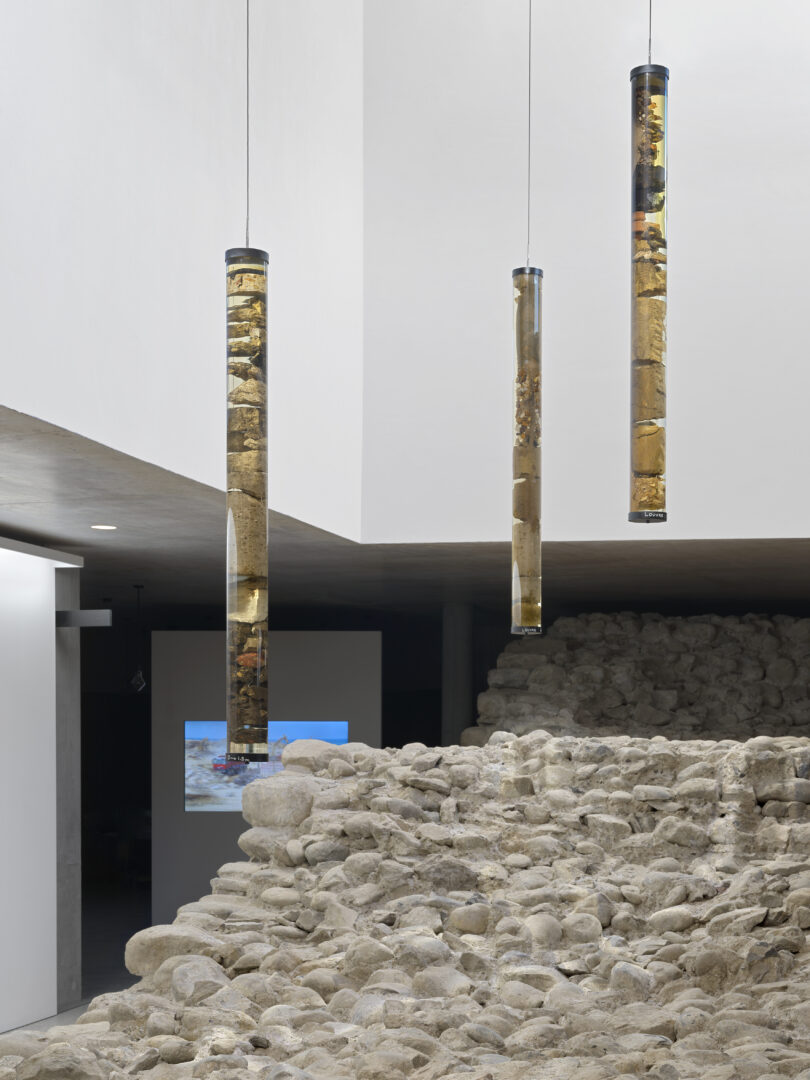
Soil samplings bring forth geological timelines that do not coincide with one another. They are thereby brought up-to-date through current narratives. Residue, on the other hand, is a testament to human and non-human activity and is a waste product as such. The Time Capsules (2026) integrate detritus as a material and function as witnesses of reality by inserting it directly into their physical materiality. Art history is no stranger to notions of the fragmentary and also construction sites. Textual (Ponge, Valéry) and cinematic (Godard) references are present in the duo’s work, as well. Can art provide a response to current day fears and societal pressure—which limit agency—in order to provide a tool kit for humanity?
The duo’s oeuvre gives rise to much more than narratives or mere coexistence. Through these situations, the artists explore the importance of the interconnectedness between people in a collapsing world. According to Unesco’s definition of cultural heritage, the term refers globally to all material wealth, traditions and techniques that possess artistic value and that can be passed on to future generations. Archaeology’s principal raison d’être is to reconstitute the history and customs of past human civilisations based on their vestiges. The fact that the exhibition has been installed in the very centre of a heritage site allows us to read it as a form of palimpsest: the site, whose first century foundations are superposed by a 16th century cemetery; a film about an excavation in Lebanon (the two artist’s country of origin) that is shown adjacent to the ruins; the currently-under-construction MAMCO, whose story plays itself out here.
Long Term Vestiges, Social Sediments
Does so-called ‘social sediment’ (the gradual accumulation of norms, customs, structures and historical memories) not cause an individual’s identity—or a society’s way of functioning—to fossilise? Philosopher Annie Le Brun has mapped out a protocol of servitude, of invisible sedimentation that acts as a scenography of control. For Annie Le Brun, each layer of fossilised customs formed by a social group represents a systemic attempt at imposing a lock-step formation on individual members of that society. Norms thereby represent an opposing force to life (the social sediment framework having led to petrification). In a capitalist system, “too much reality”, converts sediment into overly-processed subculture, a type of background noise that alienates us from our surroundings, with the aim being to numb our critical capacities. The attention given to ruins—the way that we conserve and exhibit them—is a manifestation of our need to make sense of the present. What if that (or those) we consider as rejects are actually active forces? Ruins become an allegory of a society coming undone, despite the care it has been given.
Making Visible
In Joana Hadjithomas & Khalil Joreige’s Time Capsules, the strata of archaeological digs recall social strata that have been reinforced by industrialism and modernity. The parallel does not, however, lead to over-determinism—the artists encourage us to adopt a speculative approach, instead. While the artwork may indeed be carried out through the model of the exhibition, it could also remain sealed off to any attempt at interpretation. Terra (1989), a large, terra cotta sphere imprinted with the hands of Italian artist Claudio Parmiggiani, represents the most radical piece that responds to this. The work—which was briefly exhibited at macLYON—was buried in the ground during a performance in the contemporary art museum’s garden. Andy Warhol’s Time Capsules (1974-1987) contained detritus from the studio (press clippings, letters, super 8 footage…), serving as a first-hand account of the sociocultural context of a bygone era. “Time Capsule 2045”, held in 2020 at Geneva’s musée d’Art et d’Histoire gathered together the work of 17 artists, sealed together in a hermetic container/time capsule. The currently buried works are not slated to see the light again until 2045. Lastly, the European project Sanctuary on the Moon2 plans for a collection of artifacts to be deposited on the moon in 2030. In addition to scientific and archaeological research, a selection of manifestos and artworks from our current era will also be included.
Joana Hadjithomas & Khalil Joreige’s work functions as an archive for the future. By conserving the deposits of an era, the artists are erecting an undergirding for days to come. The present appears to us in all its complexity, discontinuity. “Discordances” (Unconformities) is a geological term which refers to temporal ruptures, natural disasters or geological movements. Both artworks and archaeological digs interpret and reveal while human beings destroy. For Sarcophages aux amours ivres (Sarcophagi for Drunken Love, 2024), the artists chose the National Museum of Beirut as the location for the film, capturing the frequent electrical outages the museum was subject to due to the country’s conflict with Israel.The museum allows visitors to tour the galleries illuminated only by cell phone torch. The film makes evident the consequences of a not-so-proud modernity.
What Makes Heritage
The artists have fortuitously been invited to collaborate with archaeologists seeking to develop public outreach programs for their work, which cannot always be made public. The film Palimpsests (2017), for example, shows an excavation from behind-the-scenes—depicting everything from insignificant events to the most momentous ones. The art object has an impact on the reality in which it takes part. The artists’ process varies from one project to another (Notre-Dame to the current edition of the Venice Biennale, Beirut to the Marcel-Duchamp prize in 2017…). The residue is generally collected in the form of previously obtained core samples. The samples are mounted in a resin that transforms them into a geological, archaeological, but also fictional object. In a future film project, the duo plans to transpose the same technique to the moving image.
While Hadjithomas & Joreige’s approach may involve unearthing things, this should not be confused with searching for what has been lost. Rather, it is a way of accepting the fact that all traces are always already matter in a state of becoming—to be completed by the viewer. It is an opportunity for new meaning to be created. By riffing on the signs produced by the fossils, the work survives by way of the exhibition, a new situation which is more of a site of orientation rather than representation.
A Living Site
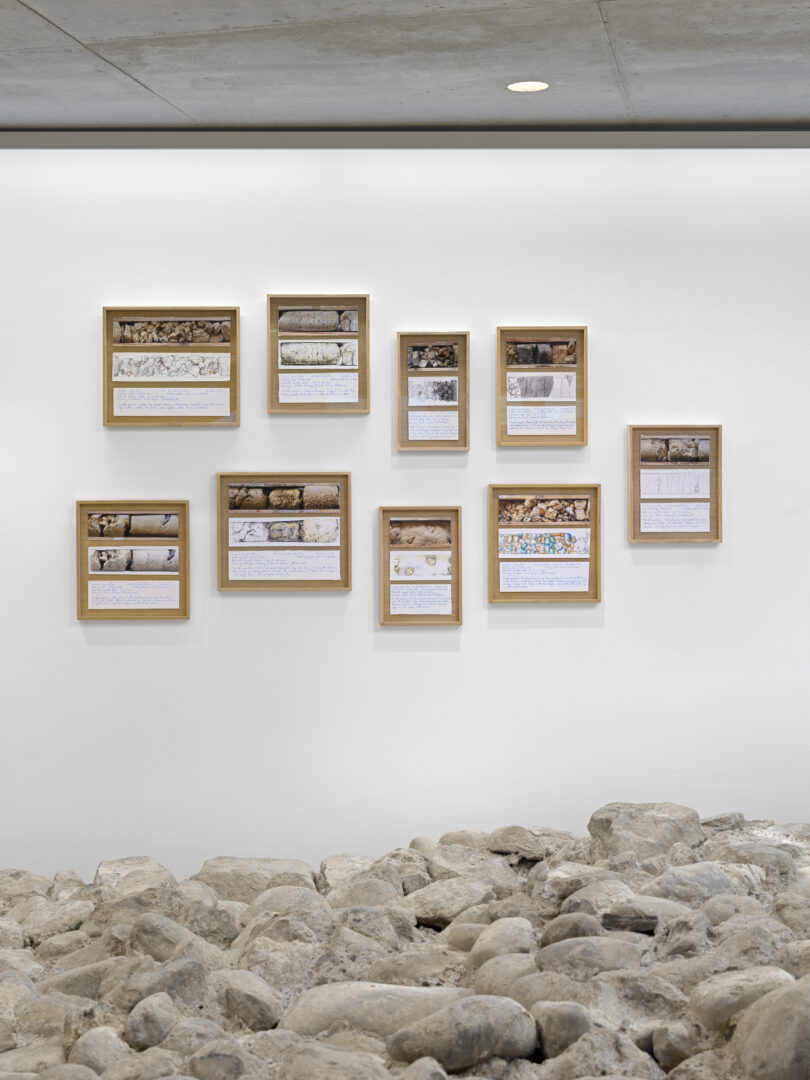
The worlds uncovered by the archaeological digs are the starting point for the drawings, capsules and films on view in Geneva. The adjacent cemetery ruins which are still being pored over remind us of the brief nature of human existence. As we know, periods of crisis are always fertile ground for artistic creation; the same can be said for major transformations. To turn to the body for succor is to consider modes of exhibition (and by extension, social spaces) as a living organism, a site for living rather than for contemplation.
Nature serves as a model for memory and for phenomenal space to bloom. Heritage, of course, has a role to play in the cohesion between inhabitants and local cultures. While the exhibition does address issues of locale, it primarily concerns itself with notions of forming shared habitats, for the duration of this coexistence. The work of art and heritage are material means through which that which would otherwise be lost. The material aspect of the works give us access to their immaterial properties—intentional (their signification) and axiological (their values).3
The Economy of the Fragment
One of the cardinal points of the postmodern sensibility resides in a fascination with fractals, a sudden enthusiasm for discontinuous mental states which are more sensitive to upheaval. Hadjithomas & Joreige engage different topographical systems in order to convert fragments into vectors of destruction for the narrative duration. The residue used for the capsules take stock of a century of everything nuclear: reading becomes discontinuous, films are chopped into short sequences, relationships are fragmentary, social media provides us with montages, signs are manipulated using AI, guiding us toward a post-literate era. Our attention is distracted by multitasking. The media theorist Marshall McLuhan once warned of an upcoming dehumanised future—even a decivilized one—as evidenced by the destruction of books in the United States and the erasure of history.
By questioning the way narratives are formed along with what remains hidden, Joana Hadjithomas & Khalil Joreige unfurl matter and space as if unfurling history. Their body of work bears witness to the vastness of humanity, which cannot be reduced to data sets.
- The traveling exhibition « Time Capsule 2045 » was established in 2020 by Art by Translation and Lab’Bel, in conjunction with l’École des Beaux-Arts de Paris [https://www.lab-bel.com/exhibition/time-capsule-2045/].
- sanctuaryonthemoon.com
- Roger Pouivet, « Pourquoi conserver les œuvres d’art et le patrimoine ? », in Nouvelle Revue d’esthétique, PUF, vol. 1, no 21, 2018, p. 109-119
- Share: ,
- By the same author: Francisco Tropa, Larissa Fassler, Carole Douillard, Chantal Akerman,
Related articles
Hisae Ikenaga
by Clémentine Davin
Marie-Claire Messouma Manlanbien
by Camille Velluet
Francisco Tropa
by Agnès Violeau