Hisae Ikenaga
Anatomies of Use
KIOSK, Ghent
4 April – 7 July 2026
In the spring, KIOSK presented ‘Anatomies of Use’ by Hisae Ikenaga (b. 1977, Mexico City; lives and works in Luxembourg), a previously unseen collection of ceramic sculptures and a new video work, conceived specifically for the venue and in dialogue with it. Following the retrospective exhibition dedicated to her at the Konschthal1 (Esch, Luxembourg) in 2024, ‘Anatomies of Use’ focuses on the sculptural dimension of this Mexican artist of Japanese origin’s practice, building on her research since the 2000s into the question of the uses and transformation of objects.
Located at the heart of the KASK & Conservatorium campus in Ghent, KIOSK maintains a close relationship with the surrounding student community. This proximity forms one of the starting points for the collaboration between the artist and this unique exhibition space within the Belgian cultural landscape, which, before becoming a venue dedicated to art education, was a clinical and polyclinic institute. Designed at the end of the 19th century by the architect Louis Cloquet (1849–1920), the architectural complex housed, among other things, two anatomical theatres intended for the teaching of medicine. One of them disappeared during the site’s conversion some fifteen years ago – giving rise to the current exhibition space – whilst the other remains in its original configuration. The preserved anatomical theatre has a layout almost identical to that of KIOSK, featuring the same circular arrangement with numerous points of light entry. This architectural kinship produces a striking mise en abîme effect in Ikenaga’s practice, where the building’s past acts as an additional layer, a backdrop that informs the entire project. Without necessarily knowing the history of the site, the public perceives the diffuse presence of a phantom architecture that seems to surface beneath the exhibition space.
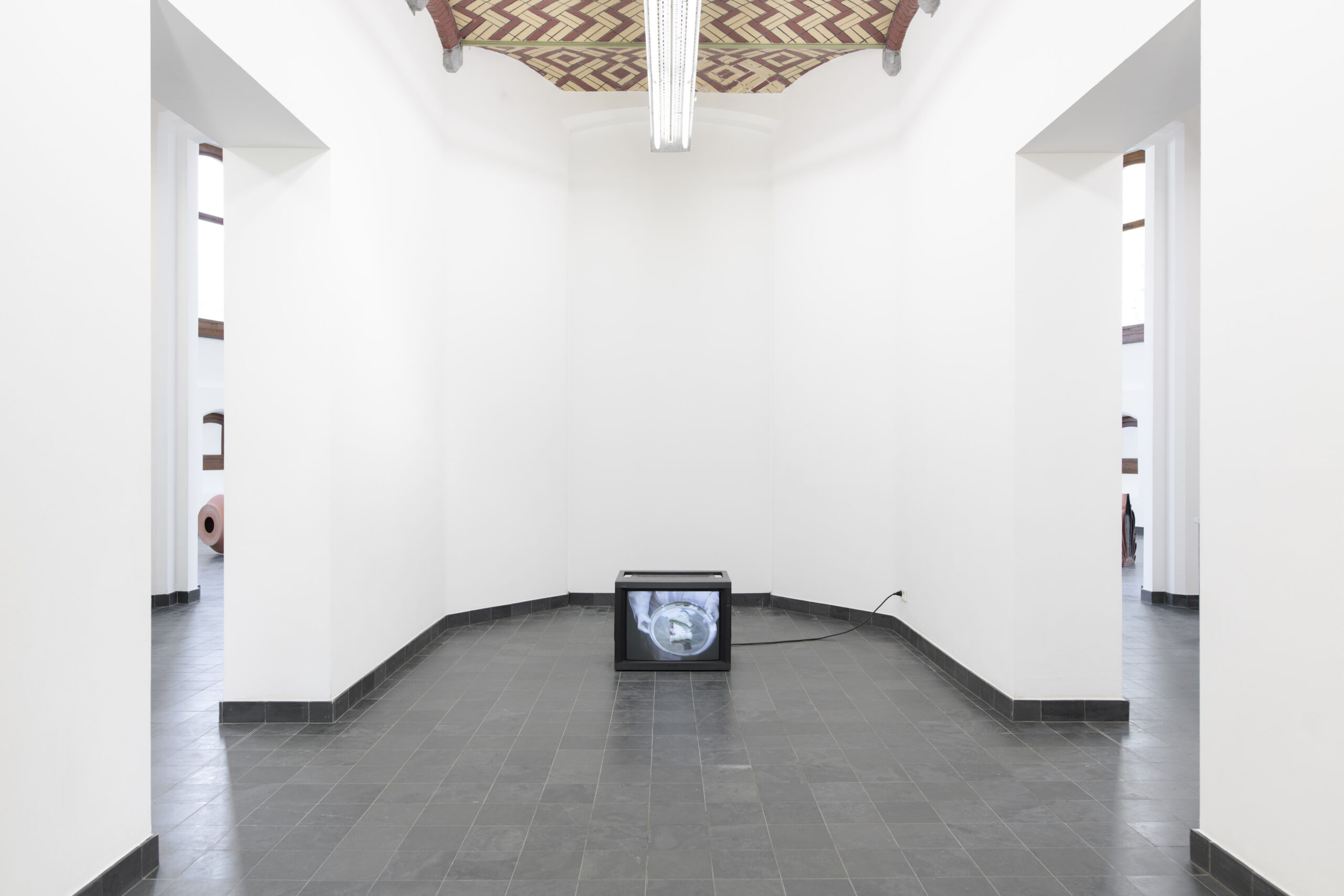
Upon entering, the film Soft Dissection, produced in collaboration with filmmaker Paula Onet, introduces this reflection. Shown on a loop on a CRT screen placed directly on the floor, it depicts a group of students carefully dissecting and observing various unidentified specimens. Inspired by the history of the natural sciences and by the practices of observational drawing that preceded the widespread use of photography, Ikenaga imagines a form of speculative dissection that takes place in the very spot where medical students once observed anatomical dissections. The film has its origins in a series of extruded forms created by the artist, which struck him as strangely organic. From this arose the idea of creating new bodies, intended to be manipulated by KASK students. Translated onto screen in a relatively ritualised manner, the gestures of this silent assembly oscillate between scientific protocol, performance and academic exercise, ultimately resulting in the production of observational sketches that are carefully stored in a kiln. This unexpected gesture is disconcerting: it is no longer the sculptures but their drawn representations that become the objects to be preserved, like witnesses to an operation whose very purpose remains ambiguous.
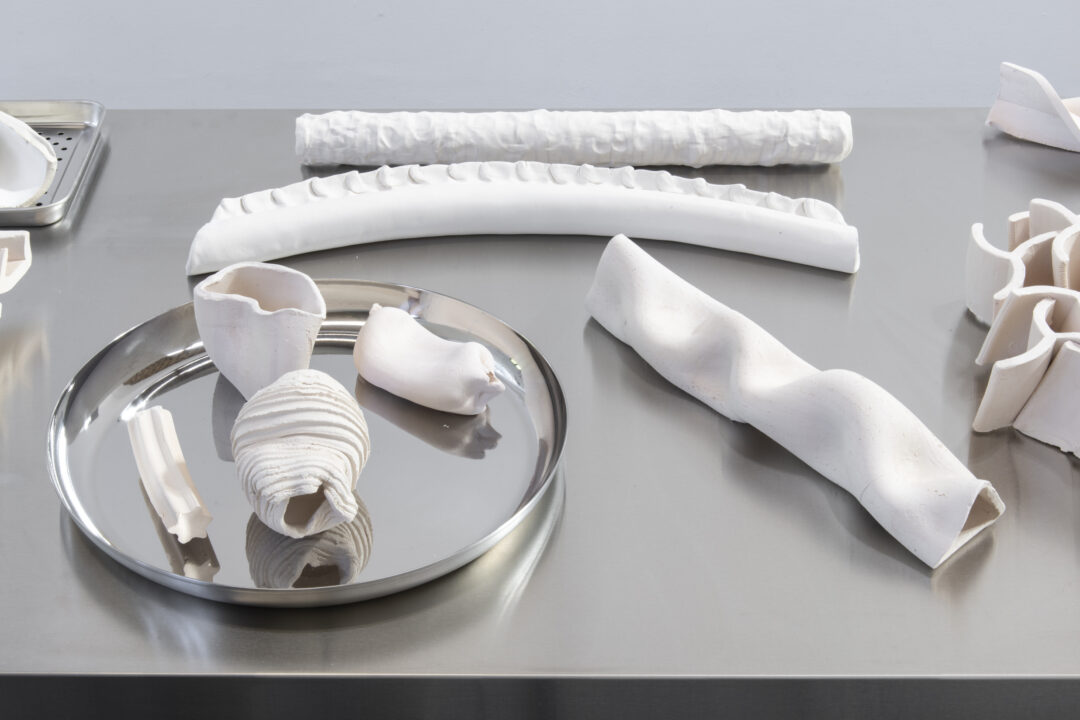
This reflection on the body and fragmentation continues with the series entitled Restes morcelés, initiated in 2024. On two long metal tables reminiscent of those typically found in laboratories or catering establishments, positioned on either side of the corridor—whichever direction one takes—are arranged various flesh-coloured ceramics that defy reduction to a single interpretation. The tubular and sinuous forms are reminiscent of organs or viscera, and their presence emphasises the resolutely tactile dimension of Ikenaga’s practice. Each element appears to belong to a structure of which only certain parts remain, on which one can discern, in places, traces of modelling, areas of pressure and cracks caused by the folds in the clay.
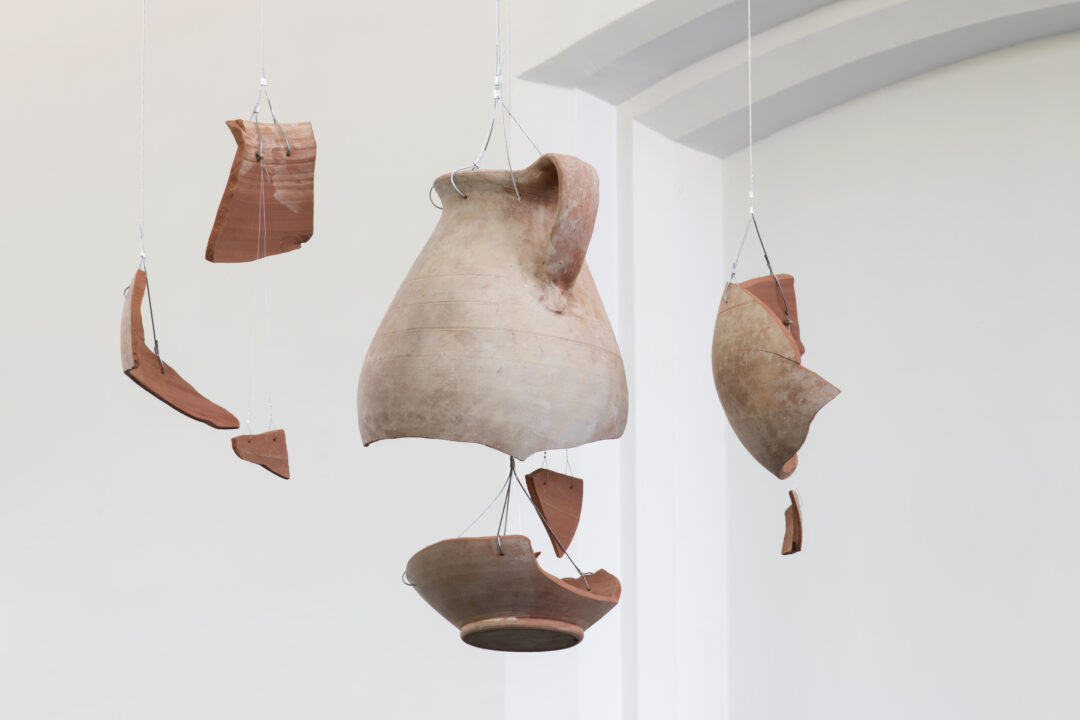
The exhibition continues in the rotunda, where several groups of works create a veritable drama of the object. On the floor, three imposing glazed ceramics, sectioned in the centre and nested like Russian dolls (Black Artichoke), evoking at once the cross-sections of vases or bulbous vegetables, face three semblances of mechanical parts (Industrial Ruins), stripped of their function. Incomplete, these frozen forms maintain an ambiguous relationship with the architecture surrounding them; a feeling reinforced by the suspended installation, Hanging Archaeological Manufacturing, which, at first glance, appears as an impressive constellation of ancient pottery shards gathered within a mobile structure whose movement seems to have been interrupted. On closer inspection, one notices that certain surfaces reveal traces of recent manufacture. Somewhere between relic, artefact and prototype, the objects thus seem to contain multiple temporalities. In doing so, the artist shifts our systems of recognition and places us in a state of permanent uncertainty where past, present and future merge.
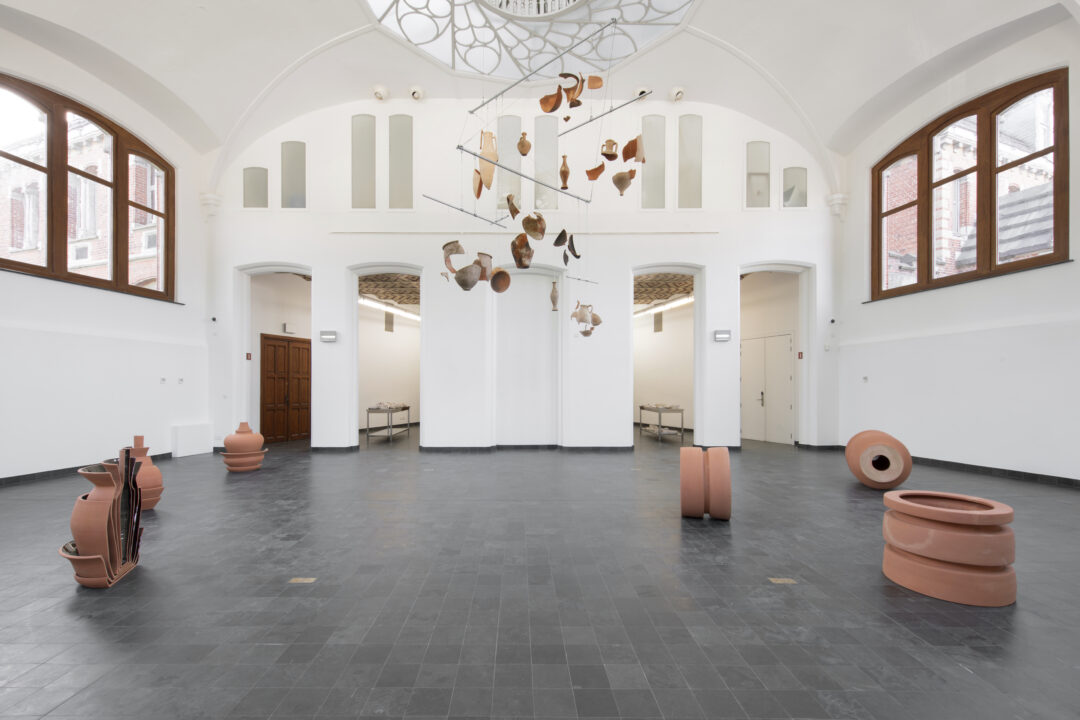
The strength of this exhibition lies above all in its circularity, which mirrors the very logic of the artist’s project, founded on shifts, correspondences and transformations. Ikenaga’s works resonate fully with the architecture and history of KIOSK, whilst the building’s acoustic atmosphere – due in part to the rhythm of life at the university – blends seamlessly into the visitor experience.
1. https://www.konschthal.lu/fr/expos/hisae-ikenaga-phantom-limbs
Head image : Soft Dissection, exhibition view © Isabelle Arthuis-
Related articles
Joana Hadjithomas & Khalil Joreige
by Agnès Violeau
Marie-Claire Messouma Manlanbien
by Camille Velluet
Francisco Tropa
by Agnès Violeau