Daniel Dewar & Grégory Gicquel
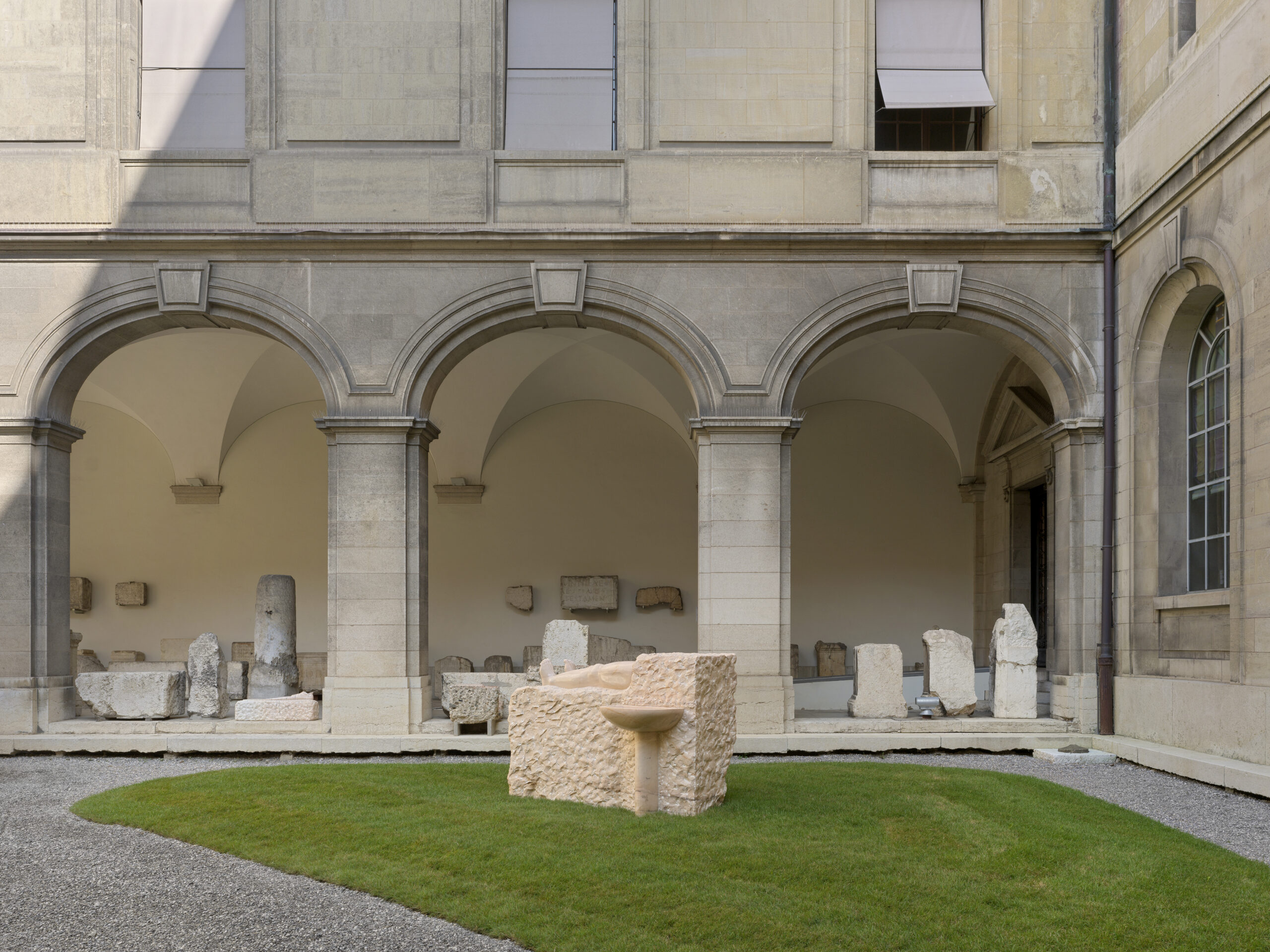
Daniel Dewar & Grégory Gicquel, *La Chair et le Siphon*, as part of the PlasMAH art and architecture programme, Museum of Art and History, Geneva
Resembling a cloister, with its lawn, fountain and galleries, the square inner courtyard of the Geneva Museum of Art and History (MAH) houses the institution’s collection of stone carvings as well as the terrace of its restaurant. Prehistory and history coexist here with the contemporary leisure of deckchairs featuring Hodler prints. This charming enclave, suspended between eras, where everything seems to hover close to the ground and a sense of languor, harmonises perfectly with the seven Rosa Aurora marble sculptures by the Franco-British duo Daniel Dewar & Grégory Gicquel, whose overflowing flesh appears to flow into the grass. ‘La Chair et le Siphon’ is precisely the title of this ‘intervention’ – as the MAH calls it – which comprises five works dating from 2017 to 2022 and two new commissions produced especially for the occasion.
Geneva residents will recognise variations on works seen at the 2020 Sculpture Garden open-air biennial. There, Dewar & Gicquel exhibited a diver’s fin with a silky surface emerging from a hammered plinth, the legs of a recumbent figure, and a washbasin trapped within a block of stone. The new sculptures, each weighing several tonnes, straddle the line between decorative slip-cast compositions and Rodin-style non finito works, creating geological or coral-like landscapes of striking morbid sensuality. Undulating concretions resembling breasts are crowned with large snail shells, whilst a garden tap seems capable of extracting fluids from this flesh, whose hues range from cream to salmon or sandy pink, and which is streaked with black veins. Far removed from the tranquil grandeur extolled by Winckelmann, the duo explores a more convulsive relationship with matter and sensation, situated between birth and petrification, shaped by consumer society, at the crossroads of the Baroque and Surrealism.
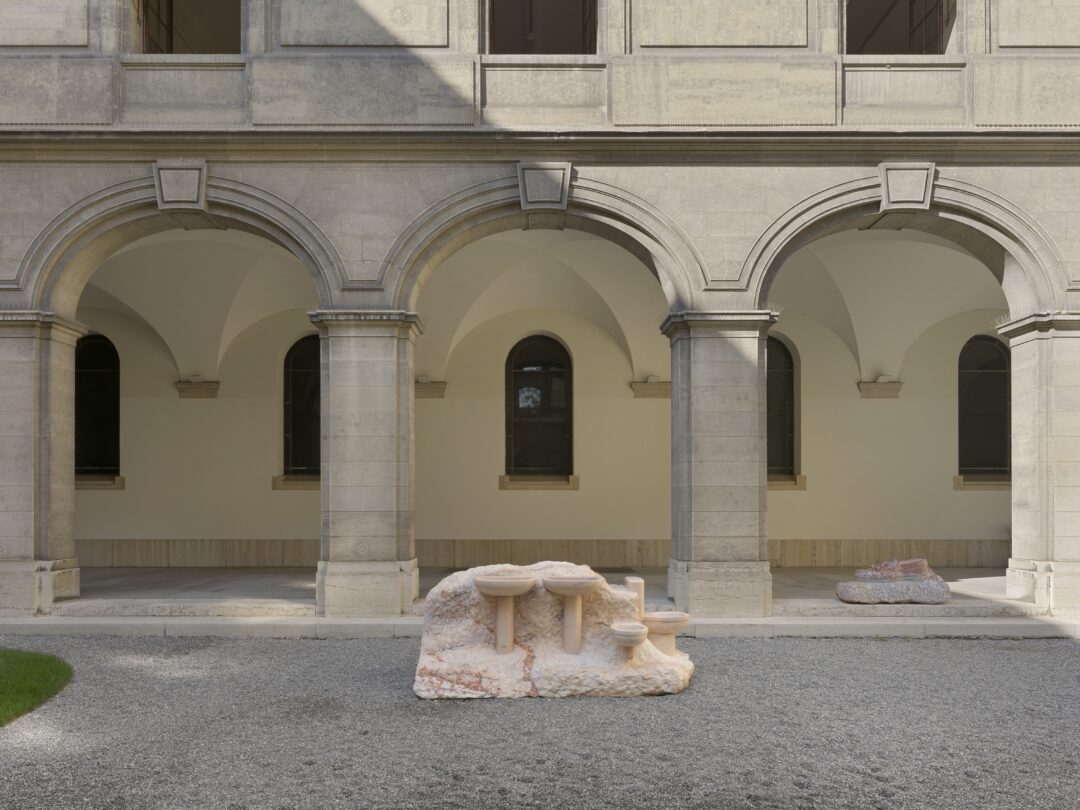
Daniel Dewar (1976), Grégory Gicquel (1975), Nudes no 7, 2017. Marbre Rosa Aurora, 120 × 270 × 129 cm. © MAH. Photo : Annik Wetter
Through their recurring use of traditional craft techniques – woodcarving, embroidery, silk painting, etc. – Dewar & Gicquel have, for two decades, positioned themselves at odds with the technological world, from which they extract artefacts to restore them to the realm of human labour. This process of de-alienation takes on a metaphysical dimension in their treatment of marble, a material so traditional and inert. In this mutable and carnal minerality, one recognises the Aristotelian idea of ‘matter in potential’ from which all things emerge. But it is also the creative act itself that is called into question. Faced with the avalanche of surreal, artificially generated images produced by the demiurge MidJourney, the duo adopt the stance of humble artisan-gods, whilst celebrating the autopoietic power of matter. The morphogenesis of molluscs’ helical structures embodies this intersection. This mineral tissue, already almost fossilised, yet still growing thanks to the action of a soft tissue that produces it in layers of secretions, seems to generate and sustain itself within the sculptural system through the multiple nourishing breasts and the careful maintenance of sanitary fixtures: washbasins, toilets and bidets, which recur from one work to the next.
The seven sculptures stand alongside another megalith in the courtyard, known as the ‘Pierre-aux-Dames’, the forerunner of the museum’s lapidary collection, dating from 4,500 years before our era. One face of this menhir, excavated from a burial mound in the Geneva countryside, bears four female figures. According to archaeologists, the figures are thought to represent Celtic deities associated with fertility. The stone can thus be interpreted as a cradle and a place where life is inscribed, constantly renewing itself in a profusion of forms.
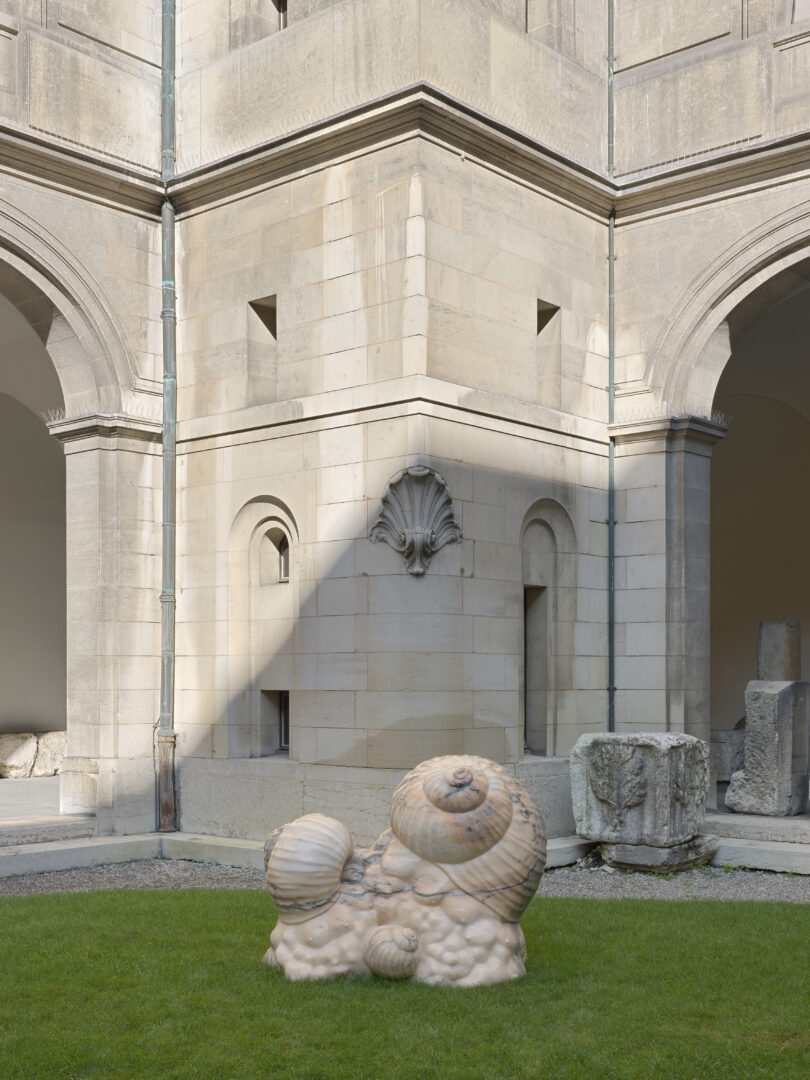
Daniel Dewar (1976), Grégory Gicquel (1975), Marble sculpture with snails, taps and body fragments, 2026.
Marbre Rosa Aurora, 300 × 150 × 100 cm. © MAH. Photo : Annik Wetter
head image : Head image : Vue de la cour carrée. © MAH. Photos : Annik Wetter
- Share: ,
- By the same author: Everything Must Change,
Related articles
The Swiss model – miracle or plan?
by Gabriela Anco
Everything Must Change
by Patrice Joly
Sarah Benslimane
by Gabriela Anco