Sarah Benslimane
It seems as if Sarah Benslimane advances through her artistic career in giant steps. A product of her time, her development manifests at the same velocity as the latest technological advancement. Her works in 2025 feel like an upgraded version of 2024, which were themselves an upgrade from 2023. We could trace this back further, but not for long—her master’s degree dates only to 2023 and her first solo show to 2022. What is impressive is not only the speed of this progression, but also her ability to skilfully refine both discourse and technique. In a world where attention spans shrink to seconds, this artist manages to simultaneously adopt and confront the rules.
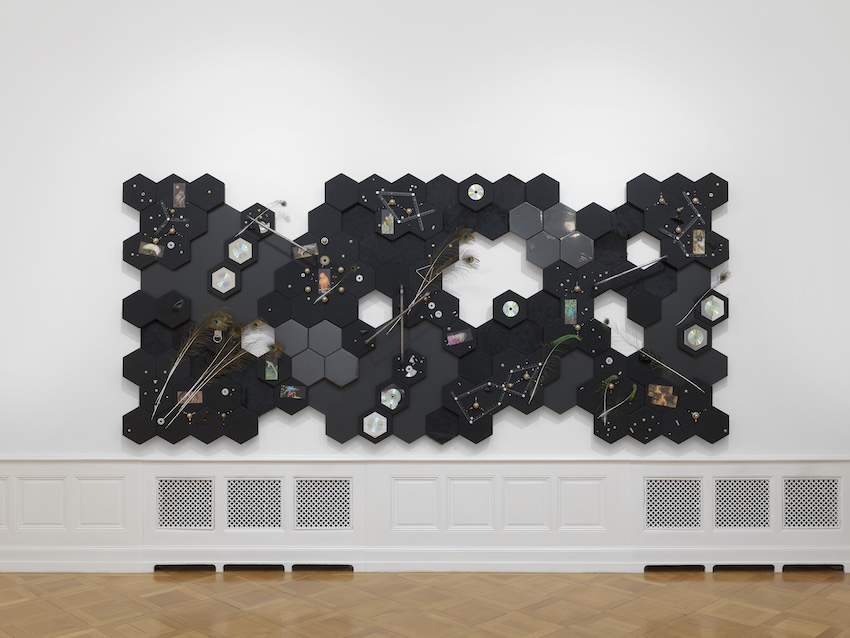
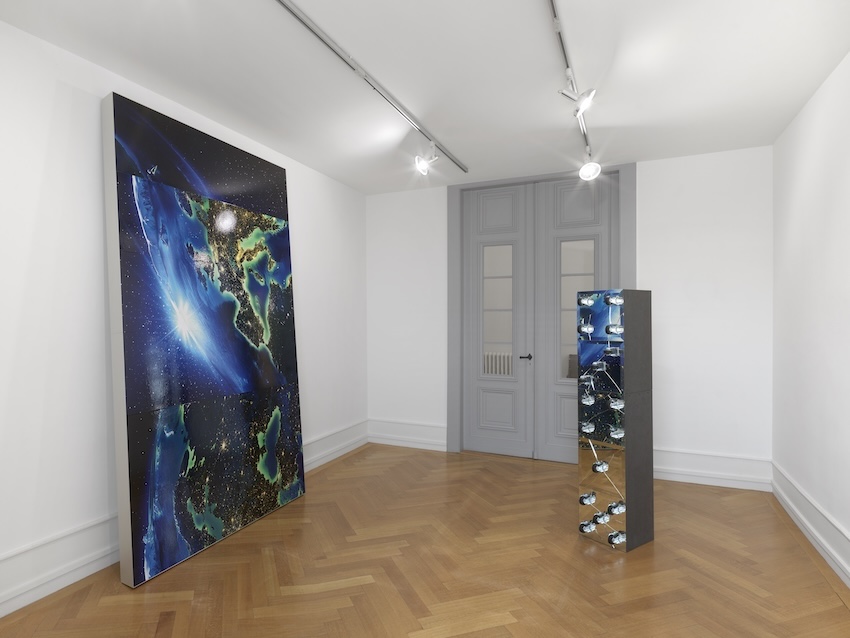
In the last two years, Sarah Benslimane’s work has undergone a visible shift. This transformation became particularly apparent in the exhibition organized by MAMCO in collaboration with the Société des Arts de Genève at the Palais de l’Athénée, following Benslimane’s receipt of the Manor Cultural Prize 2025. The playful pink and baby-blue backgrounds once arranged in cartoonish shapes and covered in beads and stickers have gradually given way to broken glass, mirrors, nails, and reproductions of apocalyptic cosmic views. The transition, however, was less abrupt than it might appear. Benslimane insists that the substance of her work has not so much changed as clarified.
To grow up is chronological. To grow artist is methodological. It requires a progressive elucidation of gesture and a ruthless editing of one’s own vocabulary.
When I asked whether the disappearance of overt play corresponded to growing up, Benslimane resisted the biographical shortcut. The shift, she insists, is not about age but about precision of material—about identifying what in the work is essential and using it, sometimes to an obsessive degree, eventually letting it go.
In fact, Sarah’s use of materials resembles a love affair: the encounter, the obsession, the abandonment, the memory. The examples are many—blue glass tiles, the brick motif, fake ivy, dice, caster wheels, climbing elements, and lately, mirrors.
In fact, it is striking how central the mirror has become in Benslimane’s recent work. Even though reflective materials—adhesive mirrored paper, shiny mosaic—were already present earlier, the mirror now takes an explicit, utilitarian role. It is also, in a way, a counterintuitive material for an artist working within a minimalist framework, although Sarah Benslimane’s relationship with minimalism deserves a deeper dive, which we will return to later.
Formally, the mirror is minimal: flat, often square, serial, yet conceptually, it becomes unstable. Its content cannot be fixed. One can control its dimensions but never what it reflects. In this sense, Benslimane’s practice intersects less with the likes of Donald Judd and Carl Andre who preferred opaque and firm materials, and more with the phenomenological concerns articulated by Robert Morris—the object remains stable while the viewer’s position generates variability.
For Benslimane, the mirror is soft and hard simultaneously. Soft because it is seductive, shiny, immediately attractive. It promises recognition. Hard because it cuts, cracks, confronts. This opposition lies at the core of her artistic production; materials and elements are organized around this deliberate division—metaphorical in one sense, practical in another. The work first lures, then destabilizes.
In Les mains en l’air (2025), presented at Galerie Francesca Pia in Zurich, twenty-four mirror squares form a strict grid. Public-transport handrails protrude from the sides and on the surface; fragments of cracked mirror are screwed onto the surface; letters and adhesive elements punctuate the reflective field. From a distance, the piece reads as coherent geometry. At close range, it becomes precarious. The title—Hands Up—operates in two registers: festive calls for unity and forced surrender. And yet, to raise one’s hands would imply releasing the rails and… fall? The illusion of security collapses in the dreadful confrontation with unexpected explosions of shattered mirrors. Little glass—or perhaps plastic—beaded chains hold deep red pendulums pointing downward like arrows, or more plausibly, drops of blood. This work takes upon it the translation of the fear of a generation that has been facing deadly outcomes in celebratory settings. The mirror multiplies the spectator, while the cracks fracture the promise of stability.
Originally, the breakage is not theatrical or instrumental, rather consequential. Benslimane does not smash mirrors for effect, instead she stacks and screws them in the process of layering the work. Mostly, the material resists under pressure, but sometimes cracks emerge. They are the by-products of the creative act, and the artist insist they be visible. The fracture is evidence of force applied—proof of a true gesture, the trace of the artist.
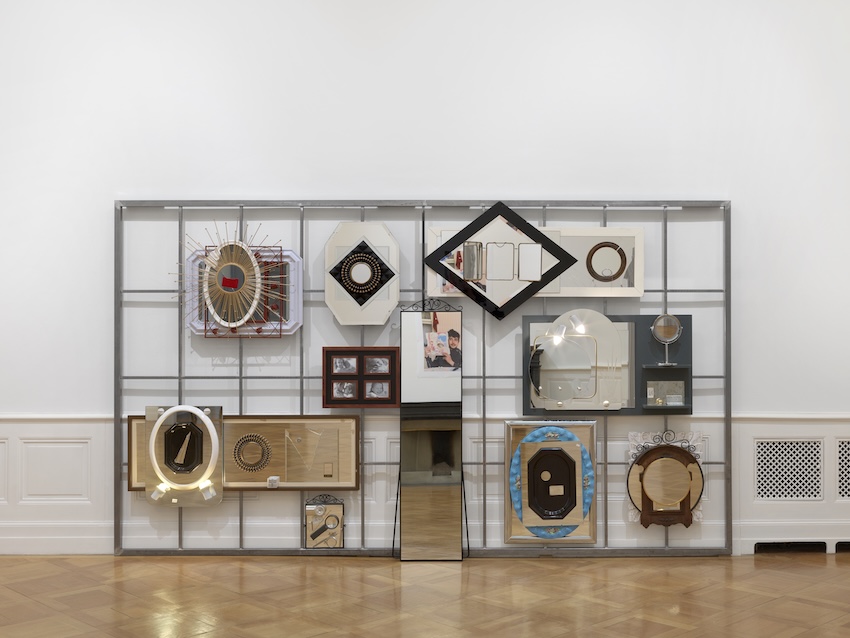
Ça vous regarde (2025), exhibited at the Palais de l’Athénée extends this logic architecturally. Mirrors of varying formats—selected as much for their frames as for their reflective surfaces—are stacked in clusters and mounted onto a large steel grid. One frame contains not a mirror but a stock image of an idealized family. The ambiguity of the French title—“it concerns you” / “it is looking at you”—is operational. The grid functions as a matrix of eyes. The viewer is both surveilled and implicated.
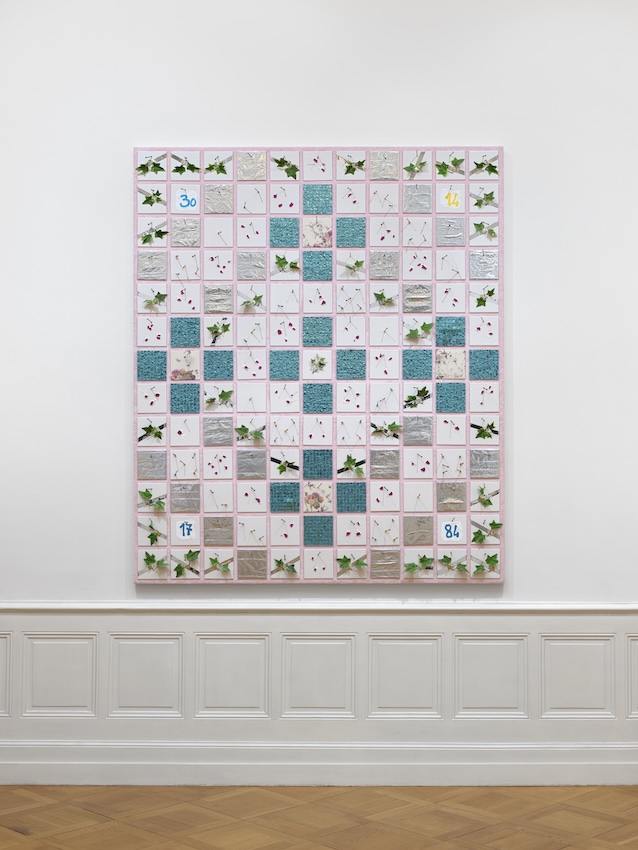
In La panthère des neiges (2025), equally part of the MAMCO and Société des Arts de Genève show, the grid becomes irregular, constructed like a failed Tetris puzzle. Some mirror squares are bordered by blue mosaic—a memory of an earlier material attachment. Postcards, winter imagery and a climbing hold populate the surface. Several squares are missing entirely. In their void, a Christmas reindeer light ornament appears to fall. The work oscillates between seasonal décor and ecological lament. The snow leopard—emblem of fragile ecosystems—hovers absently in the title. Here, the soft register of festivity coexists with the hard reality of extinction and the mirror reflects the spectator into a landscape already compromised.
Across these works, the mirror functions as moral device, a sort of a trap, but also as an ever-present companion. It confronts the viewer with a double awareness: looking at the work and seeing oneself looking. Benslimane wants the viewer to register their own spectatorship—not only in front of her work, but in relation to the act of looking at art itself, and to become aware of being present in the moment, in the place, in the system.
The titles are an intrinsic part of the work, a sort of seal. Sealed with a kiss, we say—and here, it is sealed with a title. The act of naming does not come across as pedantic or illustrative, but rather like a compass pointing in the direction the artist takes the viewer.
Sarah embraces minimalism as an operating structure, a point of departure, but she admits that the final result is far from minimal. She retains the grid, the repetition, the modular clarity à la Donald Judd and Sol LeWitt. What she refuses is the erasure of the artist’s hand and the fantasy of industrial neutrality.
Central to this precision is the notion of geste vrai—the true gesture. A finished work may appear seamless, but it is the result of dozens, sometimes hundreds, of micro-decisions. Benslimane works horizontally, laying pieces flat on the studio floor. She adds, removes, repositions. Nothing is left to chance. Compositions emerge through sustained confrontation with material. Layers are not simply accumulated; they are edited. What becomes public is the result of a long sequence of invisible acts.
Some gestures, however, remain legible. A screw piercing a surface. Two objects stacked. A sticker placed deliberately. In phenomenological terms, these gestures though technically invisible, make use of our inherited common knowledge as humans allowing our minds to reconstruct the causality of their genesis. Two objects stacked thus transmit the true gesture, the trace of the artist. For Benslimane, this legibility is necessary and real, because it acts as her point of contact with the viewer. It resonates with Marcel Duchamp’s concept of the inframince: the minimal yet undeniable trace of a previous action, like the warmth left on a seat in a bus, after someone unknown has left.
Her recent practice can be understood as a form of conceptual minimalism: reduction of formal vocabulary combined with expansion of semantic density. Early works proliferated material to test limits. The recent works restrict means to heighten consequence. It is not as much “less is more” as adopting a purity of form but overflowing the content.
The world, she says, enters her works on its own. She does not illustrate headlines. Instead, she constructs frameworks—grids, series, repetitions—capable of absorbing external pressure. Under this pressure, surfaces crack. The metaphor is controlled but unmistakable.
In Untitled (2024), for instance, caster wheels are attached to the fractured mirror surface or a 5 cube module. The combination is disconcerting. Wheels imply mobility, weight, logistical labor. They evoke skateboards and rollerblades, but also industrial devices used to transport heavy loads. Their intrinsic quality of motion alludes to change, transformation, efficiency, but a closer look reveals that one module is positioned perpendicularly to the others, effectively blocking any potential movement. Moreover, the wheels are arranged following the usual display of pips on a dice, however the sequence (4, 3, 4, 1, 5) follows no recognizable order, letting us guess the riddle. This work is an excellent example of Benslimane’s strategy of attracting us with familiar forms, only to later destabilise the balance.
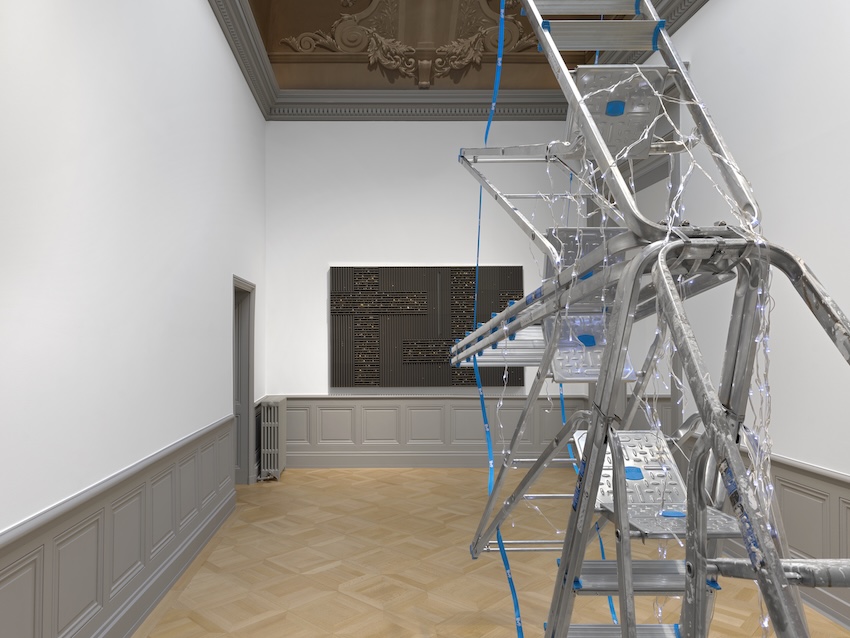
Similarly, La vie est une fête (2025) reconfigures six workmen’s ladders into a half-star structure wrapped in garlands of light. The geometry suggests half a Ferris wheel, a semi-snowflake, a bisected festive emblem. The ladders remain utilitarian, stripped of decorative excess. The work condenses a critique of capitalist logic: labor as identity, effort as prerequisite for leisure and spectacle. We are defined less by who we are and how we act than by our professional activity. The fairground and the workplace are thus not opposites but two halves of the same system.
When asked whether she is an optimistic person, her answer is a strict no. Though through further conversations I understand that it is not so simple. Sarah may be a pessimist in essence, but she remains an optimist in form. Her hyperactive production and involvement in social and political activism would not permit otherwise. She reluctantly admits that all this effort must stem from a faint sense of hope. That is something.
Nonetheless, her current works are far from expressing utopian naïveté, and yet they do not perform despair. They are composed, rigorous, even seductive. To a certain extent, they are utilitarian. Sarah uses them to lure the audience in, only to have them confront a truth she chooses to expose.
Growing artist, in Sarah Benslimane’s case, means recognizing that structure can hold contradiction without resolving it. Soft does not cancel hard. Attraction does not neutralize threat. The mirror does not lie; it multiplies instability. To grow artist is to accept that the world will fracture your surfaces whether you intend it or not. Benslimane does not prevent the crack. She lets it stand as witness.
head image : Sarah Benslimane, Ça vous regarde, 2025, steel, mirrors. 230 x 400 cm. Courtesy of the artist and Galeria Madragoa, Lisbon
- Share: ,
- By the same author: The Swiss model – miracle or plan?,
Related articles
The Swiss model – miracle or plan?
by Gabriela Anco
Everything Must Change
by Patrice Joly
Mondes nouveaux
by Patrice Joly