Everything Must Change
Ninth edition of the Thessaloniki Biennale of Contemporary Art
23.05 – 05.07.2026
“Everything must change”. The title of the ninth edition of the Thessaloniki Biennale of Contemporary Art sets out a programmatic ambition that could easily serve as a rallying cry for any party with even a hint of populism… this everything immediately raises questions of interpretation regarding the scope and purpose of this grand whole in question, as well as its target: is it a question of changing everything in a global society mired in a context where everything seems to be cracking – from trust in democracy, linked to the erosion of rights in major democracies such as the USA, to faith in news subject to the self-serving manipulation of GAFAM, via a frightening resurgence of machismo, right down to the way we ‘consume’ nature? Or does this great upheaval, called for by a determined curator, concern instead the way we understand contemporary art and convey it? To these questions, which this exhortatory title incidentally raises, the Thessaloniki Biennale offers answers that are sometimes clear-cut, often radical and occasionally singularly original. It also has the great merit of raising the question of how a biennial event functions, the limits of such an exercise and its implications beyond the usual, accustomed audience of these events.
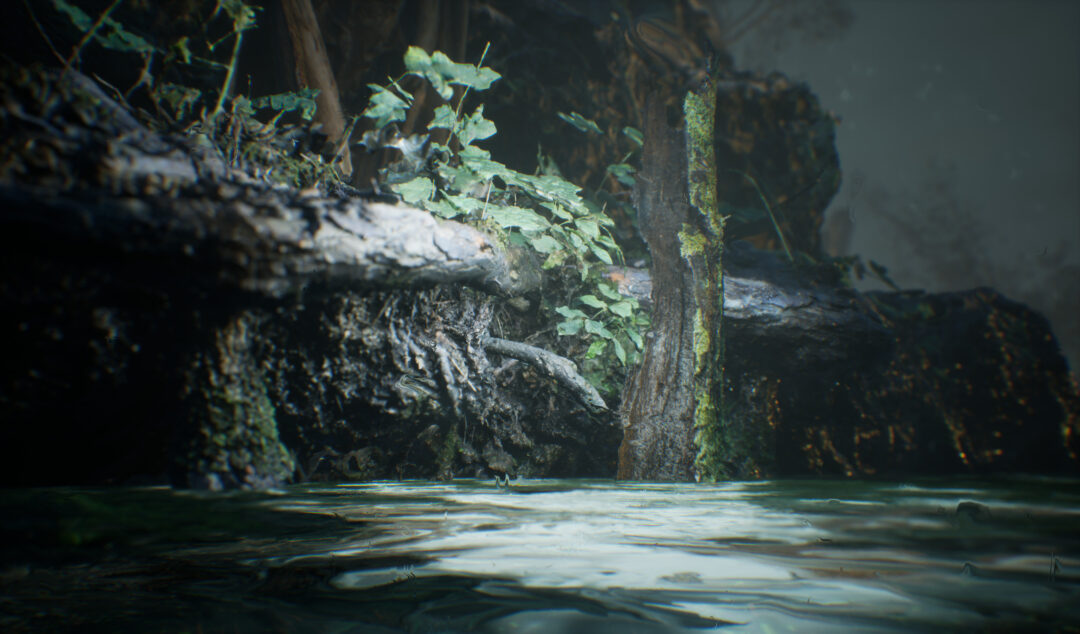
Jakob Kudsk Steensen, Berl-Berl, 2021-ongoing. Live simulation and virtual performance stage (still). Courtesy the artist.
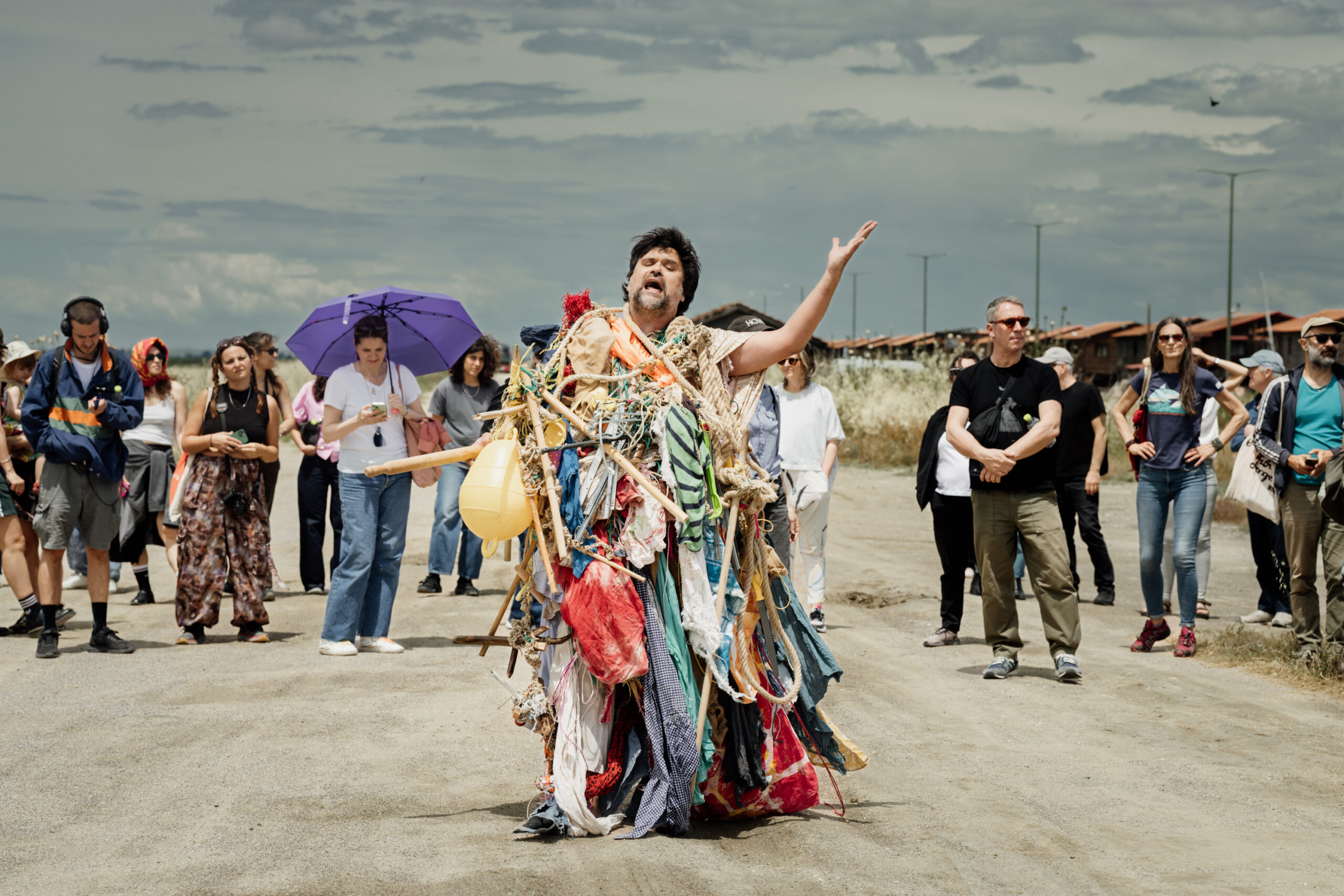
Housed in the enormous hall that usually serves as a venue for international fairs – a building which, incidentally, was the subject of a referendum to assess the merits of its continued existence, set amidst an urban landscape where it appears as a chaotic architectural outgrowth, whilst many residents would have preferred the creation of a garden right in the city centre1 – the Thessaloniki Biennale extends its premises to the nearby Museum of Modern Art, MOMUS; but also, more unusually, it encompasses the vast Kalochóri lagoon, which provided the setting for a performance by the artist Dimitris Ameladiotis (The hal(l)ophyte) clad in the vast amounts of plastic waste (the tatters of civilisation?) littering the lagoon. This performance, in which the artist revives the ancient tradition of the mourners – a quintessentially Greek custom – lamenting at length the pollution and misery afflicting this unique environment, is emblematic of a biennial that aims to place the damage to wildlife at the centre of the debate, a damage generated by our civilisational model, which manifests itself not only in rising sea levels but also in the uncontrolled expansion of urban areas. These are increasingly real threats to ecosystems where the fragile balance between the conservation of wild habitats and the preservation of resources for the many marine and agricultural industries requires heightened vigilance.
“Everything must change” is underpinned by the absolute necessity of radical change, which it views as both a call to action and a demonstration. While the leading figures of this call to action are present – such as Arthur Jafa and his iconic film Love is the Message, the Message is Death (2016), which retraces the key moments in the struggle for the civil rights of Black Americans, or Pierre Huyghe and his unsettling video, Human Mask (2014), which urges us to take a fresh look at the animal question, or Meriem Bennani and her speculative video imagining a future where issues surrounding immigration remain unchanged, save that teleportation has replaced air travel (Life on the CAPS, 2022)… –, the biennial gives pride of place to Greek artists. Alongside Dimitris Ameladiotis, the main contributions come from artists based in Athens and Thessaloniki, with significant works such as that of Sofia Dona, who revisits the history of the Tempe Valley, the site of the train crash that claimed many lives and sparked the anger of the Greek people. In Tempe or The Dales of Arcady (2026) revisits the myth that idealises the valley and inspired the poet John Yeats, in the light of the realities of a society undermined by the collapse of its public services.
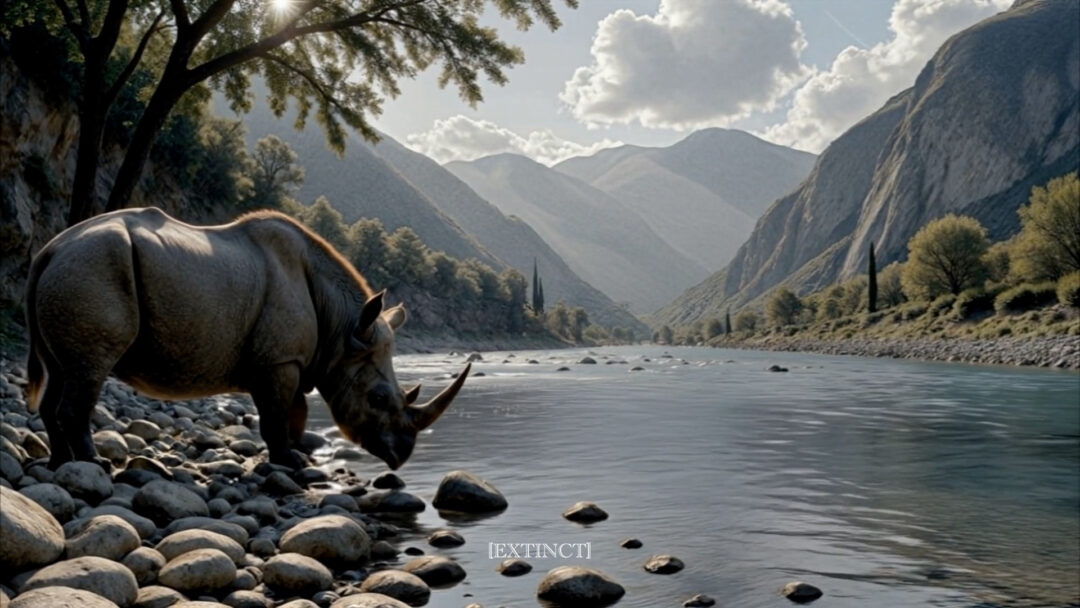
Sofia Dona, In Tempe or the dales of Arcady, 2026. Single-channel video, 4K, colour, sound, loop, AI-generated animation and filmed footage, 15 min. Courtesy of the artist. Curator : Nadja Argyropoulou for the 9th Thessaloniki Biennale.
The curator of this ninth edition does not mince her words: for Nadja Argyropoulou, it is urgent to change everything, to shake things up, to give free rein to the voices being raised from all quarters to denounce the hypocrisies, the obstacles, the backroom deals, the governments’ failures to act, but also the behavioural habits that are perhaps the hardest to change. Whilst acknowledging the difficulty of forcing these changes: a visit to the Kalochóri lagoon highlighted the dependence of local farmers on ecosystems, as rising sea levels threaten soil fertility and warming waters endanger shellfish farming. It is necessary to preserve the fragile balances that human activity is endangering. Everywhere, the desire for change comes up against resistance that must be overcome; this resistance takes many forms: corruption, political compromises, the love of profit, systemic racism, intolerance towards differing sexual orientations and deviance, etc. A state of society and the planet that the curator does not hesitate to attribute to a resurgence of patriarchal values, of which the rise of fascism in almost every country is merely a symptom. Thus, the biennial’s programme appears as a typology of ecological, economic and societal issues to which the artists bring a perspective that is by turns detached or decidedly radical. Notable is the presence of Arthur Jafa, whose practice has consistently denounced racial violence in the USA, a perspective that intersects with Meriem Bennani’s focus on migrants or Pierre Huyghe’s on the animal question. However, some positions are more nuanced, as exemplified by Katarina Komianou. Her photographic and film work on statues in public squares reveals their almost imperceptible alterations, silent evidence of the minute events they bear witness to: a capture of the fleeting nature of aspirations and struggles that fade with time (Abduction, 2026). Similarly, Alexis Fidetzis’s work (Oblivion, 2026) highlights the ordeal of Christians (the Bogomils) decimated by the henchmen of the Byzantine Empire, which could not tolerate the presence of a people who challenged Orthodox dogma and espoused reformist principles ahead of their time, much like the Cathars of southern France, who were themselves persecuted by the Catholic Church. This review of the abuses, violence, predation, intolerance, blindness and other thirsts for power that plague our world could obviously not overlook the LGBTQIA+ issue, which is explored extensively as part of the biennial and whose performance by VASKOS (Vassilis Noulas & Kostas Tzimoulis), From Vardari to Omonia (2026), was a highlight in which the duo revisits the parallel history of the Athenian queer community, its tragedies and moments of jubilation, before the feminist Rap Riot (2026) by Ladelle, Dolly Vara, Sarah ATH, Penny & Iria, brought the biennial’s opening days to a jubilant close. But numerous other examples of attention to sensitive issues complete a necessarily non-exhaustive overview of what ought to spur us to urgent action: for example, Jakob Steensen’s impressive video triptych on the marshy foundations of the city of Berlin makes us reflect on the (irreversible?) fate of wetlands doomed to be transformed into future concrete cities; Antigoni Tsagkaropoulou’s installation, In The Wild (2026), challenges us to consider our ability to collaborate with increasingly sophisticated technological entities; whilst Olivier Ressler, in a review of the environmental struggles ranging from the ZAD at Notre-Dame-des-Landes to the protests against the COPs, highlights the determination of opponents in the face of governments’ empty rhetoric and the art washing of ‘fossil fuel companies ’.
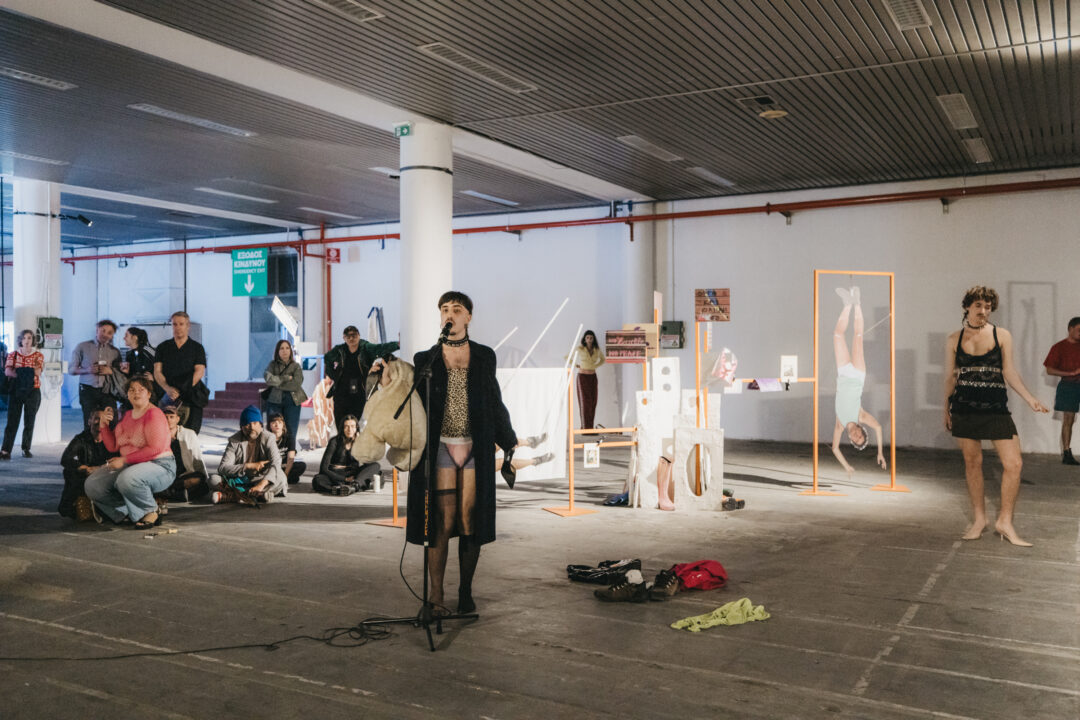
VASKOS, From Vardari to Omonoia, 2026. Performance realized on May 22 and 23rd, Pavillon 2 / Pavillion 2, TIF-HELEXPO during the press and professional preview and public opening of the Biennale 9. Photo : Olga Deikou & Fotis Vlachakis.
For its part, MOMUS featured a section of the biennial devoted to historical works and references to Surrealism, Situationism and the Russian avant-garde, as well as other works such as the ‘Disobedience Archive’ and pieces by Maria Karavela, Anna Zemankova and other artists. The section dedicated to Situationism (‘Flipper zone. Playing again the spectacle’) was organised in collaboration with Vanessa Theodoroupoulou, a lecturer at the École des Beaux-Arts d’Angers and author of a reference work on Situationism (2).
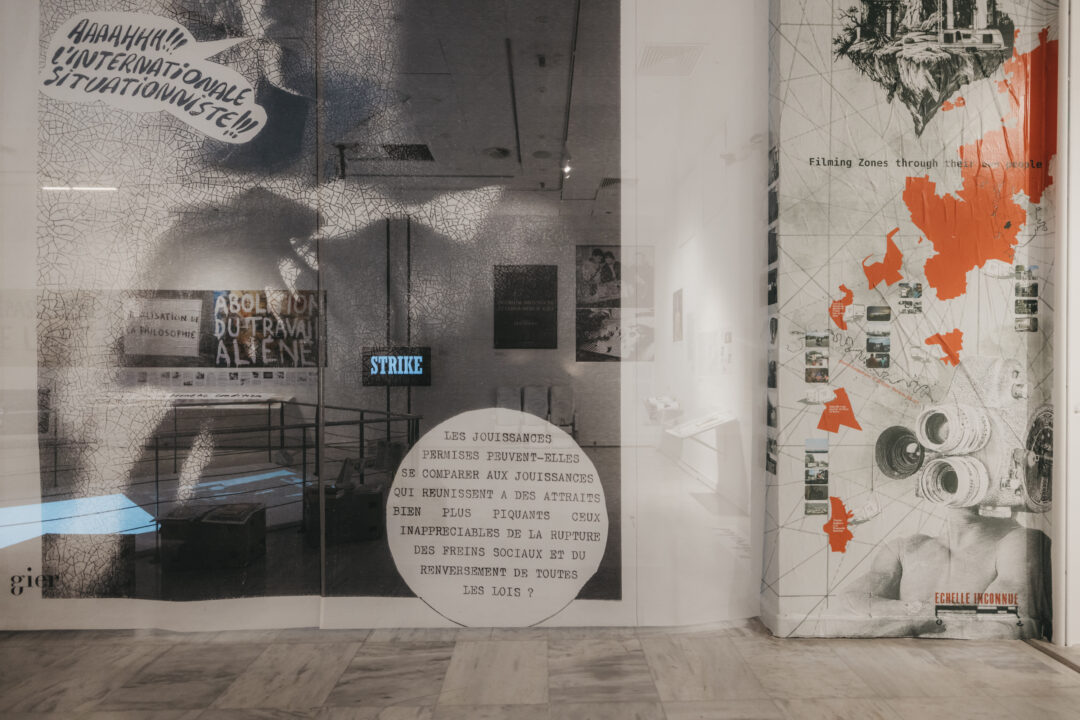
Flipper Zone, Playing Against the Spectacle. A special section co-curated by Nadja Argyropoulou
& Vanessa Theodoropoulou. Photo : Olga Deikou & Fotis Vlachakis.
1. Alexandros Litsardakis’s film, TIF: The Pavilion of the City (2026), presented as part of the biennial, revisits the story of a referendum asking residents whether they wanted the Thessaloniki Art Fair (TIF) to become a metropolitan park whilst retaining the pavilions of notable historical and architectural value. The film traces the stages of an urban transformation process that might be considered welcome given the city’s density, yet which is buried beneath political and economic dealings that are opaque to say the least.
2. Vanessa Theodoropoulou, The World in Situation. The Sensible Revolt of the Situationist International, Dijon, Les presses du réel, 2025.
Head image : Dimitris Ameladiotis, the ha(l)lophyte. Performance, 23 mai / May 23rd, Axios Delta. Repeated later during Biennale 9. Photo : Olga Deikou & Fotis Vlachakis
Related articles
Sarah Benslimane
by Gabriela Anco
Mondes nouveaux
by Patrice Joly
The Round
by David Evrard