Die and Retry
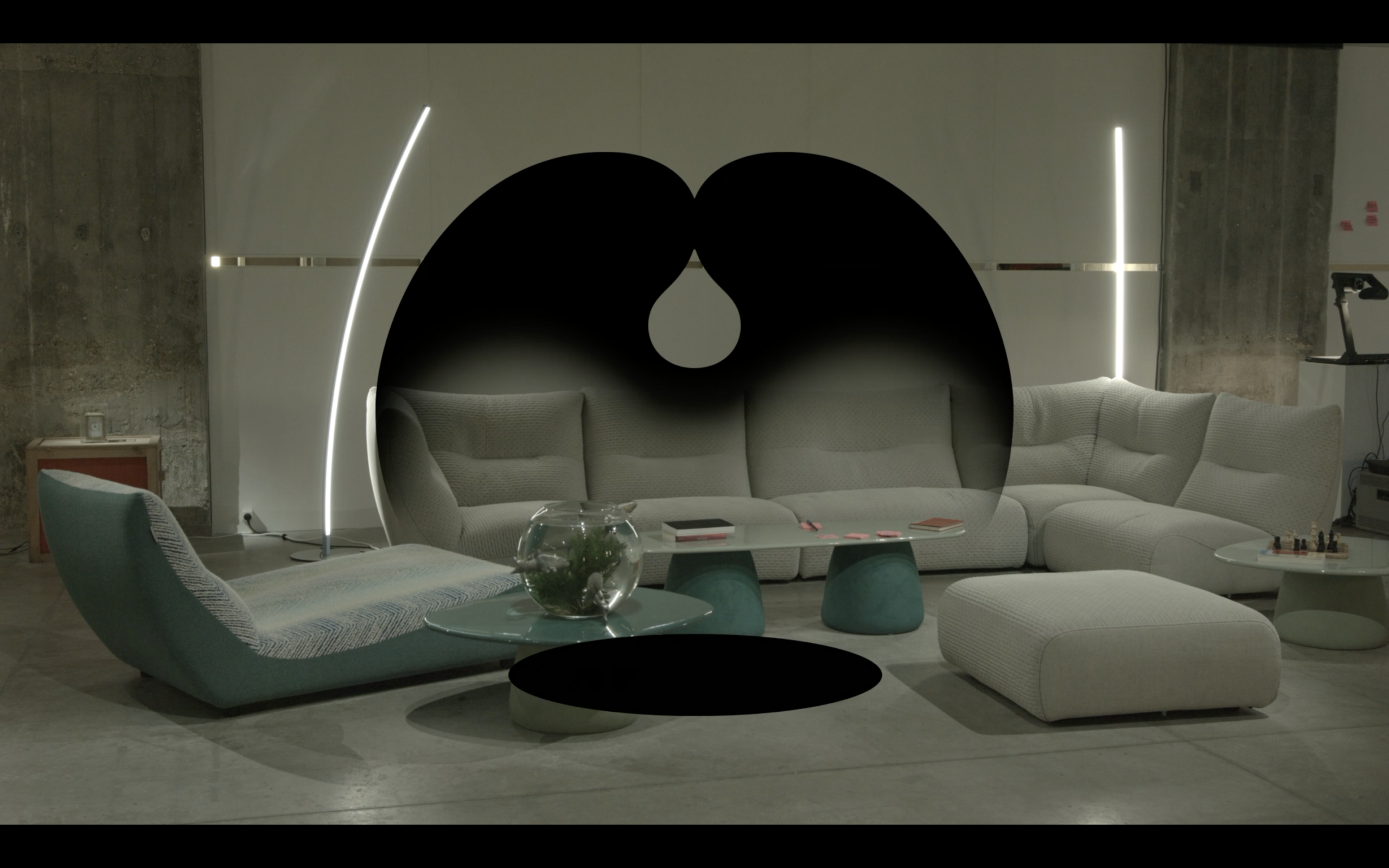
ANGELS FRONT, Flora Bouteille & Victor Villafagne
Commissariat Anna Labouze et Kemis Henni
Magasins généraux 8 octobre – 8 novembre 2026
DYE & RETRY
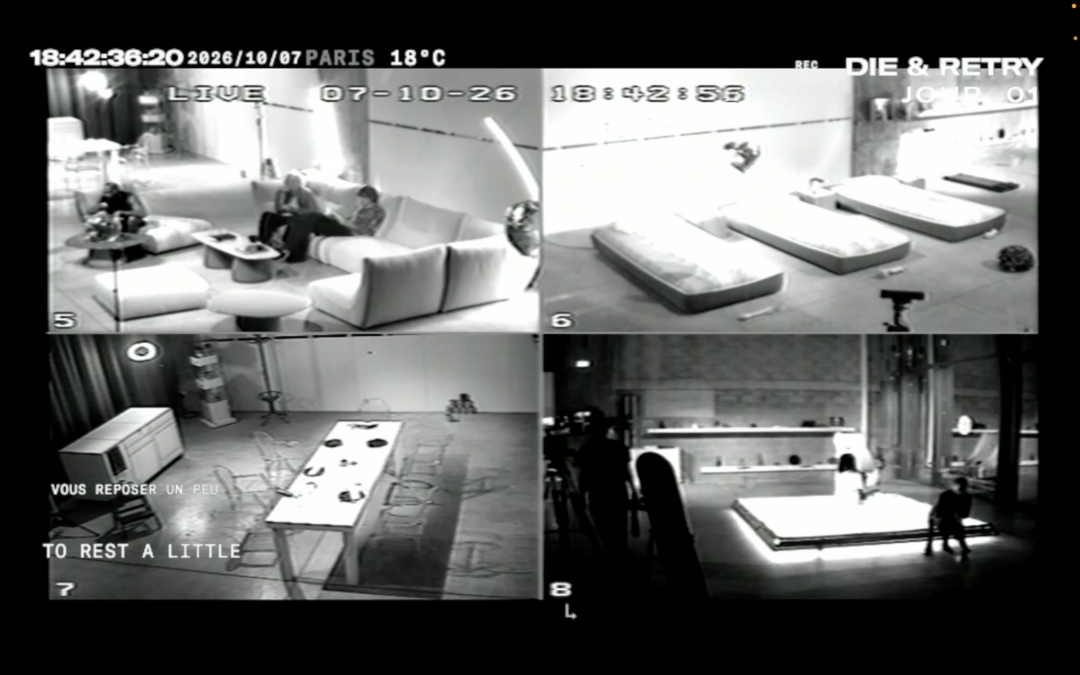
Against the backdrop of a film set, six people interact, filmed and scrutinised, as if left exposed for all to see. Within this panoptic environment – where a few openings allow us to catch a glimpse from the outside – the members of this anonymous group, the A22 Family, move under the spectre of several visual regimes. The unstructured narrative eludes us at first glance. We catch a few snippets, without fully grasping the dynamics of what is unfolding. Between us and the set, a team of technicians is recording, augmenting and distorting what is happening before our eyes. Our perception is consequently fragmented, alternating between a direct view of the scene and intermediaries, such as the television screens broadcasting certain key moments. Editing, filters and sound effects all serve to distort what might otherwise be perceived directly. The screen separating us from what is happening live and its altered version is no longer merely metaphorical; the image taints reality before our very eyes, which are fixed on the monitors scattered throughout the space. We are thus drawn into this process of staging, which turns us into voyeurs of what is happening and, to a greater or lesser extent, complicit in the creation of the slightly falsified content that is being projected.
Echo Chamber
For several years now, the duo Angels Front, founded by Flora Bouteille and Victor Villafagne, has been exploring the medium of performance through a collective approach that enables them to create projects unfolding across multiple venues and over varying timeframes. It brings together around ten members within a cooperative that studies the evolution of psychosocial behaviours through the creation of immersive situations. Their latest project features a family that is not really a family. Individuals who have come to join a training camp to learn how to resist a latent attack. Without regard for actual biological family ties, they are led to reshape the contours of a completely fabricated family context by embodying archetypal roles – the parents, the daughter, the boyfriend – which they choose to assume for several months in order to create a shared narrative designed to fuel their performance. Whilst the first iteration of this project took place over a week in a show flat at the Fiminco Foundation’s premises in June 2026, this social experiment is now continuing in an expanded form at Les Magasins Généraux. Taking the form of an exhibition-in-residence, this new initiative fundamentally reconfigures the venue, transforming it into something akin to a reality TV set, where every moment is broadcast live across various streaming platforms. Conceived as an extension of the viewer’s experience—who has the opportunity to continue watching from home—‘Angels Front’ redefines the temporal and spatial approach to the exhibition by inviting us to re-evaluate its boundaries. From now on, everything that happens within the four walls of the space becomes accessible beyond it. The aim is therefore to give tangible form to our personal experience of the image, of the constant stream that bombards us, of the opacity it generates, and to question the strict separation between our private and public spheres.
Roleplay and simulation
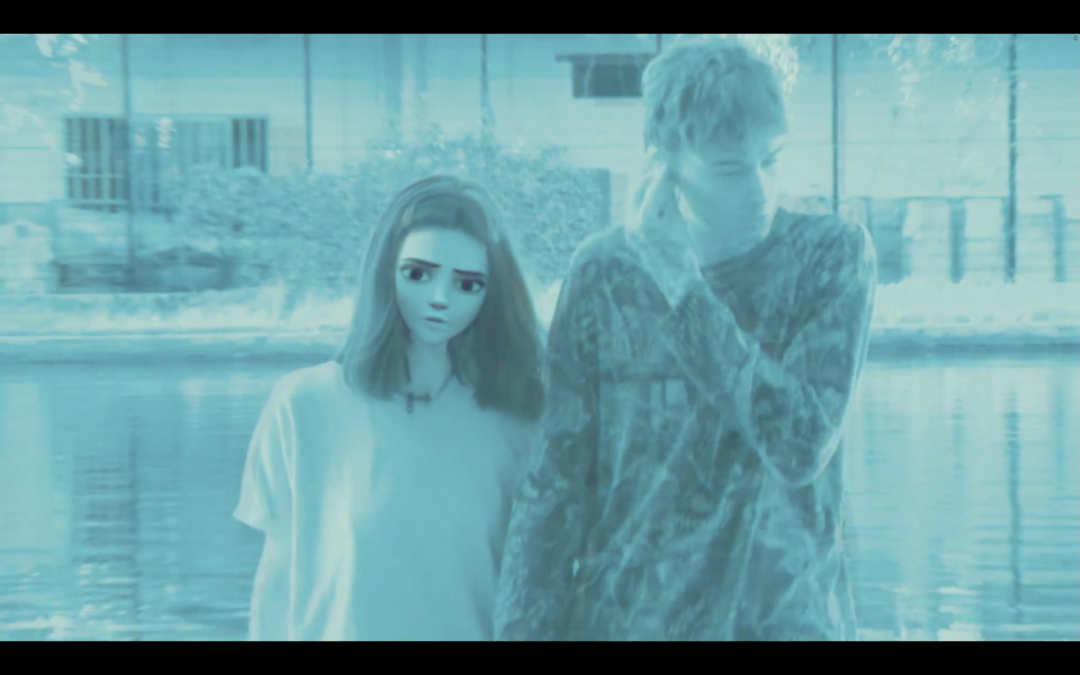
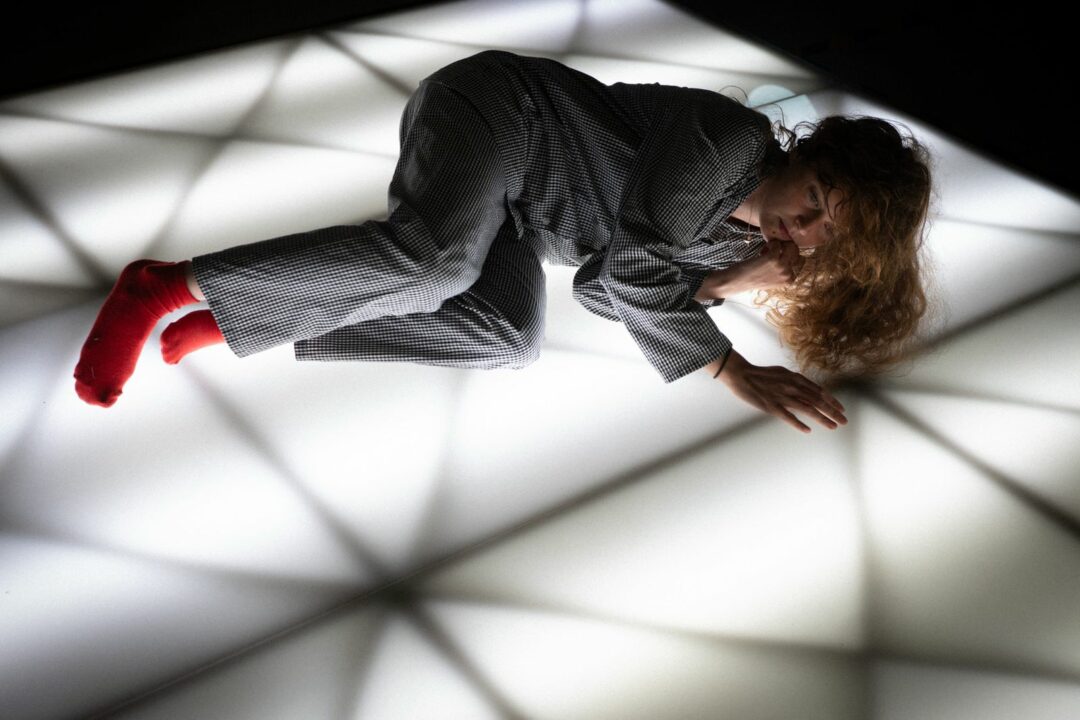
DYE & RETRY explores this notion of a barrier, whether physical, mental, spatial or temporal, social or private. Through a setup that highlights a Truman Show-like effect, it exacerbates the absence of boundaries that now exists between a state of control and psychological infiltration. Drawing on the conventions of roleplay, the proposed environment employs a simulation process aimed at preparing participants to psychologically resist cognitive warfare. In order to explore the pathologies that have emerged over the last ten years as a result of interactions with the digital world, Flora Bouteille, Victor Villafagne and the actors accompanying them examine how we may—or may not—protect ourselves from the mechanisms of influence arising from the advent of new psychological weapons. These digital ecosystems, which influence our capacities for reasoning, attention and action, make the brain one of the major battlegrounds of our century. Now categorised by NATO as the ‘sixth domain of conflict’, this intangible war—which is being waged in both the civilian and military spheres—has a definite impact on the geopolitical landscape. As artificial intelligence, deep fakes, micro-targeting operations and social media contribute to new forms of manipulation of images, information and our relationship with the truth, artists must consider fiction and play as a methodology to combat attempts at control that are insinuating themselves ever more deeply within us. By enacting several scenarios—akin to role-play exercises designed to train the brain to resist external attacks—the performers featured in the exhibition strive to simulate moments of everyday life in which they express various emotions and relational and emotional experiences, with a view to developing survival strategies to be applied in everyday life. The narrative arcs are invariably re-enacted according to parameters that vary depending on the stage of the exhibition. Much like a user behind a screen, the viewer may choose to alter certain parameters, deciding whether or not to influence the fate of the characters unfolding before their eyes.
Prospective Fictions
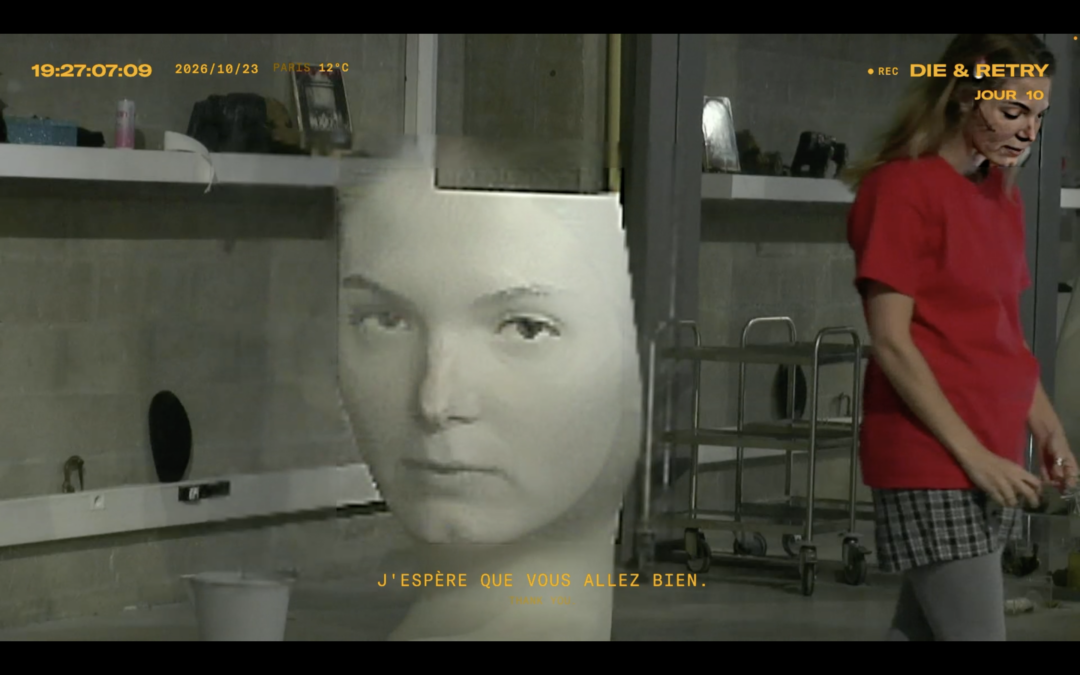
Within this zone of friction—which brings into dialogue the audience’s expectations, the ‘characters’’ availability, and their technical intermediaries, who do not hesitate to emphasise certain emotional sequences through sound effects or to occasionally film an actor’s face in close-up to capture their expression—reality becomes blurred. This staging becomes the theatre of soft power laid bare and invites us to choose whether or not to take part in this power dynamic. By creating false interpersonal relationships, the aim is to examine how our psychological landscape can be disrupted by technology. The erosion of human relationships serves as an indicator of shifts in relational behaviour, reduced to purely utilitarian purposes or to artificial interactions with digital facsimiles. Beyond merely taking stock of our collective unconscious, the framework established in DYE & RETRY is intended to be forward-looking. Comprising scenarios with a slightly speculative dimension, the experience lies between these two aspects of foresight defined by Jean-Philippe Toussaint: ‘Knowledge, or exploration, of the public future falls within the realm of foresight, which constitutes a scientific discipline in its own right, whilst the desire, or fantasy, to know one’s own future falls within the realm of spiritualism or clairvoyance[1]’. In the protocol established by Angels Front, the aim is rather to find a middle ground, to experience a possible future in such a way as to create certain sensory responses, and to cultivate an awareness of what might occur in a future that seems to be taking shape. Through this desire to conceive of a staged installation as a study of our cognitive evolution in relation to concrete current events, the aim is to envisage a potential future ‘(…) thereby broadening the horizon of what is politically imaginable[2]’, to borrow the phrase of the philosopher Oliver Marchart.
Scripted reality
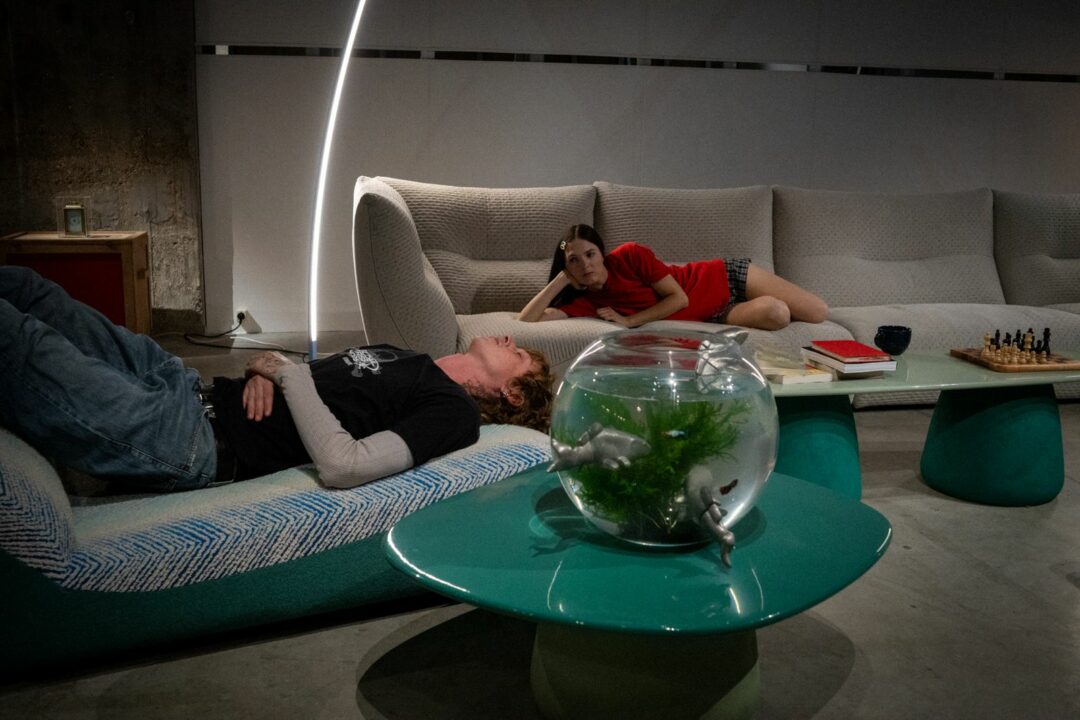
Upon entering the exhibition, the viewer is invited to take part in the game. Asked to complete a psychological questionnaire, the public contributes to the compilation of data that adds to the archive built up over the years by the collective. This data also helps shape the evolution of the techniques and scenarios developed by Angels Front, with visitors always providing the raw material for the installations they create. This antechamber, designed as a preparatory space, forms part of the environment arranged by the Angels Front team before visitors enter, via the backstage area, a set designed to resemble a loft. Cleverly structured, the scenography—conceived in collaboration with Michael Price—evokes a domestic setting, composed of various elements that coolly furnish the space. A bed, a walk-in wardrobe and balloons create a familiar atmosphere that can nevertheless evoke a sense of unease. In the centre of the area through which the audience is led to wander, a confessional – an integral part of the reality show – is left freely accessible to performers wishing to share their experiences exclusively with the audience. The blurring of the lines between fiction, manufactured emotions and authenticity highlights what goes on within us when we are confronted with an impairment of our cognitive faculties on an individual level. Echoing the words of the philosopher Byung-Chul Han from his bookThe Society of Transparency: ‘With digital technology, we live under the illusion that we can realise our full potential. We create this fiction ourselves. It is a form of self-exploitation that is all the more effective because we submit to it voluntarily[3]’, the speculative protocol established as part of DYE & RETRY analyses the workings of a society largely subject to a system that has now come to overshadow it.
[1] Jean-Philippe Toussaint, Les Émotions, Paris, Minuit, 2020, p. 7.
[2] ‘Marcuse’s Contribution to Political Thought: On Potentiality, Pre-enactment, and the Surrealism of Liberation’, published in 2021 in the journal Theory, Culture & Society.
[3] Byung-Chul Han, interview with L’Express, December 2015, quoted in Jean Duchesne, ‘Byung-Chul Han: “The Society of Transparency”’.
Related articles
Sculpture Garden
by Patrice Joly
Anita Molinero
by Elisabeth Wetterwald
Camille Blatrix
by Antoinette Jattiot