Manifesta 16 Ruhr
This is not a church
Manifesta 16 Ruhr
21 June–4 October 2026
This is not a church. The title, which transgressively subverts Magritte’s famous phrase, is that of the sixteenth itinerant contemporary art biennial, Manifesta. Set against the backdrop of twelve post-war churches, now deconsecrated, this edition spans the cities of Duisburg, Essen, Gelsenkirchen and Bochum in the Ruhr region. True to the spirit of Manifesta, the programme is firmly rooted in its host region, featuring a significant number of works commissioned especially for the occasion, centred on the palimpsestic history of this post-industrial German region. The exhibition traces the post-war reconstruction of the Ruhr, the arrival of the Gastarbeiter (migrant workers) during the years of prosperity, followed by the waning of the golden age and the ensuing socio-economic decline, whilst drawing parallels between this history and the more universal crises of the present day. The various exhibition venues, many of which are located away from town centres, are sometimes several kilometres apart. I opt for a cycle route that partly follows former industrial infrastructure converted into cycle paths. As I follow railway lines, riverbanks and canals through residential areas, I sense, as I make my way along, a gloom in the air that is characteristic of these regions which have left their glory days behind them. The grey light and overcast September sky no doubt accentuate this impression.
As with most biennials held in historic buildings, throughout the route the pleasure of discovering the artworks blends with that of discovering the venues that host them, though I cannot say for certain which drives the other. The churches taken over by Manifesta are for the most part small buildings, intended for local worship. They offer contemporary art a setting far removed from the white cube without, however, imposing a cluttered scenography, thanks to a certain neutrality that emanates from their architecture. In the exceptional cases of more imposing buildings, this neutralisation is achieved through the artistic intervention itself. The immersive installation by the Catalan collective Penique Productions in St Joseph’s Church in Gelsenkirchen, for instance, covers the entire nave with a cobalt-blue inflatable structure, thereby suspending the architectural and iconographic references. The decision to choose churches as exhibition venues is justified in the biennial’s curatorial statement by their former function as community gathering places, a role that has now disappeared. The end of coal mining and industrial activity has profoundly transformed the environment surrounding these churches, and more broadly, the process of secularisation has contributed to churches no longer being used as such. Of the twelve churches, some are completely disused, whilst others have found new uses, such as St Gertrude’s in Essen, which has become a centre for arts education. Learning that this is a widespread phenomenon in the region and that the number of disused churches in the Ruhr exceeds several hundred is bound to come as a surprise. Manifesta aims to reflect on the future of these abandoned churches, to reimagine them as places that strengthen social cohesion and interaction, and to restore, in a sense, their former function as community gathering places.
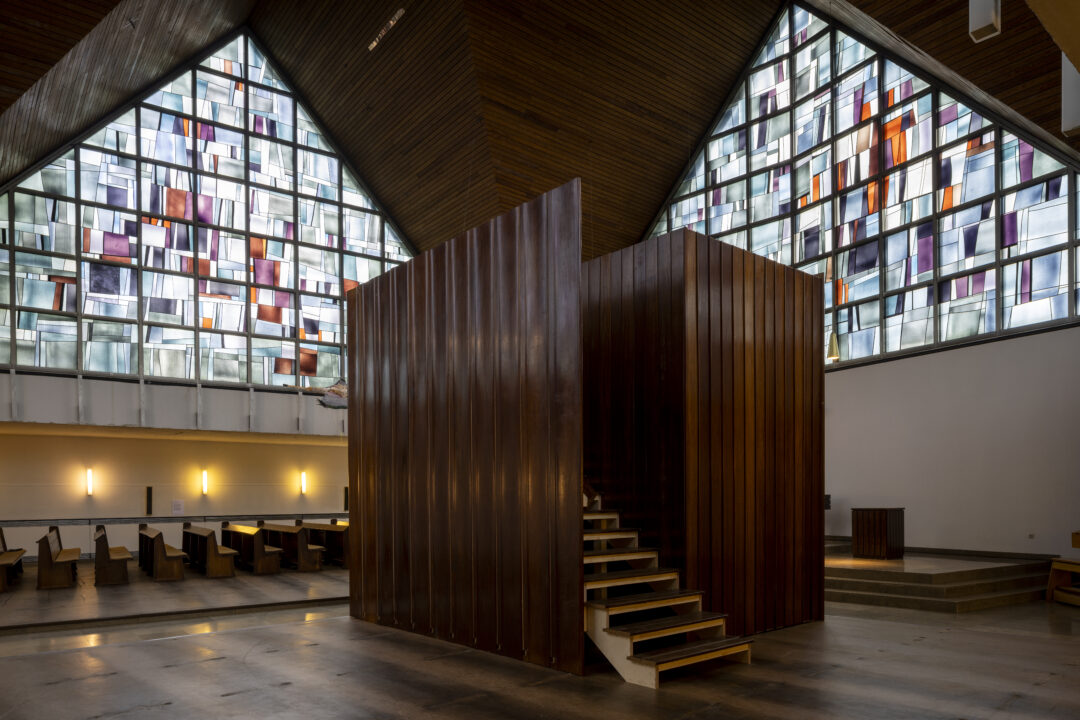
Each edition of Manifesta is conceived by a team of creative curators to emphasise the social aspect. The Biennale’s theme takes on different forms depending on the exhibition venues, with each curator interpreting it according to their own sensibility. In the Essen area, the focus is on the churches themselves. The pews, the organ, the confessional and other items of liturgical furniture found in almost every church become the canvas for the artworks. Among the most striking installations is Pew Tower (2026) by Augustas Serapinas in St Mark’s Church in Essen. It is a monumental structure that visitors can climb, constructed from a reworking of the church’s disused pews. This radically transforms the visitor experience, offering a raised, almost divine vantage point and a close-up view of the building’s beautiful stained-glass windows with geometric motifs, which are a remarkable example of contemporary stained glass. In addition to these works, which redefine the experience of the space, others question or even reinterpret the functions of the liturgy. In St Gertrude’s Church in Essen, Ayşe Erkmen’s Confessional (2026) consists of a glass confessional booth in which the priest is replaced by a screen enabling interaction with artificial intelligence. Whilst the technological innovation is intriguing, its glass walls completely eliminate privacy, making the experience deliberately uncomfortable. The artist poses a recurring question: in a so-called hyper-transparent world, what remains of the confidentiality of our secrets when we constantly share our most sensitive data with this technology without having any control over how it is used?
In Duisburg, the works on display at the Church of Our Lady are closely linked to the destruction and trauma of the Second World War. Built or rebuilt in the 1950s and 1960s to replace buildings destroyed during the war, the churches featured in Manifesta bear witness both to the wounds of the past and to the spirit of renewal in the Ruhr region. Several works at the Church of Our Lady in Duisburg draw inspiration from this history and embrace an aesthetic of rubble. I am thinking in particular of Athina Koumparouli’s glass sculptures, made from fragments of glass salvaged from the region, which, when reassembled, form what could almost be windows – through which, however, it is impossible to see. Her works prompt reflection on the impossibility of post-war reconstruction and of continuing to see the world as before. Elizabeth Price’s videos explore the psychological resonances of post-war architecture. Her study of St Mary’s Church in Essen superimposes past and present images and plans, literary accounts by writers who experienced the aerial bombardments, and more analytical quotations from architectural theorists. The artist argues that this type of building crystallises a certain war-related trauma within the region’s collective memory. Then, on the upper floor, Abbas Zahedi’s installation *Ouranophobia 47051* (2026) further intertwines the destruction of war with architectural history. By assembling disused organ pipes from across Europe into a new arrangement, the work evokes a martial architecture, reminiscent of these imposing metal structures that rise towards the sky in a menacing verticality. As I was leaving Notre-Dame de Duisburg, I couldn’t help but feel that the exhibition’s reference to war remained somewhat unresolved. The realisation that I was standing on a site that had once been entirely destroyed, coupled with the thought of the impossibility of its reconstruction, inevitably drew my mind to the ongoing destruction of Palestine. However, in Germany’s cultural and political climate, marked by censorship, it seems that no connection with Palestine was possible throughout the Biennale.
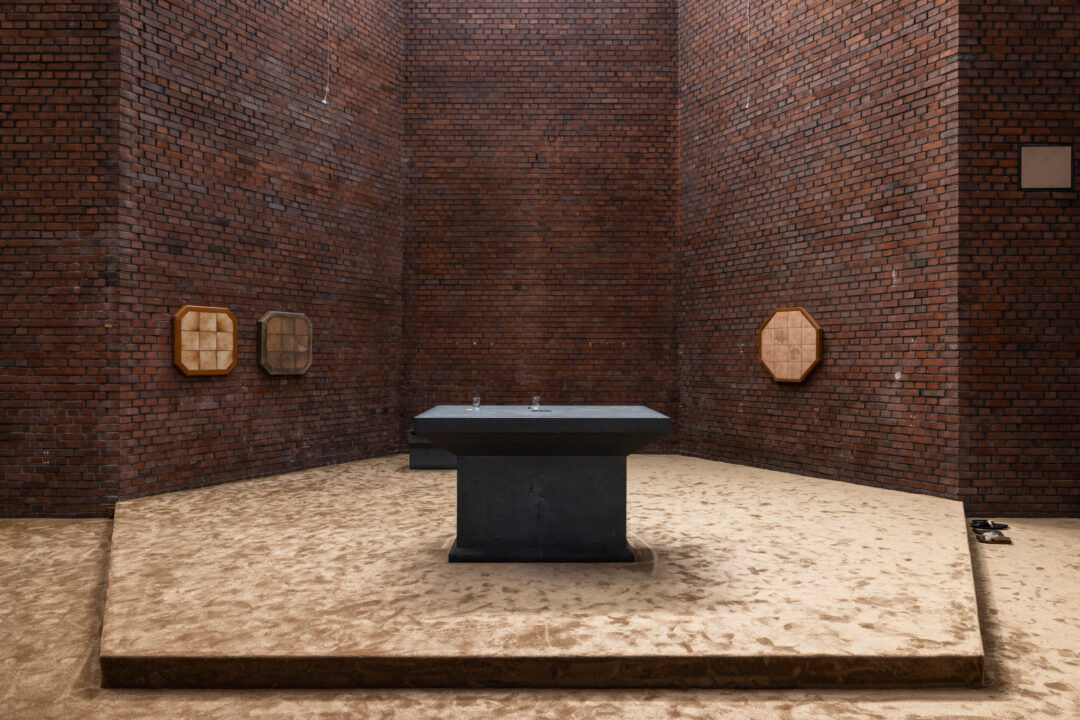
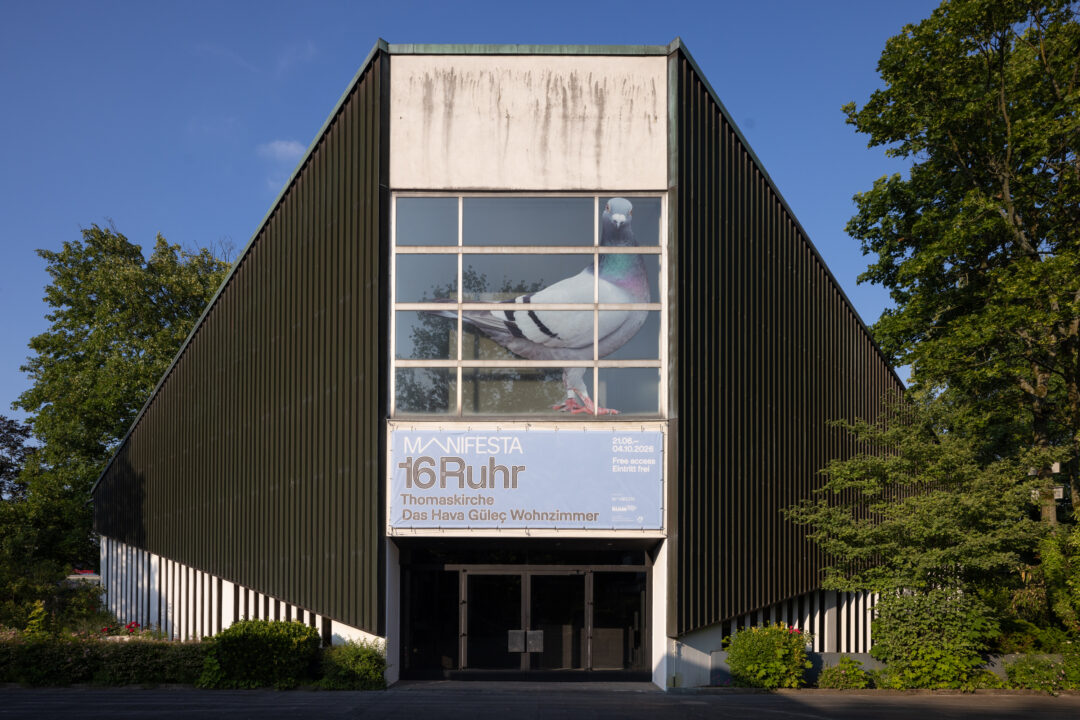
In Gelsenkirchen, the exhibition’s narrative shifts significantly, focusing this time more on the inhabitants of the Ruhr region than on its architecture, with works exploring the issue of migration. Curator Gürsoy Doğtaş has renamed the three churches in this area as new cultural venues, conceived in honour of figures from the Turkish diaspora: the Hatay Engin Music Hall, the Hava Güleç Salon and the Ferdane Satır Tea Garden – the latter having been the victim of a racist arson attack in Duisburg in 1984. These names serve as a reminder of the Gastarbeiter who arrived from Italy, Greece, Turkey and Yugoslavia from 1955 onwards, under bilateral recruitment agreements. Workers from Turkey, including the Doğtaş family, remain Germany’s largest immigrant group to this day. Some works adopt a tone of subversive irony to address the discrimination faced by successive generations of people with an immigrant background. Cana Bilir-Meier, in particular, is conducting participatory research with a choir of former migrant workers. The starting point is the 1970 public competition to replace the word Gastarbeiter (literally ‘guest worker’), a term that had become obsolete since, by the 1970s, these workers were no longer temporary arrivals but had settled permanently. Of the more than 30,000 entries received, many proved to be racist or discriminatory. In his experimental video A New World (2025), the artist reappropriates this material by asking participants to compose a musical piece from it. This work of remembrance is all the more important in the current context, given the rise of the AfD, a far-right party with a strongly anti-immigration stance.
The exhibition brings together artists such as Nejla Gür and Abuzer Güler, who are part of the history of labour migration; others, such as Hanefi Yeter and Matin Talayman, who came to Germany to pursue an artistic education; and those who left Turkey amid a difficult political climate, such as the Kurdish painter Rıza Topal. Added to this is a subsequent generation of artists born in Germany to immigrant families, who have not directly experienced immigration themselves, but whose works are steeped in this family history. In Merve Kaplan’s installation Companion (2025), in particular, objects such as a Turkish tea glass or indoor slippers become vessels of memory. Some works feature images conveying a troubled emotional state marked by alienation or fear, with tense and unconventional figures that convey the emotional ambivalence of the migratory experience. This is the case, for example, with Metin Talayman’s grotesque paintings (1970–1980), featuring rather sombre figures, or Gülbin Ünlü’s gigantic pigeon—a creature that is as familiar and domestic as it is a nuisance and an unwelcome presence in cities. The strength of Doğtaş’s curatorial approach lies in avoiding a reductive take on narratives of immigration; rather, it recognises the multiplicity of identities and affiliations. I am delighted to see the installation by Mesut-Sabuha Salaam, which brings together archival material from Gayhane, parties organised by queered people of colour from the late 1990s onwards. This allows us to trace the long-term history of queer diaspora communities, which are often marginalised in broader narratives of immigration. Using art as a vehicle for social cohesion naturally has its limits, but if we accept that to look to the future we must first revisit the past, then Manifesta fulfils this role very well by drawing on artists who engage with this legacy of immigration through their own lived experiences.
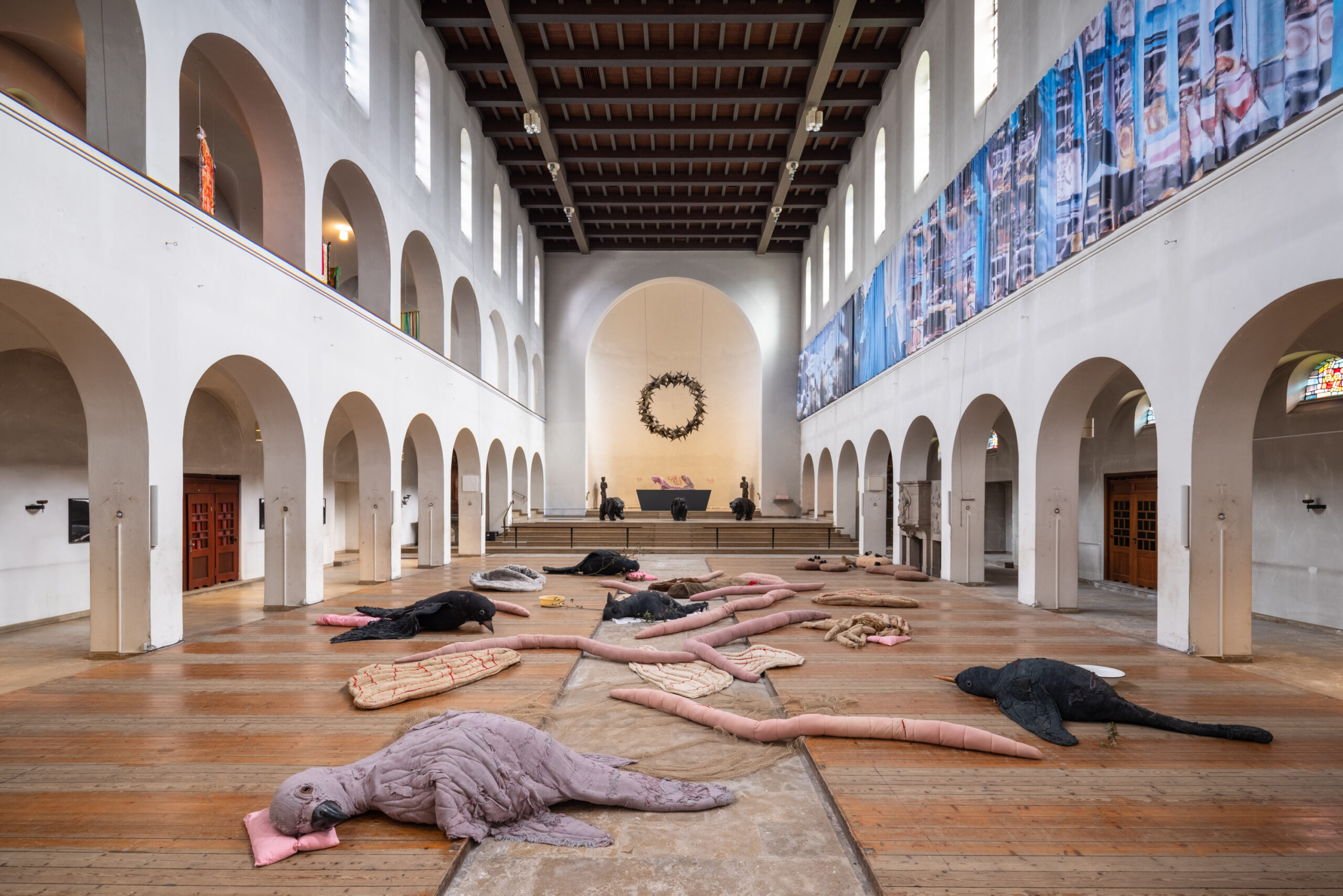
I conclude my visit with the churches in the Bochum area, which are, in a sense, a portrait of the Ruhr today – of what remains of decades of coal mining and industrial activity, and their impact on nature and living beings. Nicolas Grospierre’s photographic series The Black Below (2026) reveals its barely perceptible traces through landscapes that focus on nothingness, on what remains underground and on what no longer exists. When Animals Fall From the Sky by Eva Kotatková presents an almost apocalyptic vision of the end of days, with oversized animals scattered across the floor of the Christ-Roi Church in Bochum. The artist transforms the church into a refuge for urban animals, weakened or wounded by human activity. This installation also echoes Mehtap Baydu’s silicone sculptures, The Distance Between Me and Everything Else (2017–2022), displayed right next to it. Working from casts of her own body, Baydu creates sculptures that resemble flayed skin – like a skin left behind, a moult in progress. The fragility of the bodies resonates with the fragility of a territory, traces that Manifesta invites us to observe rather than erase.
Related articles
Lisa Oppenheim
by Warren Neidich
Hannah Darabi
by Guillaume Lasserre
Art-O-Rama 2026
by Giorgia Basili