Nicolas Momein
Don’t blend into the background.
Nicolas Momein, *Des clous dans la bouche*, Ceysson & Bénétière Gallery, December 12, 2025–February 14, 2026
It’s hard to imagine that we’re in Saint-Étienne at a French gallery: it feels more like Chelsea, in one of those oversized spaces the New York city has accustomed us to, but we are indeed in the capital of the Loire, at the Ceysson & Bénétière gallery, which is hosting Nicolas Momein, a young local artist who divides his time between Paris and Saint-Étienne.
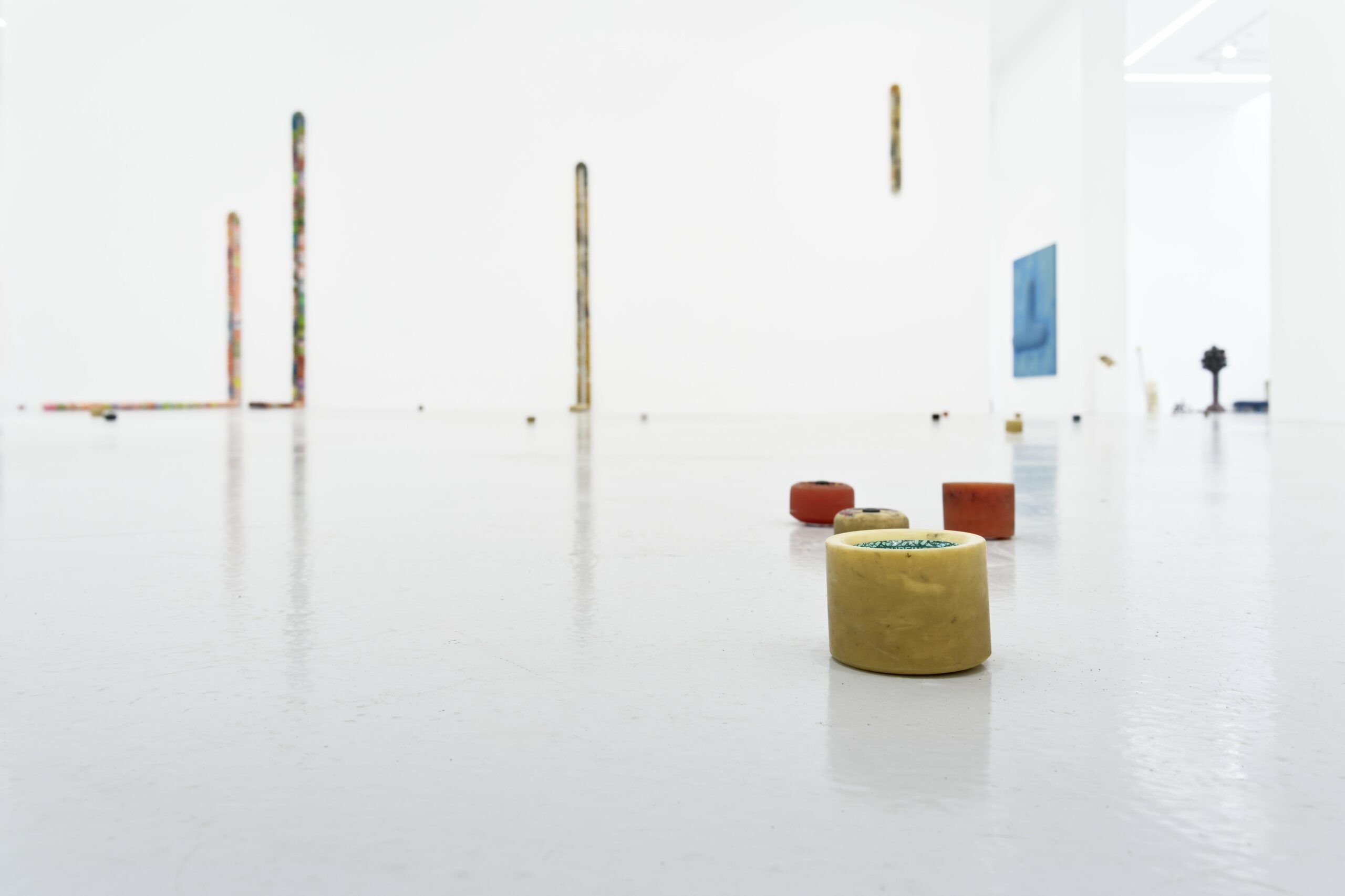
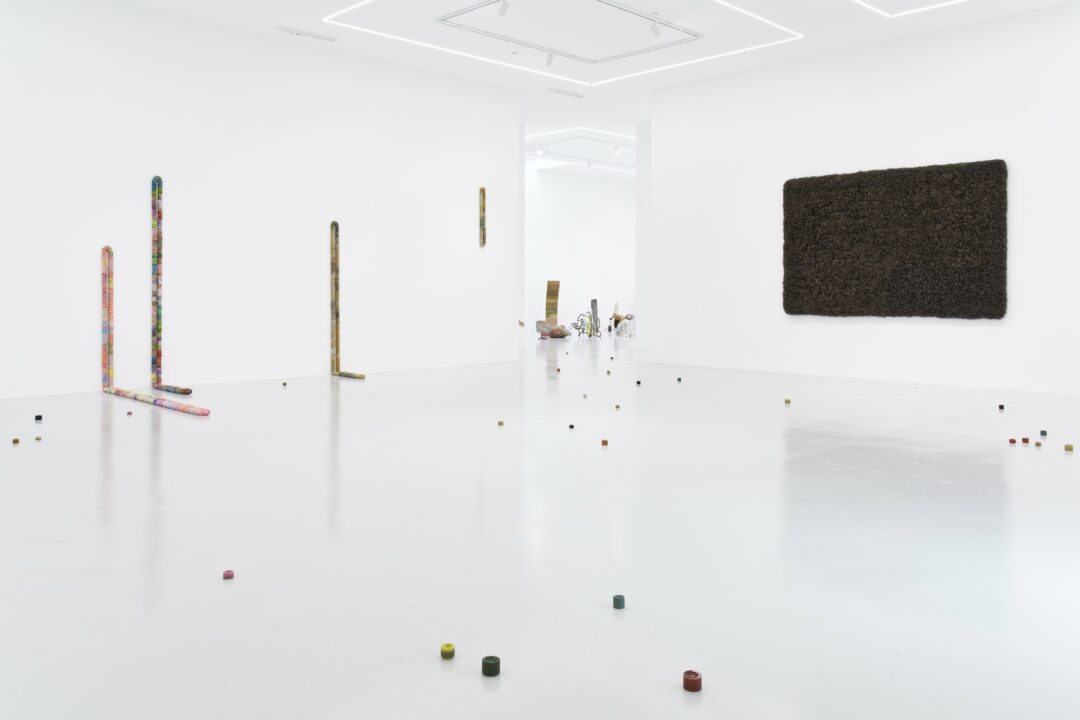
In the first room, we are curiously drawn to a display of small pieces on the floor that we cannot immediately identify, but which turn out to be skateboard wheels—the artist was an avid skateboarder in a youth not so long ago; the title of this installation, En roue libre, seems to correspond as much to their primary function as wheels as to the artist’s own condition, evoking both mental and physical drift as well as the absence of brakes. But while the wheels can spin, they are fixed in place, as the artist acknowledges, seeing this as a sign of maturity achieved after countless experiments of all kinds in an artistic journey marked by breaks and formal hybridizations. Nicolas Momein is not a “natural-born artist”; his vocation—if one can still use that term—came to him only after working as an upholsterer for seven years. Momein entered the art world late in life, abruptly leaving a profession that guaranteed him relative financial security to venture into the far riskier terrain of an artistic career. After the Fine Arts school in Saint-Étienne, he enrolled at the prestigious HEAD in Geneva.
In this first room, “the room of the casters,” one could also discover strange pieces shaped like freestanding supports covered with colorful sleeves reminiscent of hair scrunchies. It turns out that what covers these bent tubes is none other than paintings that the artist has folded to form gathers. Clearly, the artist does not like objects to conform to what their form and composition would normally dictate: he nails wheels to the floor, preventing them from rolling; he wraps pipes in paint so that one cannot grasp them in their full form, but only by speculating on their appearance, in a sort of inverted “affordance.” Is there a desire to disappoint the visitor, unsettling their expectations and their relationship to things? But isn’t it the role of an artist to never be where one expects them to be and to never conform to the established order of things?
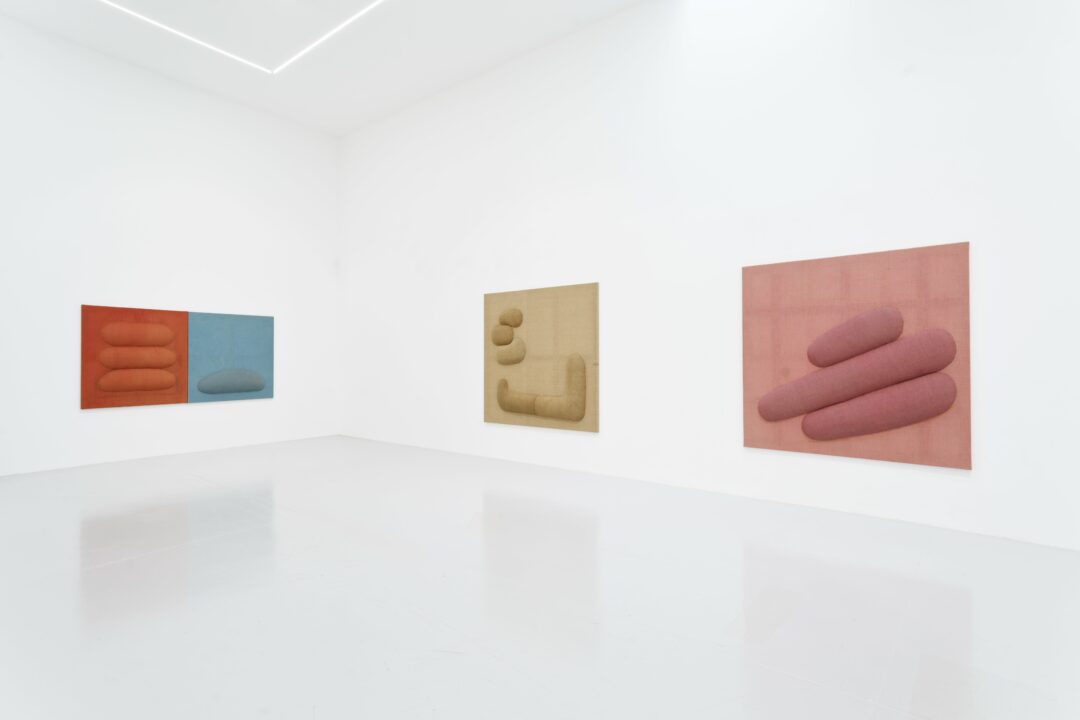
His first trade deeply infuses his practice: burlap, in its raw materiality, is widely present, as is horsehair; the artist always returns to them, after taking exploratory detours that, as a true snoop, he ceaselessly experiments with. It also creeps into linguistic nods like the exhibition’s title, “Nails in the Mouth”: the craftsman must, to facilitate his work, hold nails between his teeth, so as to give his hands full freedom to sew, nail, assemble, and adjust. Unlike painters, for whom the canvas serves as a support for applying the various layers that will cover it, here it serves as his base material. Let’s say that this canvas is not entirely raw, but, like the gouache-coated sheets of a Matisse (dare we make the comparison!), it is dyed throughout before serving as a matrix for various treatments: bulges, blisters, stretching, perforations, and other forms of abuse. This series concludes a free-flowing journey through the exhibition; it corresponds to the artist’s latest works and appears as a return to his former craft, from which he has freed himself from the constraints of surface treatment and embellishment, retaining only the flexibility of the canvas and the comfort of twisted horsehair. This allows him, in particular, to produce bumpy, upholstered paintings resembling sofas. The protrusions created by this padding form, at the center, more or less distinct shapes—such as this exclamation point jutting out from the surface—perhaps to signify the feat of its creation and the staging of the artist’s self-satisfaction? Proud to be freed from the utilitarian? Proud to be an artist who destines the canvas for uses other than padding?
Liberation once again, as this XXL-sized work made from this fleece “normally” dedicated to filling furniture and creating softness: this diversion of use explodes here in a jubilant manner to form an imposing monochrome, once again without going through the painting stage. On the black backdrop of my sleepless nights (Sur l’écrin noir de mes nuits blanches): playing with the title of Nougaro’s famous song, the artist creates sinuous associations where the metaphor of the daydream that keeps one awake transforms into a desire to doze off on a good horsehair mattress—padding material obliges— Lacan would lose his sheep there… while on other canvas reliefs, eyelets act as inverted peepholes to peer inside: introspective impulse or mirror stage?
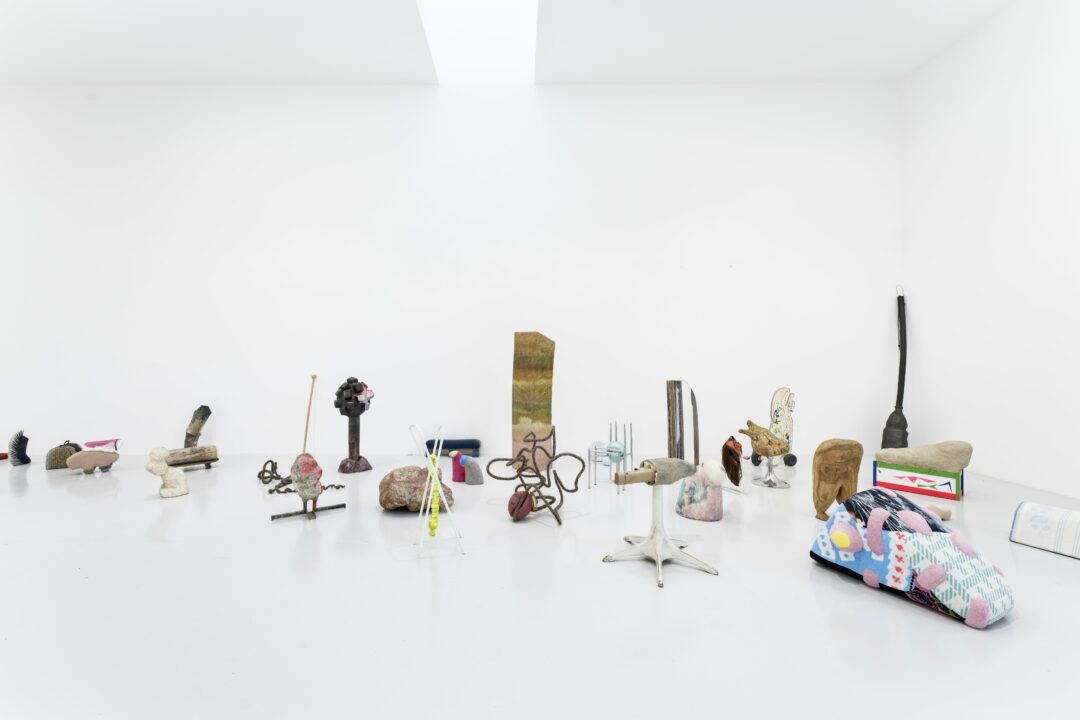
But let’s step back and revisit the many formal detours the artist has taken, always with this propensity for derision, even self-derision, as if he were not fully embracing the position he occupies and were using humor to make the pill of his imposture easier to swallow: in his small, cobbled-together pieces where unprecedented collisions of materials and forms occur, hybrids emerge that betray the artist’s love for improbable formal fusions that are nonetheless delightful in their strangeness. Is this an ode to our era, where the unabashed oxymoron of politics flourishes without shocking populations who have had enough, or simply a tendency to create bizarre forms, like the echoes of a constantly renewed surrealism?
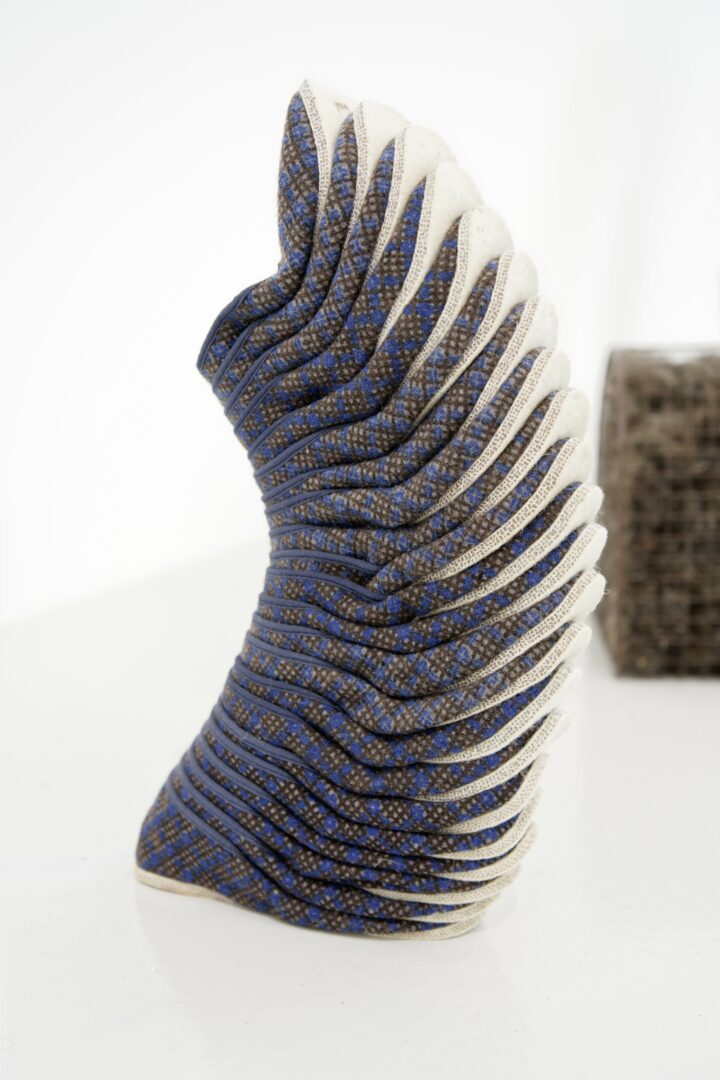
The artist is a maker; he loves to sew, assemble, and manipulate. He does not shy away from using materials supposedly less noble and chemically less well-regarded than wood, such as epoxy paste, to construct the frames of his monochromes—themselves made of a material that any self-respecting environmentalist might condemn without appeal (polyurethane resin…). Nor does the artist hesitate to employ industrial techniques to produce flawless results: he could claim the legacy of a Larry Bell, who in his day did not hesitate to use industrial techniques to produce smooth surfaces immaculate of any “manual pollution.” One senses he is ready to use the full range of possibilities to achieve his formal ends, from the repurposing of secondhand or found objects, gathered for the effect they produce—such as that indescribable stack of seashell-like slippers—while at the other extreme, metallized drippings produce crepe paper effects that no manual technique could even come close to replicating.
In a catalog essay devoted to Matisse’s final years, Antoine Compagnon revisits a classification of artists: according to him, there are two categories: the foxes who, like Picasso, burst onto the art scene and immediately reach the pinnacle of their art—at the risk that the bubble of recognition might burst—and who constantly test the limits of their inventiveness; and the hedgehogs who, like Cézanne, carve out their path toward a late mastery and a maturity that comes almost at the end of their lives. Looking at Nicolas Momein’s zigzagging career path, one tends to think he belongs to the first category. But this jack-of-all-trades, who jumps from one technique to another and from one medium to another, claiming at age 45 to have reached maturity, nonetheless remains faithful to his favorite materials and techniques; he returns to them, once explored, all these detours. As for categorization, let us say, mimicking Compagnon’s phrase, that he is a hedgehog disguised as a fox…
galerie Ceysson & Bénétière, Saint-Étienne, 2025-2026.
- Share: ,
- By the same author: Iván Argote, Yan Tomaszewski, Thomas Giraud - Avec Bas Jan Ader,
Related articles
Larissa Fassler
by Agnès Violeau
Jean-Alain Corre
by Vanessa Morisset
Louise Mutrel
by Camille Velluet