The Arts of the Earth (Les Arts de la Terre)
Guggenheim Bilbao
Curator: Manuel Cirauqui
5th December 2025 – 3rd May 2026
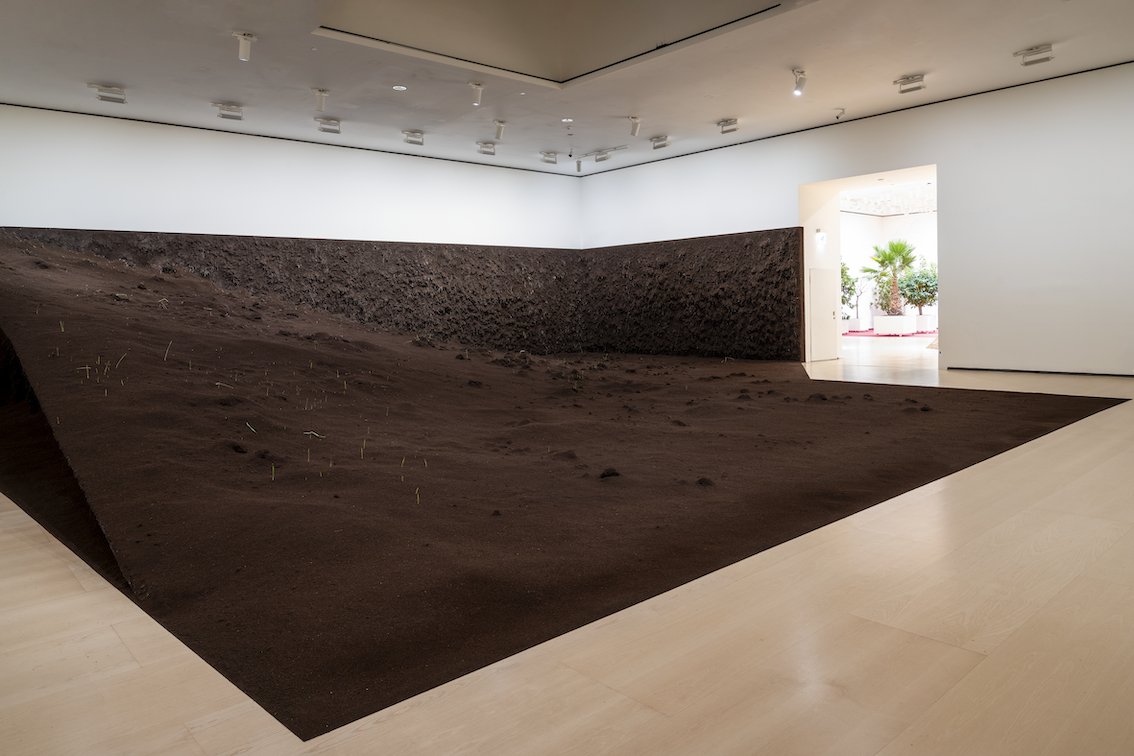
“The Arts of the Earth”, a new exhibition which opened at The Guggenheim’s Bilbao location in early December avoids becoming yet another show about the Anthropocene—an ever-present topic in many contemporary art institutions at the moment given the climate crisis. While the exhibition does address this issue; it is also full of hope, showcasing artists who—rather than waving a red flag signaling the coming apocalypse or taking a solastalgic1 stance— focus instead on the reconstruction and regeneration of ecosystems and what we might loosely refer to as “collaboration” with living organisms. “The Arts of the Earth” presents a major shift in the way that exhibitions are made, going far beyond the mere integration of the circular economy, the recycling or conservation of materials used to create the artworks. The Bilbao exhibition examines the entire artwork production chain, ranging from provenance, transportation and composition, including the potential for materials to not only be re-used, but also to regain their original, “natural” state once the show is over. Such is the case for some of the works which are more exemplary of this effort. For example, in works by David Bestué (Pomes, Xiprer, Barca, Barranc, 2021) and Asad Raza (Root Sequence (copse) 2017), the former of which is intended to return to the mud of the nearby rias from which they came; potted trees meant for reforestation once they have briefly sojourned in the museum-incubator for the latter. The exhibition has first and foremost had to give way to a scenographic upheaval—something the directors have referred to as a small revolution. Indeed, Sorcière (Witch), by Delcy Morelos takes up the entirety of one of the museum’s principal exhibition spaces; the work required a logistical and scenographic process combined with a gargantuan installation effort which included a hydrometric plan. Consisting of a soil-based surface, or ground measuring several square metres, the work has been propped up on wooden stilts made of recycled tree trunks. The most spectacular aspect of this spectacular piece is the aliveness of it, its emanations, which tickle the viewer’s nostrils. Environmental-themed artworks featuring living organisms existing within an installation in a museum are admittedly nothing new; this type of work has practically become cliché at this point. Sorcière operates on such a grand scale, however, giving the viewer the impression that Delcy Morelos has had a (small) mountain moved into the museum, one which is progressively becoming covered with a mossy blanket, creating an indoor countryside landscape.
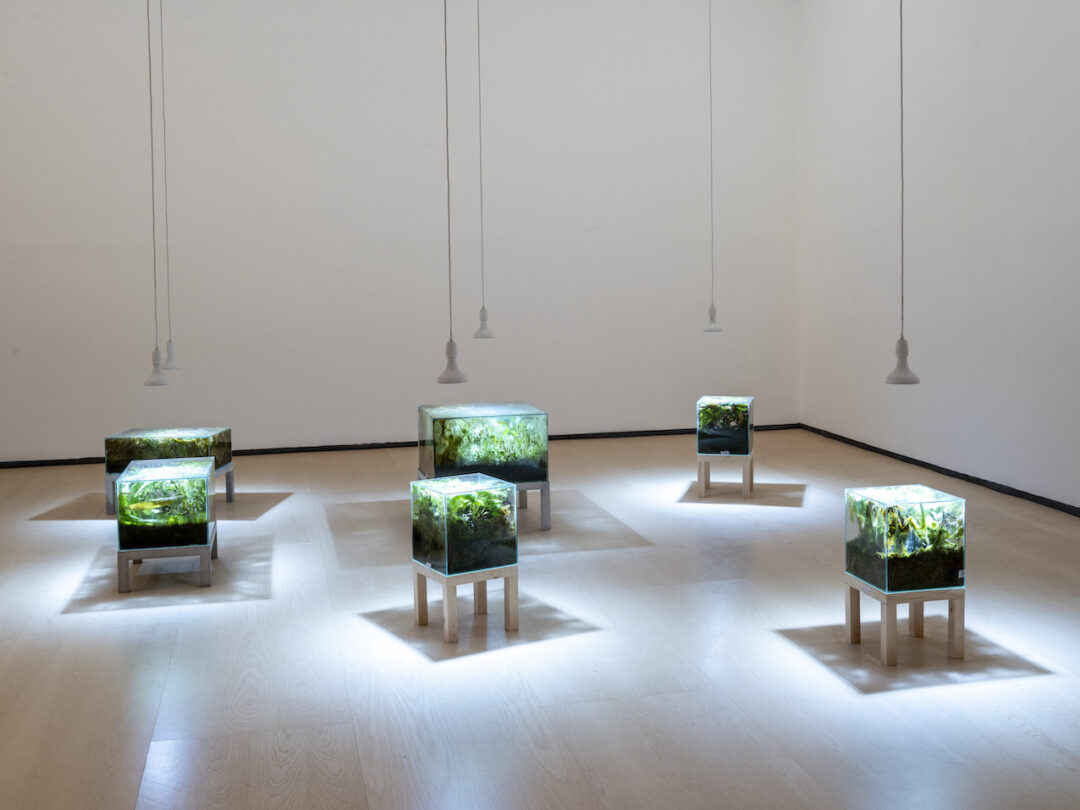
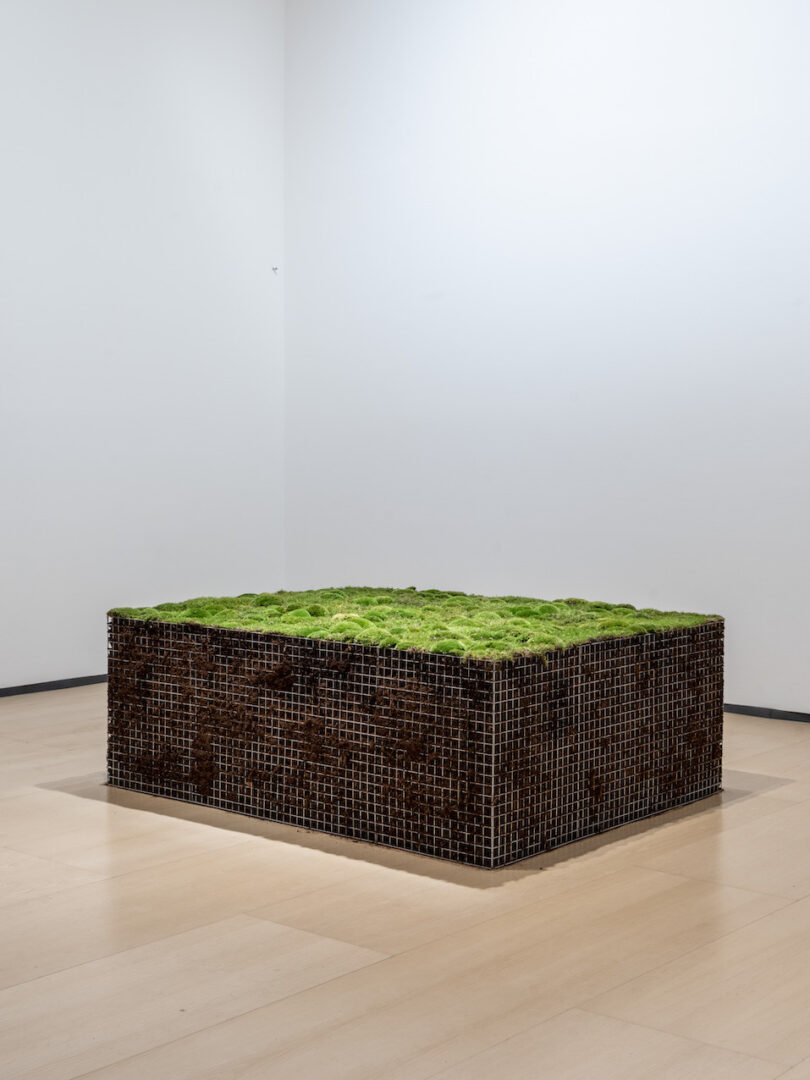
The idea of the “living” work of art is therefore the central line of questioning of this exhibition which addresses the Anthropocene in an understated way; it does this by highlighting principles such as recycling and reducing carbon emissions, going beyond mere slogans. At the Guggenheim Bilbao, early environmental practices reaching back to the 1960s such as those of Dennis Oppenheim, Robert Smithson, Richard Long and Joseph Beuys, of course, along with Michelle Stuart are included. The work of Ana Mendieta is given pride of place, revealing its fusional relationship with nature among this constellation of works. Meg Webster’s earth concretions and hay pyramid make a spectacular appearance, welcoming viewers to the exhibition, as do the works of Isa Melsheimer, encapsulating plants under glass as a testimony to the colonial predation of non-native plant species. Here, female and male artists both are on equal footing in terms of visibility as well as importance.
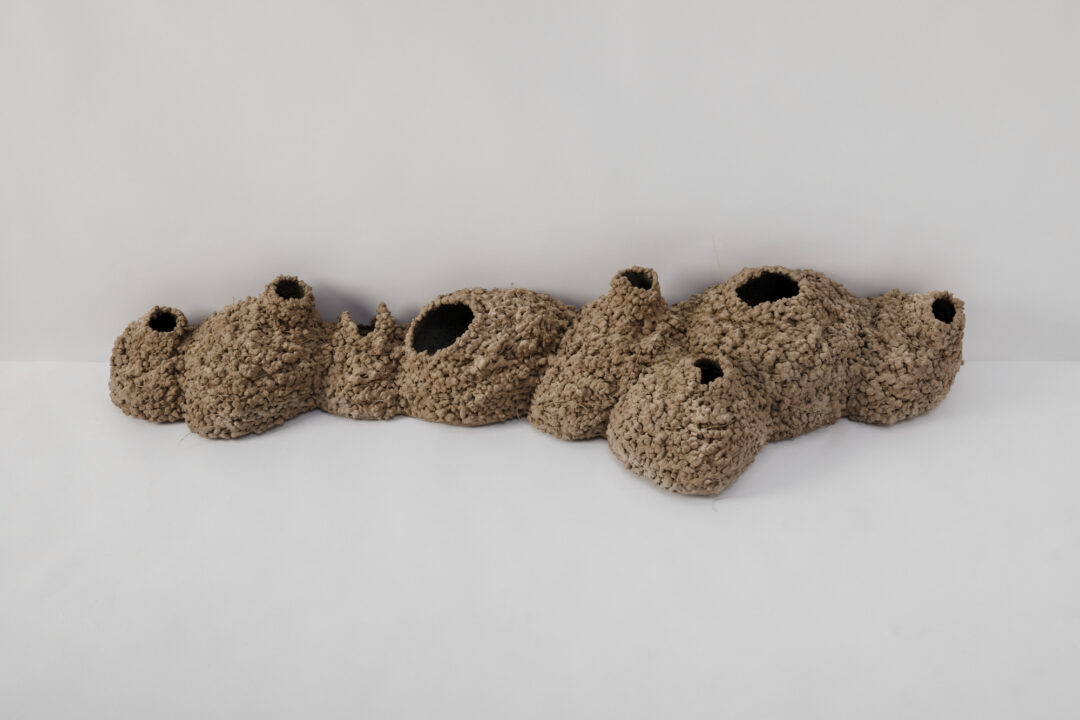
Mixed media, clay and straw. Variables dimensions. Courtesy of the artist & Travesía Cuatro,
Madrid. © Asunción Molinos Gordo, Bilbao 2025.
Natural choices for this exhibition based on works made of natural materials such as soil or clay include artists whose practices reference traditional techniques: Héctor Zamora and Oscar Santillán, whose Spacecraft (Venus) features clay pots lined up in a poetic and irreverent reproduction of an interplanetary spacecraft, while Zamora’s work systematically integrates the use of bricks—the very essence of earth-sourced material. María Cueto’s pioneering works are just as fitting for the exhibition, earth-friendly as their techniques are with their assemblages of wheat chaffs and branches gathered here and there. Other practices indirectly reference the role of domestic animals in the upkeep and resilience of soil—for example, the work of Asunción Molinos Gordo (A Thousand Milks/Strain), which were produced in collaboration with the Multur Beltz2 cooperative, near Bilbao, in the Karrantza valley. This partnership with a farming cooperative which uses wool from crossbred sheep challenges not only the supposed superiority of purebred races, but also the importance of sheep in the diversity of rural landscapes, the likes of which we often see depicted in “pictures” by the artist.
Molinos Gordo’s swallow nests have been placed at the beginning of the exhibition, adding a poetic note, attracting the viewer’s attention to places which are not typically used for display—in the corners between the ceiling and the walls—indicating the capacity of animals to create near-artworks. This engaging and subtle “collaboration” with living organisms—in this case with swallows, birds that symbolize a nomadic and fragile sensibility—opens up a dialog about animal welfare, one which is inextricable from our own, questioning art’s potential to influence consciences at a time when environmental concerns are at an all-time high. Other projects which were conceived for non-traditional display—Mel Chin’s Revival Field (1989-) for instance, is intended to depollute ex-industrial sites through the use of toxicity accumulating plants—can be considered a logical extension of an exhibition like this, where the idea is to allow for the natural environment to communicate with the museum, for the museum to communicate with its environment, in order to raise consciousness without having to make concessions with regard to form.
- Solastalgia is a philosophical concept developed by Glenn Albrecht which designates the feeling of distress and anxiousness which is felt by certain individuals faced with ecological changes.
- Multur Beltz is a rural cooperative and artist collective co-founded by Laurita Siles and Joseba Edesa in 2015. The cooperative organises workshops as well as art and design residencies.
Head image : Delcy Morelos, Sorcière (Sorgin), 2025. Earth and mud on a wooden structure. Variable dimensions. Courtesy Delcy Morelos & Marian Goodman Gallery. © Delcy Morelos, Bilbao, 2025
- Share: ,
- By the same author: Saâdane Afif, Global Fascisms, Geister, The Story That Never Ends, Modern Love at musée d'art contemporain d'Athènes,
Related articles
Biennale Son
by Guillaume Lasserre
Marcel Duchamp Prize 2025: alchemy and demiurgy, different perspectives on a changing world
by Anthony Ong
Condo London 2026
by Héloïse Chassepot