Global Fascisms
Global Fascisms
HKW, Berlin
September 13 – December 7, 2025
Curator: Cosmin Costinaș
How can fascism be exhibited? How can we bear witness to the rise of fascism in a Europe plagued by widespread anxiety, in a world ravaged by multiple attacks on democracy? Although the exhibition “Global Fascisms” was conceived a decade ago, when the issue of fascism was not as pressing as it is today, its occurrence in 2025 seems obvious. In the political context of Germany—a country where the Holocaust wreaked havoc and where the German far right is taking advantage of the collective amnesia that has swept over part of the population to revisit a very real history—a sense of guilt persists among democrats. Thus, talking about fascism and exposing it is not as easy as it is in other European countries. And although most countries were affected by this morbid impulse that shook the world in the middle of the last century, it seems that the lessons of history have been completely forgotten, giving free rein to the most violent racist, authoritarian, and segregationist rhetoric.
Far from seeking to downplay the responsibility of the German people and its elites in the creation of the National Socialist phenomenon, the exhibition “Global Fascisms” nevertheless leaves little room for German artists who were involved in denouncing this policy at the time, such as Hannah Höch, whose paintings before and after World War II bear witness to the rise of Hitlerism and the dramatic outcome it produced, with its millions of deaths and the fracturing of Europe into two antagonistic blocs, and Martin Kippenberger with his painting Heil Hitler Ihr Fetischisten (1984), which also participates in this return to history—in addition to the work of Austrian artist Maria Lassnig, Shafatt der Eliten (1995). These are the only two German artists who deal directly with Hitler’s fascism, but also the only ones who refer to Nazi history. Hence the feeling of incomprehension that can emanate from an exhibition dedicated to fascism, where the main episode of this dark history is so poorly represented, while the film work of the duo Jude & Cioflâncă, which brings together archive images and texts, documents in a frontal manner the roundup of Jews in Romania (The Last Train 1941 – Images and Testimonies, 2025). Admittedly, it is important to describe a phenomenon that engulfed the whole of Europe and not just Germany, but the overall impression is that what happened in Germany was no more serious than what happened in other countries.
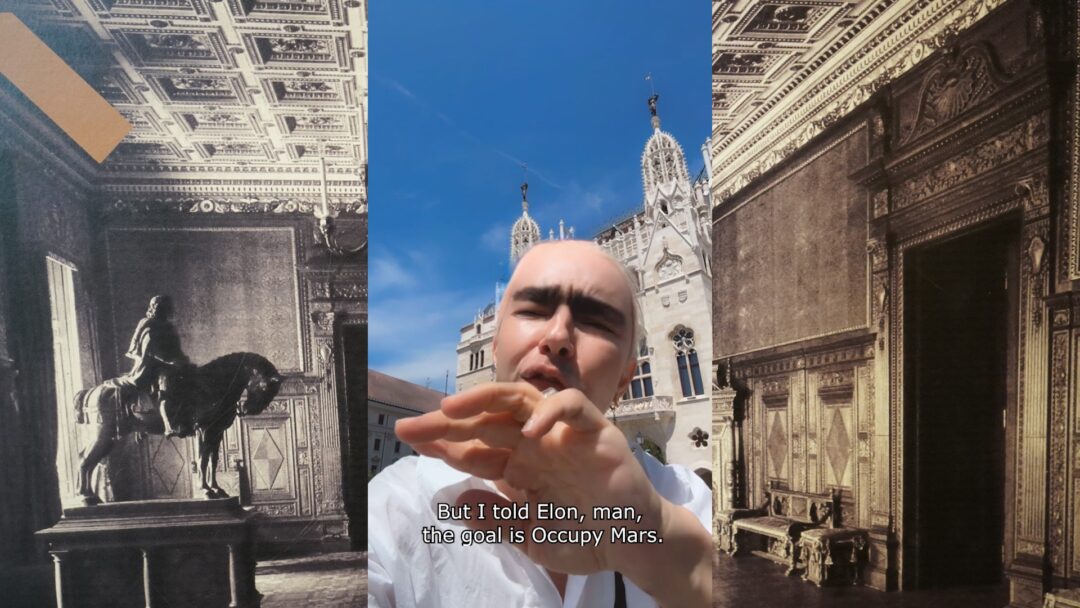
En collaboration / in colaboration with Ilinca Manolache (@ilincamanolache).
The curatorial decision not to focus on the main fascist episode in history, but rather to show the “universality” of a phenomenon that has its origins and explanations in multiple social, economic, and cultural factors, explains this oddity. The opening words of the exhibition booklet (which is distributed to all visitors) serve as a reading guide, quoting a passage from Michel Foucault’s preface to the American edition of Deleuze and Guattari’s L’Anti-Œdipe, which acts as a guideline, referring to each individual’s predisposition to accept morbid and destructive injunctions, preliminary to the establishment of fascist regimes (1).
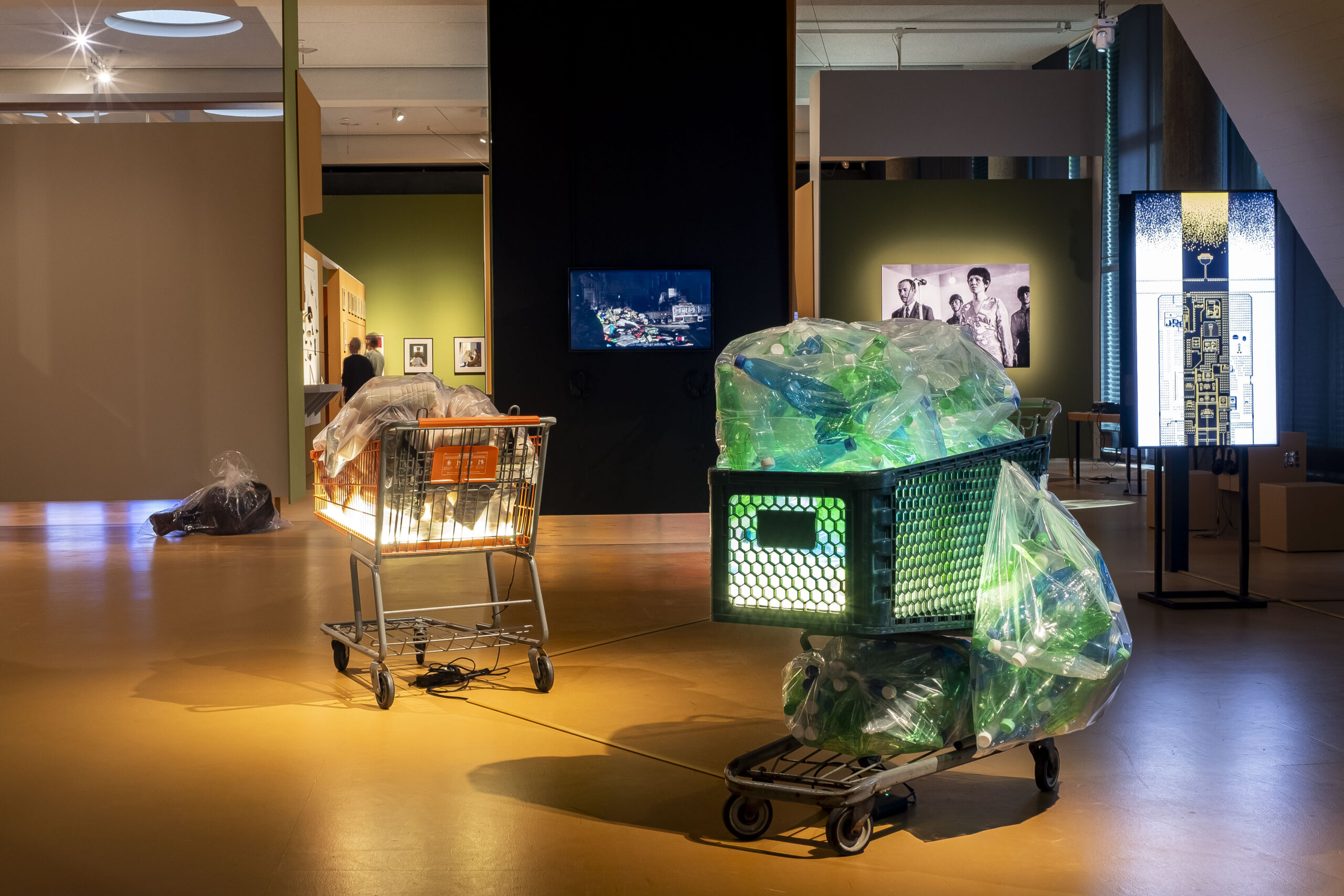
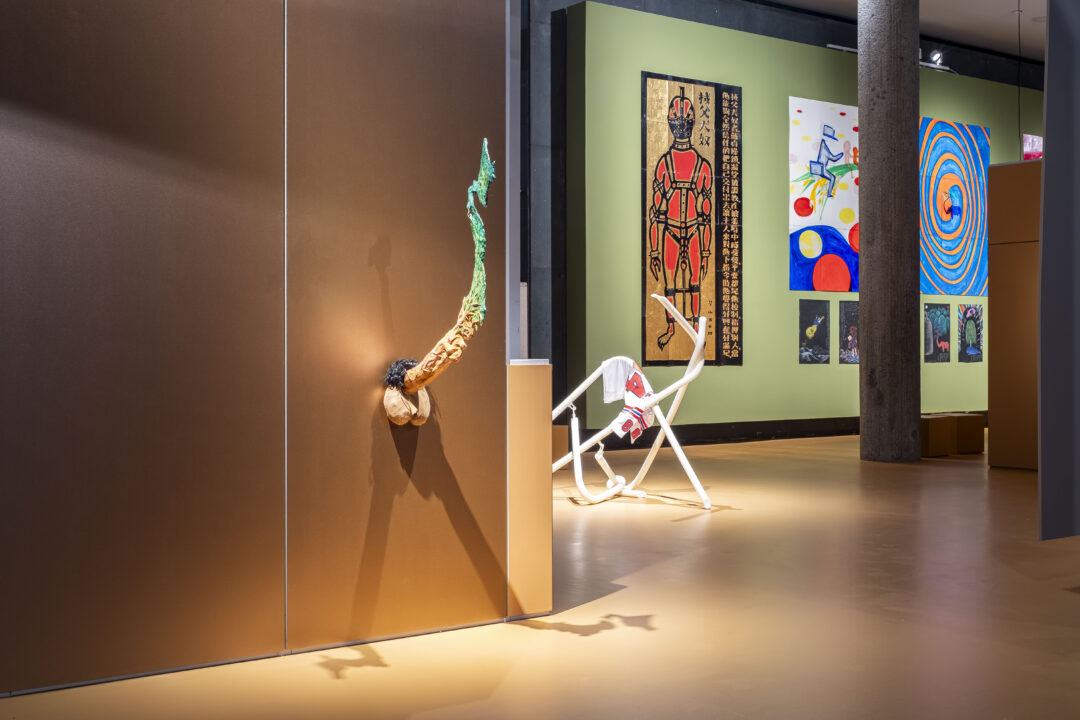
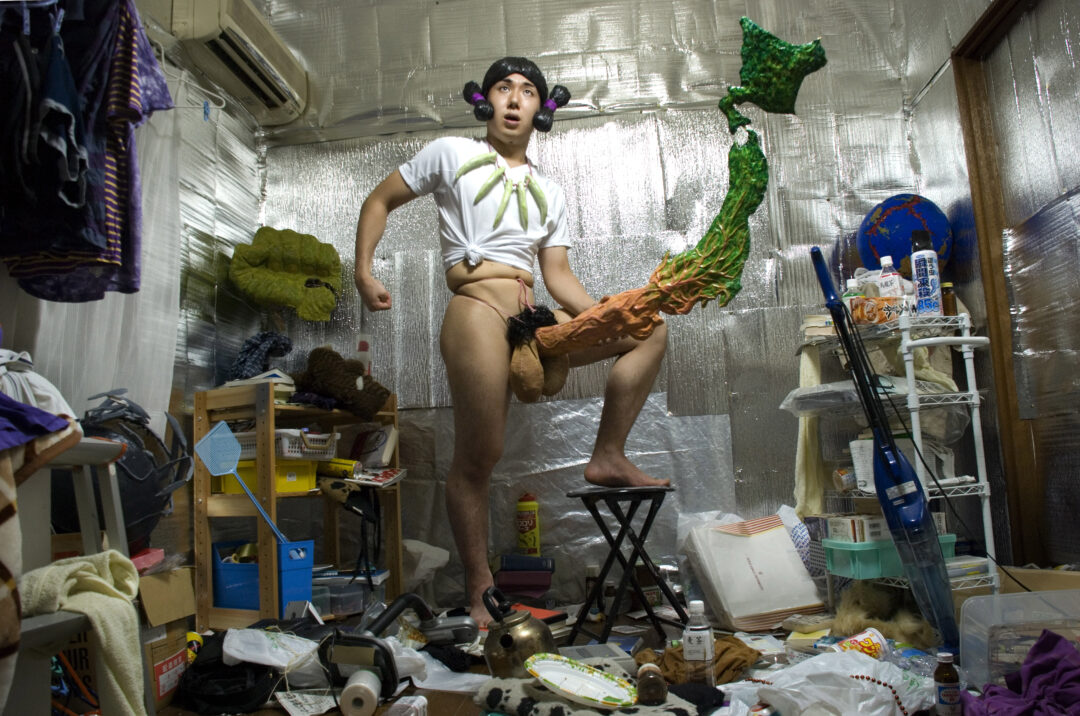
The exhibition exemplifies the causalities that favor this liberation of impulses, with the curator insisting that while socio-economic factors tend to resemble each other from one century to the next, they differ profoundly: major events would explain this new rise of fascism at the beginning of the 21st century, such as the 2008 subprime mortgage crisis and the 2020 pandemic, which would overlap with a widespread feeling of decline among the middle classes and impoverishment among the working classes, which a left entangled in its contradictions and missteps would be unable to curb. From the denunciation of a morbid but increasingly prevalent consumerism (Josh Kline, Desperation Dilation, 2016) to the devastating effects of predatory real estate development (Niklas Goldbach, Paradis Town from the series The Next Day), from the fabrication of a flawless body to the rise of masculinism (Matthew Barney, Patriot, 2024), the exhibition catalogues the issue in a way that is supposed to cover all aspects… without necessarily convincing, either in its analysis of causality or in the absence of strong denunciatory works, apart from perhaps that of Roee Rosen (Out (“TSE”), 2010) against a backdrop of self-flagellating exorcism, the exhibition dilutes itself into a smooth, but sometimes jubilant and offbeat journey, as shown in the video by Japanese artist Fuyuhiko Takata (Japan Erection, 2010). The recent congruence between US tech giants and the US far right also contradicts this historical reading, which sees a replay of the complicity between pre-war German industrial barons and their pro-Nazi tendencies: Elon Musk’s recent “slip-ups” only serve to reinforce this thesis. Similarly, the dominance of these giants over digital networks brings to mind the 1,600 media outlets owned by press magnate Alferd Hugenberg, who “actively worked to spread far-right ideas throughout the country”: In an article published in the online magazine AOC, Laurent Mauduit revisits the troubling similarities between our era and that of the last century, emphasizing the collusion between the dominant companies of the time and the Nazi parties, but also the destructive divisions within the German left (2).
[au centre / in the center] Matthew Barney, Patriot, 2024. Photo : Mathias Voelzke.
In the catalog for his exhibition at the Carré d’Art in Nîmes, Wolgang Tillmans questioned the rise of the far right in the affluent society of pre-Covid Germany… which did not prevent the AfD from establishing itself in the German political landscape at that time. In other words, socio-economic factors do not explain everything, and a prosperous society like Germany’s is not immune to such a drift, which left him perplexed. (3) A country like Russia, if it were not in the hands of a dangerous megalomaniac, could be the richest and most advanced country in the world; the US has long been a welcoming, advanced and envied power that attracts researchers and artists from all over the world, before Trump’s delirium seduced the crowds and led to an increasingly Orwellian state. The development of nationalist sentiment, often associated with the rise of fascism, is often based on the figure of a single man, the Führer (leader in German), who knows how to play, more or less consciously, on the buried cracks in the individual, fascism being, for Wilhelm Reich, “the fundamental emotional attitude of man oppressed by authoritarian machine civilization and its mechanistic-mystical ideology. (4)” The problem of the rise of fascism is also linked to the fear of the disappearance of the home (heimat), which the globalization of technology only accentuates or engenders: let us not forget that philosophers such as Heidegger supported this thesis in their time, which led to the development of the concept of the Third Reich, the outcome of which we all know. This feeling of loss of the notion of home is all the more relevant today, as new technologies have brought to a peak a feeling of not belonging to any historical territory. The rise of fascism could perhaps be explained by all these combined phenomena, which are not limited to social and economic factors, but also involve psychological factors that the exhibition, in our view, only touches on in a vague way.
How can we resist?
The underlying question posed by the exhibition is that of the barriers that need to be erected to stem the rise of fascism that we are seeing almost everywhere in Europe and around the world and which seems inexorable, even in countries that have experienced the consequences of this rise. The question of the effectiveness of warnings is also raised in an exhibition that attempts to focus primarily on describing the causes of evil, with the weaknesses described above, rather than highlighting the postures of resistance that are rarely deployed, such as the Instagram posts by actress Ilinca Manolache (@ilincamanolache) featured in the video by Mona Vătămanu & Florin Tudor (Ornament is Crime, 2025); artists use the same propaganda channels that appeal to young audiences and the same vulgar rhetoric as the promoters of this neo-fascism, successfully pointing out the excesses and aberrations of the latter, and using devastating humor and irony. The risk of an exhibition like “Global Fascisms” is that it devalues criticism, as the Japanese video does. When faced with aggressive postures, should we be content with allusive testimonies and distant references, however commendable they may be? This is a real question that shows the limits of contemporary art’s power to challenge, torn between the aestheticization of practices and the necessary political awareness of audiences.
Notes
1. “Flast but not least, the major enemy, the strategic adversary (whereas the opposition of Anti-Oedipus to its other enemies is more of a tactical engagement): fascism. And not only the historical fascism of Hitler and Mussolini—which so successfully mobilized and exploited the desires of the masses,—but also the fascism that is within us all, that haunts our minds and our daily behavior, the fascism that causes up to love power, to desire the very thing that dominates and exploits us”. Preface by Michel Foucault to the American translation of the book by Gilles Deleuze and Felix Guattari, Capitalism and Schizophrenia I: The Anti-Oedipus, in Michel Foucault, Dits et Écrits, volume III, text no. 189, 1976-1988, Paris, Gallimard, 2001 (1994), pp. 133-136. pp. 133-136.
2. Laurent Mauduit, “Chapoutot’s blind spot on Hitler’s rise to power,” in AOC, online magazine, September 17, 2025.
3. “In any case, there is never any logical correlation. It became clear to me that it is not a question of social groups or communities, but of individuals who are receptive to these authoritarian ideas. There is no cause, no cause-and-effect relationship inherent in a given socio-economic situation. You can’t say, ‘Here are the marginalized people.’ A West German lawyer has not suffered in any way from globalization: he is a wealthy individual who feels that his sense of self-importance has been trampled on.” Wolfgang Tillmans, interview with Carolin Emcke, What is different?, exhibition catalog, Nîmes, Carré d’art – Musée d’art contemporain, 2018.
4. Wilhelm Reich, The Mass Psychology of Fascism, Paris, Payot, 1998 (1942).
Head image : Ryan Gander, Tell my mother not to worry (ii), 2012. Une sculpture en marbre représentant la fille de l’artiste, Olive, faisant semblant d’être un fantôme en se couvrant d’un drap blanc / A marble sculpture representing the artist’s daughter, Olive, pretending to be a ghost by covering herself with a white bed sheet. Private Collection ; Anish Kapoor, London, Photo : Ken Adlard.
- Share: ,
- By the same author: The Arts of the Earth (Les Arts de la Terre), Saâdane Afif, Geister, The Story That Never Ends, Modern Love at musée d'art contemporain d'Athènes,
Related articles
Art-O-Rama 2026
by Giorgia Basili
18th Lyon Biennale
by Sarah Ihler-Meyer
Bianca Bondi
by Agnès Violeau