Saâdane Afif
Saâdane Afif
Five Preludes
Hamburger Bahnhof, Berlin
Curation : Gabriele Knapstein
Saâdane Afif ‘s “Five Preludes”, currently at Hamburger Banhof, is an exhibition in five sections, presenting the principles of an artist whose long-term approach and practice follows protocols put in place by the artist himself over the course of a career which has spanned from Paris to Berlin—where he is now based—and a close-knit community of artists with which he has become associated. Afif won the prestigious Duchamp prize in 2009; a decisive moment for this artist from Vendôme in particular, perhaps more so than for any of the other recipients whose emerging careers were similarly jump-started by the award.
For this enthusiast of the inventor of the readymade the prize was without a doubt a form of recognition for the artist, however it was also a form of childhood wish fulfillment—Afif began visiting Parisian museums at a precocious age, a fact which could be considered a prelude to a career born under the sign of the creator of the Fountain. The influence of Duchamp has yet to diminish to this day; in fact, for Afif, fountains remain a source of inspiration for an oeuvre which keeps the revolutionary spirit with which his predecessor imposed himself onto the art scene alive. In fact, Afif does not aim to challenge Duchamp directly, his tack is more tangential in the way that he draws parallels by accumulating representations of the acclaimed porcelain piece in art reviews and magazines, for example. The result is an overwhelming collection of reproductions of the piece which were patiently collected by the artist over the course of a years-long process of research which is still ongoing. One iteration of this research currently covers one of the walls of the Hamburger Bahnhof—a testimony to the urinal’s continued relevance and the diversity of references that have been made to the piece. Art reviews the world over have paid tribute to Duchamp’s most famous piece in the form of ingenious or otherwise laborious synonyms, wordplay and puns used to caption the reproductions; a quantity of which can nearly compete with the amount of ink which has also flowed attempting to put forth hypotheses about the symbolic interpretations of such a work. Of the five preludes, this is the one that most clearly captures the artist’s attention. In addition, the works in the preceding space—an actual library beneath glass casing containing books with reference to Duchamp—demonstrate the innumerable bibliography referencing the author of the Large Glass. It stands to mention that all of the preludes follow an identical protocol; they are all accompanied by lyrics, written by artists, singers, curators, friends, etc. commissioned by Afif, covering the walls of each space. If—as Duchamp famously claimed—the viewer creates the piece, for Afif, it is the multiplicity of this chorus of texts which makes the work, augmenting it by ramifying and performing it, given that the lyrics are meant to be sung during concerts which will take place over the course of the exhibition.
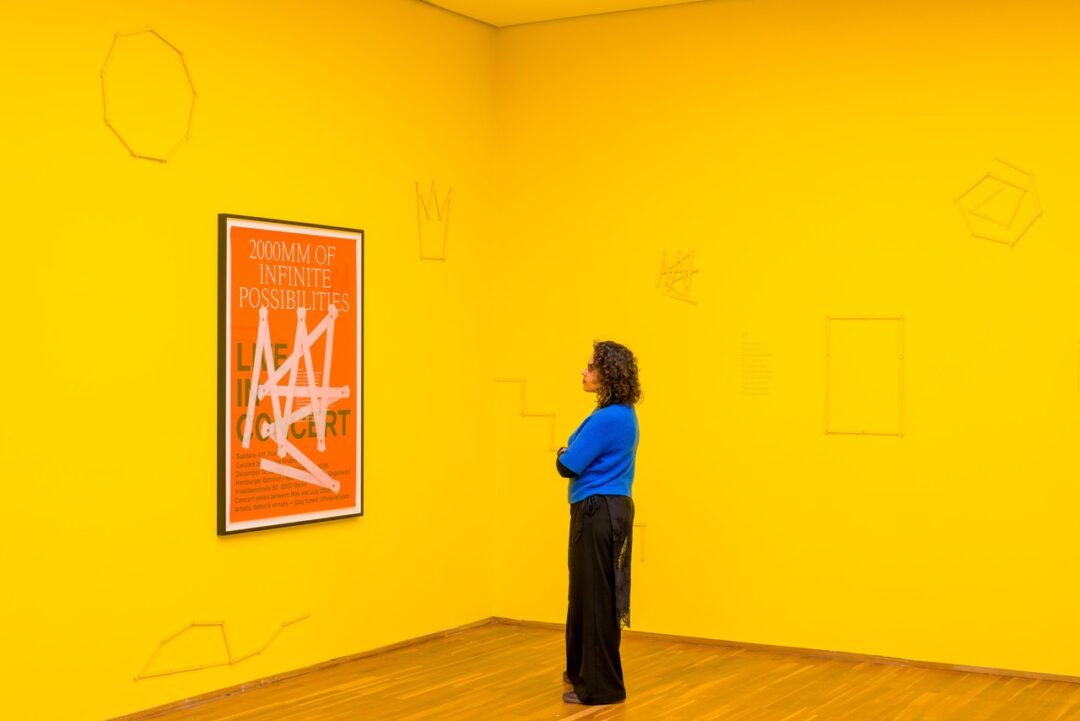
Before reaching this space, exhibition visitors will have walked through a monochromatic yellow one, where double metre rulers trace out stylistic depictions of animals, symbols and objects invented by a playful and childlike imagination. According to the artist, their purpose is to enable him to measure his imagination…however the work seems to more closely resemble an Oulipian project, where expression is allowed but within certain limits which have been imposed by the pre-existing folds and length of the object—a visual form of Oulipo. The lyrics are present here as well, inseparable as they are from the artist’s creative process. A poster has also been created for each space in partnership with a graphic illustrator who has chosen each accompanying image. Neither sculpture nor painting, the artist’s practice consists of inviting others to collaborate, of delegating and sharing research with them. Profoundly conceptual and post-Duchampian, Afif’s practice avoids producing more objects, however it does not refute their existence, either. The artist nonetheless operates within a second-hand rather than Amazon-friendly logic. The third prelude consists of an audacious and iconoclastic reinterpretation of Jeff Koons’ most renowned works in which the artist imagines their future and inevitable obsolescence. The Berlin-based artist revisits Koons’ 50-year-old vacuum cleaners sealed under Plexiglas —symbols of a triumphant United States; one of which their creator was a staunch supporter—reinterpreting them as the aging and dusty appliances they have become. Afif carries out a Picture of Dorian Grey process on them, revealing their declining potential for fetishism to us. The prelude is more memento mori than radical critique, melancholic than ironic, in that it unveils a form of societal decomposition.
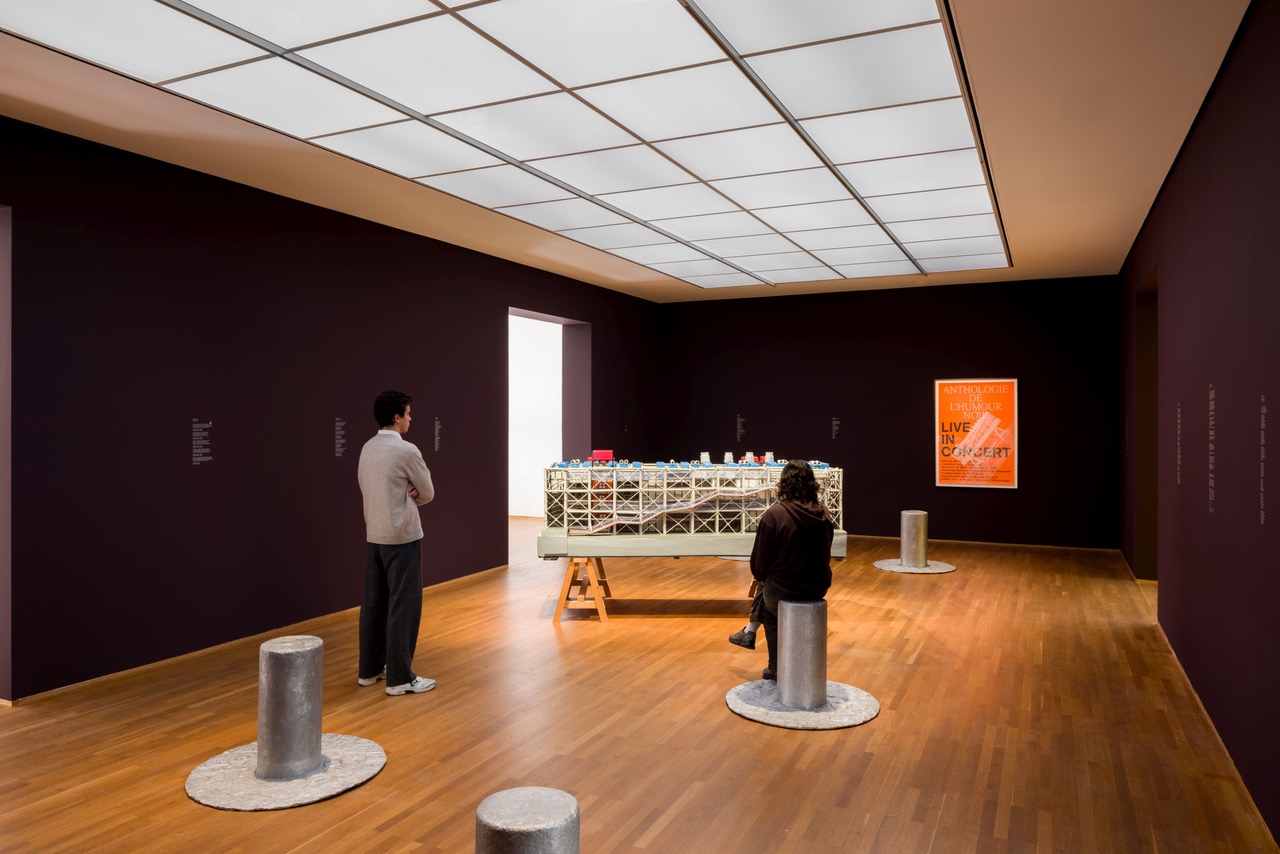
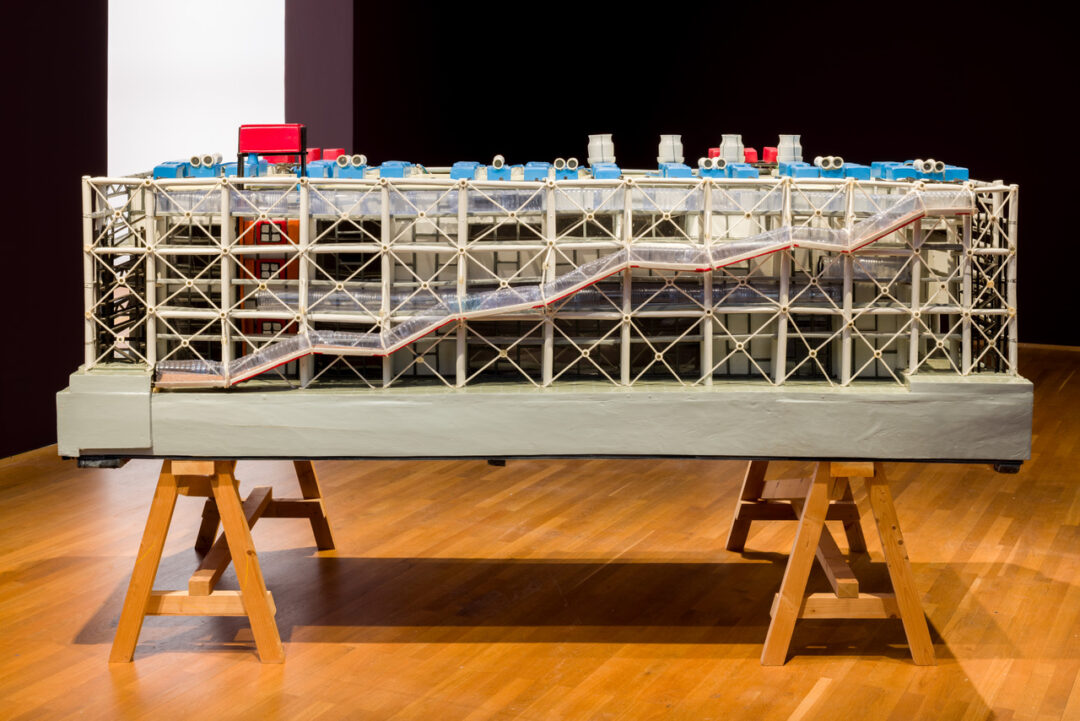
A coffin is never an easy thing to display, especially when it is so loaded with symbolism like that found in the fourth prelude—a similar method to the one used at the Pompidou, the Parisian museum which was so decisive for this artist’s career. This is the work which was shown there and which also earned him the Duchamp prize. At the time, the work had an incendiary effect as it could be interpreted—albeit rather simplistically—as a memorial for art, with the museum as a resting place for creativity, a mausoleum. This interpretation of the work as a form of provocation is difficult to avoid, just as it is to not label the artist with the term of iconoclast. This coffin which sits in the salle de l’humour noir,1 or Black Humour Room, can be interpreted as an homage to the eponymous anthology, as encouraged by the poster associated with the prelude which functions in the same way as the others, in order to provide clues as to the meaning of the works. The piece was made in Ghana, by coffin-maker Kudjoe Affutu, renowned for his work in the field. This model was made from found objects made of plastic, rubber as well as other detritus. Affutu’s practice coincides with the current period of decolonisation, and the artist’s commission is in fact in keeping with a general consciousness-raising occurring now in museums regarding this matter—a kind of effraction of “African Art” in this cathedral of Western culture.
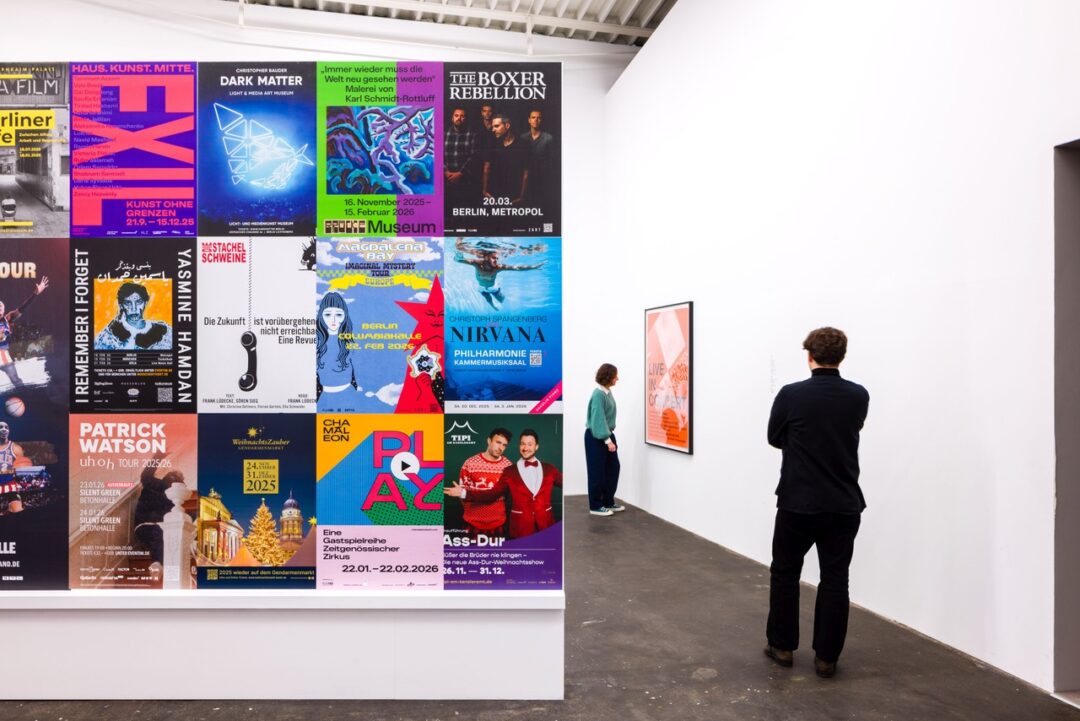
The last of the five preludes is located on the perimeter of the 1st floor at the Hamburger Bahnhof, in one of the successive spaces which outline the immense central hall: it consists of a monumental fence covered with posters advertising concerts, exhibitions and similar cultural events which have taken place in the German capital. This Berlin wall located in the centre of the museum will serve as yet another surface for the display of this type of document during the entire duration of the exhibition—a testament to an electrifying culture which persists in the face of threats of extinction, an extension to the effervescence of the outside world within institutional walls.
- A reference to Andre Breton’s Anthology of Black Humour; the definitive version of which was published by éditions Jean-Jacques Pauvert in 1966.
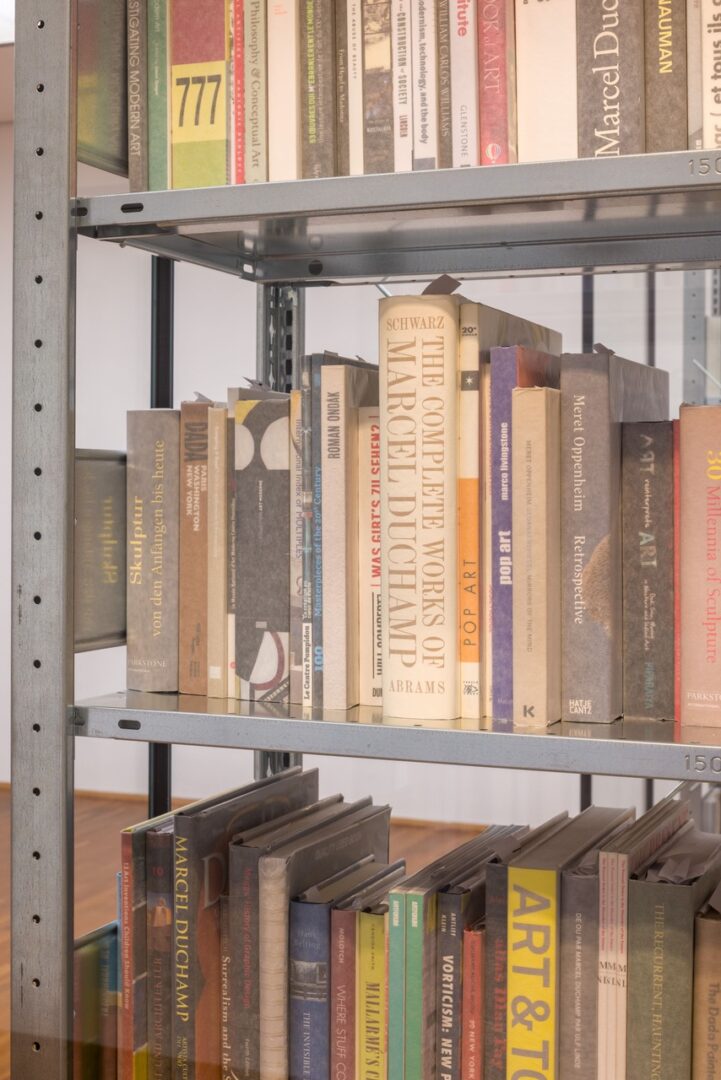
© Saâdane Afif, 2025 VG Bild-Kunst, Bonn. Courtesy de / of the artist & Mehdi Chouakri, Berlin. Foto: Jacopo La Forgia
Head image : vue de l’exposition / exhibition view « Saâdane Afif. Five Preludes », Hamburger Bahnhof – Musée national d’art contemporain, 12.12.2025 – 13.09.2026 Anthologie de l’humour noir, 2010 © Saâdane Afif, 2025 VG Bild-Kunst, Bonn. Courtesy of the artist & Mehdi Chouakri, Berlin. Foto: Jacopo La Forgia
- Share: ,
- By the same author: Global Fascisms, Geister, The Story That Never Ends, Modern Love at musée d'art contemporain d'Athènes, Interview Anne Bonnin,
Related articles
Biennale Son
by Guillaume Lasserre
Marcel Duchamp Prize 2025: alchemy and demiurgy, different perspectives on a changing world
by Anthony Ong
Condo London 2026
by Héloïse Chassepot