Ouassila Arras
Following her time at the Frac Champagne-Ardenne and Les Tanneries, as well as at the Künstlerhaus Bethanien in Berlin, Ouassila Arras is continuing her journey at the Casa de Velázquez, where she is developing the project ‘Day’man 3la Balak’; she is exhibiting at the Institut des Cultures d’Islam, alongside her fellow artists M’barka Amor and Dalila Dalléas Bouzar, until 26 July 2026, as part of the exhibition “Prolongations”, which explores the political and social dimensions of football.
Ouassila Arras’s work examines how the legacies of colonisation, the Algerian War and migration continue to shape the present. Rejecting any imposition of identity or demand for personal testimony, she seeks neither to illustrate her origins nor to produce an autobiographical narrative. Rather, her work explores the persistent traces of history: those transmitted through gestures, objects, materials, silences and ordinary ways of life.
Starting from the observation that these histories reach us in fragmentary forms, she develops a practice based on an attention to remnants, processes of transformation and embodied memories. The materials she employs for her exhibition at the Institut des Cultures d’Islam, as well as throughout her practice – carpets, rubble, plaster, fabrics, bricks, rust, henna and household blankets – are not symbols to be deciphered, but materials already imbued with past uses, bodies and social and political conditions.
Her installations make the contemporary effects of power relations perceptible: structural racism, forms of categorisation and erasure, but also the strategies of survival, adaptation and transmission that emerge in the interstices of official history. By working with fragments rather than through a unified narrative, she rejects any simplification or emotional exploitation of the experiences she addresses.
Her work thus offers a material and situated reading of memory, attentive to the way in which historical violence continues to operate within bodies, spaces and everyday practices.
In most of your work, you seek to bring to light what usually remains in the shadows, whether due to material constraints, censorship, segregation, or the desire of those involved to preserve an inner life that borders on dignity. Is it your intention to take the opposite stance to dominant modes of expression – such as those on social media, where the aim is to present one’s personality in an consistently positive light without revealing any form of vulnerability – that drives you? Should we see this as a critique of this ‘ultra-presence’, which, moreover, amounts to a form of perpetual performance of one’s personality and qualities?
I believe we must be wary of what is sometimes called ‘directness’. Very often, when an artist with a background in immigration, colonial history or working-class neighbourhoods speaks about their story, a certain kind of transparency is expected of them. They are expected to recount their origins, their family, their wounds, their traumas. A personal account is expected.
This expectation strikes me as deeply political, because it creates a situation in which certain artists are constantly reduced to their supposed status. They must explain where they come from before they can even say what they think. They must make their story legible, comprehensible and sometimes even acceptable to the gaze that observes them.
I do not work against ‘frontalité’. I work against categorisation.
I am the daughter of an Algerian labourer who came to help rebuild France. This history is fundamental to my life’s journey, but it does not sum up either my existence or my work. For a long time, I felt that the history of our families only appeared in the public sphere through narratives produced by others: the media, institutions, political discourse or school textbooks.
People talk about the Algerian War. They talk about immigration. They talk about integration. But they rarely talk about the concrete consequences of these histories across several generations. Little is said about the traumas passed down. Little is said about the silences. Little is said about everyday racism, the feeling of illegitimacy, or the difficulty of fully inhabiting a space that constantly reminds you that you are supposed to justify your presence.
This is where my work lies.
I do not seek to illustrate an identity or to dramatise a memory. I seek to observe what remains when the grand narratives fall silent. The objects kept in homes, the gestures passed down, the fragmentary stories, the forms of protection developed over generations. All these things often reveal more about colonial history than the official narratives that claim to have already told it.
If I work through allusions, fragments or shifts in perspective, it is not to sugar-coat the subject. It is because I refuse to consign these stories to a form of emotional consumption. I refuse to allow certain experiences to be reduced to their testimonial value or their emotional weight.
What interests me is not recounting an origin. It is understanding how history continues to inhabit the present, how it circulates through bodies, objects, domestic spaces and memories, long after the events themselves have disappeared from official narratives.
In the exhibition you are currently taking part in at the Institut des Cultures d’Islam, the reference to your Franco-Algerian origins is made in a detached, allusive, almost elliptical manner. Are you seeking, in this way, to distance yourself from a certain directness or theatricality—not without a touch of pathos—that is observed in certain artistic practices, but which corresponds neither to your sensibility nor to the restraint required to tackle such intimate subjects?
I do not think my work is a matter of distance, restraint or indirect form. It is not an aesthetic stance. It is not a way of sugar-coating things.
I take my starting point from specific historical and social facts: the Algerian War, colonisation, forced displacement, structural racism, and their repercussions in the present. These histories are not behind us. They continue to exert their influence on bodies, on social relations, on representations and on imposed categories.
What I observe is that these histories never reach us in the form of a complete narrative. They arrive fragmented. In bits and pieces. Through silences. Through objects. Through tensions. Through what has been silenced and what has been transformed.
It is from this reality that my work is built.
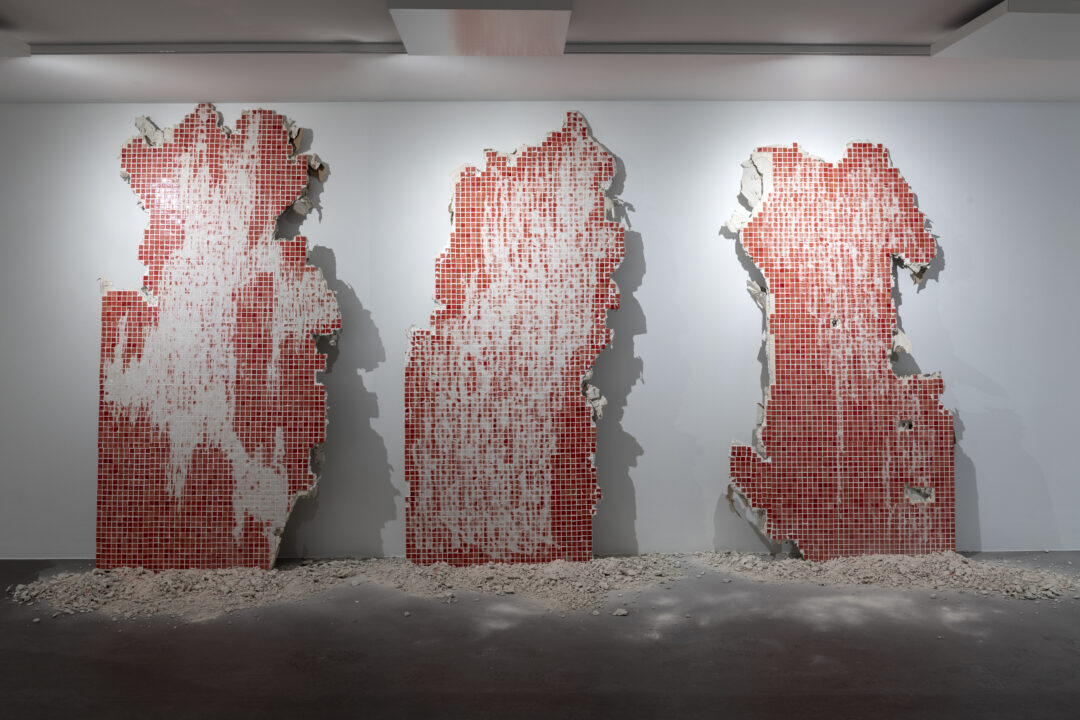
In Marques blanches, I start with very concrete actions: those of the building site and of care. Rubbing, scraping, building, plastering. Plasterboard and tiles are not neutral materials. They are linked to bodies that work, that wear themselves out, that endure under often constrained conditions. This is not a metaphor; it is a reality of actions and bodies.
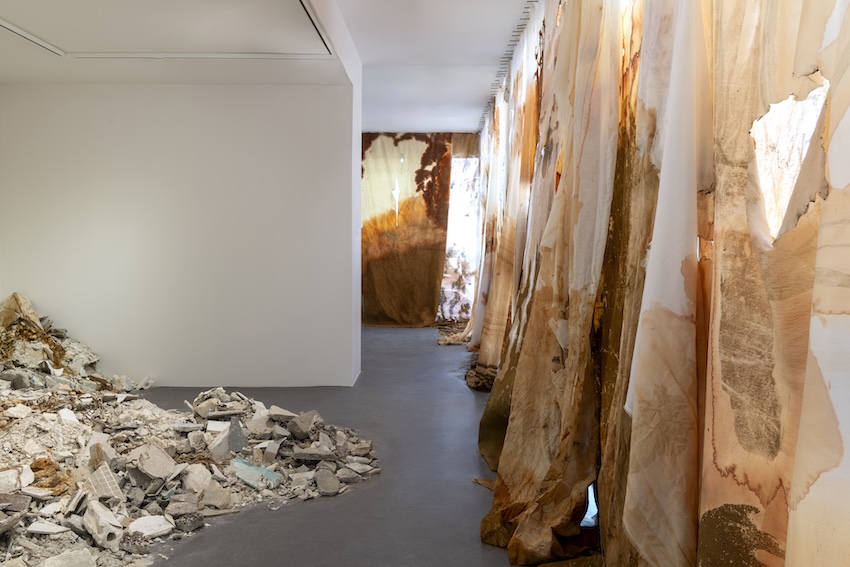
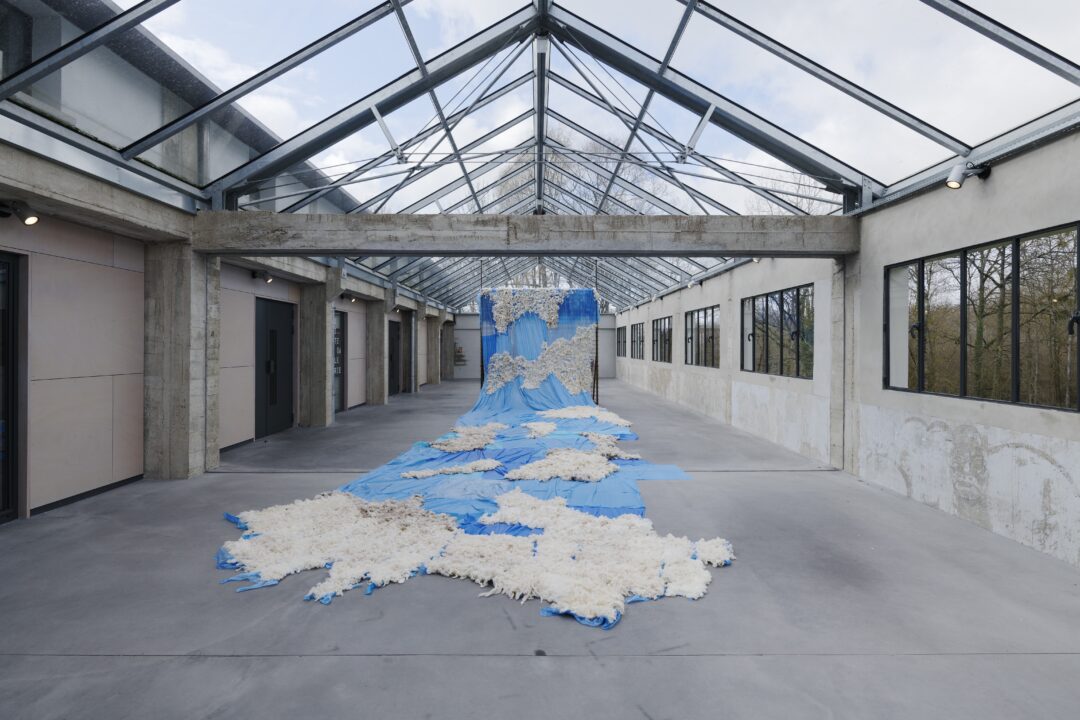
In Hagra, the rubble and ruins come from real building sites. They carry stories of demolition, disappearance and the transformation of cities. Henna runs through these materials. It is not decorative. It flows, it leaves its mark, it seeps in; it shows that even what is destroyed continues to act in other ways. Here, the issue is not symbolic: it is material and political. These are the remnants of worlds that have been displaced or erased.
In Tissus de mensonges, the fabrics, rust and nails stem directly from what the material itself allows: oxidation, slow transformation, decay. The work does not consist of recounting family or social histories, but of showing how narratives themselves are constructed, distorted, circulated, and sometimes used to organise power relations, hierarchies, forms of silence or alienation.
I do not work with memory as a stable or nostalgic object. I work with what it does. With what it still produces today: effects of violence, classification and rejection, but also forms of survival, adaptation and fragmented transmission.
The Algerian War and colonisation are not events that have been brought to a close. Their legacy is visible in contemporary forms of racism, in the way certain groups are still categorised, stigmatised or kept at a distance, even when they form an integral part of this country’s social history.
I do not seek to transform these realities into a unified narrative. I reject such simplification.
I work from their actual traces, as they still exist today.
Following your training at the Beaux-Arts in Reims and your first exhibitions at the Frac Champagne-Ardenne and Les Tanneries, you chose to settle in Berlin, a metropolis you describe as ‘culturally dense’ whilst, paradoxically, emphasising its accessibility. Today, it seems that living conditions in the German capital have deteriorated, with rents now not far removed from those found in major European capitals, whilst the city’s artistic appeal has also diminished. Furthermore, the perspective of German political and cultural institutions appears to be largely dictated by historical guilt towards the Jewish people, hindering an objective understanding of events in the Middle East, particularly in Palestine. How do you experience this situation, and does it influence your work, either personally or artistically?
I did not move to Berlin as a form of exile, nor out of a desire to break away, nor as a subjective experience of displacement. My move was driven by very practical working circumstances: after studying at the École des Beaux-Arts in Reims, my first exhibitions – notably at the Frac Champagne-Ardenne and Les Tanneries – led me to travel back and forth between France and Berlin, before a residency at the Künstlerhaus Bethanien cemented my presence there. At the time, Berlin was a vibrant cultural metropolis, brimming with diverse scenes, where it was still possible to work, to meet artists from different backgrounds and to find accommodation, even amidst a precariousness that was already noticeable but still manageable.
This vibrancy stemmed not only from artistic vitality, but also from a particular configuration of the cultural landscape, where movement between local and international scenes was still relatively open. This situation has changed with the worsening of the housing crisis and the increasing precariousness of living conditions, which have gradually made it much more difficult for many artists to gain access to the city and maintain a sustained presence there.
But beyond this material dimension, what has also become apparent is the way in which certain institutional structures produce both forms of visibility and forms of authority that strongly frame artistic practices. In the German cultural field, as elsewhere, there are regimes of legitimacy that are not merely explicit, but which organise what can be shown, supported and heard. In some cases, this organisation takes the form of institutional rigidity and normative authority that do not correspond to the way I work or to the way I understand the circulation of artistic practices.
In this context, what I have observed in Germany – and more specifically within the institutional and cultural sphere – are the mechanisms for framing discourses that are particularly sensitive to certain political issues. Certain statements quickly become problematised, not only on an individual level, but in their very ability to circulate within institutions, to be programmed, exhibited or supported. This produces concrete effects in terms of the hierarchisation of discourses and, in some cases, forms of marginalisation or distancing of certain artistic positions.
When it comes to Palestine, this is not a matter of debate but a fact. It is a situation of massive, well-documented violence, resulting in large-scale destruction and loss of life. What I have observed in Germany is that, within the cultural sphere, this situation is accompanied by forms of framing and filtering of discourse, which directly influence the conditions under which certain statements can be seen and sustained.
This does not directly determine the content of my work, but it reveals the conditions under which it is produced. My work does not consist of illustrating these contexts or responding immediately to current events. It is constructed outside the logic of reaction, with a focus on the long-term structures that continue to produce forms of inequality in visibility and recognition even today.
It is for this reason that my research is rooted in deeper temporalities: the history of domination and its continuities, those of racism, forms of stigmatisation, and the fragmented narratives arising from these histories.
Berlin is not the subject of my work. It is a space where these structures become particularly evident, notably through the ways in which they organise the visibility, circulation and legitimisation of artistic practices, and where they also reveal forms of institutional authority and normative rigidity that have a tangible impact on the conditions of artistic production.
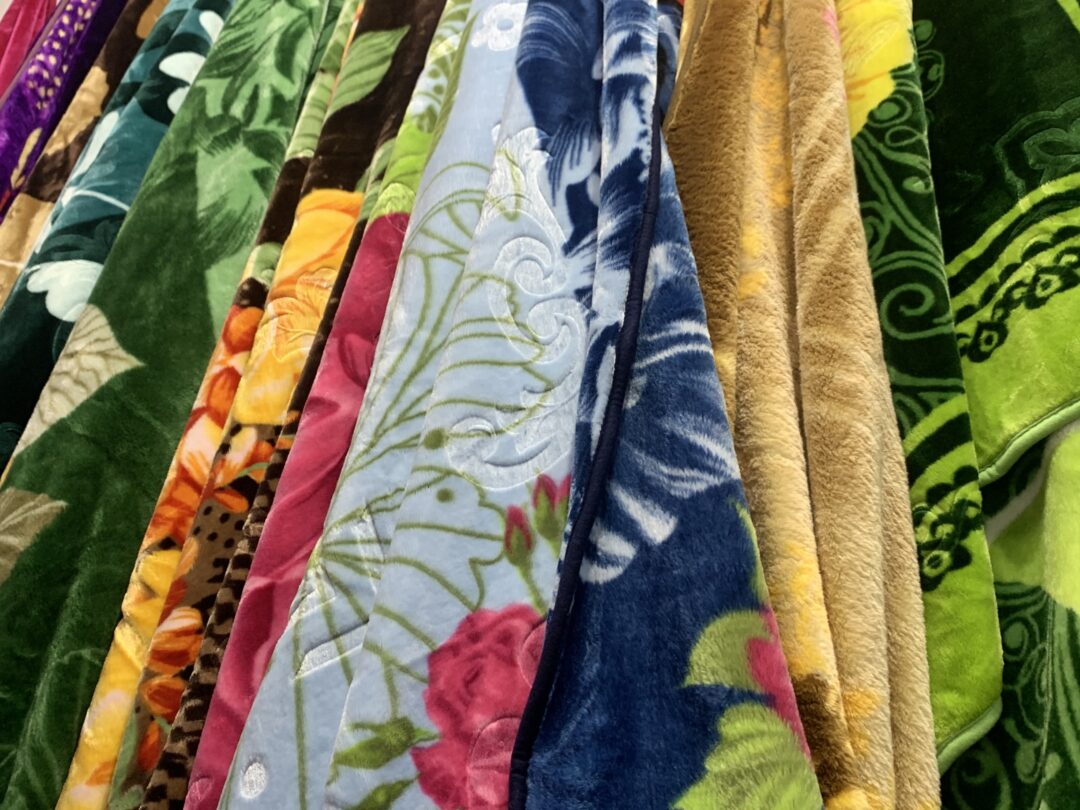
For the ‘Day’man 3la Balak’ project you are currently undertaking as part of your residency at the Casa de Velázquez, you are repeating a method you have used in the past: that of employing a symbolically charged material or object to highlight the cultural and emotional residues attached to them. In this instance, in Madrid, it is the faux velvet blankets that evoke their presence in the homes of people from immigrant backgrounds. These exploratory approaches, which enable you to connect with these individuals, also serve as a pretext for collecting narratives that will enrich your reflection. What form will this research—which intertwines the symbolic, the political and memory—ultimately take?
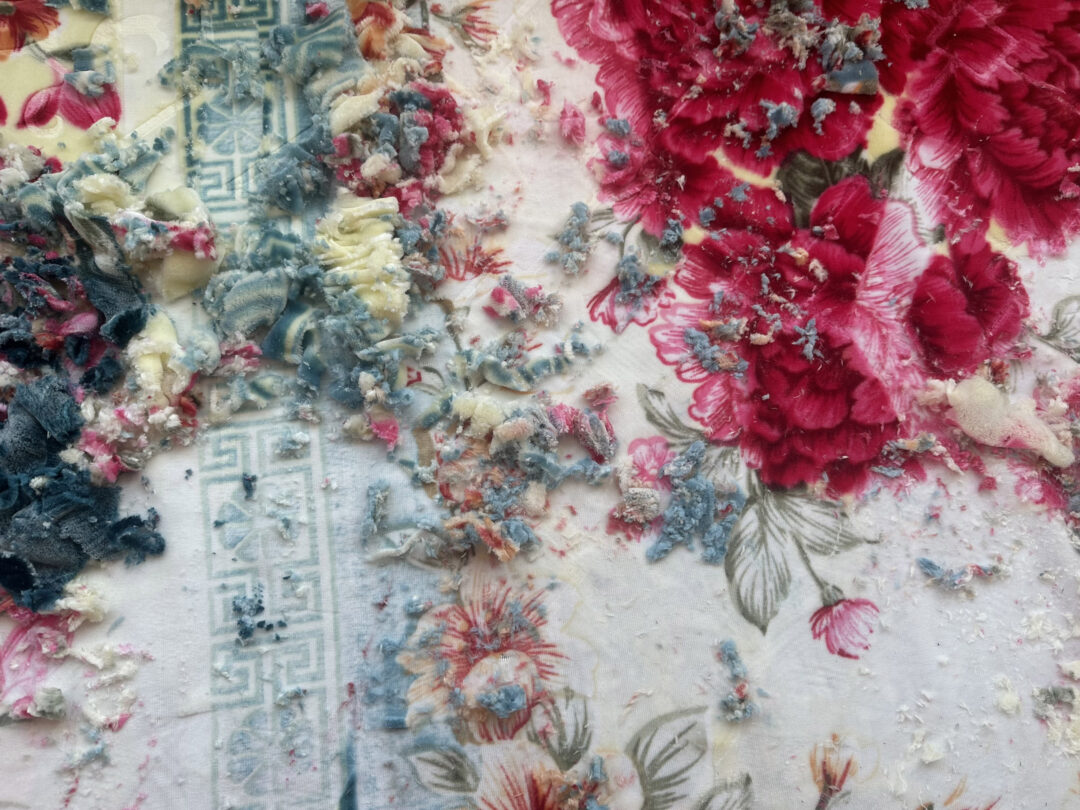
In ‘Day’man 3la Balak’, the aim is not to start with objects laden with symbolism nor to produce an interpretative reading of the materials. What is at stake are materials already imbued with uses, gestures and life stories, where memory is not represented but embodied, fragmented, and sometimes suppressed.
In the context of Madrid, the faux velvet blankets are not viewed as objects to be decoded. They belong to domestic environments, circulate between households, and carry with them patterns of use linked to experiences of settling in, moving and adapting. It is in their very materiality, in what they have already been through, that something reveals itself.
The work is not based on a collection of narratives, but on situated encounters, where speech, when it emerges, is linked to concrete life experiences rather than to a desire for representation or storytelling. It is not a question of producing an archive or stabilising testimonies, but of remaining as close as possible to what is said in a fragmentary, discontinuous manner.
What matters to me is not to articulate the symbolic, the political and memory as three distinct registers, but to work from their existing interweaving within gestures, bodies and materials. Memory is not a separate entity: it circulates through everyday practices, through repetitions, through forms of wear and attention.
Within this framework, the artistic gesture does not consist in representing, but in working with the material itself as a site of tension. Shaving, scraping and weakening the blankets is not about producing an image of memory, but about shifting forms of use and making visible areas of erasure and resistance.
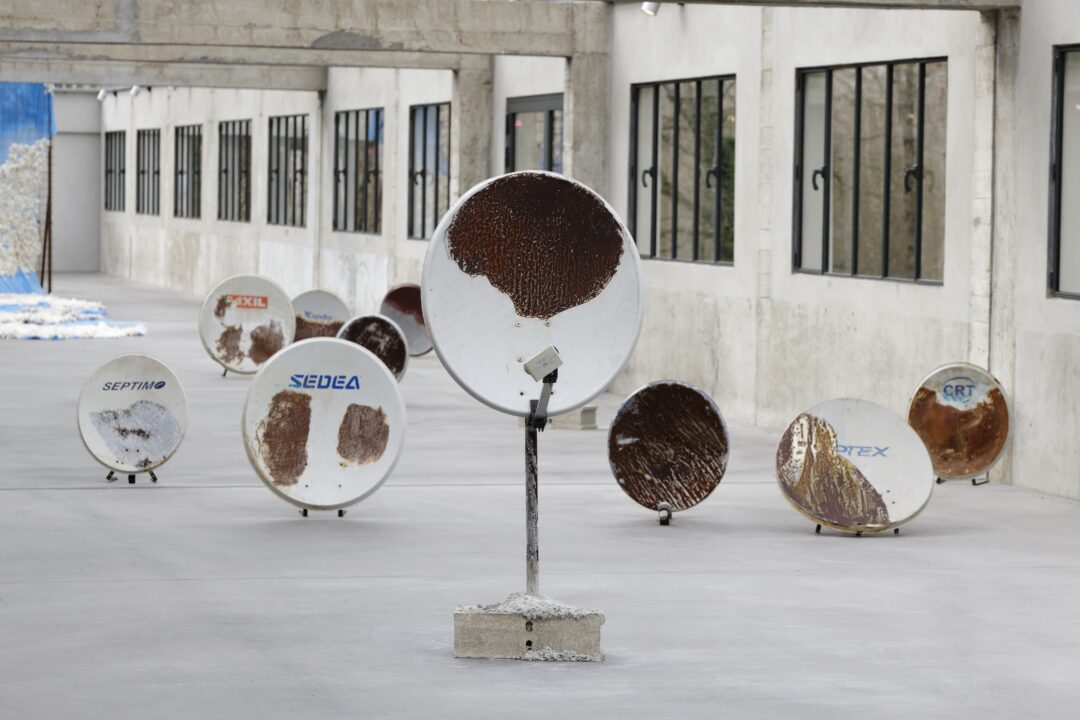
The installations extend this logic by creating unstable situations, in which the viewer’s body is engaged in a physical movement through materials that hold together and come apart. This instability points to forms of existence that do not easily stabilise, that adapt, shift, and remain in tension with their own inscription.
The final form of the research is therefore neither a synthesis nor a continuous narrative. It takes the form of a collection of traces, gestures and materials that maintain a fracture, and which refuse to close off that which, in these experiences, remains discontinuous, fragile and in a state of transformation.
In your most recent projects, such as the Casa de Velázquez, one gets the sense that you have broadened the scope of your formal reflections—which, at the start of your practice, were more closely tied to a personal history—to now encompass a ‘generic’ reflection on the question of the diaspora, with all that it entails in emotional, intimate and political terms: through this mapping of migration, are you seeking to identify universals – a sort of common ground in terms of distance, uprooting, but also memory and cultural persistence – or are you more concerned with describing specific stories?
I do not see myself as situated within this dichotomy between a so-called ‘generic’ approach and a ‘particular’ one, nor am I seeking universal themes linked to separation or uprooting. These categories imply a conceptual distance that does not correspond to the way my work is structured.
What runs through my projects is not a reflection on migratory phenomena viewed as a homogeneous whole, but rather a focus on concrete situations, where ways of life, work, movement and transmission emerge within specific contexts. It is these situations that give rise to resonances, without the need to transform them into a general model.
The shift from certain references more directly linked to a personal history towards contexts such as that of Madrid does not stem from a desire to broaden the scope towards a global ‘diasporic’ interpretation, but rather from an encounter with other spaces, other materials and other forms of daily life in which similar issues of movement, settlement and the material conditions of existence are replayed.
What interests me is not to produce a cartography of migration nor to identify a common thread in the experience of displacement, but to work from gestures, objects, materials and situations in which these experiences manifest themselves in a fragmented, sometimes silent, often discontinuous manner.
Within this framework, narratives, when they do appear, do not serve to construct a comprehensive or representative interpretation, but to make experiences perceptible in their situated complexity, without homogenising them. My work therefore does not seek universality, but focuses on the concrete conditions in which ways of life stabilise, shift or transform.
What may produce echoes between different contexts does not stem from a general principle, but from the repetition of certain material and social structures which, in different places, organise experiences of visibility, invisibility, adaptation or displacement.
Will the next stage of your work focus on transatlantic diaspora phenomena, for example, or will you seek to maintain this connection with your own history, which links you to the Mediterranean?
I do not conceive of my work in terms of unlimited geographical movement or an automatic opening up to spaces across the Atlantic. Fieldwork choices are not neutral: they involve political, social and institutional conditions that directly influence the way in which research can be carried out.
I did indeed begin a research project in Chicago a few years ago, but this type of project cannot be detached from the contexts in which it is situated. Today, the United States is a country riven by extremely intense political, racial and social tensions, which also give rise to highly restrictive institutional and discursive frameworks. In this context, this is not a matter of moral or emotional rejection, but rather an observation regarding the current conditions of work and mobility, which do not, in my view, provide the right conditions to pursue this type of research fairly.
More broadly speaking, I do not subscribe to a logic of displacement that would treat ‘transatlantic diasporic phenomena’ as a natural or desirable research focus. This kind of categorisation often perpetuates an interpretation that is disconnected from the actual power dynamics structuring these spaces.
Today, I focus my work on the Mediterranean region, not as a retreat, but as an active historical and political field. It is a region shaped by colonial legacies, labour flows, and forced or economic displacement, but it is also a region marked by very contemporary forms of racism, bodily control and the hierarchisation of lives. It is here that the structures I am studying are most immediately apparent and active.
This choice is not about identity. It is methodological and political: to remain as close as possible to the spaces where power relations are visible, and where the material conditions of life, movement and transmission can be observed without being diluted in a global abstraction.
This does not rule out future research in the United States, Brazil or Canada. But such trips can only take place if the conditions for work, travel and critical engagement genuinely permit them. It is not a question of broadening a geographical scope, but of choosing contexts where the work retains its coherence and necessity.
This article was published with support from the ¡Viva Villa! fund, a network of French artist-in-residence programs abroad.
Head image : Ouassila Arras, Tissus de mensonges, 2026, various fabrics, rust, seawater, henna, rusty nails. variable dimensions photo : Marc Dommage, Institut des Cultures d’Islam, Paris, 2026.
- Share: ,
- By the same author: The Theatre of Cruelty (Theater of Cruelty), Vanessa Theodoropoulou, Chris Sharp,
Related articles
Mai-Thu Perret
by Gabriela Anco
The Theatre of Cruelty (Theater of Cruelty)
by Patrice Joly
Interview with Perrine Lacroix
by Mya Finbow