Mai-Thu Perret
« Blazing Worlds »
A conversation with Mai-Thu Perret
By Gabriela Anco
—
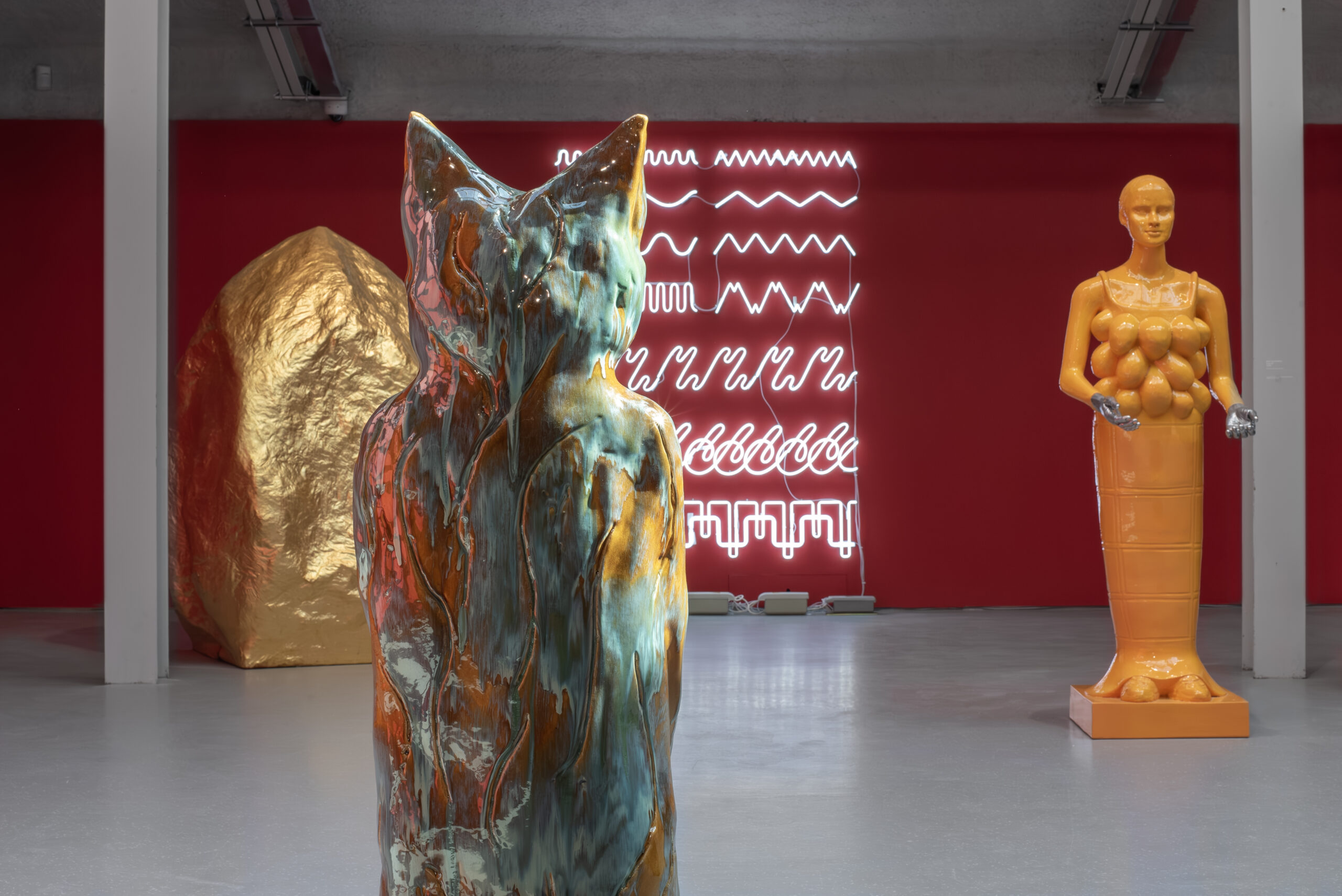
There is something radical about the way Mai-Thu Perret builds her artistic world, pushing the boundaries of creative ownership. Over more than two decades, she has developed a practice that moves between fiction and history, sculpture and performance, mythology and materiality, often through a kind of productive indirection: characters are conjured so that their work can be made; lost performances are reconstructed from a handful of photographs; ancient goddesses are reassembled, stratified, returned to a complexity the patriarchal record stripped from them. We spoke to her within her exhibition Othermothers taking place at the Centre Culturel Suisse about utopia, witches, and women’s presence in the current discourse.
Stories
GABRIELA ANCO: I’d like to start with stories, I have the feeling that’s where everything begins for you. Throughout your career, there are always several threads leading to different worlds.
MAI-THU PERRET: Yes. I’ve always been interested in all sorts of things: countercultures, communal movements, that kind of thing. Here’s a story: at one point I took a trip to New Mexico with Olivier Mosset, John Tremblay, and others. We passed through Marfa and then visited Arcosanti. It’s an ecological community founded by the Italian architect Paolo Soleri, who had this whole vision of circularity, ecology, and so on. They built their ideal city in the desert.
GA: When does it date from?
MTP: I don’t remember exactly. I think the community was founded in the 1970s. A utopian city. And all utopian projects are always a little bit on the edge of totalitarianism. There are so many rules. You arrive there and everyone spends their time selling you Soleri’s brilliant vision. A lot of the people living there are interns who come for a few months to help build the city. They also finance the community by selling bells designed by Soleri, which you find in design stores.
I remember John Tremblay and I looking at these bells, and there was something almost cult-like about this supposedly perfect communal vision. People tell you they’re completely free, but you don’t really get the feeling that they are. At one point, a guy was explaining to us that in the workshop they could design patterns, modify the bells, and so on. And John asked him:
“So you’re free? You can do whatever you want?”
And the guy replied:
“You can make anything, as long as it’s a bell.”
GA: (laughs) That’s still a pretty limited kind of freedom.
MTP: Exactly.
But I think there was also something deeper. At the time I was making abstract paintings, which I still love and still practice. And I was always a little embarrassed by how arbitrary the choices felt. Why this rather than that? In my work, I wanted some kind of filter, some distance, rather than just the arbitrariness of personal taste. Having only your own taste as a compass wasn’t enough for me. Deep down, the question was always: how do you begin?
GA: And what became that compass?
MTP: I thought that if I invented characters and the works became their works, I would be freed from the obligation to talk about myself, to tell my own story, or to make things according to my personal taste. I create the characters, and then they’re the ones who make the works.
I liked that distance. It also came from conceptual art—the idea of the idea as a machine that makes art. So I started writing the story of these women in the New Mexico desert—Crystal Frontier—and making the objects they produced.
GA: So these women are entirely fictional.
MTP: They don’t exist. Of course, it’s inspired by real cases, books, or communities that actually existed, but it’s completely fictional. And I like the fact that there’s always some uncertainty.
The Blazing World
GA: Tell me about The Blazing World.
MTP: The Blazing World was an exhibition I did at Spike Island, in Bristol, in 2018. The title comes from a book by the Duchess of Newcastle, Margaret Cavendish, an extraordinarily learned seventeenth-century aristocrat. She wrote, hosted a salon, and moved among the intellectual circles of her time.
She imagined a completely fantastical world. It’s almost a science-fiction novel before its time. A young princess sets sail, drifts toward the North Pole, and arrives in another world populated, among others, by scholarly polar bears. And all these characters recognize her as the most intelligent among them: as their queen.
In her own society, as a woman, she occupied an inferior position. So she writes in order to compensate for that.
GA: Siri Hustvedt also wrote a book called The Blazing World, about a woman artist who was never really recognized and who, late in life, has male artists sign her works. She lets herself go and starts creating works completely different from what she used to make. Like your characters.
MTP: Yes, that’s interesting. I think there’s something along those lines. When I started working, it was the era of queer theory, feminism, postcolonial studies, the whole question of identity politics. And I have to admit that, at the time, I wasn’t really approaching things in that way. Today I have a different relationship to autofiction, but back then I really didn’t want to talk about myself.
I also liked the modernist idea that art is the extinction of personality. That distinction between the person and the work has always interested me.
So I invented this story and started making the objects these women produced. And then, after a while, the work becomes a kind of world unto itself. It almost generates itself.
GA: And The Blazing World at Spike Island was also connected to the figure of the witch.
MTP: Yes. I had begun a whole line of research after being invited to work around a monument dedicated to Michée Chauderon, the last witch burned in Geneva, in the seventeenth century. And that plunged me into this kind of tunnel of readings on witch hunts in early modern Europe. What’s striking is that this is absolutely not a medieval phenomenon. It’s a Renaissance phenomenon, connected to capitalism, rationalism, transformations in modes of production, the disappearance of the commons, colonization—all the things Silvia Federici talks about.
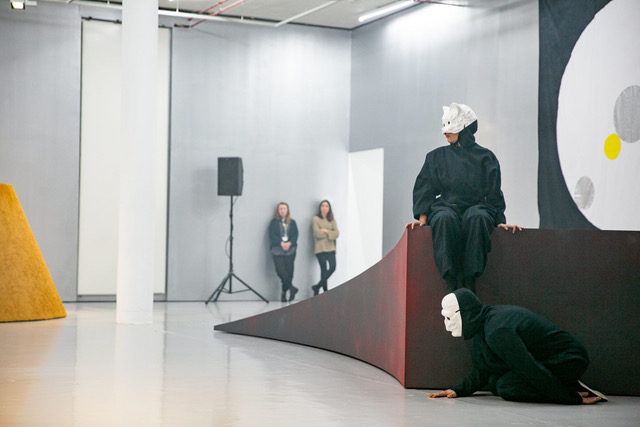
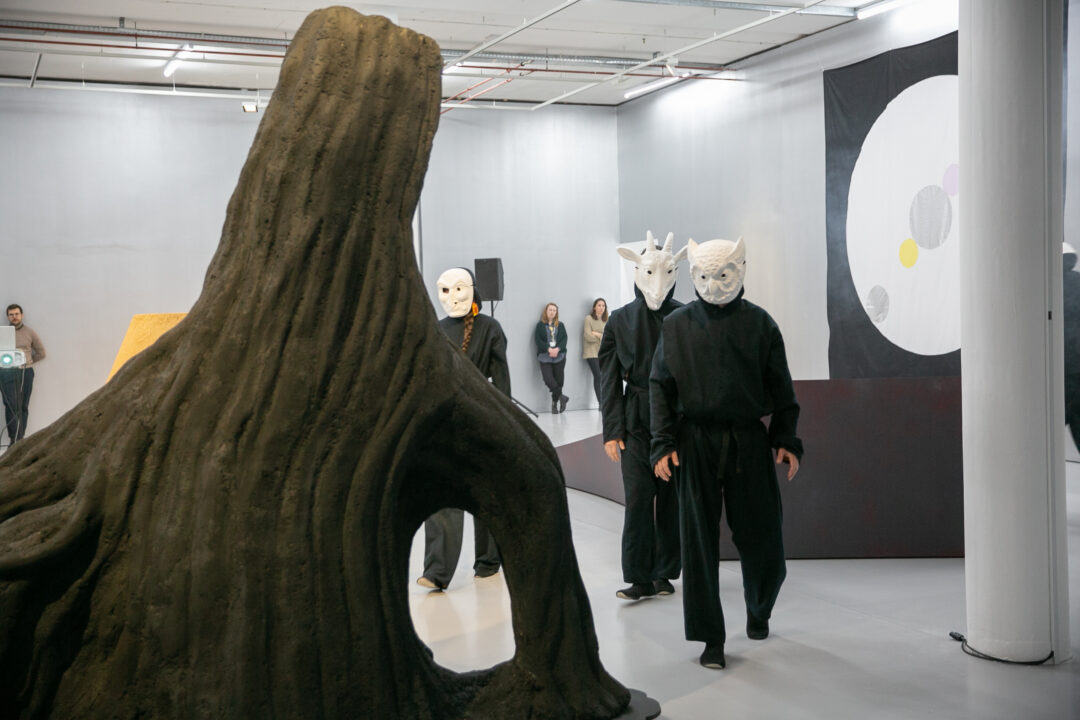
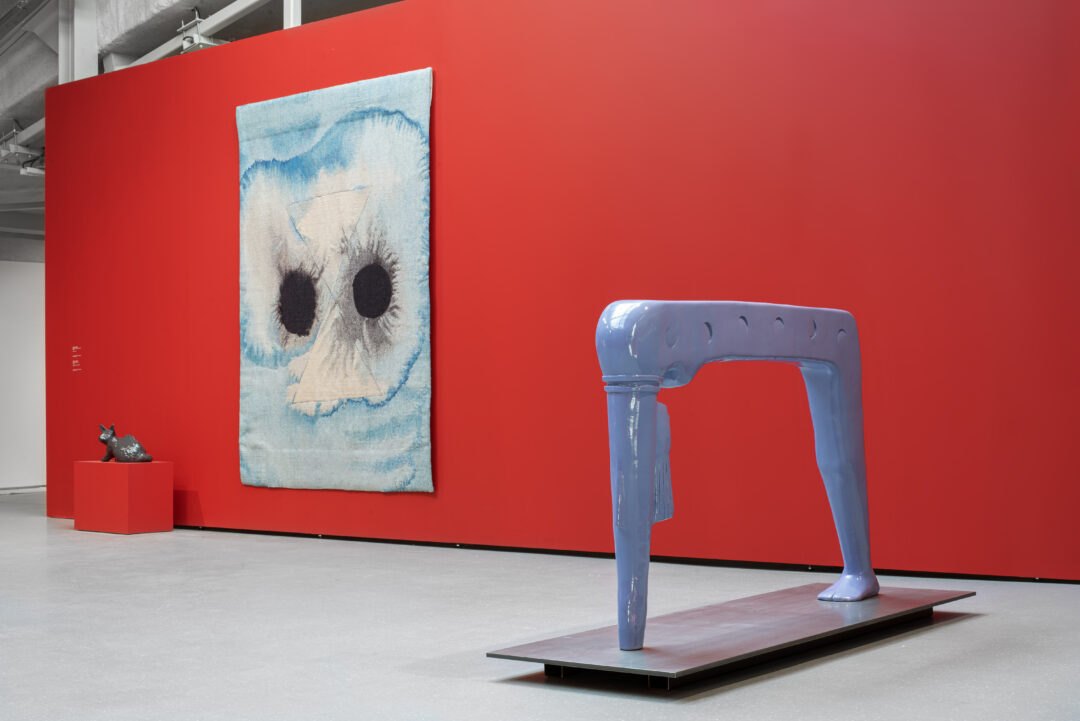
I was quite obsessed with these questions, and I felt they resonated with many things already running through my work. There was a charred tree that evoked the stake, minimalist forms borrowed from Japanese moon-viewing pavilions, animal masks like those witches transform into, but also elements drawn from fairy tales: a basket of apples, a dollhouse.
I had also commissioned a soundtrack from Tamara Barnett-Herrin, composed based on all these readings. And then there was a performance developed with students from HEAD. Tamara sang, the students were the performers. We co-wrote the movements, they also designed the costumes and contributed to the soundtrack. It was really a collective work.
GA: And the performance interacted directly with the sculptures?
MTP: Yes. All the sculptures were on wheels. The performers moved them around, climbed onto them, circulated among them. I liked this idea of a kind of scenographic machine. Opera staging has always fascinated me, that very mechanical aspect of sets being transformed right before the audience’s eyes.
Reappropriations
GA: After the story of the community in the desert, and then the one about the witches, you get the impression that you’re moving from one world to another, but that all these worlds remain connected.
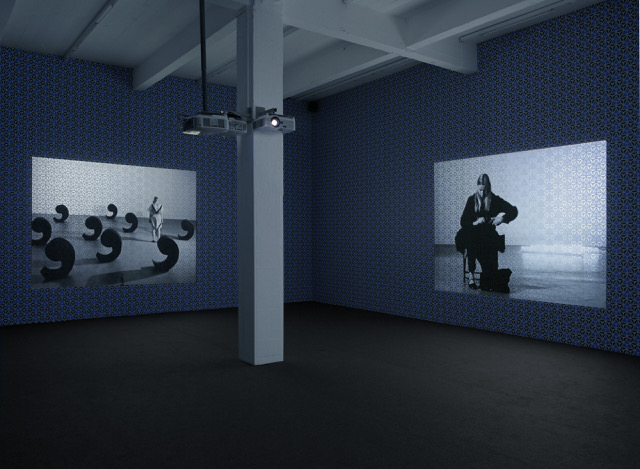
MTP: Yes. Chronologically, Crystal Frontier came first. And through that project there was already a lot of imagery related to modernism and the historical avant-gardes, especially Constructivism. Then I started making works that had more to do with reclaiming modernism, working with figures like Varvara Stepanova.
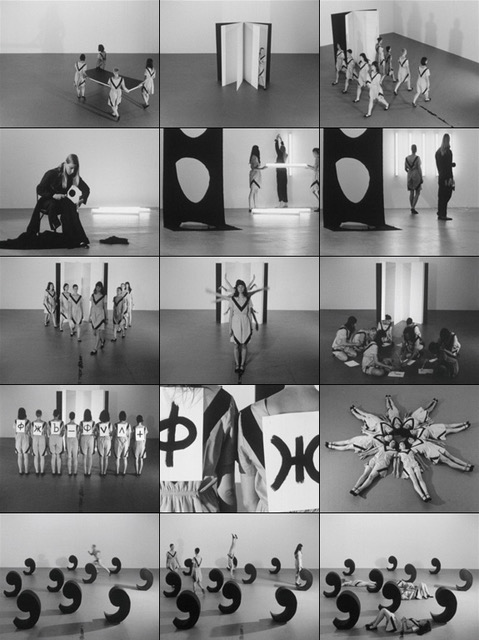
I made a film based on one of Stepanova’s lost performances. In the 1920s, at the Moscow art school, she had created a performance called Evening of the Book, a kind of theater in which characters from the new Soviet books demonstrated their superiority over the characters from books of the old regime.
Very few images of that performance survive. In all the monographs devoted to Stepanova, you always find the same four or five photographs, and they’re incredible. And because something was missing, I thought I’d try to reconstruct what no longer existed.
I shot the film in New York, at The Kitchen, with friends. The place itself carried a whole history connected to dance and performance. The performers danced for the camera, the film was shot on 16 mm, and then projected in the exhibition space.
GA: So you started from Stepanova as a kind of point of departure, before inventing your own scenario.
MTP: Yes, but above all I started from images. It’s also a very visual way of working. You begin with images and then imagine what might go with them. From just a few still images, you almost imagine a choreography. There was music, but it was separate from the film—the film itself was silent.
References to Women Artists
GA: You work refers abundantly to women artists. How do you bring feminism into contemporary work in a way that still makes sense and remains effective—without it feeling exhausted or like an obligatory gesture?
MTP: I think there’s a responsibility that belongs both to artists and to institutions. As an artist, you can foreground certain things, propose narratives other than the dominant ones. But there are also structural questions.
I teach, and I sometimes sit on committees that support young artists or acquire works for collections. But institutions can never entirely make up for the gap, because the gap itself is structural. There are simply far fewer documented women artists, because women had fewer opportunities to produce and show their work.
Griselda Pollock and Rozsika Parker’s book Old Mistresses was very important to me. It’s extraordinary. I found many intuitions there that I already had.
And one essential thing they show is that for a long time works made by women were attributed to men. This created the myth that women artists didn’t exist, when in fact they absolutely did.
GA: And how do you work against that myth?
MTP: I try to propose something else. I try to offer alternatives to hegemonic male models. And little by little, that ends up changing the way things are represented.
And then there’s something very simple that I realized rather late: I grew up as an artist with very few female role models, without even perceiving that as a problem. Today, I think this desire to build a genealogy is almost reparative. It’s a form of restoration.
Othermothers
GA: When working with historical figures, it’s also about finding other ways of looking at them, outside the male gaze or male projection. In Othermothers, how do you choose certain goddesses rather than others?
MTP: It really happens on a case-by-case basis. There are images that stay with me for a very long time. I carry them around with me and then, one day, I decide to do something with them.
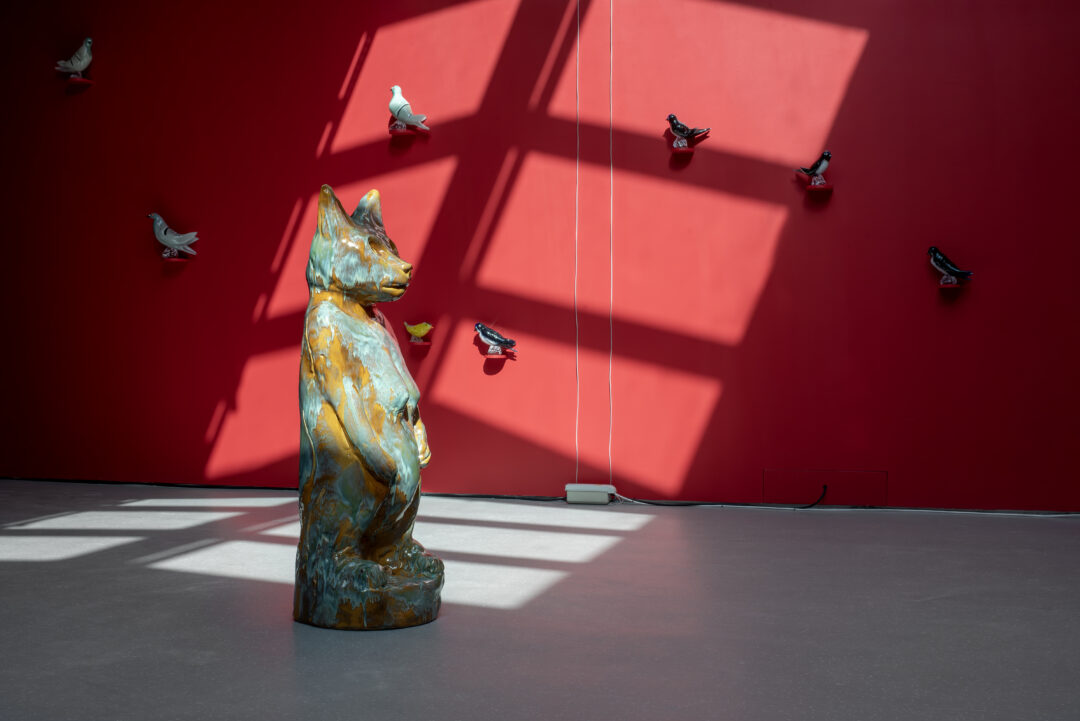
Take Diana, for example. I’ve been keeping images of this sculpture of Artemis of Ephesus in the Farnese collection at the Archaeological Museum in Naples for years. When you come across that thing in the museum, it’s quite extraordinary. It’s like looking at a sculpture by Louise Bourgeois, except that it’s ancient.
I find it completely magical because I think this figure is tied to a fertility cult that predates the patriarchal Greek deities by a very long time. Because Artemis—the virgin goddess, the goddess of the hunt—is already a collage. Goddesses are layers of histories and cults that get pasted back onto one another and transformed.
There’s a book by Émilie Hache that I find extraordinary, which asks this question: how did we move from a world of generating to a world of producing? What changes in our relationship to the world itself, to ecology, to care, if we think that we produce wheat rather than generate it?
She also comes back to this idea that, within the Christian world, there’s this lone guy in the void who says, “Let there be light,” and thereby creates the world. And because the world was made, it can also be destroyed. Whereas in the ancient world, the paradigm is different: we are co-created with the world. We participate in its death and its rebirth. Our role is to collaborate in its existence, to nourish it and sustain it. It’s no longer a relationship of domination or extraction.
GA: And who ultimately decides that Artemis is the virgin goddess rather than a fertility goddess?
MTP: I think these narratives were fixed after the fact. But these figures remain fundamentally fluid. When we look at Venus, for example, we immediately think of sex or beauty, whereas she could just as easily be the goddess of relationships, of creating bonds.
GA: And how are the characteristics of these figures chosen in your work?
MTP: I haven’t done Venus, precisely. She’s such a loaded figure. I don’t know if I’d want to tackle her.
On the other hand, Minerva interested me precisely because of the complexity of Athena. She’s Zeus’s daughter, fully grown when she emerges from her father’s head. She’s the most patriarchal one, the daddy’s girl. And at the same time, she’s justice, she’s fairness. In a way, it means that at the center of the polis, there’s a woman. I find that ambiguity very interesting.
And then there’s Nut, which belongs to something cosmic. I find it completely extraordinary that the sky itself could become a character. Something with no physicality whatsoever, and yet the Egyptians chose to represent it in the form of a divinity. I find that completely magical.
I had seen on Instagram a drawing by a nineteenth-century English archaeologist who had reconstructed representations of Nut from frescoes and hieroglyphs. It was so geometric and so beautiful that I immediately wanted to make a sculpture out of it.
The cat came in more simply. I wanted there to be animals within these goddesses, not just humans. And cats have fascinated me for a long time. Historically, they’re associated with witches, with women, with the unknown, with a form of disobedience and nonconformity. They possess a very strong autonomy.
I was very happy to start introducing animals into these works. The birds came afterwards, as companions to the goddesses.
In the book Real Estate, Deborah Levy writes about the familiars of the Greek goddesses. And at one point she says something that I find beautiful. She wonders whether all those old women you see in European cities feeding pigeons—women who are often regarded as half-crazy—might in fact be goddesses separated from their familiars by patriarchy.
I find that idea so beautiful. It proposes another way of looking at these marginal figures, who are generally granted very little dignity. Feeding pigeons is considered something dirty, whereas I almost see it as a form of care.
So I wanted to make pigeons to accompany Minerva. And then came other very ordinary birds—sparrows, the kinds of birds you see in cities or on the outskirts. Not exotic birds, but everyday companions.
——-
Mai-Thu Perret lives and works in Geneva. Her work is held in numerous public and private collections internationally.
Head image : Mai-Thu Perret, Othermothers, photo Tristan Savoy, Centre culturel suisse, Paris.
Related articles
Ouassila Arras
by Patrice Joly
The Theatre of Cruelty (Theater of Cruelty)
by Patrice Joly
Interview with Perrine Lacroix
by Mya Finbow