18th Istanbul Biennal
Time is stretched, tones sharpen in Istanbul
Review of Üç Ayaklı Kedi [The Three-Legged Cat]
18th Istanbul Biennial
First chapter 20.09—23.11.2025
A voice, a cry amplified with metallic notes, shrieks through the terrace of Istanbul Modern, resonates within the port of Galata, perhaps beyond it. The sound of an axe hammering computer units and their motherboards transforms electronic debris into a reverberating, high-pitched drumbeat. Selma Selman’s performance Motherboards (2025) brings the act of destruction to the sonic realm, forces us to hear it, along with the violence and deafening anger it embodies. Do we grow accustomed to it? After nearly two hours, do the frenzied blows, the bone-shaking din of shattering metal, and the torrent of words screamed into a microphone (finally) affect us, or do they become part of the landscape? Echoing the current contexts that linger on, this work inaugurates the 18th Istanbul Biennial, titled “The Three-Legged Cat,” and sets its tone. Could the apparent literalness that hits us head-on serve as a strategy to awaken us from our lethargy in the face of the systemic dysfunctions and violence that haunt our world?
Behind the obvious emotion and rage that the performance fuels, lies a commentary on invisible subsistence economies. Here, destruction becomes a technique for extracting gold buried in these electronic ruins. The artist, who belongs to the Rom community, thus refers to the recycling of these materials, an activity that allows some of her family members to earn a living, and mocks the absurdity by which value is measured. The performance produces an installation that brings together gold molten into a spoon and scrap metal skeletons. In this biennial, layers overlap, between flagrant displays and jarring concealments, across works brought together in historic buildings – some of which like the Zhini Han have been renovated and saved from demolition – in the gentrified and transformed neighborhood of Karaköy.
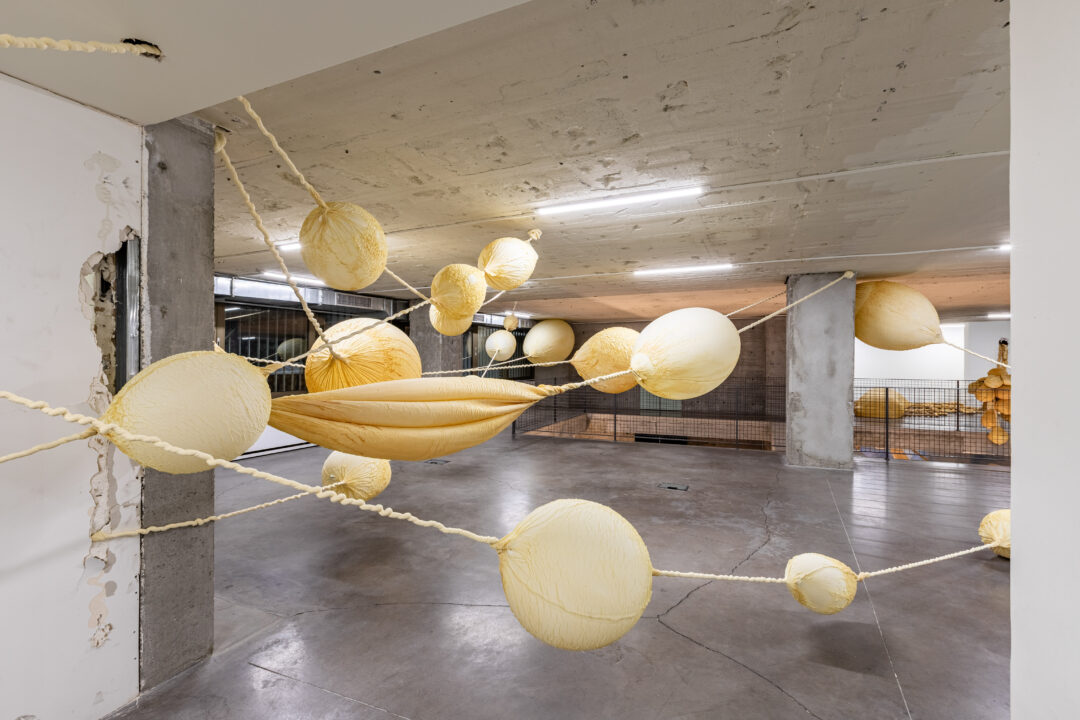
This decision regarding the location of the biennial responds to a twofold challenge. First, in contrast to the city’s excessive scale, curator Christine Tohmé imposes a more intimate survey. The experience of wandering through alleys is most appropriate for a biennial whose title pays homage to stray cats, icons of the city whose existence is nevertheless fragile. While they continue to be loved by Istanbulites to this day, we cannot forget the war that the Turkish government is currently waging on their canine “compatriots,” now the subject of a recent law aimed at removing them from the streets. Furthermore, beyond the practicality that the proximity between venues guarantees and the economy of motorized transport to visit them, the choice of this neighborhood is not insignificant. Karaköy, formerly Galata in the Beyoğlu district, has for centuries been an important port area, conducive to cultural and commercial exchanges. Relieved from its functions as commercial and touristic port in the second half of the 20th century, this neglected waterfront, which looked more like a wasteland twenty years ago, has since seen the rise of a luxurious development project called Galataport. New buildings are springing up, with seismic risk seemingly explaining such “great replacement,” while part of the Bosphorus waterfront is occupied by a gigantic cruise ship and luxury boutiques, accessible only through a secure gate. Does the biennial, as such situated, seek to draw attention to the resilience seen in the survival of a “three-legged cat”– the transformation of a previously abandoned neighborhood considered dangerous – or to the consequences of such gentrification, which reduces public space and endangers its architectural heritage and identity? Eva Fàbregas’ installation, Exudates (2025), points to the need to care for these buildings: concrete oozes biomorphic latex forms that evoke an infected wound, whose pus is nevertheless necessary to heal. These dynamics of erosion, expulsion, eradication, reconstruction, and capitalization, subject to real estate strifes, are by no means isolated to Istanbul; increasingly governing the city, they are just as prevalent in other geographies, such as Beirut in Lebanon.
Distant contexts thus seem to echo each other in this biennial, which unfolds through “humble gestures” as intended by the Lebanese curator whose selection confronts us with “lives under siege,” ruled by societal collapses.
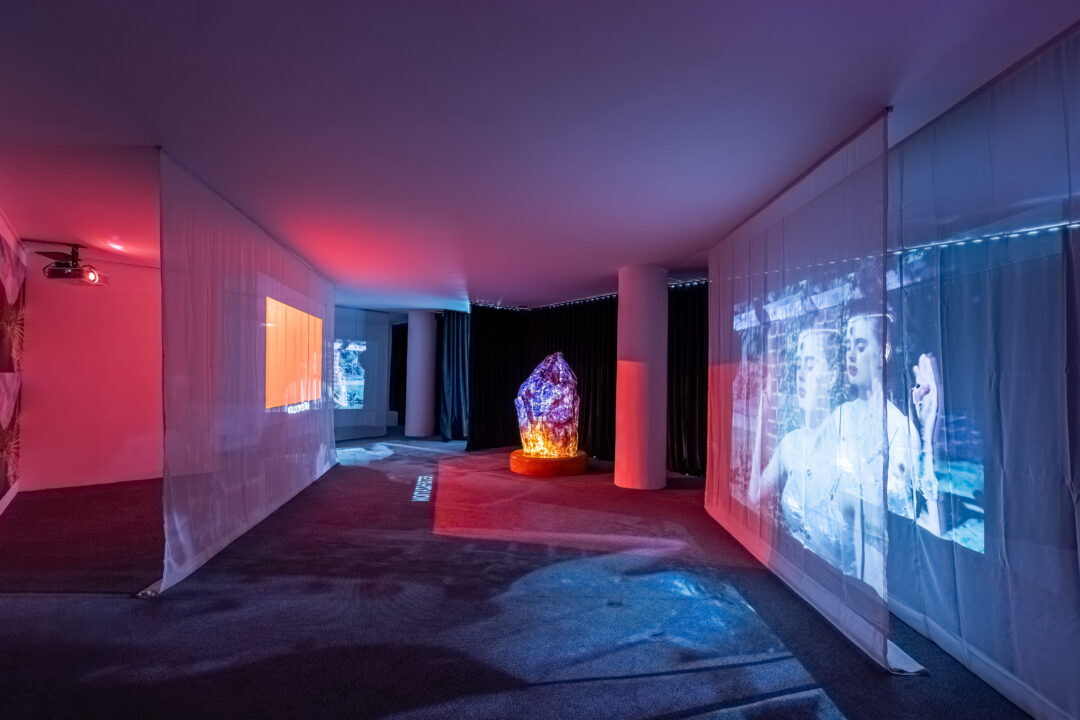
Bodies become magnetic, moving apart and coming together tirelessly, dancing for three hours in the basement of Arter Museum. Is this shared escape from the surface, and its reality, chosen or imposed? Alex Baczyński-Jenkins’ performance Untitled (Holding Horizon), in which repetition that stretches time is palpable, responds to Valentin Noujaïm’s film Pacific Club (2023) shown at Zhini Han. As hypnotic as it is emotional, this third chapter of a trilogy revives the memory of the eponymous nightclub that became a refuge for Maghreb and Arab immigrant communities in the 1980s – a period marked in France by the AIDS crisis and racism. Now alone, a dancer evolves surrounded by the characteristic concrete of La Défense, on the invisible and covered ruins of the nightclub that the artist reconstructs via 3D modeling. Further on, another basement houses a different kind of animation evoking underground life: created from collages and adaptations of black-and-white cartoons, episodes from Haig Aizavian’s series You May Own the Lanterns but We Have the Light (2022-2025) follow one another. Drawing on the nocturnal urban context of Beirut – a city marked by power cuts yet with a vibrant electronic music scene – the episodes swing between clubs with their alcohol-fueled atmospheres, the dark tunnels of traumatized subconscious minds, and the rubbles where children’s bodies are buried. Echoes to the tragedies of our time are striking, as these works become testaments to escapism as a survival strategy and form an ode to the memory of places.
Undergrounds are also explored through a critique of extraction; several works bounce and pound on this theme, nearing obvious repetition. Some installations push literalness to its peak by directly bringing prototypes of mining equipment into the exhibition space – a last-resort alarm bell in the absence of formal subtlety? Nevertheless, it is this cold, sometimes aggressive, aesthetic of the machinery dominating us that keeps coming back. In one of the “Cone Factory”’s rooms, Doruntina Kastrati’s work, produced for the biennial, introduces us to the industrial environment of Turkish delight factories. A Horn That Swallows Songs (2025) presents four video screens whose continuous shots, filmed by the artist during her site visits, reveal either the serial cutting of colorful sweet dough or the aligned pairs of legs belonging to the employees. The immersive installation requires viewers to stand on a steel floor, transmitting vibrations similar to the uncomfortable and demanding working conditions of these spaces. The artist is interested in the structural forms of violence and control of bodies that exist in the industrial apparatus. The prevalence of the exploiting machine over living beings and the right to rest is also addressed in Becquerel (2021) by Riar Rizaldi, a spellbinding film that almost takes the form of an ironic fable without a moral. In a post-apocalyptic island universe ruled by an artificial sun that never sets, powered by nuclear energy, we witness the wanderings of a child-philosopher in search of an ideal place for a forbidden nap.
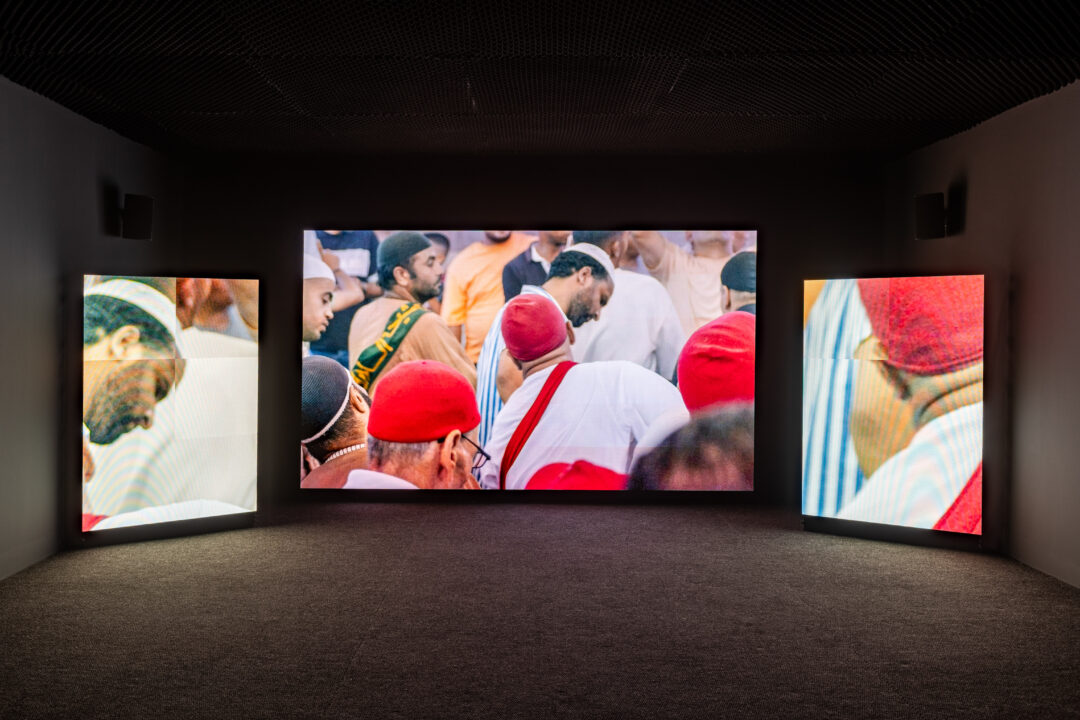
Elevation through youth and play? This is what Marwan Rechmaoui’s poetic sculptures seem to convey as we discover them, bathed in sunlight and overlooking the Bosphorus, after having made our way up the floors of the Zhini Han to its veranda-terrace. The journey culminates in the contemplation of a gigantic rocking horse, swings, sailboats, and other ancient toys, whose pastel hues and apparent innocence envelop the moment in a sweetness, nonetheless tinged with bitterness. The presence of a knife stuck in a sandbox leaves no doubt as to the underlying commentary on the violence imposed on today’s teenagers. With Xenon Palace Championship (2023), a film and interactive console by Sara Sadik found one floor below, video games add the possibility of shared intimacy and raise the question of the virtual dimension as the last safe space remaining. The collective experience as refuge through spiritual practices is also addressed. While Jasleen Kaur’s kitsch, satirical, and muslin-rich installation (My Body is a Temple of Gloom (2021)) ironically comments on the exoticism attached to the woke trend of yoga, Rafik Greiss’s film (The Longest Sleep (2024)) emotionally captures the swaying of the Sufi trance, a danced prayer called hadra, during the Mawlid rituals and confronts us with the physical and neurological extremes of devotion. As our multiple belief systems are shaken up, will our capacity to have faith be forever undermined?
This first chapter of “The Three-Legged Cat” strikes more in the accuracy of its assessment of the turmoil in our world than in the introduction of novel themes. Avoiding the pitfalls of sensationalism, this edition aims to focus on the long term and the construction of sustainable infrastructure for a city where rampant inflation, the ruins of the judicial system, and electoral disputes make any certainty of political or economic stability seem remote. Indeed, the following chapters plan to establish an academy and to introduce collaborations with local artistic initiatives – programs whose details remain unclear at present. After the ups and downs of its previous edition, the promise of a renewed Istanbul Biennial stretches until 2027 and appears to be suspended in time.
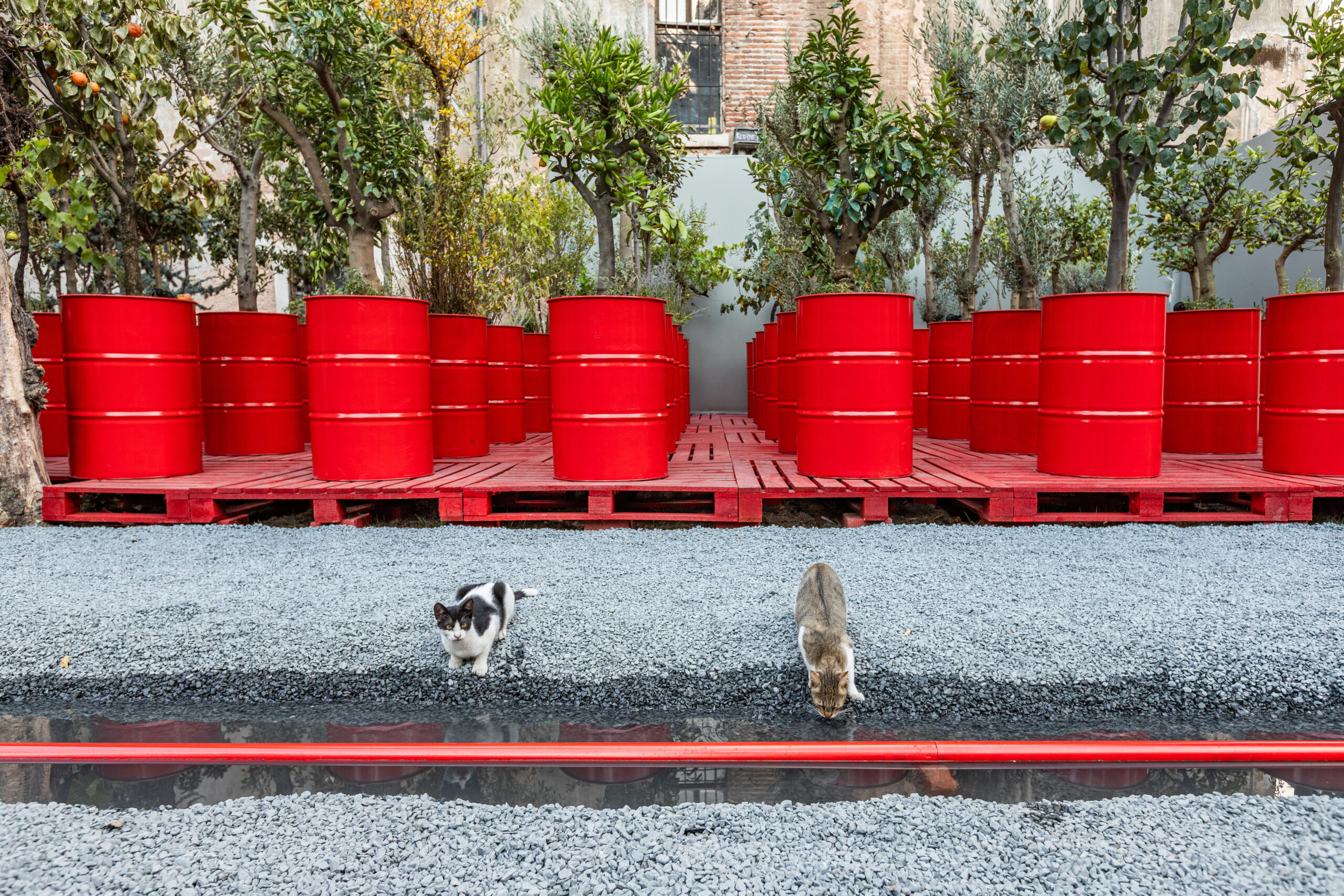
Head image : Khalil Rabah, Red Navigapparate, 2025. Courtesy de l’artiste. 18ème Biennale d’Istanbul, Istanbul, 2025. Photo : Sahir Ugur Eren.