The World Through AI
Le monde selon l’IA [The World Through AI]
April 11 — September 21 , 2025
Jeu de Paume, Paris
In cognitive capitalism, the brain and mind are the new factories of the twenty-first century. The proletariat working on the assembly line to create objects and things has been subsumed by the cognitariat, or mental laborer, transacting with the specialized universe that the screen reveals to produce data. This data not only produces consumer profiles and offers predictive shopping recommendations, driving brand loyalty and enhanced experience, but can have more insidious effects. Recently, a new kind of cognitariat has entered the laboring market described as micro-laborer who works for pennies in the Global South in refugee camps creating what Ulises A. Mejias and Nick Couldry call data colonialism. (1) In Hito Steyerl’s artwork Mechanical Kurds (2025), created for the first time for this exhibition, data collected from these laborers in Kurdish refugee camps is used to build data sets for machine vision systems which ultimately finds its way into algorithms used to guide drone attacks against themselves. In this installation, spectators sit in structures that resemble boundary boxes, that these micro-laborers used for their click work tasks, implying that we are all digital workers participating in the gig economy whether we realize it or not.
Recently, early cognitive capitalism has transitioned into late cognitive capitalism in which the material brain and its neural commons, its neural plasticity, have become the focus of capitalistic exploitation. (2) The word brain(s) refers to both its material substance incarcerated in the bony skull, as well as its extracranial components consisting of the sociogenic, political, cultural, ecological and technological relations. Its transgenerational, multispecies, collective and cosmogonic qualities reach back in time to the Big Bang and are found in mycelial communities in the roots of trees and microsomal communities of the human gut. AI as a metaphor for other kinds of collective intelligence found in the natural world is beautifully illustrated in Agnieszka Kurant’s A.A.I. (Systems Negative) series (2016–present). In this work, Kurant poured zinc into abandoned termite mounds to create her sculptures. On the one hand, the work illustrates the collective, constructive intelligence of these termite communities and, on the other, they exemplify her concept of interspecies outsourcing as a metaphor to reflect upon micro-laborer exploitation.
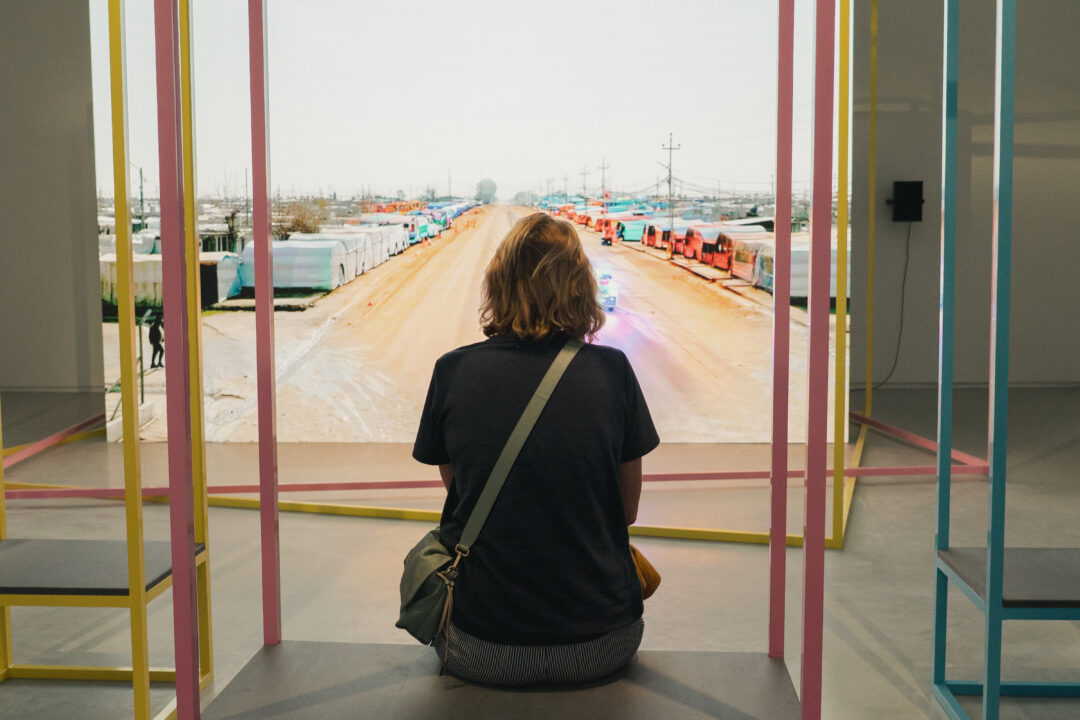
Photo : Antoine Quittet.
Beginning with Homo Habilis, technology and the brain have been engaged in a choreography for over 2.5 million years, in which AI and brain-computer interfaces are just the most recent examples, co-evolve and mirror each other in time, swapping effects back and forth in an infinite spiral of multiple heterodoxy that Bernard Stiegler names exosomatic organogenesis:
“Hominization is the continuation of organogenesis but in an exosomatic way. As with many organs, the brain has always organologically “augmented” and transformed itself: this self-transformation is precisely what characterizes human life in as much as it is also, and immediately, technical life, that is, a form of life that realizes its dreams.” (3)
With the introduction of machine learning and AI, the effects of digitality have hypertrophied at an alarming rate and placed an inordinate stress on the overall system including its subjects, who have been having trouble keeping up mentally, intellectually, and spiritually. But AI has brought on another revolution as the two systems technology and brain have merged into a seamless entity: a neural-digital entanglement. As the recently published article “Your Brain on ChatGPT: Accumulation of Cognitive Debt when Using an AI Assistant for Essay Writing Task” by Nathalie Kosmyna and others, found in participants relying on Chat GPT, in the educational context of writing an essay, lower connectivity profiles were found in the frontal or executive lobe of the brain. (4) In fact, in this group the frontal lobes may have switched from generating content to supervising AI driven content. These systems “reduce critical thinking capabilities and lead to decreased engagement in deep analytic processes.” (5) Has Bernard Stiegler’s premonition that another effect of the externalization and outsourcing of our cognitive abilities to artificial technics leads to “proletarianization—through which the hyper-industrial age becomes the era of systemic stupidity,” been borne out? (6) On the other hand, might this emptying out be the beginning of neural reorganization and the birth of new faculties of perception and cognition, as has been hypothesized for the development of language networks in the brain concentrated in the left fusiform gyrus called neuronal recycling? (7)
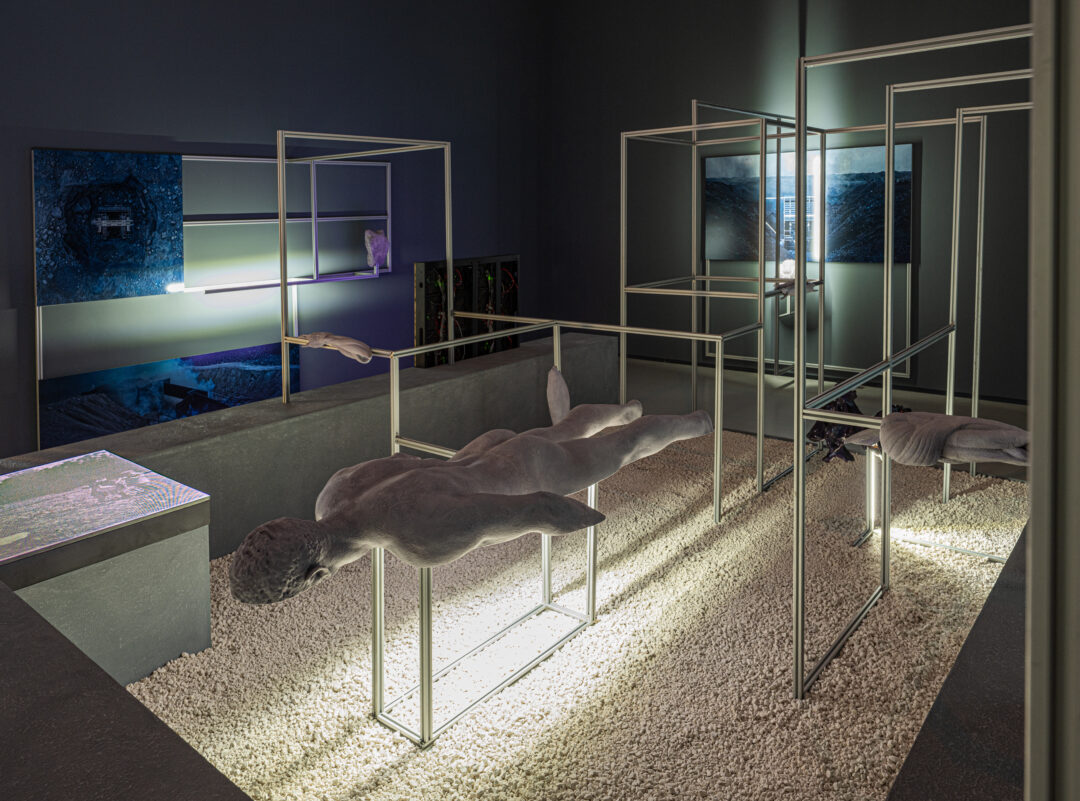
Installation, generative film, 3D prints, digital prints, robot, aluminum, stones, variable dimensions / AI models and programming languages: Stable Diffusion XL, AnimDiff, CoquiTTS, Llama 3.2 7B, Python 3.11. Training data: Laion-5B, Visual Contagions under the direction of Béatrice Joyeux-Prunel, artist’s personal archives. With programming assistance from Robin Champenois. With the support of the Canada Council for the Arts, Ottawa, the University of Geneva, and the Jeu de Paume, Paris. Courtesy of the artist.
In such a debate, perhaps an exhibition concerning AI and aesthetics might be thought of as misguided and frivolous? But nothing could be farther from the truth. First the exhibition, The World Through AI, a sprawling atmospheric exhibition which takes up two floors of the Jeu de Paume, curated by a team led by Antonio Somaini, questions whether or not AI is a device for the enunciation of new human capacities and secondly: What, if any, is the role of art in this discussion. Importantly does artistic creation through its estrangement of sensibility and cognition force philosophy and epistemology to retool itself for this new age.
Exosomatic organogeneisis, mentioned above, is still ongoing! As such the alternative relationship and history between tools of artistic production, as this exhibition shows through the myriad uses of AI, and the brain’s neural plasticity, that is to say the relation between techno-cultural plasticity and neural plasticity, gives us hope. The diverse pluri-potentiality that defines the pre-individual brain, composed of a variable population of untuned neurons found in the newborn and the process of individuation that brings it to its adult form sculpted and pruned by a process of epigenesis, has political implications. Either this fluid process results in a uniform, neural normative brain, techno-ergonomically formulated into an easily governed people or one that is heterogenous, queer and neural diverse; a multiplicity made up of singularities each having a unique free will. The former creates a subjugated normative cognitariat seamlessly sutured to the screen and the non-conscious monetized tasks it unveils, creating for the neo-bourgeoisie a higher rate of cognitariat mental surplus value and increased profit.
This is where the concept of the brain without organs is key (8). Borrowing from and elaborating on the phrase body without organs, first enunciated by Antonin Artaud and later developed by Gilles Deleuze and Felix Guattari, the brain, like the body, is free from the despotism of an overall plan—whether that be biological, political, social, or technological. Artistic engagements that estrange, through disrupting the distributions of sensibility, in the way Jacques Rancière proposes, by redistributing them or deterritorializing the foundations of the philosophical systems that understand them, have the capacity to emancipate brain/mind plasticity and create subjective liberation (8) It is a becoming mind/brain in-flux. Right wing governments in concert with Big Tech and Big Data, particularly in China and the United States, have embraced bio-technological power to thwart this becoming brain, and instead prefer a being brain, in a state of crystallization and stupor, for their own purposes of control. Some believe that AI is meant to play a grand role in this scheme. These techno-optimists believe that human cognitive and mental abilities and processes can be exploited by cognitive machines of large language models, such as ChatGPT, to induce a complicit human-digital wetware, the life blood of digital capitalism.
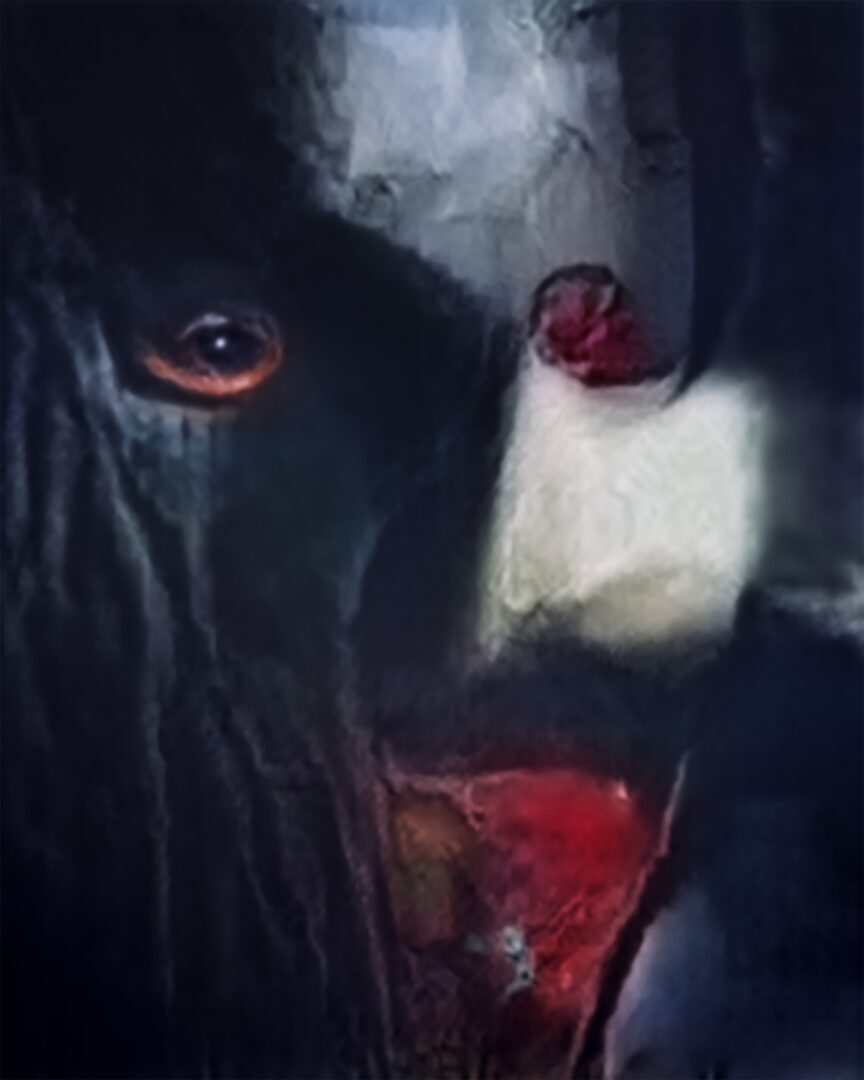
Thermal sublimation prints, 121,9 × 152,4 cm et 152,4 × 121,9 cm. Courtesy of the artist, Fellowship, Altman Siegel, San Francisco and Pace Gallery.
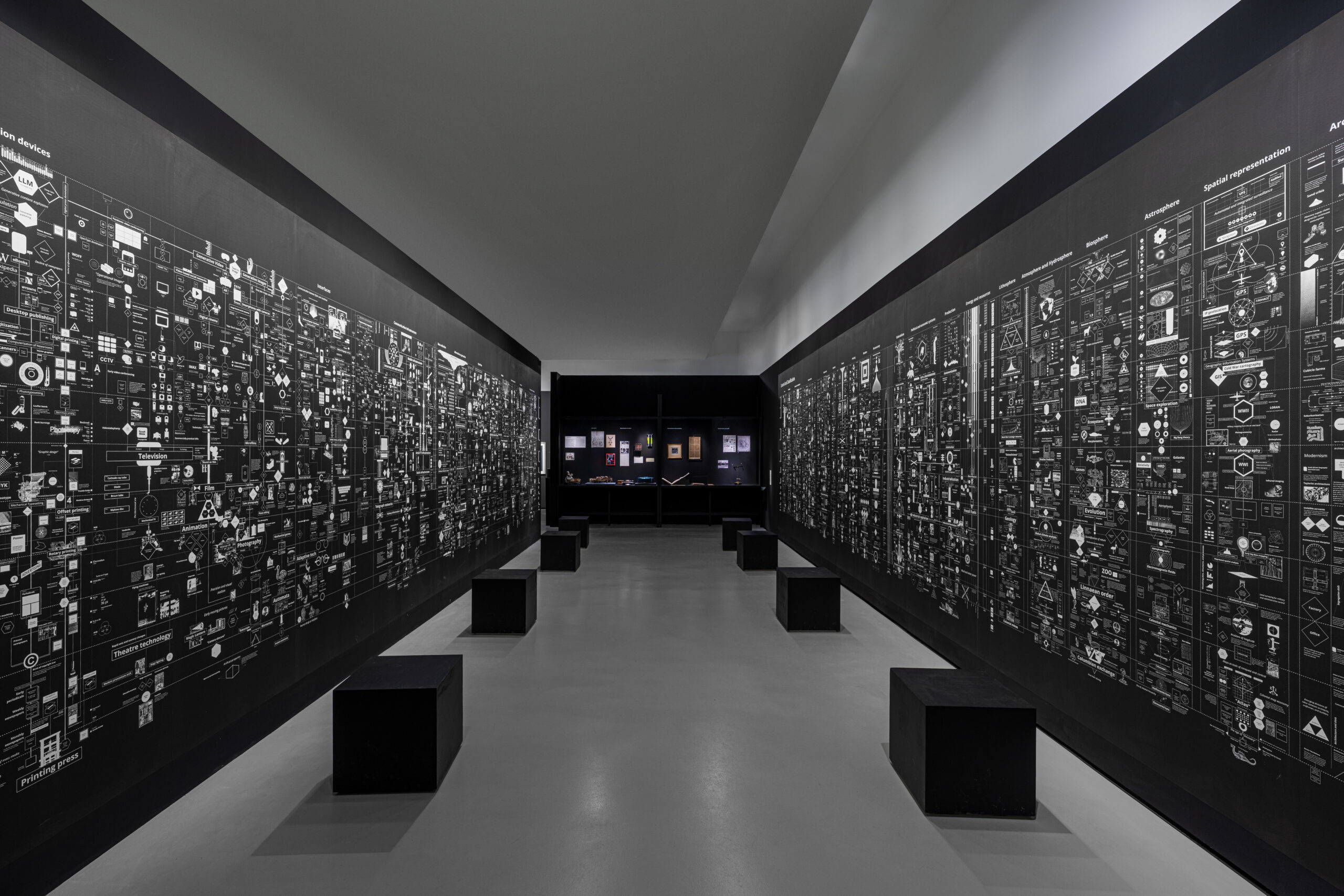
In The World Through AI, artists have become essential agents to combat and push against this contemporary form of subterfuge, exposing their apparatuses and mechanism. In the case of Kate Crawford and Vladan Joler’s work Calculating Empires: A Genealogy of Technology and Power Since 1500 (2023), they have created a largescale work organized as monumental facing walls, in which they give visual form to the synchronous histories of technical and social structures and their apparatuses, educating us on our opponents’ and allies’ weaknesses and strengths.
Through writing their own code and transforming their own latent spaces (or vector imaginaries), artists such as Egor Kraft, Theopisti Stylianou-Lambert and Alexia Achilleos, and Nouf Aljowaysir, create new and synthetic histories to correct aporias and biases of the past. (9) Kraft’s Content Aware Studies (2017-ongoing) uses AI models to fill-in absent traces of the past, either by reconstructing damaged antiquity or through synthesizing alternative low res reliefs that, in reality, have never existed. In The Fourth Memory (2025), Gregory Chatonsky embeds multiple personal histories in latent spaces to generate alternatives. Furthermore, he extends Bernard Stiegler’s concept of tertiary retention into quaternary retentions. Stiegler describes primary memory as memory of the original experience of an event like hearing a melody and secondary memory as its later reimagining of the tune inside our heads. Tertiary memory becomes a collective negotiation of the traces left in tools like a vinyl record which remains alive for future generations to respond to. Quaternary retentions form a fourth memory which consist of the statistical processing of tertiary retentions by AI which become inscribed in latent spaces and as such the possibility of their regeneration. Importunately for Chatonsky’s piece the retentions return again and again, in his filmic projected opus, but never as the same and through a Baysian overlay contain never before seen futures. Chatonsky and his collaborator Yves Citton in their text of the same name published in Multitudes, coin the expression of distention to designate this future memory which is based upon metabolization of tertiary retentions. (10) The Fourth Memory examines the combinatorial power of trans-generationally activated inorganic tertiary memories immortalized as vectors in latent spaces. He calls them meta-memories, memories of memories.
For Chatonsky, these meta-memories, become the artificial resources for a new form of counter-factuality, a realism of realism, in the age of AI. Data is not simply passively collected and collated by corporations, policing, and government agencies for analyzing consumer behavior but, as we saw, actively engages with the plastic sensorial-perceptual-cognitive potentiality and simultaneously its cohort, deep learning neural networks, to leave traces in their mnemonic synaptic architectonics, their so-called synaptic weights, sympathetically. However, the technical digital acceleration can outpace neural organogenesis. The mnemotechnics of the brain is related to the influence that synchronous neurons firing have on each other, while in artificial neural networks it relates to the strength imposed by one node upon another. The digital brain/mind and material brain/mind become engaged in a vampiric choreography leaving the human partner emptied and in a state of listless confusion referred to as the neurobiological sublime. (11) Furthermore, the concept of neural-digital entanglement refers to a digitally-induced accumulation of embodied and enacted cognitive dispositions generated through AI’s invisible latent spaces and diffusion patterns that contain surreal futures superimposed upon lingering social, racial and gender biases. (12)
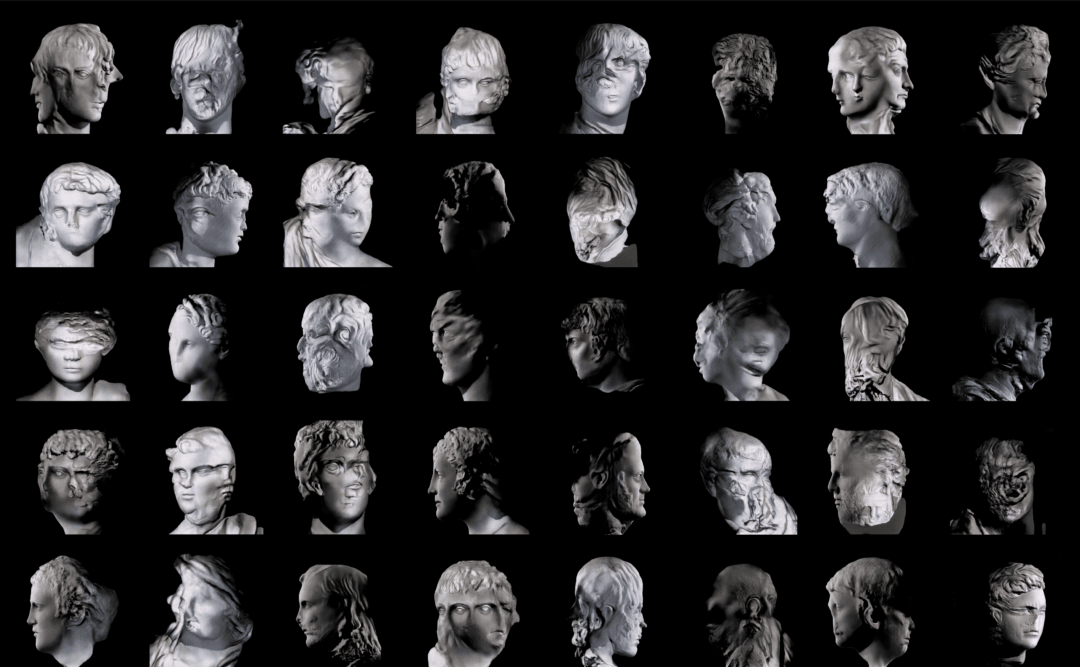
12 screens, metal structure, machine learning algorithms, specific natural data training corpus. Artist’s statement 125 × 110 × 20cm. Courtesy of the artist.
CIs the word latent here used by accident? Or could it be entangled with the expression of latent content in Freudian psychoanalysis and an inspiration for the Surrealist poets? Was Trevor Paglen cognizant of this connection when he created his beautifully crafted works which illustrates Software Surrealism with the use of Generative Adversarial Networks (GAN)? His disturbing and sublime works, Vampire (Corpus: Monsters of Capitalism) and A Man (Corpus: The Humans), eerily introduce the exhibition.
The exhibition, The World Through AI, could not have appeared at a more important moment as our world and its civilizations grapple with the effects new technologies that are changing the political, social, cultural, economic and cultural relations that define it and us.
References
Grégory Chatonsky and Yves Citton, “La quatrième mémoire,” Multitudes 96, 2024, 186–189.
Stanislas Dehaene, “Cultural Recycling of Cortical Maps,” Neuron 56(2), 2007, 384-398
Nathalie Kosmyna and all, “Your Brain on ChatGPT: Accumulation of Cognitive Debt when Using an AI Assistant for Essay Writing Task,” arXiv, June 2025
Ulises A. Mejias and Nick Couldry, “AI Companies Want to Colonize Our Data. Here’s How We Stop Them,” Truthout, April 1st 2024
Warren Neidich, “The Early and Late Stages of Cognitive Capitalism,” in Neidich, ed., The Psychopathologies of Cognitive Capitalism, Volume 2, Berlin: Archive Books, 2014.
Jacques Rancière, The politics of aesthetics : the distribution of the sensible, trans. G. Rockhill, London, New York: Continuum, 2006
Bernard Stiegler, Nanjing Lectures (2016–2019), trans. Daniel Ross, London: Open Humanities Press, 2020.
Bernard Stiegler, “The Proletarianization of Sensibility,” boundary 2 44(1), 2017, 5–18.
The World Through AI, ed. Antonio Somaini, Paris: Jeu de Paume/JBE Books, 2025
Notes
(1) Ulises A. Mejias and Nick Couldry, “AI Companies Want to Colonize Our Data. Here’s How We Stop Them,” Truthout, April 1st 2024
(2) Warren Neidich, “The Early and Late Stages of Cognitive Capitalism,” in Neidich, ed., The Psychopathologies of Cognitive Capitalism, Volume 2 (Berlin: Archive Books, 2014).
(3) Bernard Stiegler, Nanjing Lectures (2016–2019), trans. Daniel Ross (London: Open Humanities Press, 2020), 2018 lecture, 242.
(4) Nathalie Kosmyna and all, “Your Brain on ChatGPT: Accumulation of Cognitive Debt when Using an AI Assistant for Essay Writing Task,” arXiv, June 2025
(5) Ibid.
(6) B. Stiegler, “The Proletarianization of Sensibility,” boundary 2 44(1) (2017): 5–18.
(7) Stanislas Dehaene, “Cultural Recycling of Cortical Maps,” Neuron 56(2), 2007, 384-398
(8) I am developing this based on Jacques Rancière’s notion of the distributio of the sensible (le partage du sensible), see G. Rockhill’s Glossary to his translation of Rancière, The politics of aesthetics : the distribution of the sensible, trans. G. Rockhill (London/New York: Continuum, 2006), 85.
(9) “Latent space…is a foundational concept in machine learning and artificial intelligence. It refers to the abstract space within which complex, high-dimensional data structures (such as images, texts, and sounds, or whatever entity that may be translated into a digital form) are represented in a more simplified, lower-dimensional form, in order to be processed through different mathematical operations…To begin with, latent spaces are a key component of the machine vision systems that during the last few years have turned the entire realm of digital images into a vast field for data mining and aggregation: they determine the epistemological field of these systems, what they can and what they cannot “see” (i.e. detect, recognize, and classify)” (Antonio Somaini, “Theory of Latent Spaces,” in The World Through AI , ed. Antonio Somaini (Paris: Jeu de Paume/JBE Books, 2025)).
(10) Grégory Chatonsky and Yves Citton, “La quatrième mémoire,” Multitudes 96, 2024, 186–189.
(11) Warren Neidich, “Duende and the Neurobiological Sublime,” Springerin 4, 2014.
(12) “As AI models become more and more pervasive, and as internet contents keep growing exponentially, latent spaces become a way of ordering, processing, and activating a hypertrophic accumulation of cultural memory that has become unmanageable and disorienting” (Antonio Somaini, ed., The World Through AI (Jeu de Paume/JBE Books, 2025).
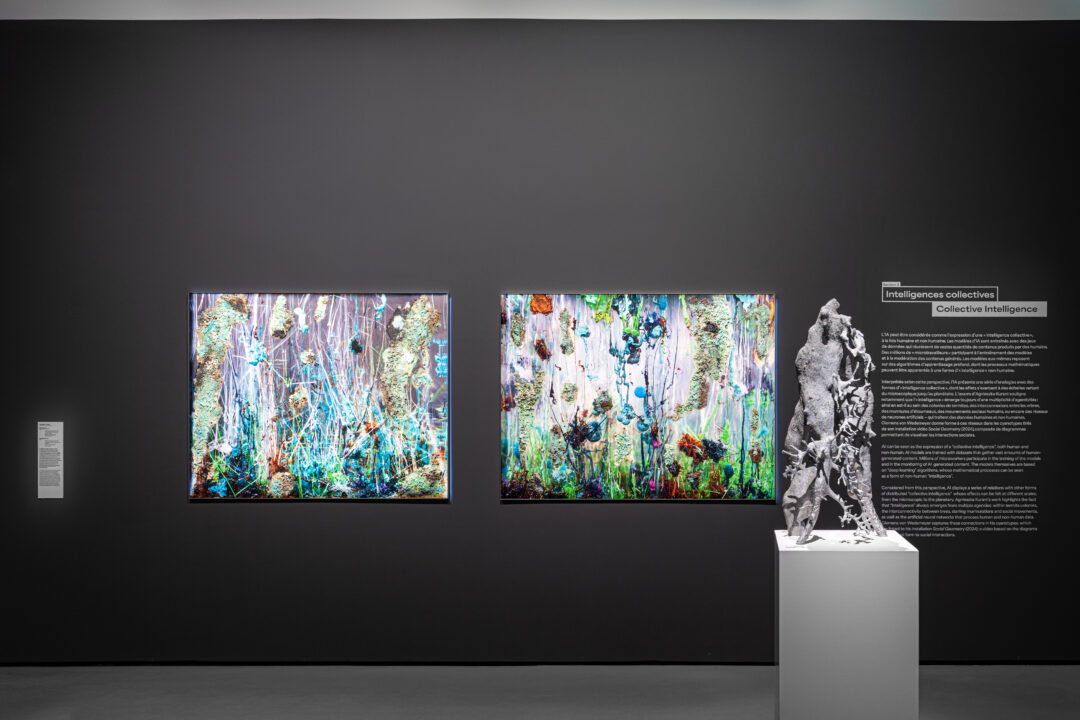
Painting with iron, cobalt, nickel, calcium, chromium, copper, and manganese salt crystals on anodized and printed aluminum plate 110 × 140 cm. Production : Kunstgiesserei St. Gallen AG. Project management : Noël Hochuli. Courtesy of Nicoletta Fiorucci’s collection.
Head image : Kate Crawford, Calculating Empires: A Genealogy of Technology and Power Since 1500. Diptych, prints on paper, 300 × 1 200 cm each. Courtesy of the artists and of the Fondazione Prada, Milan. Exhibition view « Le monde selon l’IA [The World Through AI] », Jeu de Paume. © Jeu de Paume. Photo : Antoine Quittet.
Related articles
Kill Baby Kill
by Patrice Joly
Paris noir
by Salomé Schlappi
Some white on the map
by Guillaume Gesvret