Mathilde Ganancia
The incandescent affirmation. On Mathilde Ganancia’s « Du ballooning, en attendant le bal »
Café des glaces, Tonnerre
July 5 — October 4, 2025
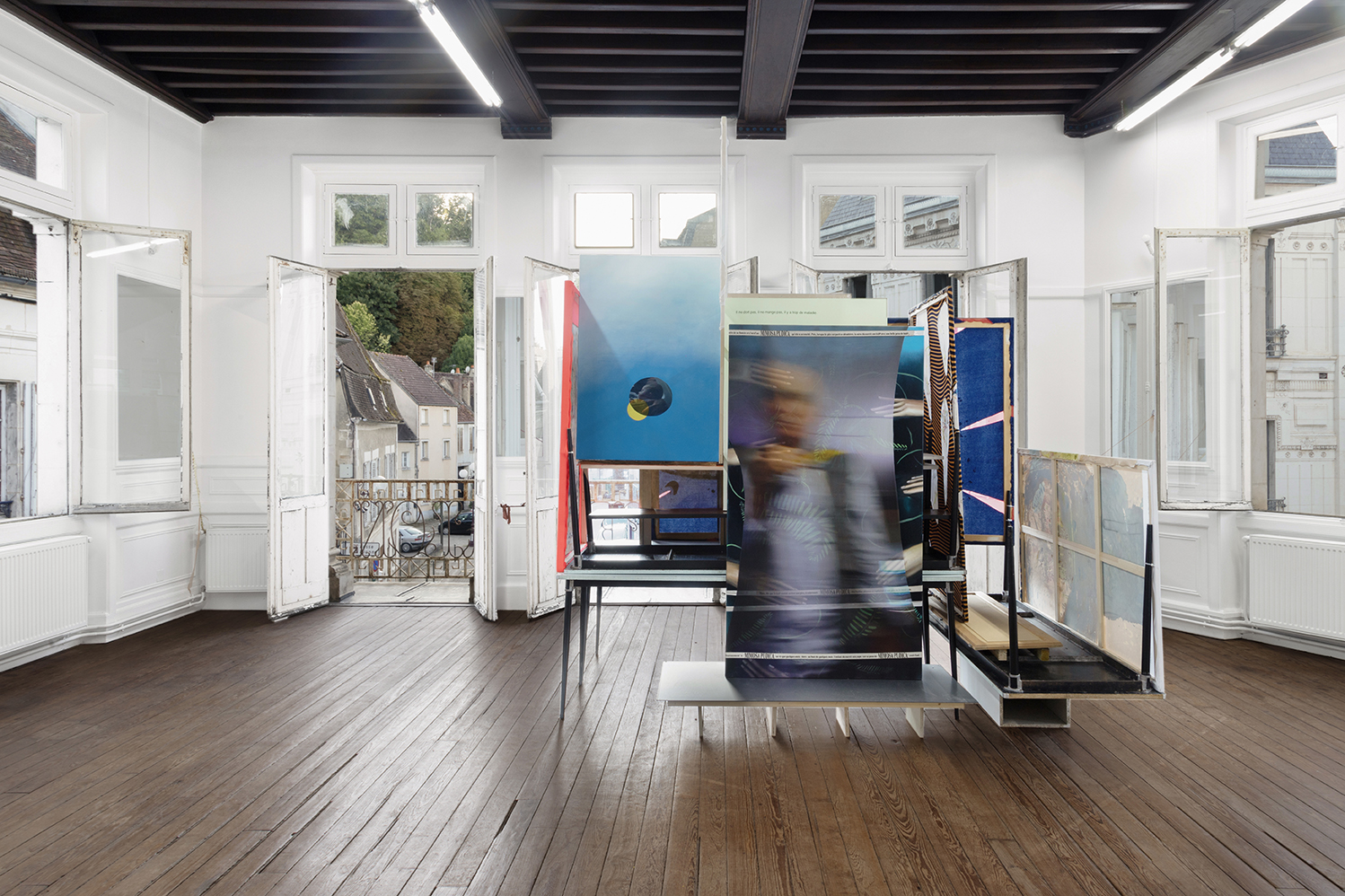
At the Café des Glaces in Tonnerre, a small town in Burgundy, 1 hour and 50 minutes from Paris, Mathilde Ganancia’s paintings dance to the rhythms of the sun’s sparkles and the scattered movements of our eyes. Invited to exhibit in this former ballroom, which has been transformed into a contemporary art space since 2021 under the impetus of Camille Besson and Haydée Marin, the artist presents a collection of recent paintings in a spectacular setting that is both theatrical and unique, in keeping with the architecture and historical uses of the venue. The space, which is open to the outside (seven windows overlook the city) and reflective (large mirrors are placed between the windows), is conducive to cascading appearances. It is clear that this is a far cry from the white cube, even if, I am told, the walls have just been repainted white. The venue invites the invention of new ways of hanging and viewing art, which Mathilde Ganancia has done with enthusiasm and audacity in affirming the Dionysian, and therefore tragic, nature of her art.
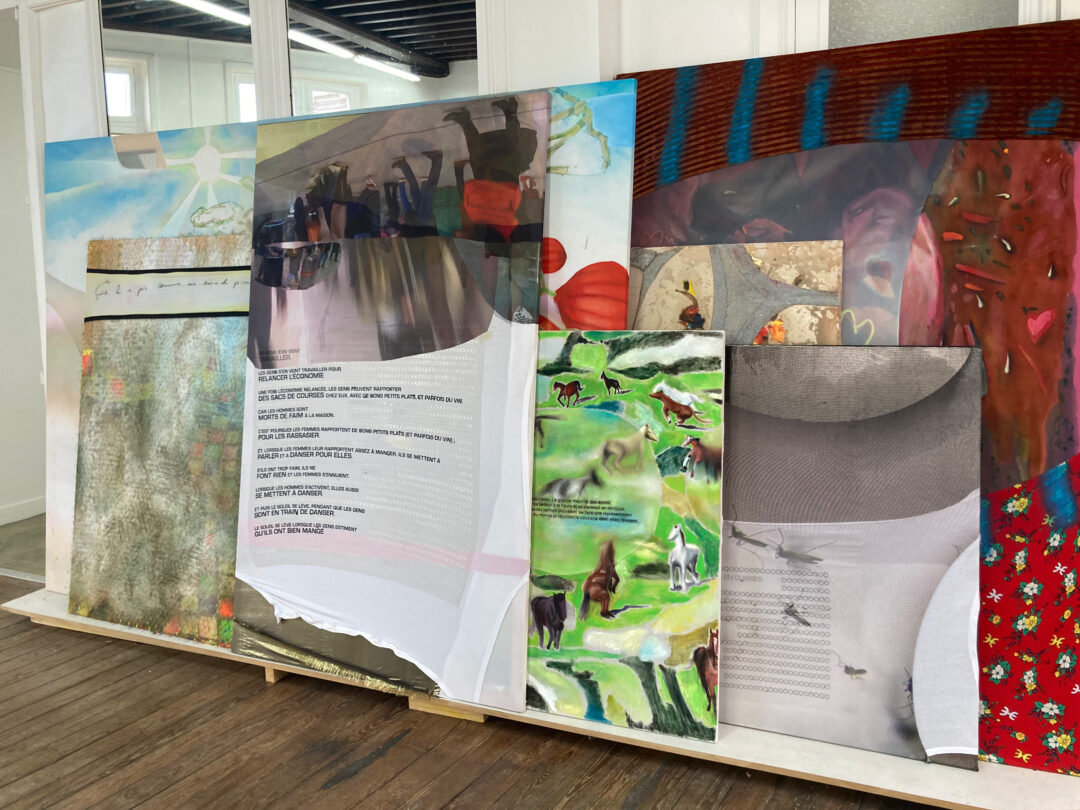
The paintings are arranged around two “islands.” The first is based on inversion. An irregular hollow cube-shaped architectural structure displays paintings on its outer walls according to principles of superimposition, overlapping, and spacing, playing on heights and widths. The second features a displacement. It shows seven paintings placed on the floor, against the wall, one on top of the other, as if stored in an artist’s studio. This arrangement reveals only strips of painted pictures, with only the one in front visible in its entirety. The spaces between the paintings in the first installation allow the viewer to see those behind, either through transparency or by approaching and looking at an angle. The hidden parts of the paintings remain hidden in the second arrangement. In a small room on the same floor, a video is playing, describing in a pictorial way the kitchen and cooking methods used in the artist’s creative process. I will come back to this later.
With all the windows open, I discover the exhibition curated by Mathilde Ganancia. The window handles are tied together with fabric ties, the openings overlook the urban landscapes and sky of Tonnerre, the sun floods the room, the shadows of the paintings attached to the structure draw geometric shapes on the parquet floor, and the bright shapes and colors of the images, like the views outside, are reflected in the mirrors. The whole thing sparkles, everything seems shimmering, luminous, alive. This theatricality in the open air gives an impression of lightness, warmly inviting the viewer to join in the dance. And in fact, that is what we do: we enter, we turn around and on ourselves, we take a step forward and another backward, we contort ourselves to see better between, we trace lines of visibility and freely weave paths that we perceive to be infinite. From this interplay of steps and glances, almost in spite of ourselves but with joy, a multiplicity of possible combinations of other paintings blossoms from those proposed by the artist.
However, the innocence of the game is nuanced and counterbalanced from the outset by the sight of a block (that of the structure) imposing in its volume, distant in its placement at the back of the room, and ultimately strange in what it represents, the painting facing the entrance. This painting is composed of two layers. On the translucent Lycra tulle of the upper layer is a blurred printed image of a worried man. His appearance leaves impressions similar to those evoked by the films of David Lynch. Troubling and frightening areas pierce through the ordinary and familiar, between visions and ruminations. The man’s immobile, upright and tense stature, his closed and determined face, his dark gaze, added to the fact that his support encloses and conceals women’s outstretched hands and mimosa leaves, suggest that this ghostly character is dangerous. This is confirmed by the words on the painting: « […] c’est d’un MIMOSA PUDICA qu’elle a accouché. Puis, lorsque le père est parti se désaltérer, la mère découvrit son bébé avec une belle peau de bébé. » Lightness will come neither without peril nor without tragedy.
Other paintings speak to this theme. One calls for help without pathos: « Bonjour, j’ai besoin de vous » ; another evokes an irresistible child’s flight; yet another, composed of comic book speech bubbles filled with scribbles, struggles to formulate sentences in front of an inattentive, even dismissive audience: « Chhht », « ok », « hum »; another, against a pale yellow background, confides that it refuses to sleep and eat because « il y a trop de maladie [sic] », suggesting that it is not the various ailments that are risky, but existence itself that is threatening. Then there are the political assemblies, encrusted in a hemicycle made of a thick layer of red-brown relief paint, selling their souls, waving their empty power around, expressing themselves in a bellowing and inaudible magma of statements. The tragedy of Mathilde Ganancia’s character-paintings, on this structure that transforms into a stage, is told in the absurd and funny manner of an obscure Beckettian dialogue with seemingly foreclosed voices. Otherness is nevertheless maintained. The paintings, especially those that overlap, communicate their world to each other. Their messages are also open to us, the recipients, who irrefutably reactivate the plurivocity of words and images.
In this cacophony, the artist creates openings and rolls the dice again. Listening carefully and opening our eyes are still possible games, even when everything seems obstructed and carved out. The viewing device illustrates this; the artist’s painting manifests it. Thus, the block is pierced and split in two everywhere, so that the fields of visibility multiply as the viewer plays with proximity to the pictorial space. More than a block, it is in fact an open labyrinthine space that blossoms before our eyes, with its voids, its gaps, its accesses to the backs of the paintings and their edges, its dead ends where the gaze stops on a motif or a light inaccessible from the front. This multiple is augmented by other fragments of reflections, then reflections of reflections produced by the presence of mirrors. The spaces expand, lengthen, and stretch as they become denser and larger.
This elasticity, which the artist shares with the work of Eva Hesse, for example, is evident in this other painting, placed lengthwise and composed on a Klein blue bath towel. To reach it, one must slip into and remain in a narrow corridor between the structure and the wall of the ballroom. There, flashes of transparency made of red Lycra pierce the opacity and absorptive power of the blue fabric. These flashes appear with stars, moons, and a new elliptical world made of fabric remnants, plant materials, rabbit skin glue, sequins, and sand. It should be noted that Mathilde Ganancia has a broad conception of painting, transforming fabrics and various other materials into plastic means of painting in the tradition of Sigmar Polke. The compositional effort gives rise to a colorful, flamboyant, and fertile territory, but one that is also softened by the gentleness of its fabrics and their graceful fringes, ultimately protected by an envelope. The contained tensions of the elliptical shape are reminiscent of a heartbeat.
However, these breaths, which are those of life itself, take place against a backdrop of obvious absence. The ellipse is certainly a geometric shape, but it is also a grammar of gaps and omissions. Its vacillating nature is further emphasized by the artist with the superimposition of a painting-writing on white organza fabric, veiling the brilliance of the birth of a new world and expressing its incompleteness: “[…] I did all the things they said, but I was still not able to put the birds, the clouds, and all the mosquitoes back into their facilities.” On the one hand, creative force must free itself from “all the things they said”, regardless of the value of what was said and the prescribed ways of doing things. This force draws its intensity from its impetuous and decidedly non-consensual or non-conformist nature. On the other hand, the power to create has a measured and limited force of expansion. This is why the effort to (re)compose worlds can never bring back to life what has disappeared forever. The formal poetry and beauty that nevertheless emanate from this force tend to view this tragedy in a more positive light.
Because ultimately, what matters is that the creative process can be expressed through insatiable curiosity, through constant experimentation with materials, tools, gestures, colors, shapes, and light, through a continuous process of exploration. In the multiple, something temporary emerges, making this multiple the only truth. The two islands take on meaning and connect through this recurring practice of the artist, who also expresses values. One consists of attributing to creation and its objects a more modest status than that outlined by a mythologizing modernity. The other recognizes the importance of the gestures and attempts of art on the one hand, and the changing forms of life in the works on the other. During my visit to the exhibition, in front of Serviette, which I mentioned earlier, Mathilde Ganancia observes that some of the materials in her painting are cracking under the heat of the sun. She scrutinizes the process and its effects but does not lament it in any way.
Thus, bringing the workshop into the exhibition space, even if this is not new, emphasizes the shifting, precarious dimensions of art in the process of being created, at work on itself. Moreover, the exhibition space is a workshop. The choice of materials for the structure of the island attests to this. By forming it from interlocking tables and chairs gleaned from the Café des Glaces and its surroundings, the artist shows that she arrived in Tonnerre with her working-class, DIY mindset, confident in the future, ready to seize upon the coincidences, potentialities, and solicitations of the place. The superimposition of paintings and the fragmentary forms of visibility further indicate to the viewer, through their experience of what they see and what is omitted, hidden from view, that the creative processes remain uncertain, indeterminate, elusive, without being mysterious or magical in the primary sense. In doing so, Mathilde Ganancia affirms the value of a non-knowledge that gives importance to the present, not to freeze it, not as a gateway to eternity, but on the contrary as an essential and necessary modality of time. It is a question of claiming an effectiveness here and now, a performativity even, which knows itself to be transient, ephemeral, approximate, sometimes laborious, but which arouses our curiosity, sets us in motion and awakens our appetite for experience, the unknown, even the unseen, that which will never be seen, in short, the potential futures.
Mathilde Ganancia practices and encourages the innocence of play. Jesting and humor—sometimes dark—are its driving forces. They appear, for example, in the discrepancies between the painting and the text of the same tableau. Thus, Bonjour, j’ai besoin de vous depicts air bubbles in soft pastel colors. This incongruous combination amuses and raises questions: how can lightness, flight, elevation, air bubbles, and suspended time need anything? What is this painting-character afraid of? Of leaving the earth forever? Of bursting in flight? Of getting lost by going too high? Of the ordeal of falling back down and returning? Of no longer being seen or heard? This other painting-character politely announces, « C’est pour moi un grand honneur de prendre la parole devant vous pour une question d’une telle importance », but his painted head, though abounding with colorful features, inspires terror and warning. He produces an ambivalent effect, both funny and thought-provoking. It is this capacity for reversal—playing with dissonance, making people laugh at the tragedy of a situation and of existence, loving them as necessities while overcoming drama and pathos—that qualifies the innocence of Dionysian play.
As Gilles Deleuze points out in relation to Nietzsche’s concept of play: “The formula for play is: to give birth to a dancing star with the chaos that one carries within oneself.” But who is the female figure in this Dionysian birth? It is Ariane. Freed from the weight of Theseus and his moral task, she can finally lighten her load and rise up. Ariane, a figure of bliss, is one of the 999 women associated with the 39 guests in Judy Chicago’s installation The Dinner Party, created in the mid-1970s as a tribute to mythological and historical women. Mathilde Ganancia’s feminism is part of this impulse for a creative, desiring, and dancing life animated by joy. Her painting Les gens s’en vont travailler is yet another affirmation, in the form of a tale, of the powers of women capable of reversing positions, of making others dance and dancing themselves until sunrise, far from the “spirits of gravity.” This affirmation is reinforced by the demands of 24 heures de butinage, pour le bal and l’ amour aussi, two titles of paintings that overlap, one composed of lingerie, sequins, and splashes of paint, the other of a profusion of exalted hearts painted with red fingers on a red background. This playfulness emphasizes that painting, like life, has an erotic dimension and is also a matter of pleasure. These two essentials for the artist have been constantly emphasized by the painter Carol Rama, whose presence we feel here.
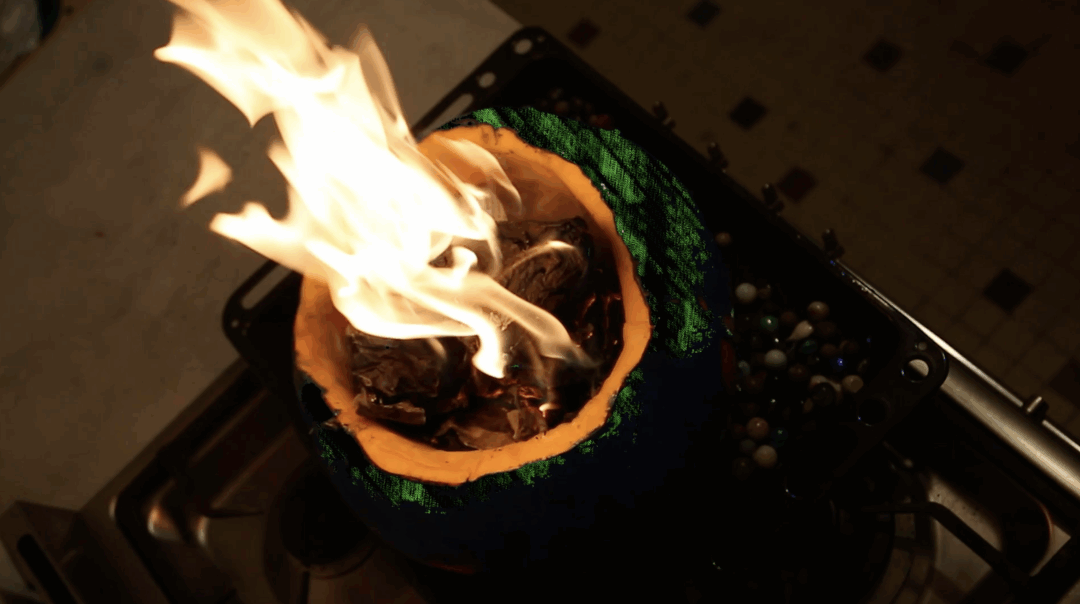
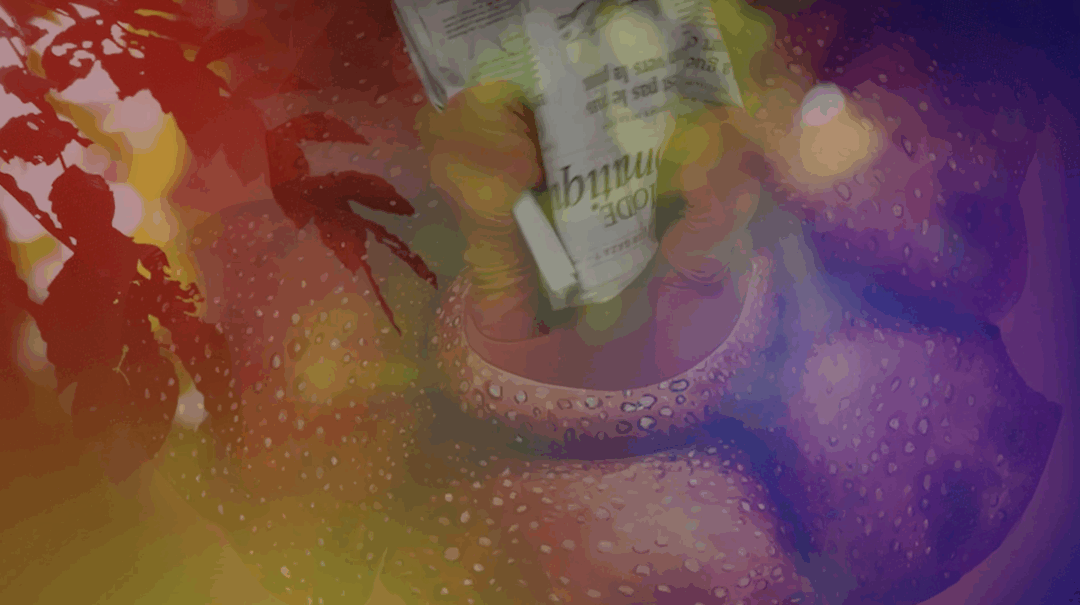
Mathilde Ganancia’s art speaks the language of life itself, which is adventure and metamorphosis. This may be one of the reasons why the video La fabrique de l’information, screened in an adjacent room, depicts the mechanisms of transformation. It tells the story of newspaper pages that, after being vaguely read with a touch of annoyance, are swallowed by a carnivorous flower, then cut up and incorporated with other materials, including paint. The mixture is placed in the oven in a hollowed-out gourd serving as a pot and resting on a bed of beads. The metamorphosis operations make use of everything available—metaphorically and literally—while being precise, straightforward, and clear in their methods, and in their quality depending on the ingredients, dosages, mixtures, and cooking methods available.
The pop-psychedelic aesthetic and tone of the video, with its Yves Saint Laurent 1960s cocktail dresses known as “Hommage au pop art,” its repetitive and obsessive electronic music, its green encoding projections belonging to early personal computers, its fragmented and accelerated moving images, sometimes borrowed from documentary films, and its AI-created characters form a composite whose rhythmic frenzy and inventive fervor ultimately overwhelms the wisdom of a jaded monkey while making us laugh at our follies—and especially those of the artist! Mathilde Ganancia’s perpetually reworked critical artistic approach produces a paradoxical feeling of joyful consternation—consternation at the abuses and violence of a discordant world, at the dramas of our personal lives, but joyful because these stories manage, through secret paths, to be turned around and overcome by art and the artist’s laughing gestures, which act as lively levers of resistance that can be shared and popularized, in the democratic sense of the term. Du ballooning, en attendant le bal undeniably presents an art of breathtaking and confident freedom.
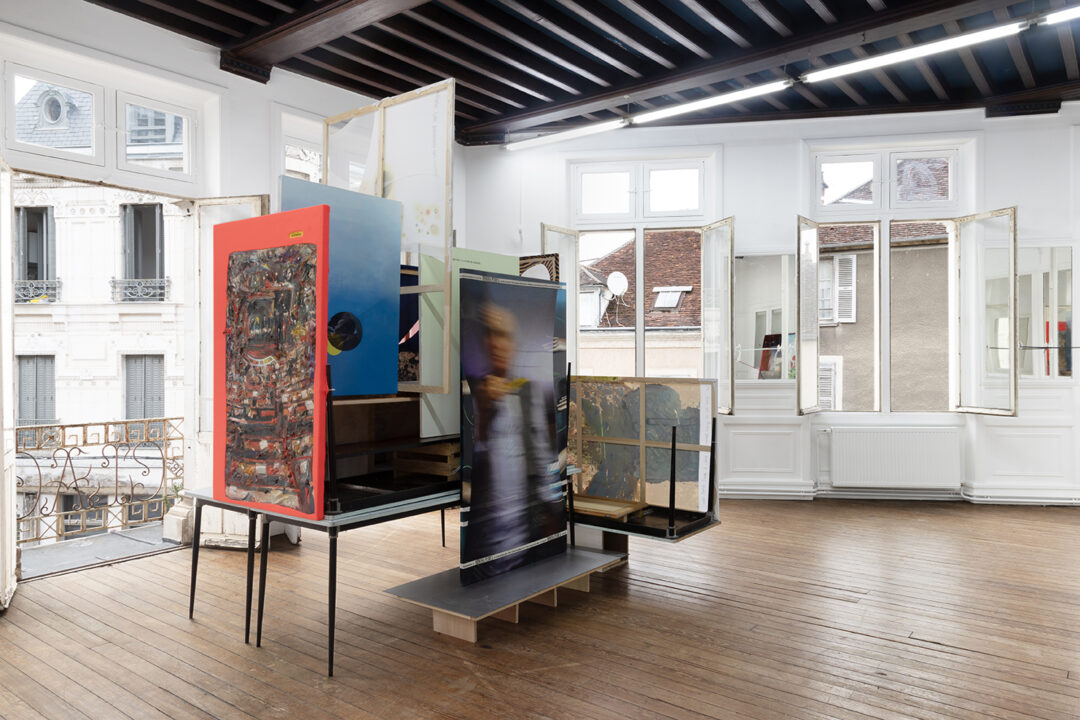
Head image : Exhibition view Du ballooning, en attendant le bal, Mathilde Ganancia, Café des Glaces, Tonnerre, July 5 — October 4, 2025. Photo : Camille Besson.