Thomias Radin
Thomias Radin
Entre ciels et terres : contingences humaines
Galerie Esther Schipper, Paris
5 sept – 11 oct 2025
Wade in the water*
“Our watery embodiment connects us materially, affectively, and politically to other bodies of water — human and more-than-human.”
— Bodies of Water, Posthuman Feminist Phenomenology (Bloomsbury, 2017)
In the work of ecofeminist philosopher Astrida Neimanis, water unfolds as one of the matrix elements of living together. Through her writings, she explores how our water-made bodies participate in material, political, and ethical planetary relations, thus proposing an ecology of relation—akin to that of Édouard Glissant.
This motif also recurs in the paintings and films of Thomias Radin, where fluidity—of both the painter’s gesture and the dancers’ movements—becomes a key notion through which his work may be read, the analogy between dance and painting resonating constantly throughout his practice.
Painter, sculptor, filmmaker, and performer all at once, Thomias Radin moves among these media with the grace of a bird—an image he embraces through his performer name, Lazy Bird.
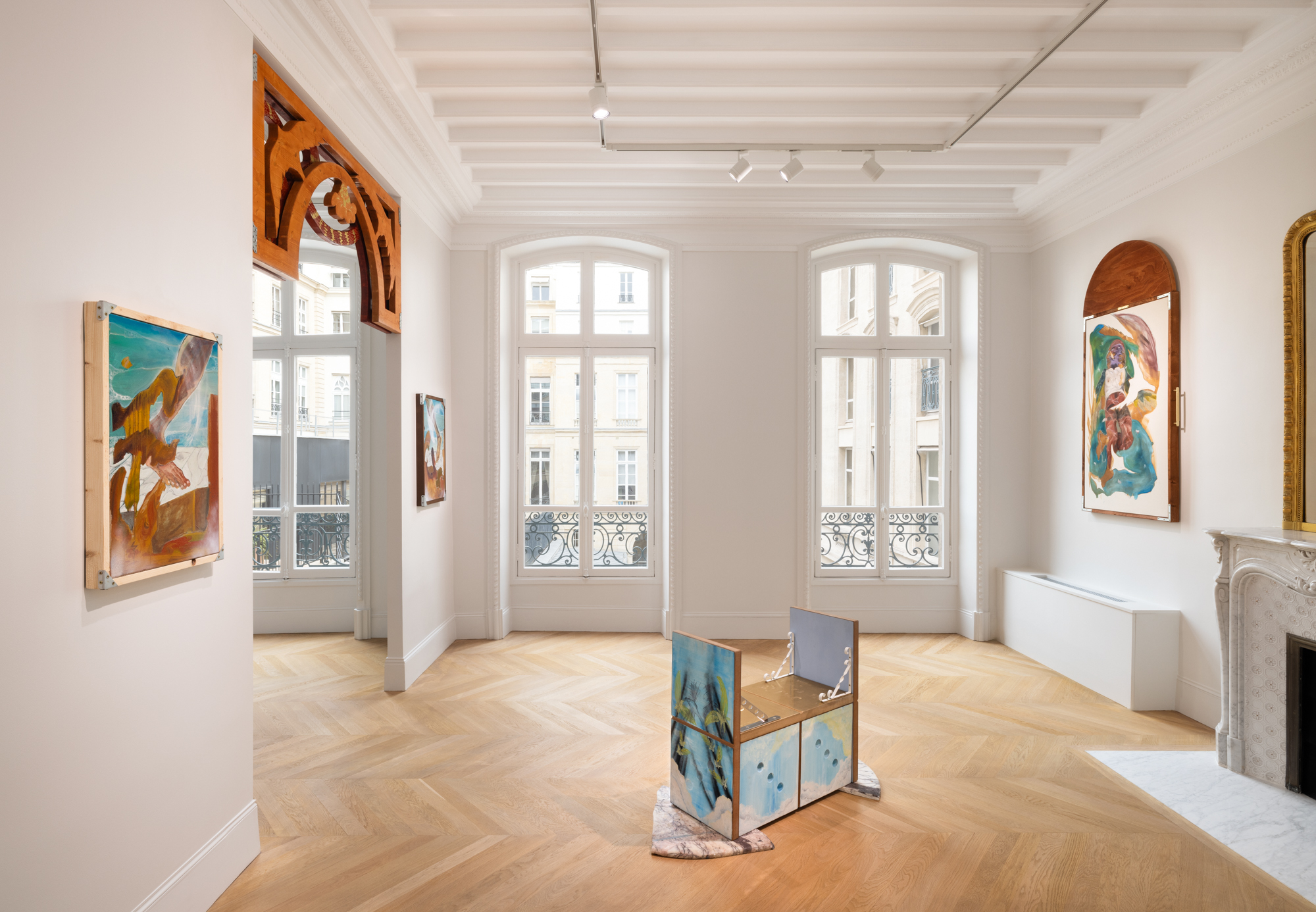
His exhibition at Galerie Esther Schipper in Paris—his first solo presentation in France—includes a large mural and several altarpiece-like paintings, somewhere between shields and coats of arms. Their carved wooden frames and attached handles evoke his family heritage and a craft transmitted through generations (his father being a carpenter). Also on view is a group of panel paintings with visible, raw metal hinges along the edges—another nod to artisanal practice.
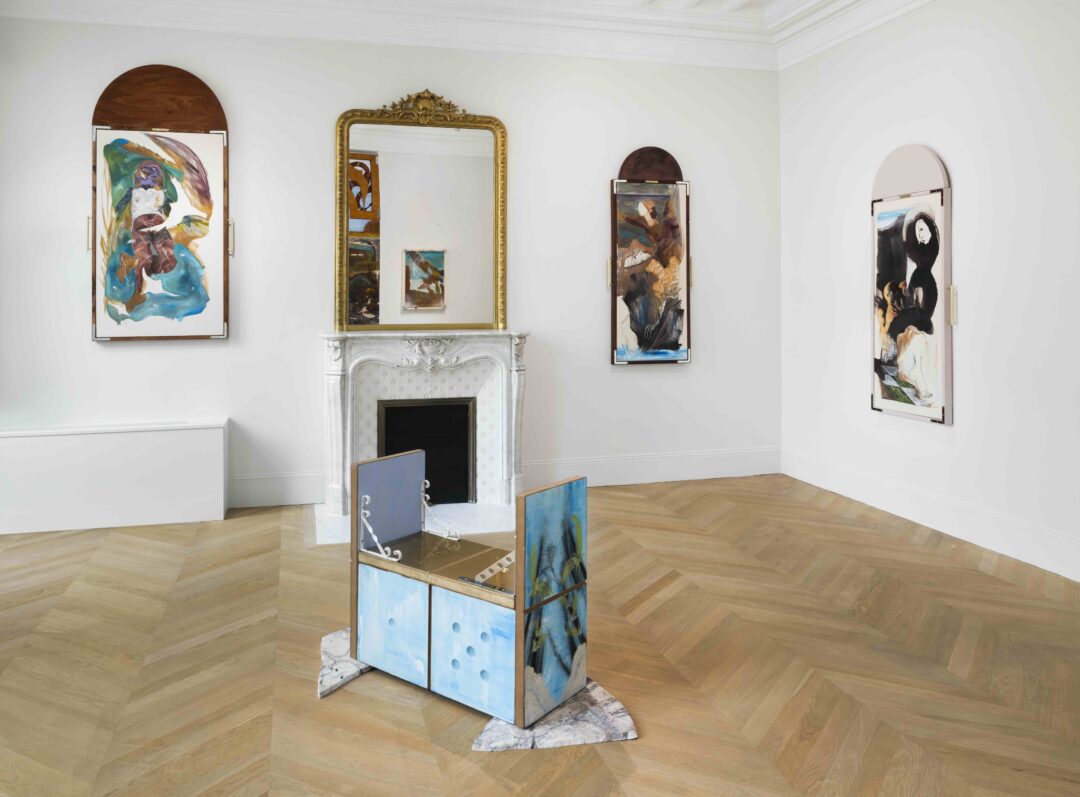
Recurring motifs in his paintings feature fragments of Black bodies—heads, feet, backs—suspended in motion yet imbued with a sense of vitality and momentum. This energy permeates his entire oeuvre, driven by a kind of dreamlike quality and a fascination with the sacred or invisible forces. These figures, caught in the tension of movement, evoke the Creole notion of bigidi—a fall that isn’t one, a wavering that becomes rhythm—also present in his choreographic work.
The large mural takes up the motif of water, evoking both the Caribbean, his place of origin, and the theme of migration. It also echoes Édouard Glissant’s idea of creolization: a site where fluid, hybrid identities are continually invented.
His palette—pastel tones of pale blue and washed-out green—contrasts strikingly with the browns of the bodies, warmed by touches of yellow that give these works a distinctive blend of acidity and softness.
The gallery space is further transformed by sculptural assemblages combining wooden panels and marble elements: a chair-sculpture resembling a reinvented throne, or a carved wooden arch that outlines a doorway and shifts the white-cube space toward a more domestic environment—like a passage extending both the exhibition and the viewer’s experience.
Since childhood, Radin has been steeped in dance culture—traditional forms such as Gwo Ka, learned in Guadeloupe from his uncle, a master of this dance born from revolt against slavery and driven by the rhythm of the ka drum, as well as hip-hop, capoeira, and contemporary dance. For this exhibition, departing from his usual fragmented bodies, he has created a series of three portraits honoring major figures in Black contemporary dance: Alvin Ailey, Germaine Acogny, and Ismael Ivo. This “pantheon in motion” pays tribute to three artists who shaped global dance history—Ailey in the United States, Acogny in Africa and France, Ivo in Brazil and Vienna—each also an activist championing Black dance and embodying powerful symbols of spirituality and knowledge.
By weaving together these various media and grounding his work in a bodily experience—its breath, its rhythm—rooted in ancestral knowledge passed down through generations, Thomias Radin proposes a new way of thinking about painting: not as a surface, but as a site of transmission and a space of relation—an experience one is invited, through this exhibition, to traverse alongside him.
*“Wade in the Water” is one of the most famous lines from a traditional spiritual, popularized in the early 20th century in the United States by bands such as the Fisk Jubilee Singers. It has no single author—it is a collective, anonymous song.
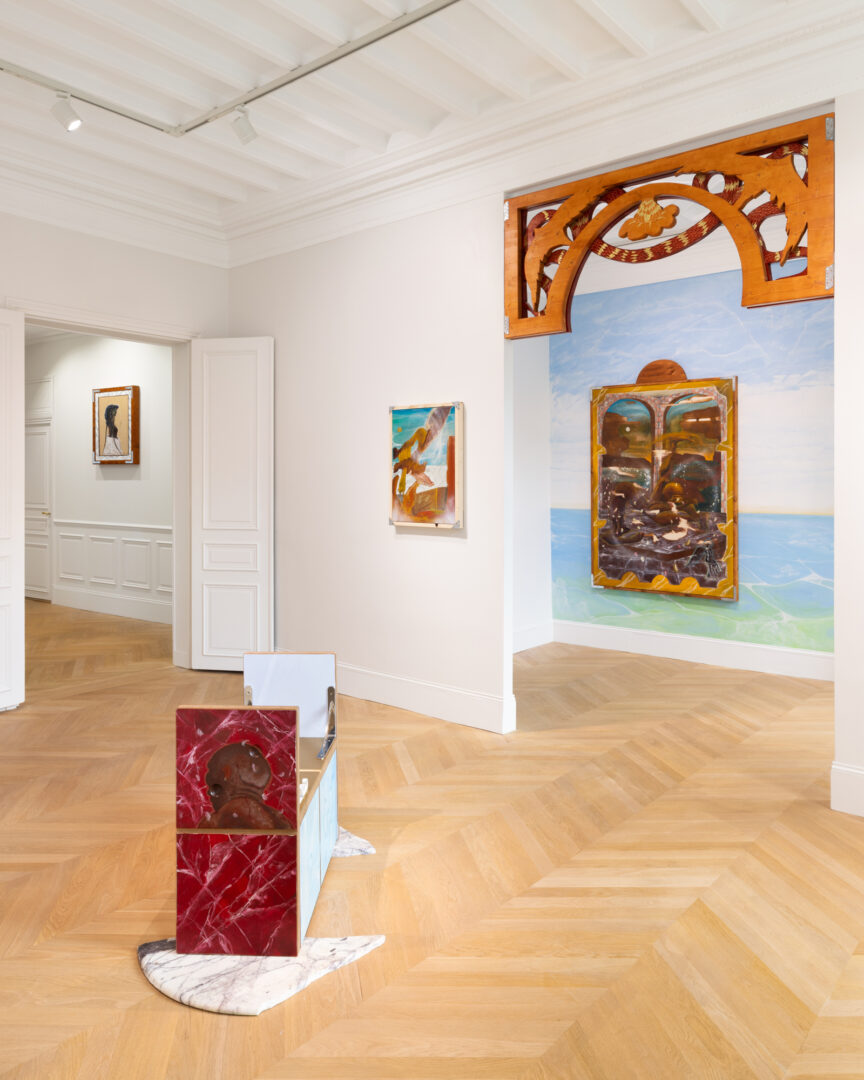
Head image : Exhibition view: Thomias Radin, Entre ciels et terres : contingences humaines, Esther Schipper, Paris, 2025. Courtesy the artist and Esther Schipper, Berlin/Paris/Seoul. Photo © Andrea Rossetti.
- Share: ,
- By the same author: Performa Biennial, NYC, Ralph Lemon,
Related articles
Biennale Son
by Guillaume Lasserre
Marcel Duchamp Prize 2025: alchemy and demiurgy, different perspectives on a changing world
by Anthony Ong
Condo London 2026
by Héloïse Chassepot