Mona Hatoum
Mona Hatoum
Encounters: Giacometti
Barbican, London
3 Sep 2025 — 11 Jan 2026
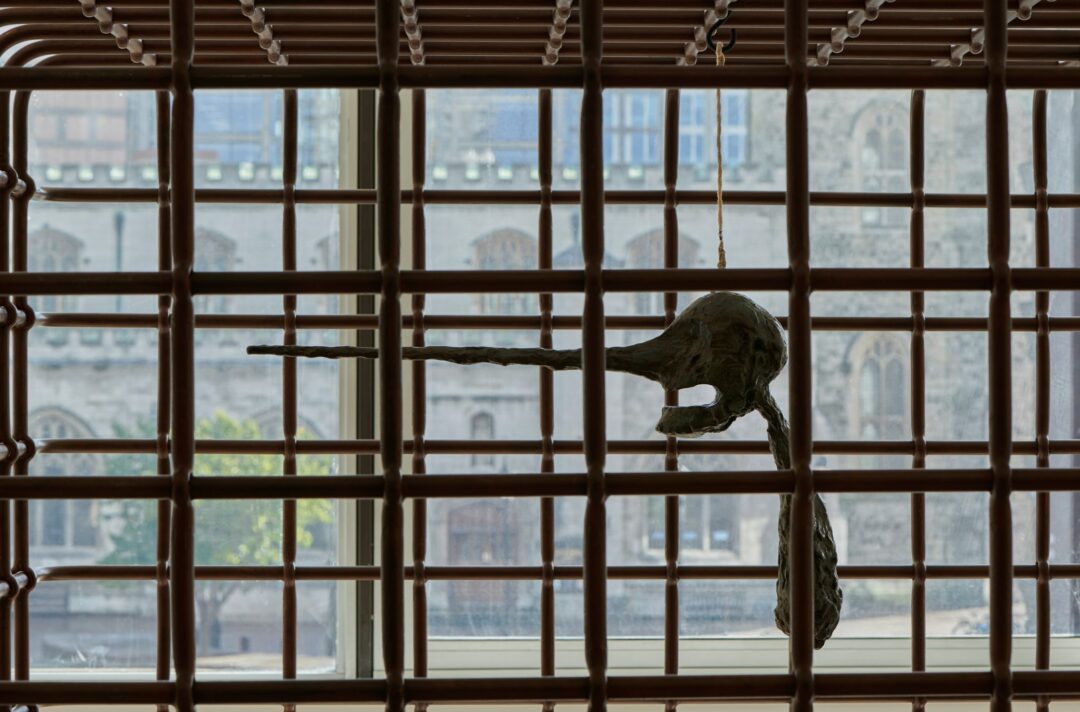
Until 11 January, at the Barbican in London, a sarcastic and macabre bronze Pinocchio with an oversized nose hangs from a wire mesh, watching over the public. Mona Hatoum encloses Giacometti’s Le Nez (1947) in a powerful medieval-looking iron cage (created under the title Le Cube in 2006), which she substitutes for the original sober modernist support. By displacing this spectral, cadaverous head, the fantastical work that Jean Clair peppered with questions in 1992, she heightens its tragedy and complicates its enigma. This fusion symbolises the principle behind the series of exhibitions organised by the London museum and the Giacometti Foundation, which brings Giacometti into dialogue with three contemporary artists, after the Pakistani-American Huma Babbha and before the American Lynda Benglis.
While this model of ‘encounter’ exhibitions between a figure of modern art and a living artist has become widespread in recent years, as seen in the invitations of Faith Ringgold and then Sophie Calle to the Picasso Museum or the current ‘unexpected dialogue’ between Monet and Sécheret at Marmottan, the Barbican exhibition particularly well illustrates the fruitfulness of these arrangements. Mona Hatoum has chosen works by Giacometti spanning a long period, from the early 1930s, at the end of his surrealist period, to the post-war years. Her own selection also ranges from her work as a performer in the 1980s to her productions in 2025. The distribution of the works embeds the two bodies of work, blurring any chronology, even though the works initially made sense in their original contexts. All of them, in various ways, more or less literal, more or less allusive, more or less elliptical, are situated after, during or before one or more catastrophes. From this point of view, the confrontation with Hatoum manifests and amplifies Giacometti’s tragedy: the stark poetry and anxieties of the two artists echo each other and literally follow on from one another. In contrast to Giacometti’s tortured sculpted bodies, Mona Hatoum’s objects offer a false, gloomy shelter from which all security has evaporated.
Mona Hatoum used her body in her early performances, such as in Roadworks (1985), on display at the Barbican. Then, turning to sculpture and conceptual art, she stopped depicting it and, more generally, representing bodies. Yet these vanished bodies remain in traces of a recent passage or awaiting a virtual one. They are hoped for, guessed at in the spaces represented, populated by beds, chairs, rugs, familiar objects that they no longer inhabit. Her places are no longer homes or cocoons. Devastated, they are, at least temporarily, uninhabitable.
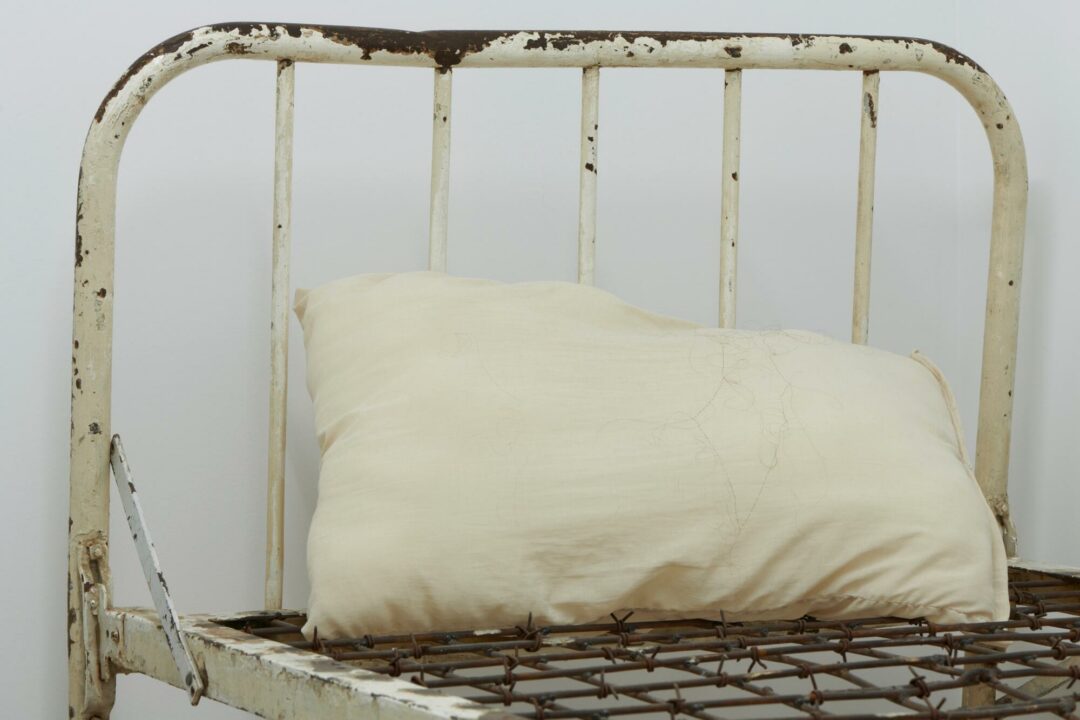
Throughout her work, and particularly in the choices made for this exhibition, the artist refers obliquely to collective events, when she does not anticipate them. Thus, Interior Landscape (2008), created during a residency in Amman, Jordan—a city and country with a high percentage of Palestinian refugees—weaves a map of historic Palestinian territory with hair left on the pillow of an abandoned bed in a hospital, prison or asylum room. In 2010, Bourj, the Arabic word for tower, refers to the Holiday Inn in Beirut, a fleeting luxury hotel built before the civil war that began in 1975. Once the embodiment of the insolent omnipotence of rational modernist architecture, it was ravaged during the fighting and now stands as an empty shell in the landscape.
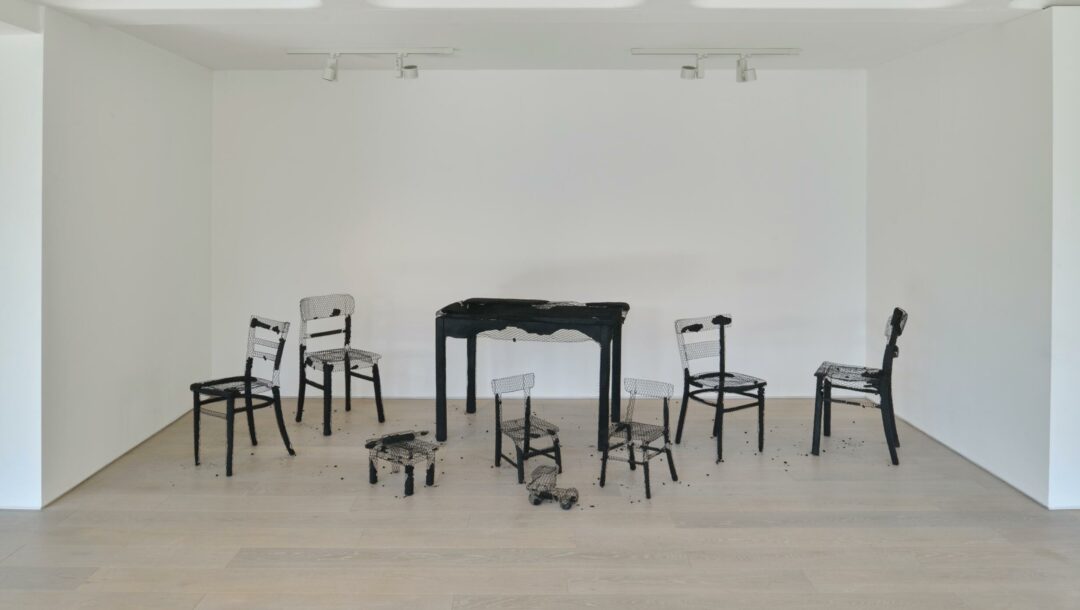
Although the personal history of Mona Hatoum, born to Palestinian parents in a camp in Lebanon, is closely linked to these two works, she refuses to allow her work to be reduced to this interpretation. She confronts the viewer with spaces of oppression and violence, both there and elsewhere. For example, in Roadworks, a filmed performance from 1985, she is seen walking through the streets of Brixton, a neighbourhood in south London where the Caribbean community revolted in April 1981 against the violence of a white, racist police force. Barefoot, Mona Hatoum drags, with a certain irony, a pair of Dr. Martens laced to her ankles, as if the skinheads who usually wear them were literally attached to her footsteps. Remains of the Day (2016-2018) is a burnt-out living room whose pieces are held together by wire. Created after the artist’s visit to Hiroshima, the work evokes all the interiors gutted by bombings that are constantly repeated in our news reports. And in Hot Spot (2013), it is an entire globe, incandescent, that bursts into flames.
Opposite, Giacometti’s long, alienated corpses, such as Figurine entre deux maisons (Figurine between two houses) and his slender silhouette between two blocks mounted on fragile feet, wander in search of refuge they will never find. The exhibition’s scenography places them in the inhospitable worlds of Mona Hatoum, where the domestic hearth, constantly unstable and threatening, continually eludes them.
Thus, the existential questioning that underlies Giacometti’s works, metaphysical silhouettes reduced to their simplest expression, captured in their perpetual movement, is symmetrically echoed by Hatoum’s, which are just a little more explicit about the circumstances of terror and vertigo that are theirs. The works of both artists blend and interact in the display cases, a kind of cabinet of curiosities dear to Mona Hatoum, who often uses them. She arranges her objects—using her own nails and hair, pierced brains, motifs of entrails—alongside and mirroring drawings from Giacometti’s surrealist period. In one of them, she places three new productions made in 2025. The dismembered arm of a child is placed on a glass tile. It is as if the encounter with Giacometti and his bodies, so material in their purity, gave rise to a renewed need, after their abandonment, to represent physically, concretely, a body, the body, even if only in fragments.
Faced with such images, the viewer is viscerally caught up and summoned. To see Giacometti’s Femme à la gorge tranchée, femme égorgée (1932) again, with its open and dismembered female torso, alongside pierced brains and baby figurines ready to be cut up, is to feel these attacks in one’s own flesh. Yet, paradoxically, in the dialogue between the two artists’ works, in her reworking of his, humour sometimes emerges: Mona Hatoum responds to Giacometti’s almost Egyptian statue of Chat, advancing threadlike on a clay base, with a clay tile bearing the imprint of a dog. Two artists who share a common obsession with matter, lines, forms, and the pain and memory they can carry.
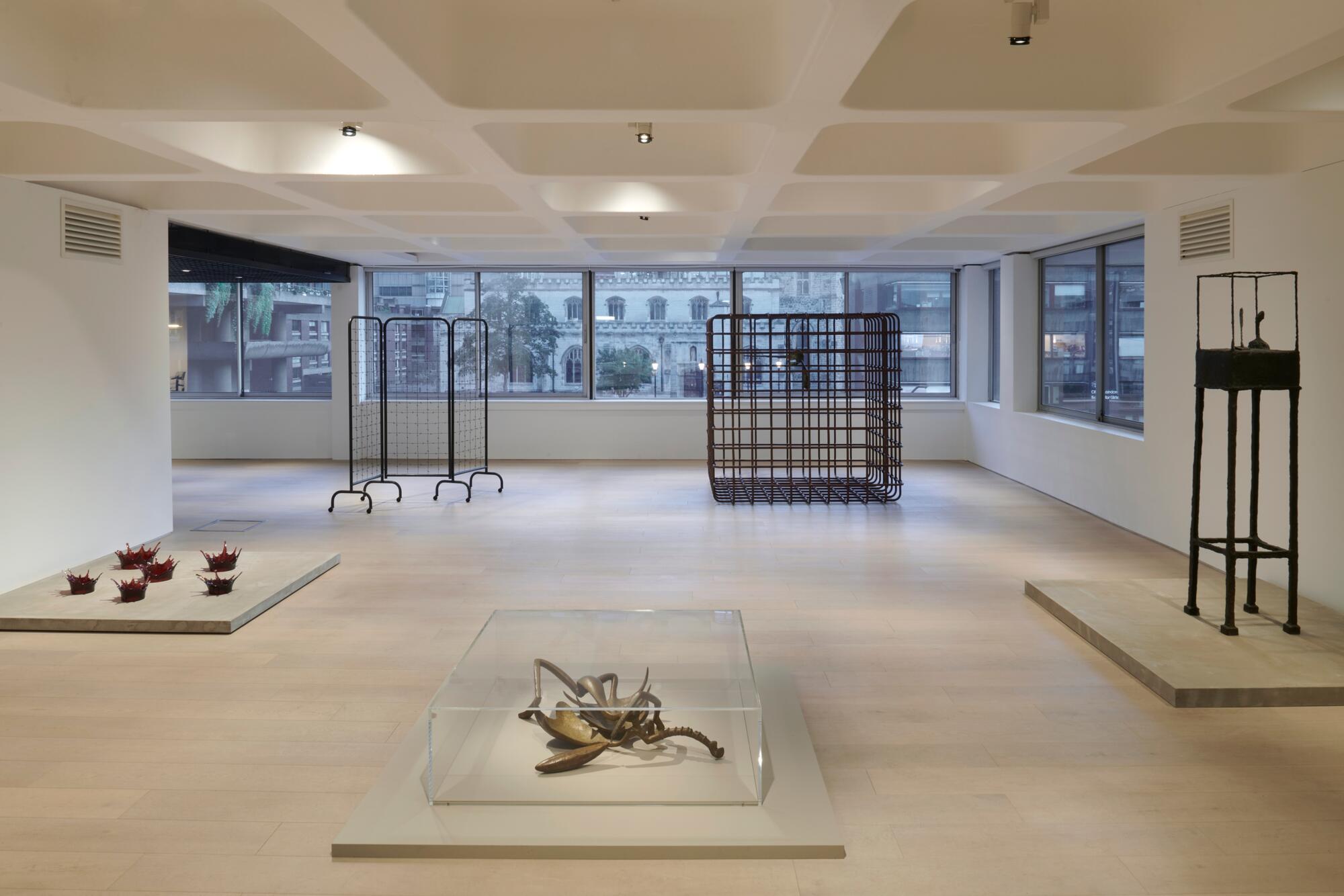
Head image : Encounters Giacometti x Mona Hatoum, Installation view, Level 2 Gallery © Jo Underhill, Barbican Art Gallery
Related articles
Biennale Son
by Guillaume Lasserre
Marcel Duchamp Prize 2025: alchemy and demiurgy, different perspectives on a changing world
by Anthony Ong
Condo London 2026
by Héloïse Chassepot