Condo London 2026
17 January – 14 February 2026.
Condo takes its revenge on a grey January, unapologetically reintroducing binge-like cultural habits into a season of sober resolutions. Derived from the term condominium, which in public law denotes a sovereignty shared between two states, Condo’s annual exhibition program is indeed grounded in values of collaboration and exchange. More pragmatically, it consists of a series of invitations extended by local galleries to their foreign counterparts. These invitations take more or less cohesive forms—ranging from the simple provision of space to joint curatorial efforts. Initiated just over a decade ago in London by Vanessa Carlos, the model has since, unsurprisingly, been exported elsewhere: to New York, Shanghai, Athens, São Paulo, and Mexico City. This year, 50 galleries are represented across 23 London spaces: the number of participating galleries has doubled compared to its inaugural edition, demonstrating the unequivocal success of the model and, in turn, the growing need for transformation within art ecosystems.
While offering the public an event whose scale lends it the air of a small biennial, each gallery pairing remains free in its proposition, leaving the overall reading marked by a raw eclecticism. The texture of language—its visual and sonic spillovers—nonetheless appears as a recurring denominator across a large number of the practices on view.
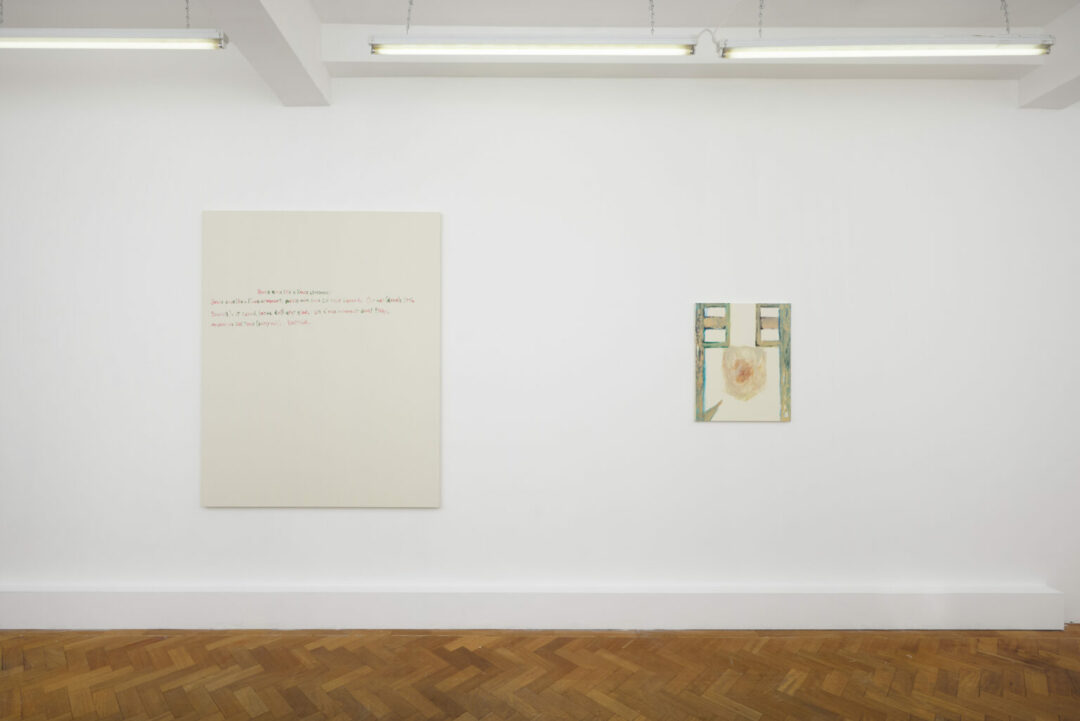
This pronounced taste for phraseology is evident from the title of Kazuki Matsushita’s exhibition, co-presented by Arcadia Missa and Kayokoyuki (Japan). Bear’s anus like a X’mas ornament brings together motifs as disparate as the bear (a reference to Japan’s current issue of bear overpopulation), its anus, and Christmas decorations. Serving as both introduction and synthesis, the full set of titles from the painting series is transcribed onto a raw canvas in an uncertain handwriting. From this follows a logic of exhibition in which the title produces the painting. Indeed, words borrowed from everyday language become, through anagrammatic play that stretches and distorts them, catalysts for images. Rendered as abstract landscapes in muted hues—where areas of reserve operate as freely as painterly gesture itself—Matsushita’s practice sharpens the porosity between sign and signified.
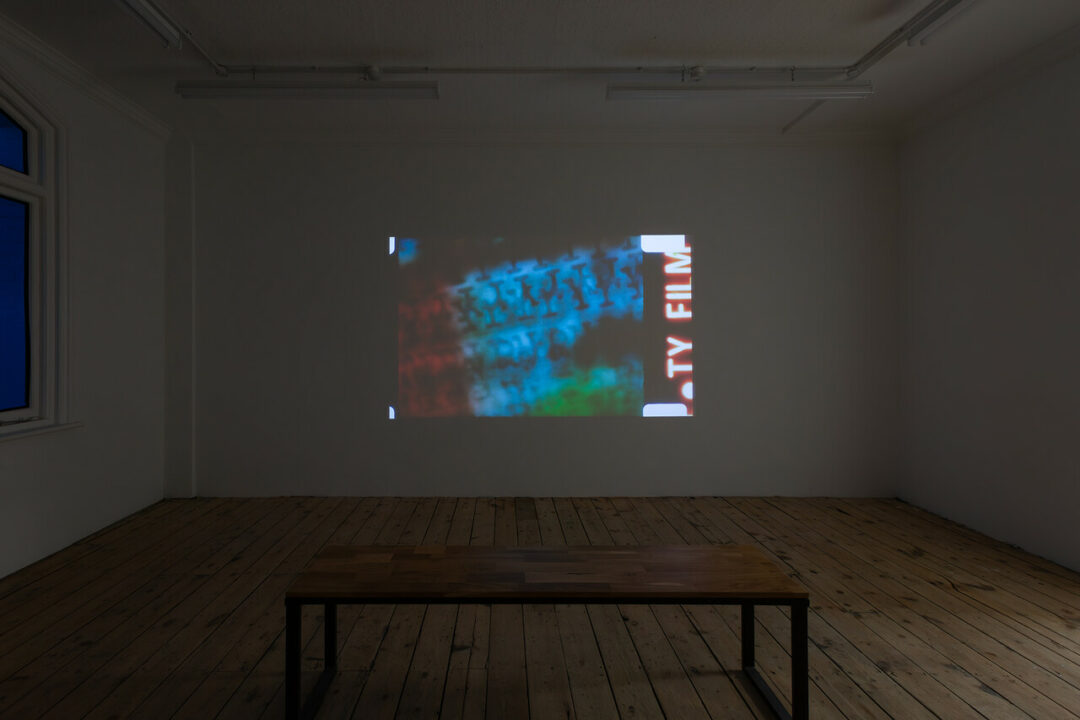
In a more avant-garde vein, the Brussels-based gallery Jan Mot, invited by TINA, presents for the first time in the United Kingdom a video recently rediscovered by Tris Vonna-Michell. To ray the rays emerges from the close proximity of its protagonists, E. E. Vonna-Mitchell and Henri Chopin, both deeply engaged in the spheres of concrete poetry and both involved in distinct forms of counter-cultural production—Chopin primarily through the journal OU, and Vonna-Mitchell through the Balsam Flex label—resulting, in 1985, in a video emblematic of the poetic experiments of that period. Over a cycle of roughly ten minutes, the typewritten letters of the title quiver and cascade over one another, suggesting a visual composition that actively seeks the reduction of meaning. The soundtrack pushes this abstruse redundancy further: ‘to ray the rays’ is stretched until only a grating echo remains, and through this process of paring down gives way to a sensitive conceptual form.
It is with the same frankness—perhaps rage—that Katie Shannon, invited by Shoot the Lobster (New York), performs a text she recently wrote on the occasion of the publication of Sara Graça’s exhibition catalogue. The text reconstructs a critical session among four Goldsmiths alumni: Katie and Sara themselves, alongside Moritz Tibes and Chris Owen. Gathered to discuss Sara’s forthcoming exhibition, they more or less inhabit their own roles: Sara, withdrawn, busies herself drawing the substance of the conversation on an overhead projector; Chris interjects with refined remarks; Moritz rationalizes; and Katie dominates. In a fragmented, free-flowing exchange, motifs of impermanence, precarity, immaturity, and homogeneity are raised—motifs crystallized by the condition of the artist in the era of ‘too-late capitalism.’ Oscillating between Dadaist performance and revolutionary call, Katie’s voice vociferates an exegesis of the style of immediacy described by Anna Kornbluh in her recent publication[1]. The performance, though absent from Condo’s official program, nonetheless feels essential to address and to receive within a context of constrained economic resilience and the growing encroachment of neoliberal logics on the operation of the art world.
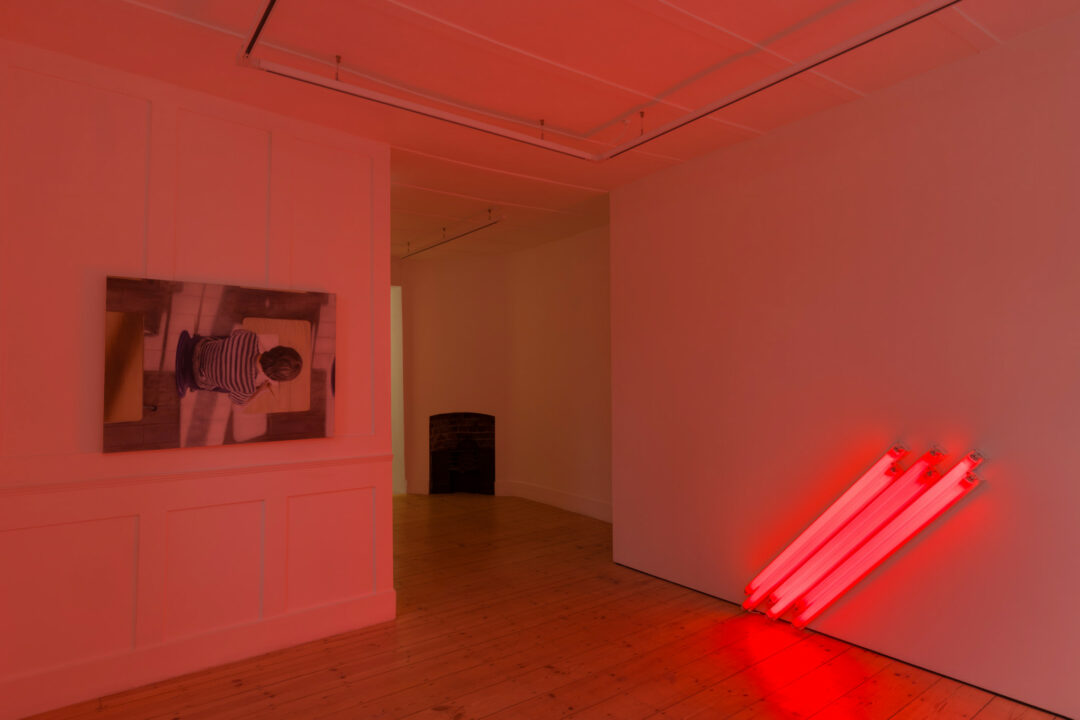
It is within this context of global instability that Condo has seen the emergence of new strategies of resistance. As novelty exhausts itself in the cancellation of the present, it appears to have slipped off the gallerists’ radar. Instead, galleries seem to have taken more seriously their role as historiographers, summoning artists from the modern era—or at the very least, the deceased. Among the less expected propositions, Emalin invited Peter Freeman Inc. (New York, Paris) to present an exhibition that, through a sharply articulated juxtaposition, revitalizes the immutability of Dan Flavin through the recent paintings of Anna Clegg and, conversely, endows Clegg’s paintings with historical prestige. Beyond a generational dialogue, these practices—however different—sublimate one another. Flavin’s red and white neons cast a filtering veil over Clegg’s photographic compositions; the latter, through their subtle materiality, resist the lure of the photogenic and instead resonate with a distinctly contemporary POV. This proposal has the merit of successfully questioning the exhibition form while simultaneously defending it as a forceful statement—one that, through a deliberately formal commitment, brings into being things that would otherwise not exist.
Crèvecœur (Paris), hosted by Modern Art, and Zaza’ (Milan), hosted by Rose Easton, offer further examples of galleries that have chosen to lean on the past in order to develop new exhibitions. Taking forms less canonical than at Emalin and Freeman Inc., these initiatives instead invest in the blind spots of history. Thus, Crèvecœur presents—alongside paintings by Alexandra Noel—a cadavre exquis realized by Remedios Varo, Benjamin Péret, and Esteban Francès. While firmly situated within the celebrated Surrealist movement, this collaboration, born of a love story, remains singular. Similarly, Zaza’, by reactivating drawings by the composer Sylvano Bussotti within a duo exhibition with Arlette, pursues a path adjacent to the institutional.
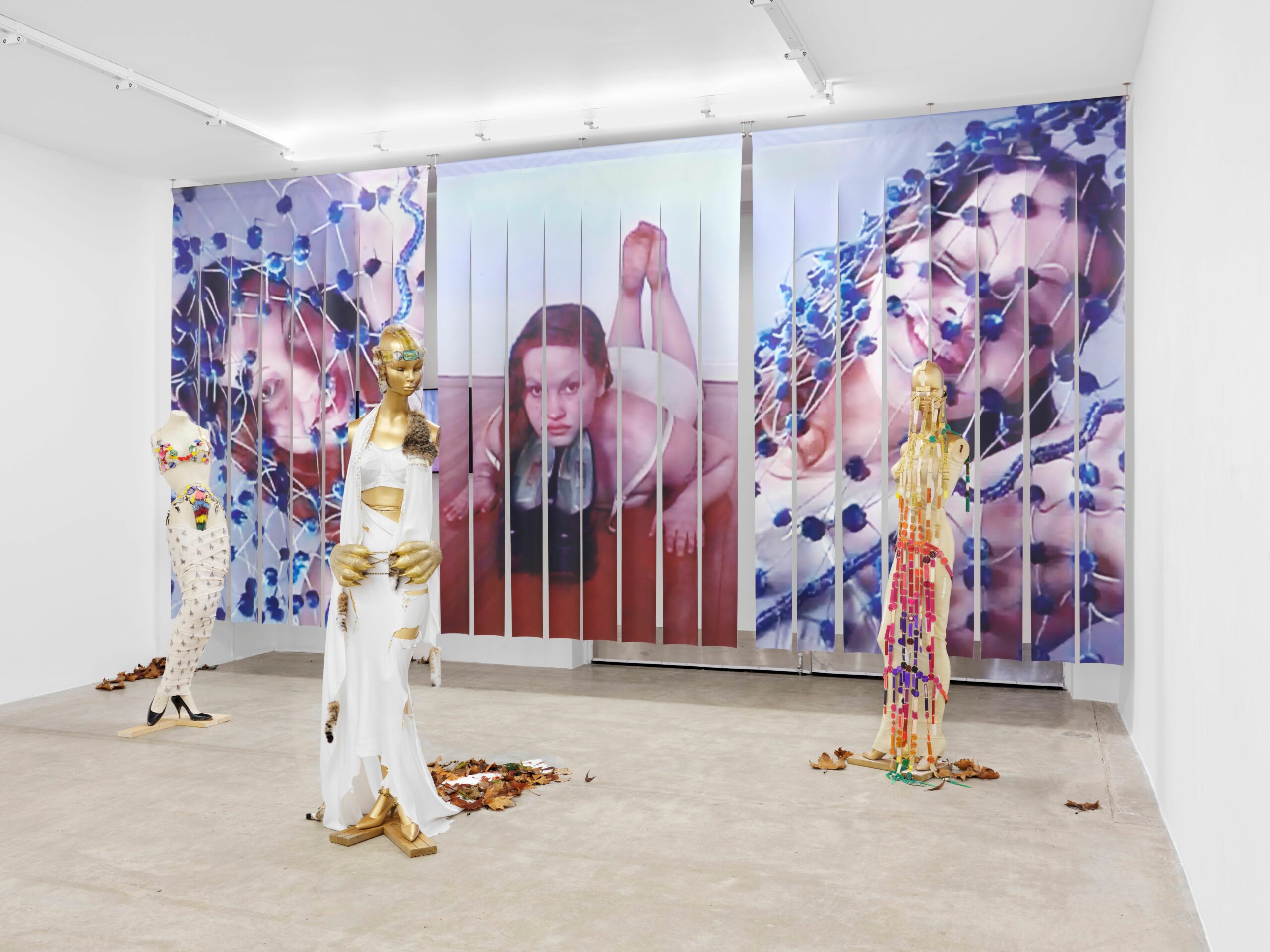
Finally, this reactivation of the past cannot be understood without acknowledging the groundwork laid by contemporary artists themselves, who have openly displayed a refined nostalgia for the avant-gardes. The New York–based gallery Company, hosted by Soft Opening, presents an exhibition by the artist duo whose very name—Women’s History Museum—already bears the mark of patina. Their mannequin-assemblages, if not the product of a fetishistic impulse, derive their compositions from the secondary circuits of amateur antiquarians. Through references and gestures that reinvest historical forms, the duo succeeds in renewing a feminist critique of the industrialization of beauty codes.
Taken as a whole, the structure of the event testifies to an inventive feat in the face of an environment hostile to risk-taking. Yet the abundance and conscientiousness of the proposals also give rise to a lingering sense of drift, revealing ever more starkly a crisis of thought within an art world that is increasingly saturated and disarticulated. One is not left unsatisfied—but one wonders when our own end will come: after nostalgia, what next?
[1] Anna Kornbluh, Immediacy or, The Style of Too Late Capitalism, Verso Books: London, 2024
Related articles
Biennale Son
by Guillaume Lasserre
Marcel Duchamp Prize 2025: alchemy and demiurgy, different perspectives on a changing world
by Anthony Ong
Saâdane Afif
by Patrice Joly