Interview with Camille Richert and Clémence Agnez
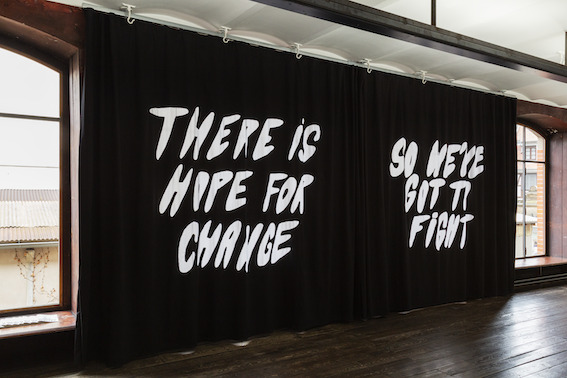
Hope for Change. Hackney Flashers, from London to Strasbourg,
group exhibition on display until 8 March at the CEAAC, Strasbourg.
With artists: Claude Dugit–Gros, Julie Luzoir and Pascaline Morincôme
The exhibition Hope for Change. Hackney Flashers, from London to Strasbourg looks back at the work of the London-based feminist collective Hackney Flashers, founded in 1975 in the working-class neighbourhood of Hackney, which denounced the inequalities experienced by women, particularly wage gaps and the lack of childcare options. At the CEAAC, their approach is being revived based on the situation of women and mothers in Strasbourg today, with the participation of three artists and researchers who are continuing their work by showing how, fifty years on, the political and social issues that the collective addressed are still relevant.
Clémence Agnez: The exhibition project at the CEAAC follows on from the publication of the monograph you edited on the activities of the Hackney Flashers, activists and artists who formed a collective in the Hackney district of London exactly fifty years ago. Upon entering the exhibition space, visitors discover a large number of archives of their work spanning from 1975 to 1980. This was a well-defined period during which the collective sought to highlight the reality of life for women in this working-class neighbourhood, whose wages for equal work did not match those of men. From this primary imperative to show the untenable social reality of women in Hackney came the collective’s mischievous name: the ‘Exhibitionnistes de Hackney ’, in its French translation. Can you tell us about the three campaigns that highlighted the daily lives of these precarious women, whom we discover to be both valiant and overwhelmed by their double lives as employees and mothers?
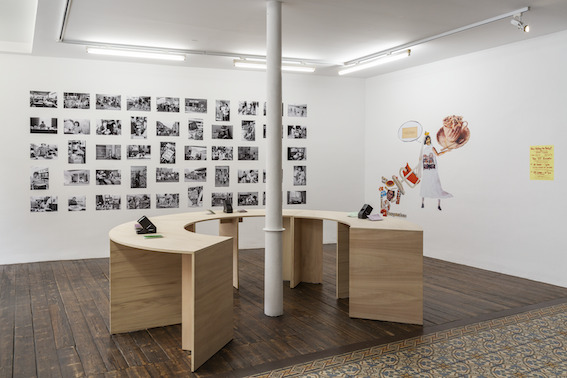
Hope for change, curator Camille Richert,exhibition view, CEAAC, Strasbourg, 3 October – 8 March 2026. Photo: Émilie Vialet
Camille Richert: The nine members of the collective began by producing Women and Work (1975) in response to a commission from a trade union for an event entitled ‘75 Years of Brotherhood’. One of the organisers had realised that the images planned for the exhibition would only highlight the work of men: the contribution of the Hackney Flashers was intended to counterbalance this invisibility. The group’s photographers then went knocking on the doors of companies in Hackney that employed a lot of women, with the Equal Pay Act coming into force in 1975 in mind. Despite the legal obligation, official statistics from 1975 show that women’s salaries remained lower than those of men in equivalent positions. The series thus presents portraits by sector of activity and captions with figures highlighting persistent wage inequalities. The result is all the more striking as the images highlight the professionalism, skills and courage of these women, far from any sense of misery.
This commission led them to continue their collaboration with Who’s Holding the Baby? (1978). It complements the first series: for women to have access to employment, to be able to pursue a career and not be relegated to the least skilled and lowest paid jobs, they must have access to childcare. However, post-war British family policy provided little support for public nurseries, being reluctant to interfere in what was seen as a strictly private matter. This forced some women to leave their jobs to look after their children and, in doing so, take on unpaid domestic tasks. The series was driven by a wave of protest that swept across Europe and North America, the Wages for Housework movement. It has a less documentary feel than the first: photocollages, photomontages, illustrations and verbatim exchanges with working and stay-at-home mothers make up these photographic panels.
Domestic Labour and Visual Representation (1980) is a set of slides accompanied by a booklet. The aim is educational: to teach people how to decode the sexist construction of images in the media and advertising. This series shows the influence of Brecht, as well as that of John Berger and his famous programme Ways of Seeing, which the members of the collective greatly appreciated.
Clémence Agnez: Rather than simply presenting the various forms their actions took between 1975 and 1980, you chose to augment them with current productions, on the one hand, carried out by other people and located in the CEAAC territory, and on the other hand, with research focused on Strasbourg initiatives of the time. On the one hand, these new forms, conceived by artists Claude Dugit-Gros and Julie Luzoir, take up the principle of agitprop, a mode of activism using widely ‘dispersible’ cultural forms – this method, which characterises the historical collective, subsequently enjoyed varied posterity. On the other hand, the research carried out by Pascaline Morincôme within the MIRA1 video archive shifts the focus to the reality of Strasbourg at the time. You first conceived the exhibition with the members of the Hackney Flashers, then with the artists and researcher associated with the project, a movement that resonates with the spatial progression of the visit: can you tell us more about how you envisaged this confrontation between two eras and two cities? What were the exchanges between the historic Flashers and your three guests beforehand?
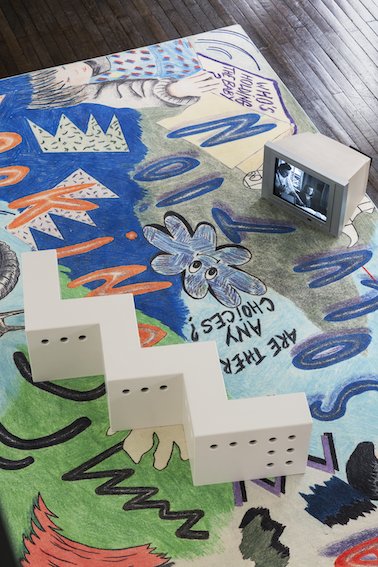
Hope for change, curator Camille Richert,exhibition view, CEAAC, Strasbourg, 3 October – 8 March 2026. Photo: Émilie Vialet
Camille Richert: When I met the Hackney Flashers, I asked them straight away, ‘What would you say if I offered to exhibit your work?’ They responded enthusiastically, but set two conditions: that the project should incorporate the context of Strasbourg and that it should reflect the lives of women today.
These conditions were productive constraints. They led me to reflect on the merits of showing a British practice in the Alsatian context. Inviting Julie Luzoir, an artist and graphic designer based in Strasbourg who is very active in local life and activism, made perfect sense: her works provide a precise understanding of the daily challenges faced by the people of Strasbourg. Pascaline Morincôme’s expertise in participatory practices and amateur film was invaluable: she identified documents from the 1970s in the MIRA collection that dealt with subjects similar to those highlighted by the Hackney Flashers. Claude Dugit-Gros, for her part, responded in volume to the challenges posed by the articulation of the historical and archival part of the exhibition with contemporary proposals. Her work at the intersection of art, design and scenography connects practices and structures the relationships between the 1970s and today, between Hackney and Krutenau, and between our elders and the younger generations, while also adding complexity to them.
The exhibition took two and a half years to mature, during which time links were forged with local communities, institutions in Strasbourg and, of course, a rapport developed between these three artists who had never worked together before. It was an unusual length of time, but necessary for the proposal to be sincere and accurate. I regularly updated the Hackney Flashers on the progress of the project, but, as with the book, they kept saying to me, ‘We trust you.’ ” With the initial conditions respected, I had complete freedom. What they and I absolutely wanted to avoid was turning this exhibition into a retrospective. It was clear that we had not resolved the issues raised in the 1970s, and that we should not defuse their controversial dimension by relegating them to questions of the past.
Clémence Agnez: With regard to the contemporary production for the exhibition project, it seems to me that each of the three invited artists and researchers is developing one of the main themes that intertwine in the Hackney Flashers’ campaigns: plastic forms for Claude Dugit-Gros, to be practised collectively and as a family; for Julie Luzoir, a performative approach that activates moments of exchange around the social realities of working parents during the exhibition, encounters aimed primarily at residents of the CEAAC neighbourhood; and finally, the curation of amateur videos proposed by Pascaline Morincôme, the collection and documentation of middle-class lifestyles, carried out from within by those concerned and in a specific context (here, the city of Strasbourg in the 1970s). While each of your guests takes on one of these three dimensions, they are then cleverly interwoven through the choices made in terms of spatial arrangement. How did you go about thinking about the symbolic and spatial place of each of them?
Camille Richert: Among the multitude of themes addressed by the Hackney Flashers, I highlighted those found in the films in the MIRA collection to emphasise how many concerns were shared by Londoners and Alsatians in the 1970s. In other words, it is the issues in Strasbourg, among others, that organise the British corpus and therefore the exhibition. The other organising principle is to take a close look at issues that, half a century after the collective was formed, remain unresolved. Six subjects form the chapters of the exhibition: the division of labour, the gender of work and domestic tasks, the double shift, the availability to get involved and the struggle to bring about change, and the inculcation of egalitarian values in the youngest members of society are issues that fifty years of progress in rights have not resolved. The works of the three guest artists and researchers in each section of the exhibition engage in dialogue with the work of the Hackney Flashers, adding nuance or reaffirming the current relevance of their observations.
In this exhibition, I am as interested in what happens inside the art centre as I am in its surroundings. Inside, everything that can be manipulated, especially by children, can be manipulated: the pieces produced contribute to the inclusivity of the exhibition space. Claude Dugit-Gros’ play mat, the Saturday afternoon bingo games organised by Julie Luzoir, and the miniature house designed by Pascaline Morincôme, where children can hang and move reproductions of pieces as they wish, allow different generations to learn about the work of the Hackney Flashers. The exhibition also opens up to the outside world through workshops outside the walls, reproductions of phrases written by local residents, and curtains from the space that can be taken down and transformed into banners for 8 March. But it is also open to passers-by: drawings from Who’s Holding the Baby? reproduced on the art centre’s windows and shopfronts catch the eye of people in the street. We know that not everyone will dare to push open the door of the art centre, but I wanted everyone to know that they were invited, welcome and possibly concerned. Because the work of the Hackney Flashers was, and still is, as political as it is democratic.
1. Mémoire des images réanimées d’Alsace, regional digital film library.
Head image : Hope for change, curator Camille Richert,exhibition view, CEAAC, Strasbourg, 3 October – 8 March 2026. Photo: Émilie Vialet
- Share: ,
- By the same author: Céline Poulin, Anna Longo, Patrice Maniglier, Catherine Malabou, Nicolas Bourriaud,
Related articles
Vanessa Theodoropoulou
by Patrice Joly
Céline Poulin
by Clémence Agnez
Calla Henkel & Max Pitegoff
by Ingrid Luquet-Gad