Céline Poulin
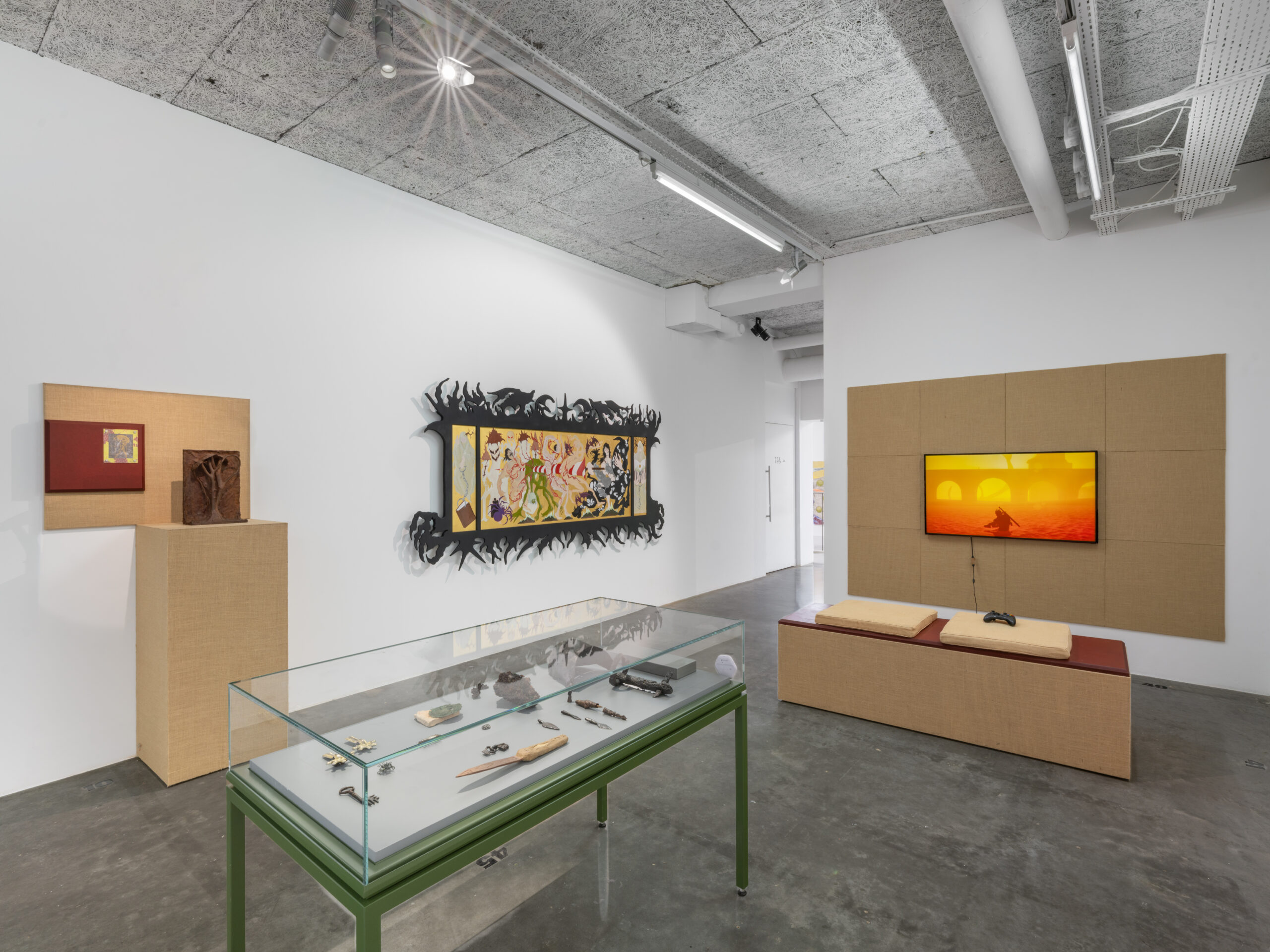
The exhibition Berserk and Pyrrhia, Contemporary Art and Medieval Art opened on 21 March at several venues: the two main sections are divided between the Plateau Ile de France and the Réserves du Frac Ile de France in Romainville, and are complemented by a selection from the permanent collections of the Musée de Cluny – Musée du Moyen-Âge. The exhibition is the result of a long-term project by its curator, Céline Poulin, who is also director of the Frac Ile de France, in collaboration with a number of contributors, including Camille Minh-Lan Gouin, associate curator, Michel Huynh, scientific advisor and chief curator at the Musée de Cluny – Musée National du Moyen-Age, and Agathe Labei and Florian Sumi, who designed the exhibition.
The exhibition, which runs until 20 July, features works by Nils Alix-Tabeling, Carlotta Bailly-Borg, Jacopo Belloni, Bernard Berthois-Rigal, Camille Bernard, Peter Briggs, Aëla Maï Cabel, Rose-Mahé Cabel, L. Camus-Govoroff, Pascal Convert, Mélanie Courtinat, Parvine Curie, Neïla Czermak Ichti, Corentin Darré, Caroline Delieutraz, Mimosa Echard, Frederik Exner, Héloïse Farago, Teresa Fernandez-Pello, Alison Flora, Lucia Hadjam, Laurent Jardin-Dragovan, Nicolas Kennett, Agathe Labaye & Florian Sumi, Lou Le Forban, Liz Magor, Pauline Marx, Ibrahim Meïté Sikely, Philippe Mohlitz, Raphaël Moreira Gonçalves, Léo Penven, Théophile Peris, Jérémy Piningre, Agnes Scherer, Cecil Serres, François Stahly, Wolfgang Tillmans, Gérard Trignac, Clémence van Lunen, Xolo Cuintle and Radouan Zeghidour.
Clémence Agnez :
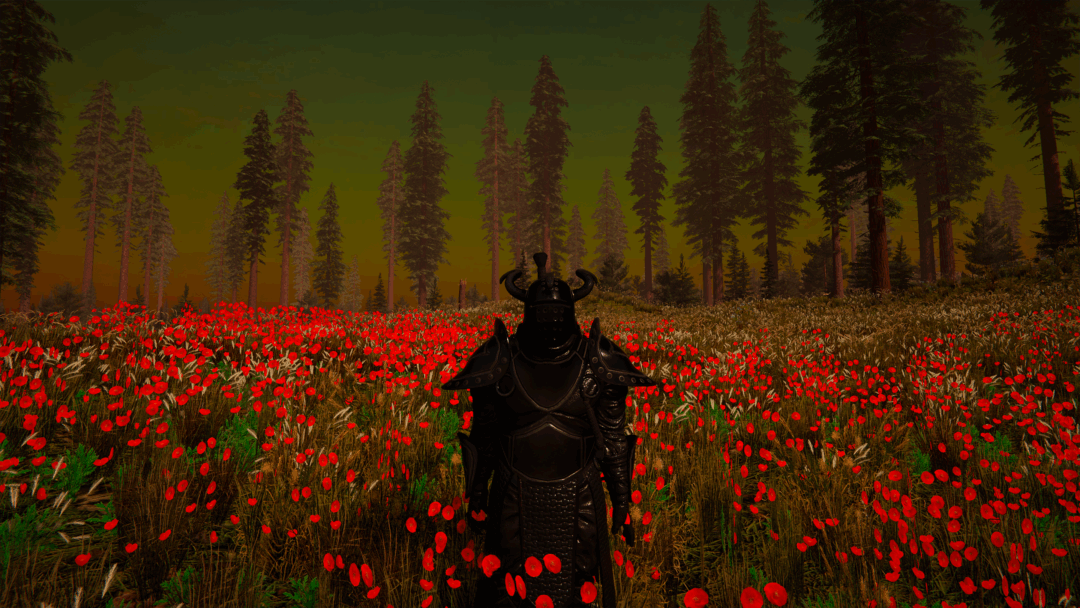
In recent years, art schools have seen a marked interest in various popular cultural forms that draw on the fantastical world of the Middle Ages. Whether in TV series, manga, video games or internet culture, medieval tones have become widespread since the 1990s and have strongly influenced generations of artists who are just leaving school or at the beginning of their careers. The exhibition echoes this trend, placing it squarely within a singular frame of reference: Berserk, a manga series from the 1990s that follows the adventures of a warrior inspired by medieval Europe in a dark fantasy world. While this choice may be surprising, it has the merit of highlighting the heterogeneous nature of medieval-inspired cultural productions. Here, the point of entry for visitors shifts the focus away from the locality associated with the period, as we are invited to look at the European Middle Ages through the Japan gaze of Kentaro Miura, the creator of the manga Berserk, which gives the exhibition its title. These shifts between different eras and locations remind me of the concept of “cultural transfer” coined by Michel Espagne, who says that ‘any passage of a cultural object from one context to another results in a transformation of its meaning, a dynamic of re-semantisation. (…) Transferring is not transporting, but rather transforming, and the term cannot be reduced to the ill-defined and very banal question of cultural exchanges. The study of cultural transfers leads us to relativise (…) above all the notion of centre. “Can you come back to this initial choice, which is counterintuitive for many, but in fact very striking, to approach neo-medieval aesthetics through the prism of this very specific Japanese reinterpretation, where the codes of manga, role-playing and medieval fantasy collide?
Céline Poulin :
Ah, I wouldn’t have imagined it to be counterintuitive because it was obvious to me. I began fantasising about this exhibition in 2020, thanks to my encounters with several artists, including Lucia Hadjam, Corentin Darré, Ibrahim Meïté Sikely and Neïla Czermak Ichti. Their work wasn’t necessarily inspired directly by medieval history, but it’s mediated by a deep knowledge of pop culture, which is itself infused with medieval imagery. Berserk is a reference shared by many. The work is directly present in the work of Lucia Hadjam and Neïla Czerbak Ichti, for example, and it’s also a reference for me, as I read a lot of manga. I was also a role-player (1), so it’s really my cultural universe. Kentaro Miura was directly inspired by Jérôme Bosch, Gustave Moreau and Gustave Doré. Some of the panels seem to be copies, versions or interpretations of their works. We find the same process of inspiration from the Apocalypse according to Saint John. This circulation between pop culture and fine arts interests me a lot. I don’t think contemporary art can be understood ex nihilo; it is linked to the history of art, pop culture, visual studies, etc. Making these connections visible creates paths between each person’s culture and the works, opening doors. I often think of the words of Patrice Loraux, my professor of platonist philosophy at Paris 1: ‘Let’s imagine that one person is in A and another is in B. If the first wants to bring the second to A, then they must put some of B into their A.’ This is a process of decentering thought as much as it is of attention and openness. When I conceive an exhibition, I connect several poles of desire, those of the users: the people who experience the exhibition, who are as much the artists as the visitors or the team. In the same way, the Berserk & Pyrrhia exhibition is constructed through a sharing of subjectivity and according to a principle of de-hierarchisation of places and practices. The project as a whole is co-constructed with Camille Min Lahn Gouin, Michel Huynh and Séverine Lepape from the Musée de Cluny, Rémi Enguehard, Marie Baloup, Peggy Vovos, Héloïse Joannis, Laure Delcaux, and the entire mediation team and partners for the off-site exhibition, amateur artists involved, etc. For me, there is a conceptual parallel between the polyphony at work in the production of exhibitions, which draws on subjectivities of different kinds, cultures and knowledge, and the integration of references that are a priori less legitimate in the field of fine arts, such as manga and video games. It is not a question of erasing the history and importance of the knowledge conveyed by medievalists. On the contrary, the exhibition gives pride of place to the medieval heritage by presenting historical objects, exhibiting in medieval locations, and leaving plenty of room for scientific discourse. The contribution of the Middle Ages is not minimised or distorted, but put into perspective. Indeed, the meaning is not exactly the same, but certain elements nevertheless remain.
C.A. :
This project was particularly close to your heart, as it was the concrete example on which you based your project for the direction of the FRAC Ile-de-France. Beyond the exhibition as it exists, with its two parts at Le Plateau and Les Réserves, and its resonance beyond the museum walls, discreetly infiltrating the collections of the Musée de Cluny – Musée National du Moyen-âge, it seemed urgent for you to tackle the question of the medieval in order to clarify the meaning, or rather the plurality of meanings attached to the term. With this in mind, you combined your own inclinations and knowledge with those of historian Michel Huynh, curator at Cluny, to conceive an exhibition that brings into tension the notions of medievism and medievalism. The former refers to the study of sources from the period in question (a thousand years spanning the 5th to the 15th centuries), while the latter refers to the various representations with a medieval tone constructed a posteriori and referring to the contemporary reception of a fantasised Middle Ages. I feel that this second category encompasses a whole host of other levels beyond the strictly historical: it plays on desires for elsewhere or, more radically, for a space-time that would be the Great Other of our everyday lives, but also on the question of the use and popular dissemination of medieval representations, as well as the idea associated with the Gothic (a notion also characterised by the counter-cultural emergence of what it designates) of the persistence of a motif from the past that is invested precisely because it is always already past and goes against legitimate culture. Where the Middle Ages have been widely described as a period of obscurantism between two high points of Western civilisation – Greco-Roman antiquity and the Renaissance in Europe – the term Gothic was coined by Vasari in the 15th century with a view to establishing the works of the Renaissance precisely against what preceded them, which he called Gothic, in reference to the barbarians who sacked Rome. These latter aspects particularly intrigue me because they open the way to a possible empowerment: by asserting itself as a counter-canon, the aesthetic plane is enhanced by a political dimension that is widely embraced by various minority groups, ranging from the fascist far right to the anti-capitalist communities of the radical left. Can you elaborate on this dialectic between medievalism and medievalism, as well as on the uses of forms and images associated with the Middle Ages?
C.P. : The best thing to do is to read Michel Huynh’s text on the subject: “The Middle Ages is a period stretching from the end of Antiquity to the beginning of the Renaissance, covering a thousand years of history, but it is mainly rooted in the collective imagination through representations and facts from its last third. For historians, the Middle Ages is a specific period, but certain aspects, such as politics, are considered to have lasted until the industrial era. Finally, medievalism is the academic discipline that studies the reception of the Middle Ages and the persistence of its customs in later periods. Beyond a certain fashion in academic circles, the persistence of the Middle Ages in material and artistic culture is a phenomenon of extraordinary depth and unexpected diversity. […] Medievalism is ultimately nothing more than the expression of a fascination with a bygone era, imperfectly known but deeply rooted in the collective imagination, to the point where historical certainties merge with elements forged by the distortion of time, the passage of stories into the world of ideas and the invention of artists. Whatever aspect of today’s societies we consider, we will almost always find an interpretation of its medieval origins. Company logos and car emblems, like local taxes, are medieval remnants of coats of arms and tithes, according to Michel.
If there is a ‘political ambiguity’ in the Middle Ages, as Clovis Maillet (2) notes, because there is a risk of traditionalism and attempts to essentialise a national territory, the artists of B & P are obviously not part of this movement. We find references to rural legends in Corentin Darré’s work, which allow him to portray a fear of difference and create the figure of the Monster. Similarly, by revisiting Romanesque and religious architecture, L. Camus Govoroff pays homage to botany and plant science, enabling the liberation of women’s bodies. Ibrahim Meïté Sikely places the medieval heritage in a broader culture that blends religious representations with elements of his daily life and personal history, as well as forms derived from manga. Radouan Zeghidour uses medieval liturgical and architectural vocabulary to recount the resistance of the inhabitants of the mountains, where he lives, to industrialisation.
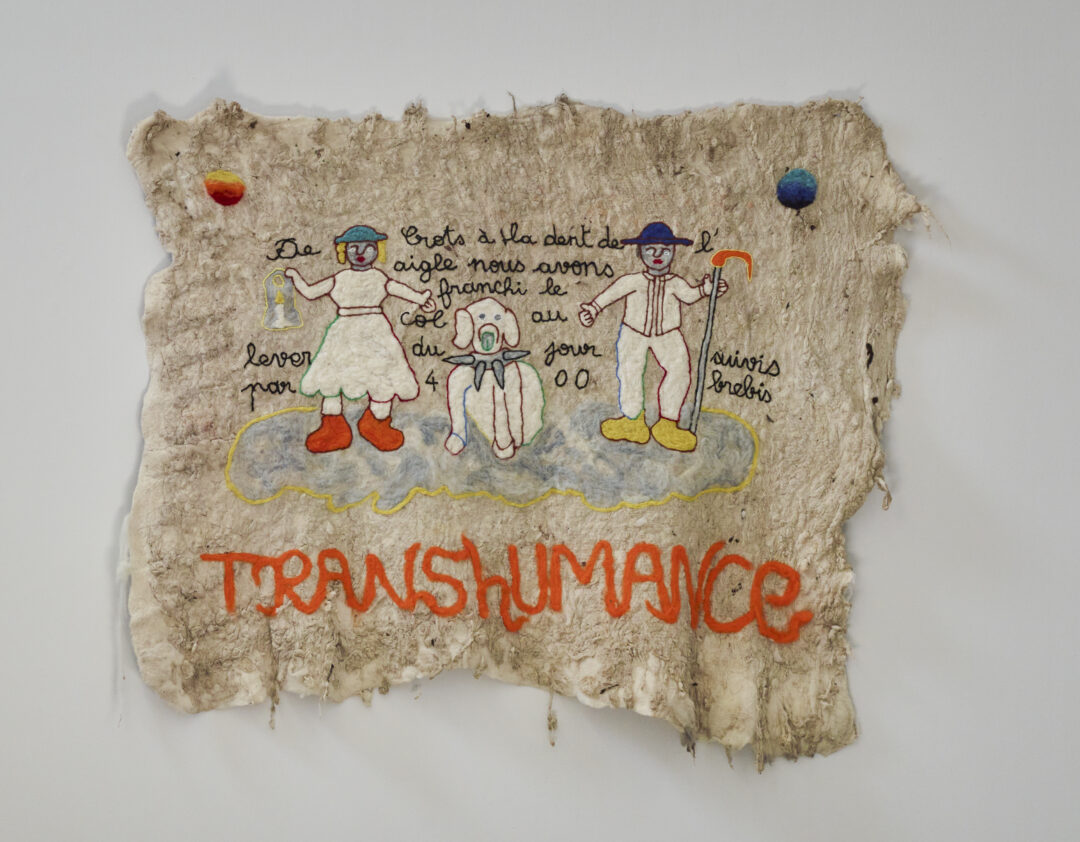
Laine feutrée et broderies / Felted wool and embroidery.
C.A. : You have chosen to structure the exhibition in two parts, Berserk, the darker of the two, at Le Plateau, and Pyrrhia, more closely linked to enchantment, at the Frac reserves in Romainville. Pyrrhia is the name of a wood-eating butterfly, known as the ‘chrysographer’, which is also used to describe illuminated monks. It is also the name of an imaginary island in Tui T. Sutherland’s fantasy series The Fire Series, which focuses on the adventures of the dragons that inhabit the island rather than the humans, who are present but relegated to secondary characters or even elements of the scenery. Here we find the same decentring mentioned above, but in an enchanted version, where the marvellous largely outweighs the disturbing or dark dimensions that predominate in Berserk. This division gave me the impression of a necessary antagonism: not two distinct modalities, but rather a first dark moment resonating with contemporary anxieties, and a second moment, correlated with the first, invented as an antidote to it, a safe conduct or a utopian space of resistance, which we hope will be performative. The apocalyptic imagination, so prevalent today, is only sustainable through enchanted fictions, fictions that call for their actualisation in the world. This gives us the feeling that eschatology and fantasy form a polar couple, characteristic of our era. Could fantasy and the marvellous be envisaged as an aesthetic and political remedy to the chilling prospect of ecological and military crises? Furthermore, Les Royaumes de feu is primarily a work intended for young people. What place does childhood, and its enchanting power, occupy in this second episode of the exhibition?
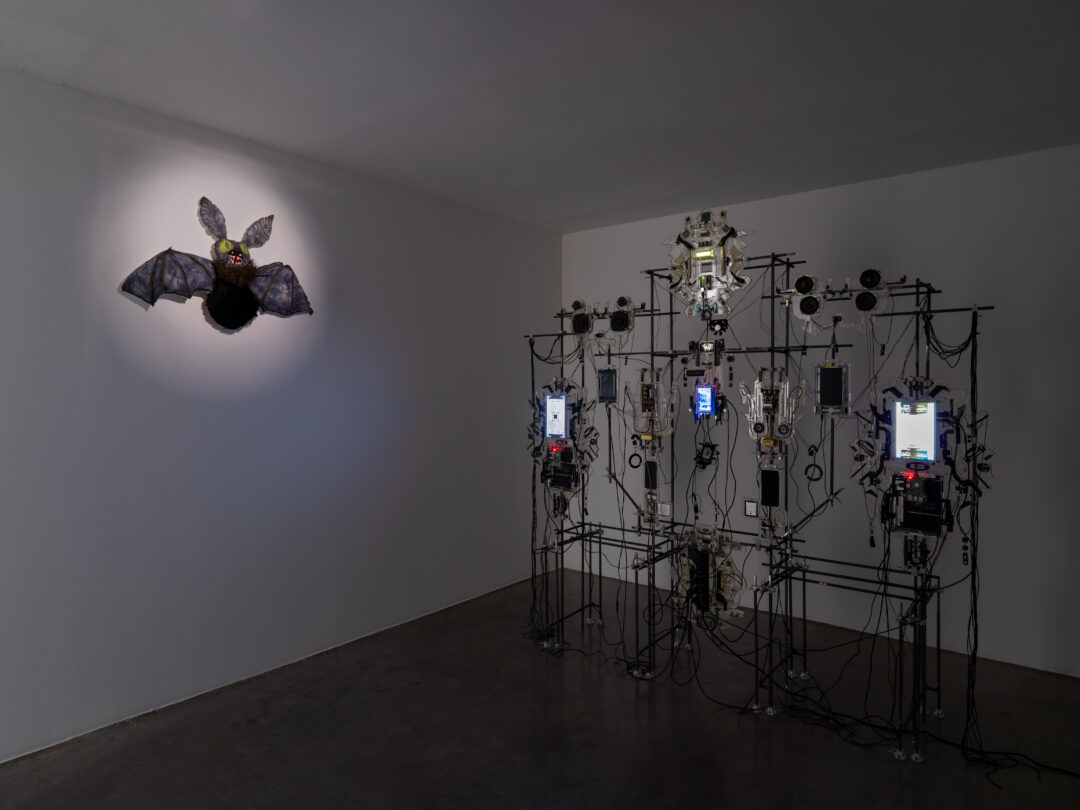
C.P. : This duality between the two spaces is illusory. While Berserk at Le Plateau embodies contemporary violence through medievalism, and Pyrrhia at Les Réserves embodies the hope of a dreamt-of elsewhere, several artists are actually present in both exhibition spaces. Binary oppositions did not really exist in the Middle Ages: unicorns were as real as toads or griffins, and the imaginary and the real intermingled. Many hybrid beings thus existed in people’s minds, books and stories, bringing about an encounter between humans, animals and plants, which we now long for. The spiritual is not detached from the earth, good from evil. Semantic categorisation is linked to a quest for efficiency and, in fact, to industrialisation. Thus, several artists exhibited at Les Réserves, in particular, have chosen to withdraw from cities and use pre-industrial techniques, but also to seek other forms of pre-modern socialisation, based on the collective rather than the individual. But a work such as Teresa Fernandez-Pello’s at Le Plateau shows the possibility of a spiritual or mystical approach to digital technology, and Mélanie Courtinat’s works show a poetic use of video games that goes beyond the heroic quest. Berserk and Pyrrhia are two facets of the monstrous and the hybrid that cannot function without each other, and each is a manifestation of the marvellous. I also see them as two first names, two figures in love, like Tristan and Iseult, the legendary couple of the Middle Ages. This artificial duality is a tool for taking the audience on a journey through a story.
Going back to childhood, this narrative dynamic speaks to children and to the child in all of us. I am an avid reader of young adult literature and a fan of teenage movies, but I also enjoy children’s books and comics (including manga). Exhibitions have different levels of interpretation, making them accessible and interesting to a wide range of people with different expectations. Exhibitions create more of a universe, an overall image, than a discourse that is ‘safe’ and ‘on point’ at first glance: this way, everyone can immerse themselves at their leisure. The discourse is present, but on the one hand it is plural, and on the other hand it is not imposed. I don’t want to tell anyone what to think or feel.
- Michel Espagne, Michel Espagne, « La notion de transfert culturel », Revue Sciences/Lettres [En ligne]. URL : http://journals.openedition.org/rsl/219 ; DOI : https://doi.org/10.4000/rsl.219
- Role-player, both on stage and in real life.
- Clovis Maillet, medieval historian and artist, has published Les genres fluides and, with Thomas Golsenne, Un moyen-âge émancipateur, two essays in which he examines the versatility of symbolic and political categories that later become rigid.
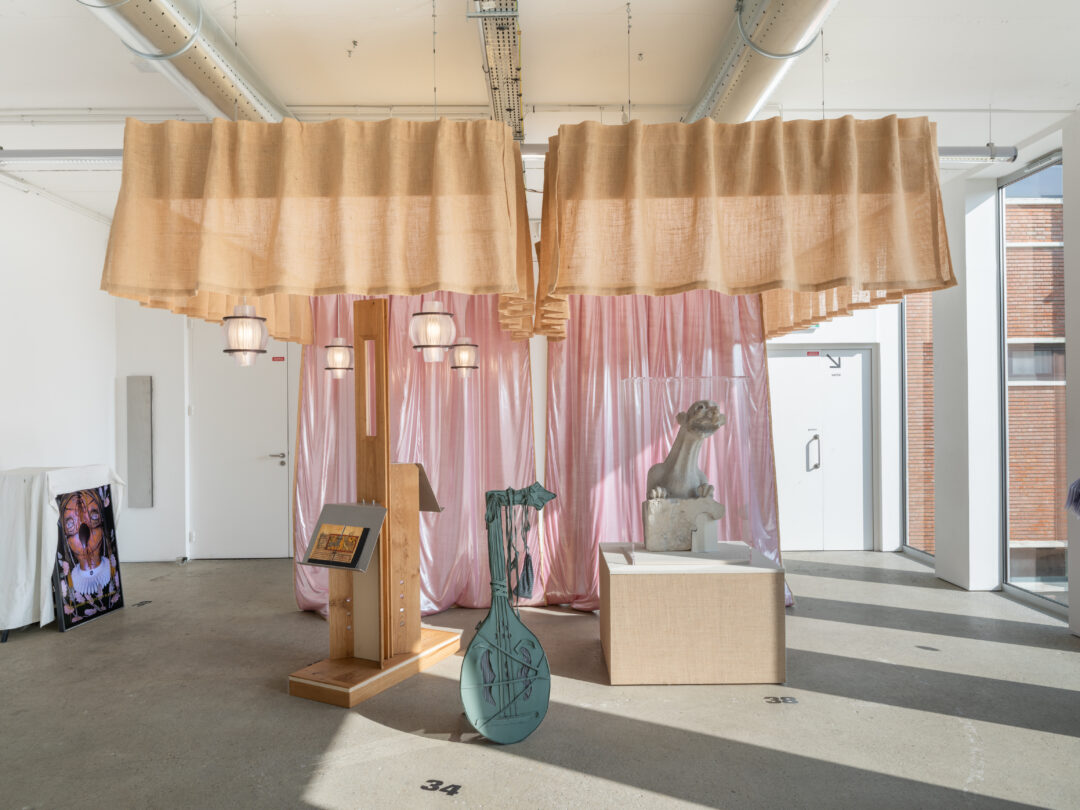
Head image : Vue de l’exposition / Exhibition view « Berserk & Pyrrhia, art contemporain et art médiéval » au Frac Île-de-France. Photo : © Martin Argyroglo.
- Share: ,
- By the same author: Interview with Camille Richert and Clémence Agnez, Anna Longo, Patrice Maniglier, Catherine Malabou, Nicolas Bourriaud,
Related articles
Interview with Camille Richert and Clémence Agnez
by Clémence Agnez
Vanessa Theodoropoulou
by Patrice Joly
Calla Henkel & Max Pitegoff
by Ingrid Luquet-Gad