Jean-Charles de Quillacq
Leave Your Body
How best to ‘enter’ Quillacq? Through the body, however, where does the body begin?1
Everywhere, nowhere, inside, outside: “The body does not begin anywhere, it is an anywhere space.”2 It is precisely this “anywhere” space that Quillacq addresses in his sculptures, performances, videos and drawings; in the artist’s practice these media all dialogue with one another in an organic way. Working with his own body—a lived-in one which has experienced things—the artist focusses on the factual nature of existence, unique and paradoxical as it is, without getting lost in discourse: “Certain things—even the most abstract or spiritual things—can only be experienced through the body. The same experience through a different body would not be the same at all.” (Pier Paolo Pasolini, Petrol). The artist therefore engages both himself and the viewer in an untranquil experience, in order to confront “something which is deeply just and completely immoral.”3
In the work of Quillacq, the body is everywhere and yet does not appear in its entirety at all. It is truncated, fragmentary or even masked: headless. One striking aspect of the exhibitions are the body parts which are exclusively from the lower regions; those with no prehensile functions or any notion of reality. Quillacq exhibits a kind of fascination with these nether regions, making of this high-tension zone a centre of gravity in both his sculpture and performance.
The title Quillacq Ouverte announces its intentions in a quite literal way. The word “Ouverte” (Open) appears in highly-visible bold black type on a faded white background on several posters which read The Desire to be Open (the title of one of the posters). This radical availability, which is nonetheless ambiguous, riffs on all possible forms of availability: the on-call 24/7 mode required by capitalist societies that never sleep, the freedom to experience unlimited pleasure, the illusory free spirit, and anything else imaginable… The posters are palimpsests made from movie posters of Maurice Pialat’s La Gueule ouverte (1974) (The Open Jaws) which have been erased using acetone in order to conserve only the word “Open”. The film is about a woman, her husband, their son and daughter-in-law; it is a very difficult film to watch—I saw it when I was 13 years old and still have not been able to shake some of the impressions it left on me. The title has been truncated, the image and the word “mouth” erased: here, the ultimate experience of a life which has fallen to pieces and a body which is falling apart serve as a background to an intention, that of a palimpsest. With a bit of effort, we can even interpret this destructive act as a productive one, an operation: truncations, removals, cut-outs, erasure.
Truncation, then, becomes a method for opening. The artist reproduces the lower part of his body via injection moulding, it seems to automatically reproduce itself, a way of concretising “the reproductive system”. “Autofunction” and “My Reproductive System” are the titles of two exhibitions which explore the artist’s universe: one at the Marcelle Alix gallery (2020) and the other at Bétonsalon (2020), the art and research centre. The artist works with a fragmented body as a point of departure. These disjecta membra of course recall Gilles Deleuze and Félix Guattari’s “body without organs”: “The BwO is not contrary to organs at all. Its enemies are not organs. The enemy is the organism,” which is it say a hierarchical structure, or a rational subject, endowed with subjectivity. Everything that Quillacq quite literally blows up—into legs, sexual organs and buttocks, has a masked double. The artist therefore provides the viewer with an even more striking spectacle of depersonalisation as his omnipresent body multiplies, becoming fragmented. Legs and sexual organs become autonomous, creating a family of strange phantoms which includes Dimwit (the title of several mouldings of the artist’s sexual organs and legs, 2023). The video Travail Fmailial/Fmalily Work (2021), the artist features masked, nude bodies, freed from social strictures and also of their humanity, which become, through their resemblance, anonymous, disposable and interchangeable.
In Quillacq’s performance The Stand-In (2023), the most extreme form of availability is on offer. In an isolated gallery in the museum, the artist, who dons a mask, allows a visitor to do what they like with his body; on one condition involving a part of the body: the visitor can only participate in the performance with their nose covered in plaster, the result of which is then added to a collection of participant’s noses. The performance is based on an exchange: my body in exchange for your nose. The encumbered nose becomes, in this situation of complete availability, the perfect partial object: sexual. The nose gives a burlesque tone to a situation which confronts visitors with a desire that has no limits, testing the boundaries of this space which can separate or unite beings. Quillacq orchestrates communication between unconsciouses.
Although Quillacq’s exhibitions may well be scenic, they nonetheless give the impression that we are witnessing the aftermath of some drama which took place; the byproducts of which have been skillfully arranged so as to be taken stock of. Clues from a crime scene abound—dismembered bodies are scattered on the ground or on tables, used or dirty objects, bottles or containers filled with suspicious liquids, worn-out mattresses covered in used clothing (Portrait of my father sleeping, 2003-ongoing). A delinquent, sexual ambiance reigns, revealing a burlesque strangeness: each truncated figure seems to be minding its own business, focused on holding its own. Certain details provide comic relief, evoking a minimalist version of Mike Kelley, Paul McCarthy, Paul Thek. Handmade cigarettes, some of which are thin and contorted, others oversized and made of painted French baguettes, embellish a crazy afterparty tableau. Through a pared-down theatricality, Quillacq neutralises the pathos his chosen themes—bodies, sex, violence—often give rise to.
However, the themes are conceived as directly related to sculpture, seen from the concrete point of view of their production. One of the artist’s early and recurring sculptures can provide insight into the artist’s sculptural discourse: a long, malleable sausage-shaped form which is often attached to ordinary objects, hiding in corners or displaying itself on a polystyrene pedestal. Franz West’s Passstücke are direct ancestors. This rough, yet elegant form bears a striking resemblance to the “consistent and molded matter” of faeces, as defined in the dictionary, falling under the category of base materialism. However, these abstract sausages are also a friendly form of punctuation emerging amongst these truncations, some of which, quite beautiful and of an intensely blue colour, have been made with extreme care, through a heady yet exhausting experience which puts a vital function to the test—breathing. The inky, midnight blue colour is the result of the artist having orally blown through Bic pens. Quillacq has referred to the process as a form of meditation, and in fact, this performance is the measure of an expenditure which operates through something exiting the body. As to the materials of the sculptures, they are also physiological in nature (urine, sweat, eggs mixed with epoxy resin) and are the result of a physical dissemination.
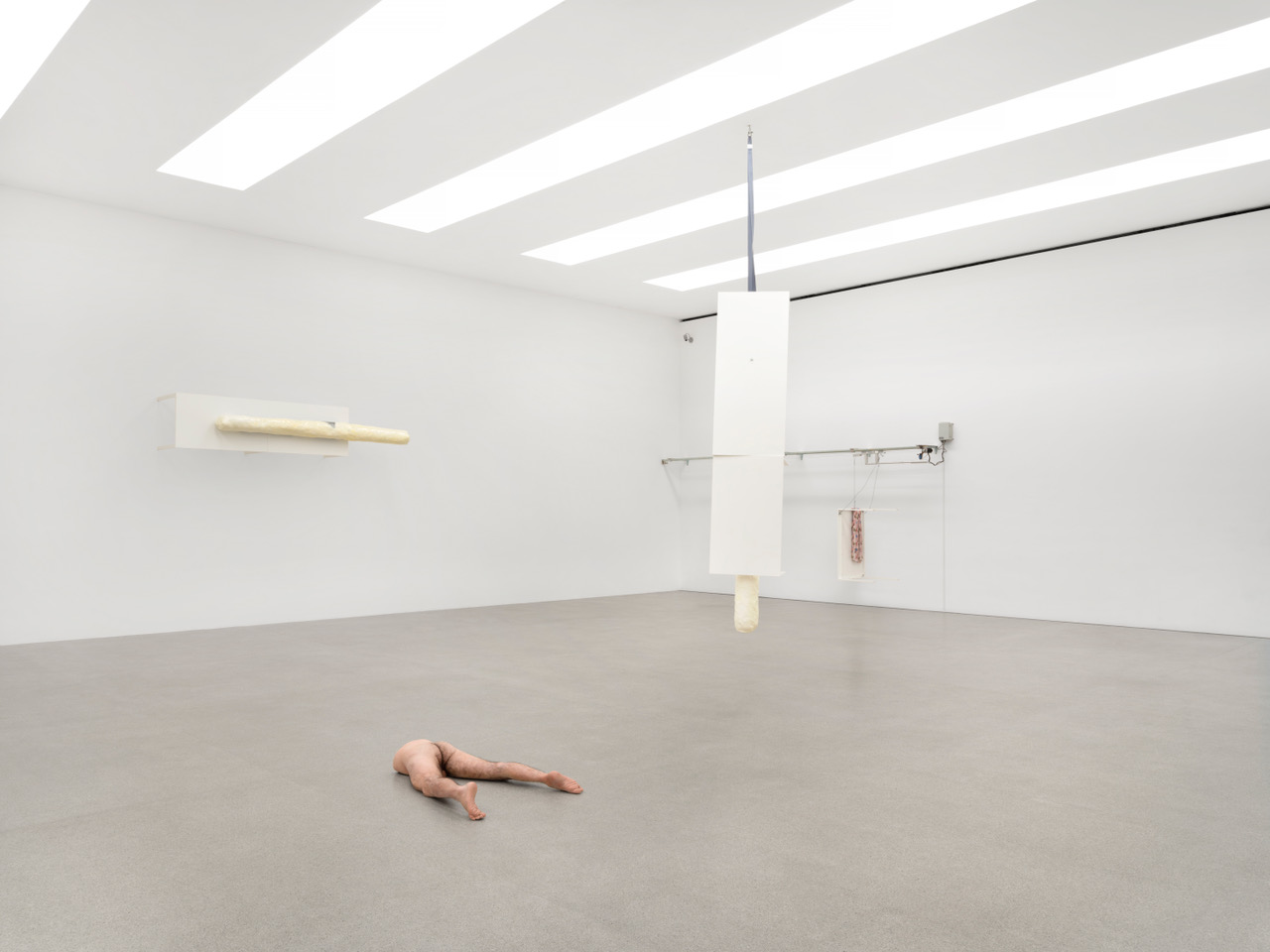
For the Kunsthaus Biel Centre d’art Bienne, the artist envisioned what he refers to as a “dramaturgy”, bringing to life the immense, clinical white cube: a spectacular yet minimalist machinery. The hyper-realistic sculpture displayed on the floor of the Centre played a pivotal role: a pink, hairy lower half of a body attracted viewers’ attention immediately upon entering, anchoring the gallery with all of its weight, emitting a paradoxical energy. The figure’s genitals are flattened against the floor, a photo of gay Texans plastered to its ass—a homoerotic subtitle which can easily be projected moving underground in the Southern U.S. region. Its unfinished, hairless and corpse-like twin lies in the same position under a table, seemingly defeated, in a suggestive way. These visions are frightening and comic all at once.
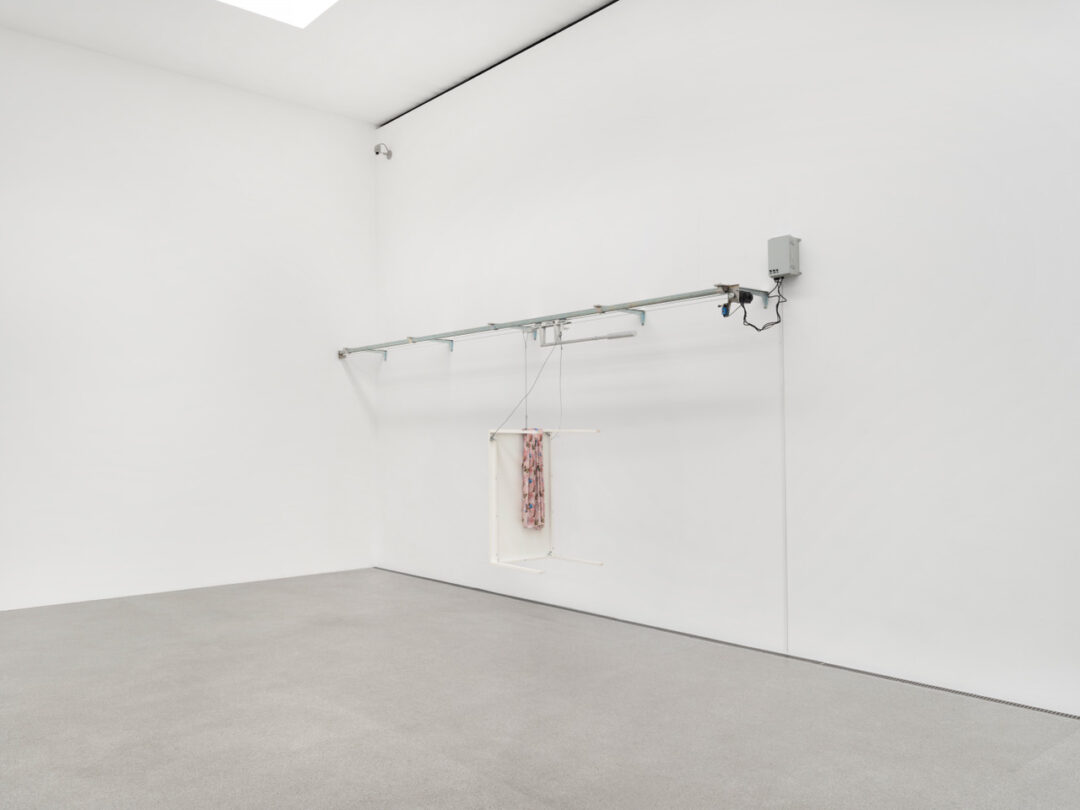
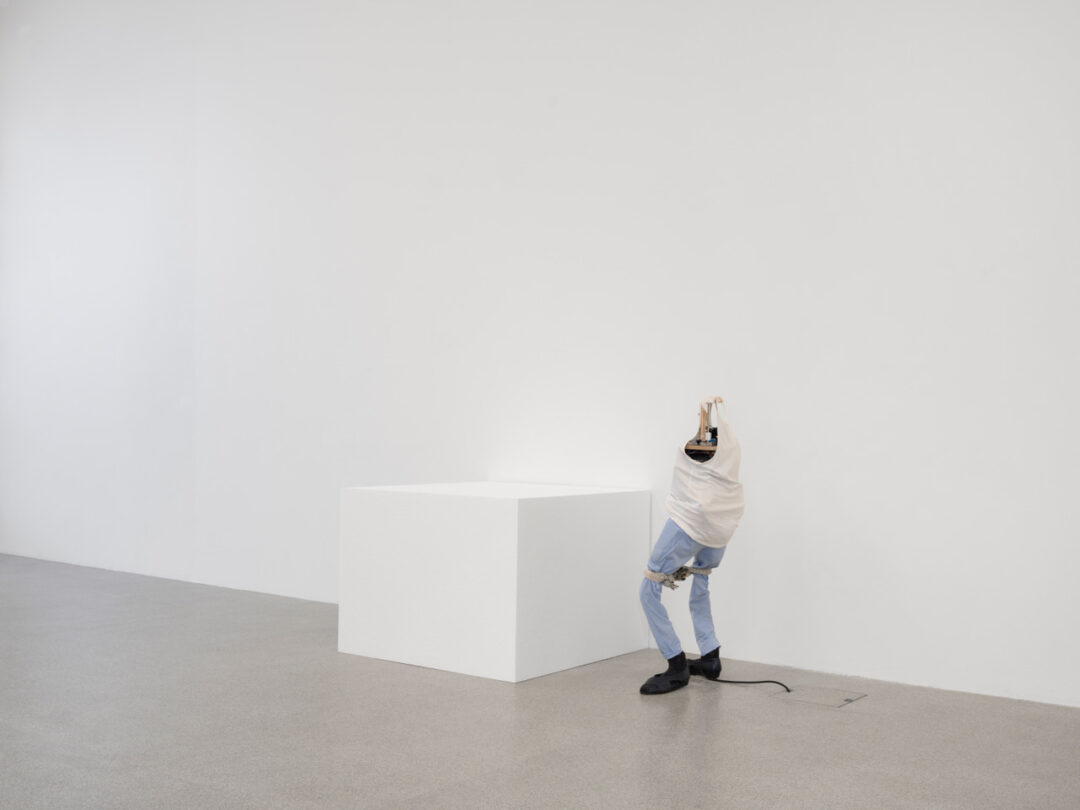
The KBCB exhibition’s title, “Daddy is Home,” while a factual phrase; is far from insignificant given the father theme. The phrase incidentally references a political event of some significance, to say the least—it became a viral congratulatory slogan during the re-election of the current President of the United States, the father of the primitive hordes. Here, the father era is now drawing to a close, while there, it has been experiencing a resurgence. A badly-dressed father in diminished form bats his bandaged chest, a spoon over his genitals, rising and falling (What’s the plan?, 2025). Elvira (2025) produces the echo of the sound of an Ikea table on rails, from which a feminine, outdated fabric has been suspended: a faded memory of the transgender character from the Rainer Werner Fassbinder film, The Year of the Thirteen Moons (1978), in search of the past.
The artist appears to have taken on the role of erotic messenger, like the protagonist in Pasolini’s Teorema (1968), who reveals an all-encompassing force to everyone who crosses his path. The artist’s literal and elliptical oeuvre preserves it from all pathos, as well as from any heroic interpretations. Quillacq’s work can be considered as opening up unexplored regions inside ourselves, a realist and fantastical theatre which takes on the tones of a burlesque farce, completely removed from any form of pathos.
1. Par où commence le corps humain. Retour sur la régression “Par où commence le corps humain. Retour sur la regression” is the title of a book by Pierre Fédida, Paris, PUF, coll. “Petite Bibliothèque de psychanalyse”, 2000.
2. Georges Bataille, as quoted par Roland Barthes quoted by Pierre Fédida.
3. Elsa Vettier, exhibition text for Jean-Charles de Quillacq, “Sepultura”, Café des Glaces, Tonnerre, November 2024.
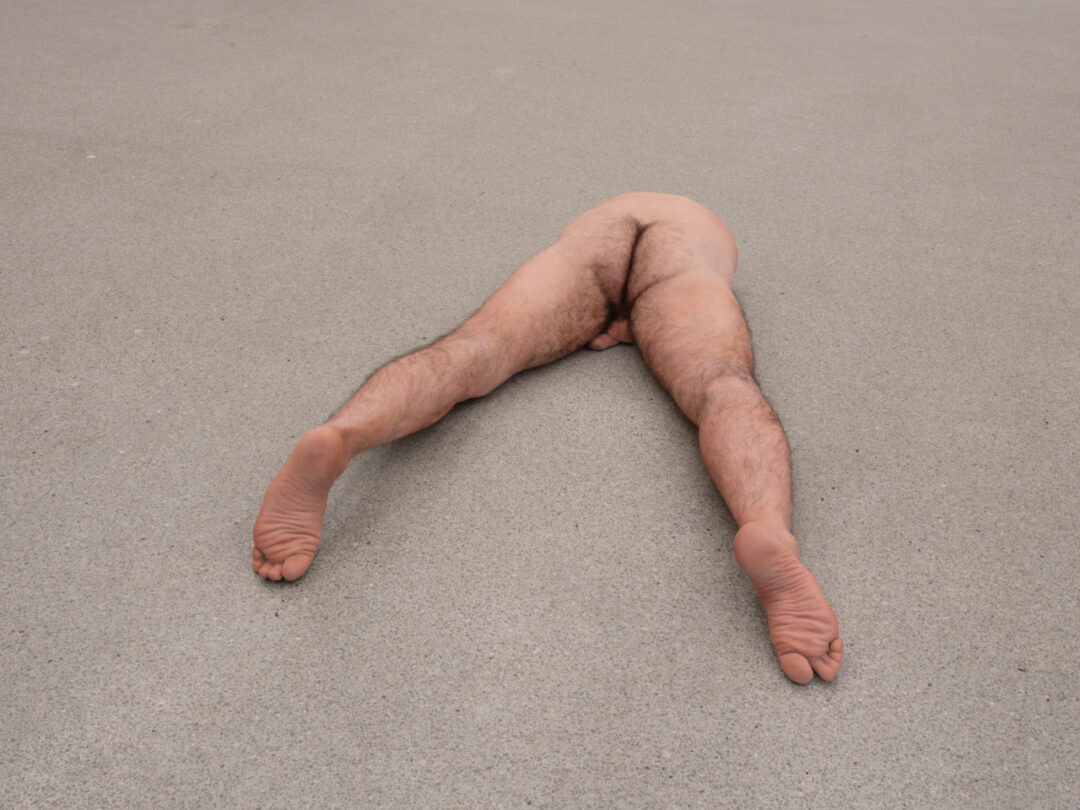
Head image : Vues de l’exposition / Exhibition views « Daddy is Home », Jean-Charles de Quillacq, Kunsthaus Biel Centre d’art Bienne, 2025. Courtesy de l’artiste & galerie Marcelle Alix. Photos : Julien Gremaud.
- Share: ,
- By the same author: Philippe Van Snick,
Related articles
Julie Béna
by Anna Kerekes
David Claerbout
by Guillaume Lasserre
Alicja Kwade
by Vanessa Morisset