David Claerbout
A Poetics of Time
Konschthal Esch, Luxembourg
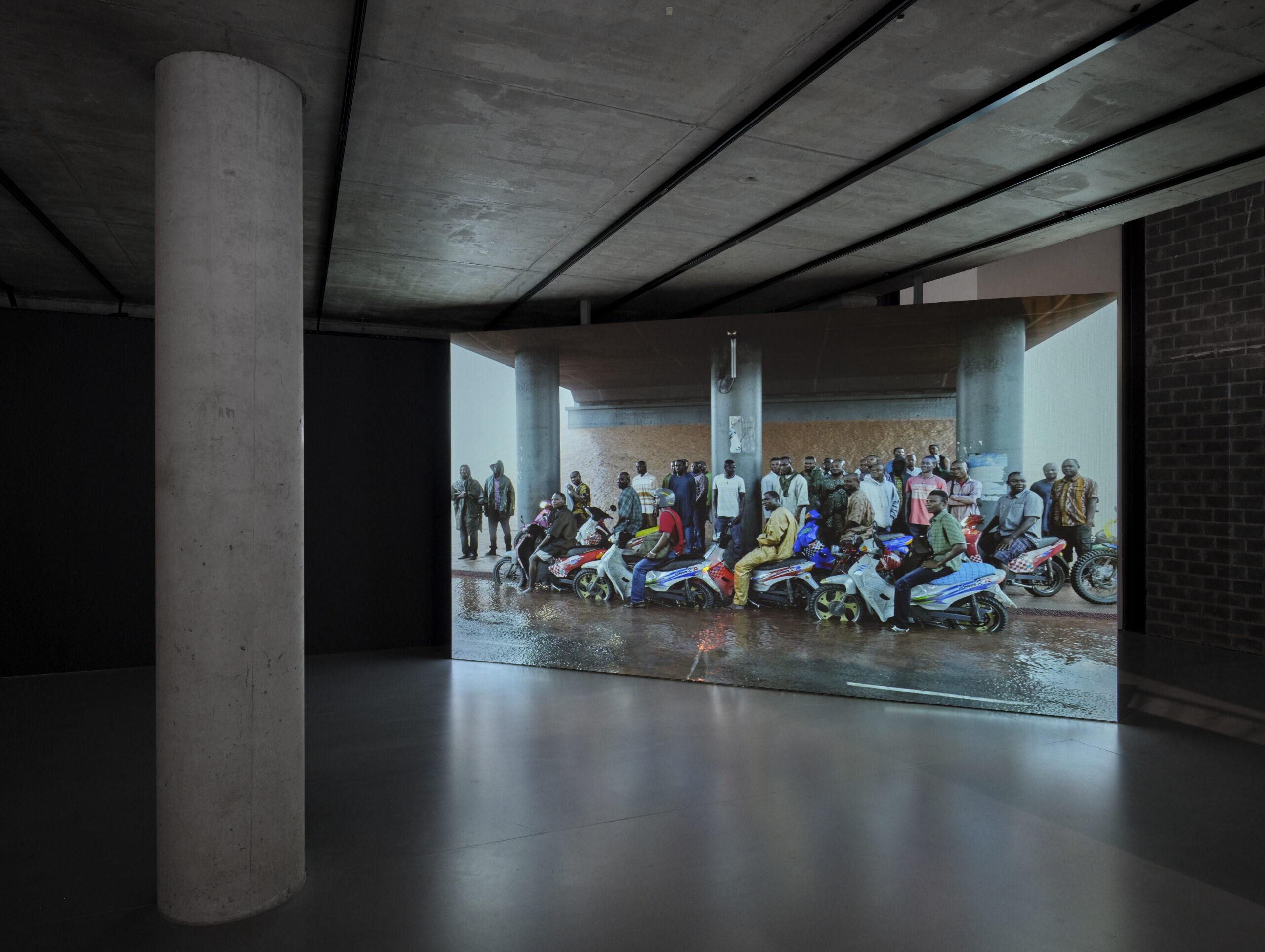
“Five Hours, Fifty Days, Fifty Years1”—Konschthal Esch Luxembourg’s exhibition dedicated to the work of David Claerbout2—serves as a portrait of this Belgian artist whose oeuvre has provided an in-depth exploration of the production, presentation and perception of images beginning in the 1990s. Rather than operating as a mere manipulator of images, Claerbout seems more like an archaeologist of time, remodeling our perception of reality through his immersive installations which defy chronological linearity. David Claerbout (b. Courtrai, 9th April, 1969) has solidly positioned himself as one of the most singular voices in contemporary art by crafting a category-defying oeuvre, one that opens up a dialogue between photography, video and digital imagery with a near-clocklike precision. For the artist, time is never a mere backdrop. Instead, it is raw material, a playground; sometimes even an adversary. Not a whole lot seems to happen in these films; rather, they are an invitation to observe patiently until a ray of light sweeps along, a breath blooms, some detail slowly metamorphosizes. The artist cultivates this tension between seeming immobility and imperceptible movement, as if each image might contain a buried memory, ready to resurface at any given moment. Whether by manipulating images one pixel at a time, or by creating entire scenes using computer generated images, Claerbout’s fragmented narratives are often silent, guiding the spectator to see things in a different way. The works are a meditation on duration, on the fragility of the present moment, on what the human gaze no longer takes the time to contemplate.
Origins : From Drawing to Duration
David Claerbout’s middle-class origins in an industrial milieux in Flanders saw him grow up among rural landscapes in the process of transformation—a place where time seemed to stand still. As a child, he began drawing with the precision of a goldsmith, capturing objects which were not static, but rather suspended in time. “My main ambition has always been to try to use duration in such a way as to sculpt time, or to sculp images,” he explained, highlighting the difference between duration and measured time. Duration is a kind of in-between state, a fluid place where past and present meld together.
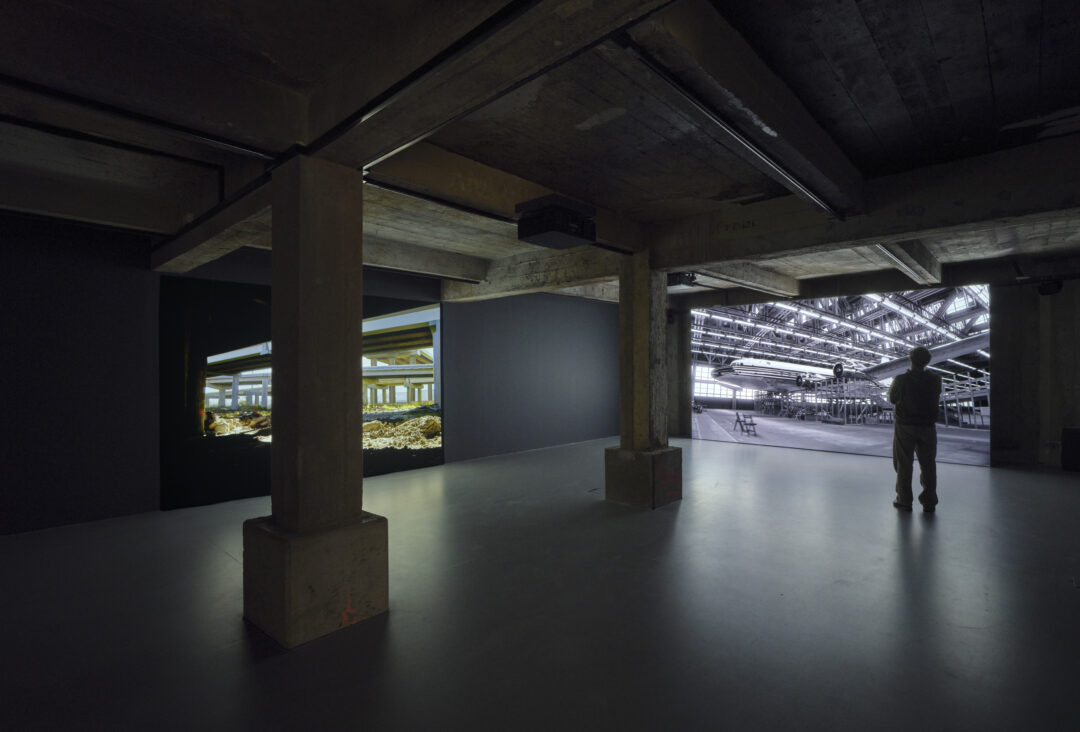
[à gauche / at the left] David Claerbout, The Stack, 2002. [à droite / at the right] Aircraft (F.A.L.), 2015-2021.
As drawing always came naturally to the artist, he realised only later on as an adult the potential that lines hold to represent other, larger concepts which might reach beyond simple representation. Claerbout studied at the Royal Art Academy of Anvers3 from 1992 to 1995. Flemish painting was a major influence, ranging from Brueghel to Magritte, leading him to begin experimenting with digital methods of production as if with a hybrid paintbrush. He then received a bursary to attend the Rijksakademie of Amsterdam from 1995 to 1996, broadening his horizons. In Amsterdam, further experiments in image retouching while fusing photography with video led to the discovery of “animated photography.” An early breakthrough was Ruurlo, Borculoscheweg, 1910 (1997), which transformed an early 20th-century postcard depicting the Holland countryside into a living tableau in which leaves fluttered imperceptibly on an invisible breeze. Time comes back to life through immobility. This piece represents a watershed moment for the artist—from this point on, David Claerbout ceased creating animations, he excavated buried temporalities.
A Practice at the Crossroads of Different Worlds
At the crux of Claerbout’s oeuvre is an obsessive questioning—how does the technologically-produced image alter our way of seeing the world? The artist’s medium of predilection is a form of large-scale video installation which oscillates between experimental cinema, 3D animation and real-time feedback imagery. These works feature altered sound and image which generate otherworldly environments through which the spectator is invited to become co-author. “I’m mostly interested in the way in which we perceive images,” he stated. Recurring themes such as memory, hallucination or ecology play themselves out in an elliptical discourse within which sound acts as a type of ongoing theme throughout the narrative architecture of the works. In Retrospection (2000), we are witness to a class photo dating from the 1930s which springs to life. The camera zooms into frozen faces, while suspenseful background music suggests a latent narrative. As the artist has explained, “The camera zooms in, [the spectator’s gaze] forming a question for which an answer will never be provided [in the children’s faces].” The historic instant becomes a kind of temporal labyrinth, a questioning of the notion of photographic truth. Similarly, Piano Player (2002) unfurls a domestic scene in the form of an infinite loop. A woman comes home after having run through the streets in the pouring rain. Once inside, a soothing music can be heard. A young girl plays piano in an upstairs room while outside, day and night endlessly intermingle. Claerbout’s cinematographic structuralism recalls the work of Michael Snow, with added tenderness tinged with a near-Proustian melancholy. Here, music is an escape from the everyday. In the 2000s, Claerbout’s work began to take on a monumental aspect. In a work commissioned by the Centre Pompidou, Sections of a Happy Moment (2007), a joyous event featuring a Chinese family is dissected, capturing a balloon they toss about in the air. The scene has been created using multiple cameras stationed in different places, providing multiple points of view. The successive images in the film erase our expectations of movement, the scene trades a fugitive lightness with a feeling of control, creating something close to propaganda. With this work, Claerbout established himself as a master of immersive works, creating a space where the spectator finds themselves trapped; one where time becomes matter, it is palpable.
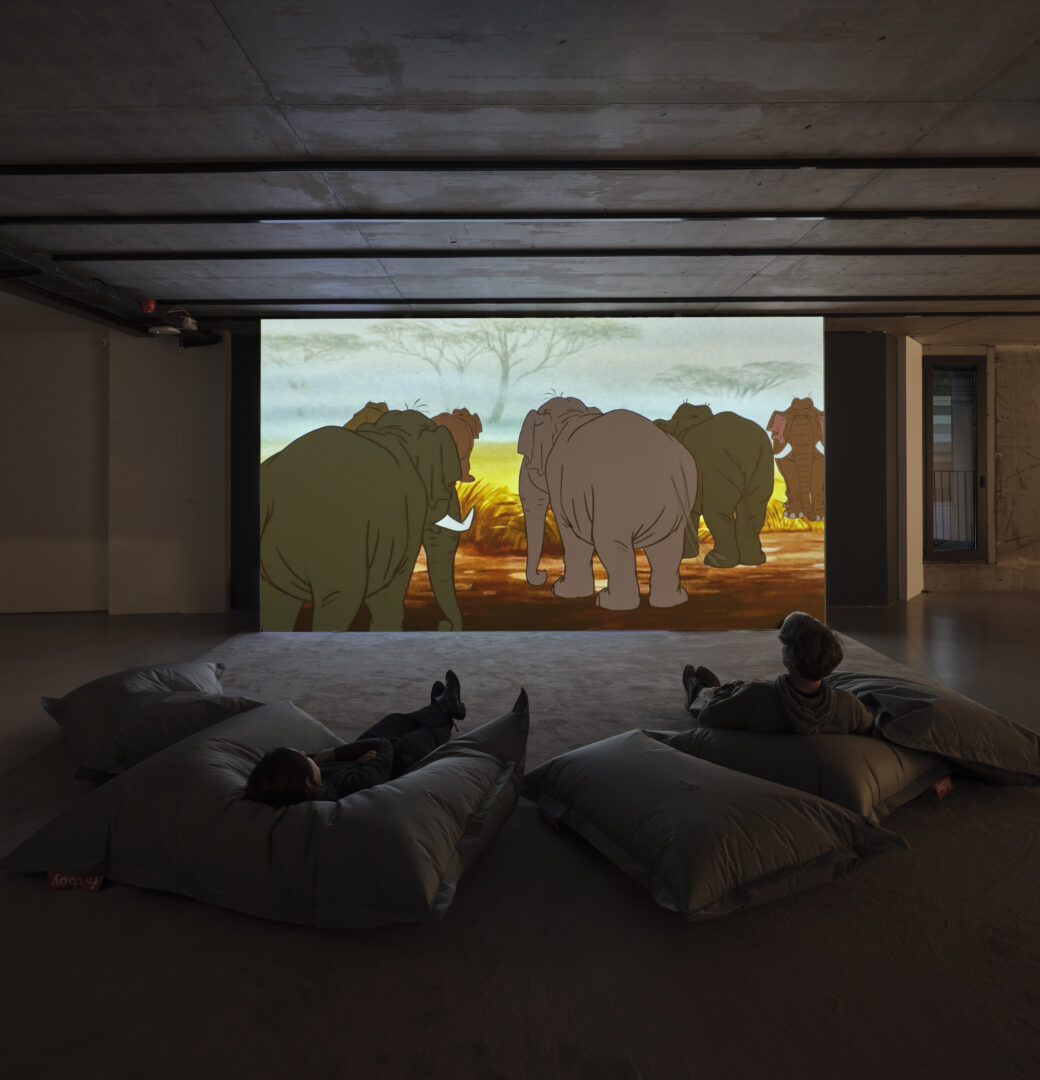
David Claerbout, The pure necessity, 2016.
Time, Simulation and Ecological Crisis
Claerbout’s practicetook a radical aesthetic turn beginning in the 2010s, by integrating 3D simulations and artificial intelligence. For example, The Pure Necessity (2016), which reprises the Walt Disney animation film The Jungle Book (1967)4 frame by frame, sketch-for-sketch. In this bourgeois story where Mowgli joins the human world, the artist decides to keep only the animals. The boy is no longer; all of the dialogues and musical sequences disappearing along with him, allowing the animals to become simple animals once again. Any sous-adjacent anthropocentrism is equally annihilated. In KING (2015-2016), a photograph taken by Alfred Wertheimer of Elvis Presley dating from 1956 is re-created via computer simulation. The virtual camera explores the scene from multiple angles, transforming an iconic image into a timeless, exploratory terrain. Claerbout models Elvis’ body using hundreds of photographic fragments of the now defunct artist’s skin and face, calling the bi-dimensional quality of the image into question while adding time and space to the mixture. “I make what was invisible in the original version visible,” he stated. The work examines the way that celebrity is constructed. A real-time simulation of the disintegration of Berlin’s Olympic Stadium occurs over the course of 1,000 years5 in Olympia (2016-in progress). Bit by bit, the concrete begins to crack as vegetation begins to grow, taking over everything. Projected onto giant screens, this slow-motion apocalypse evokes human vanity in the face of entropy. Shades of Henry Bergson’s pure duration6 can be discerned here, with an added ecological dimension. His often natural landscapes become allegories of the climate crisis. In another 3D-rendered work, Wildfire (2019-2020), a re-created prairie sequence takes place in front of a forest, between and above the trees, confronting nature with technology. At one point, a fire ravages the forest, charring everything in its path. The absence of human presence is confirmed by the continual forward motion of the camera, which is guided by digital technology, unhindered by the blaze. While the artist does use technology to create these works, his aesthetic and artistic preoccupations go beyond. In the 19th century, photography caused an upheaval for painting, just as video caused an upheaval for photography in the 20th century. Here, the artist invites us to look “as if we were blind”, as if preparing for a new era where lenses and cameras were no longer in existence. In Claerbout’s most recent work, which was co-produced by Konschthal Esch, this poetics reaches a level of paroxysm. Here, the consequences, contradictions and paradoxes of a “back-to-nature” stance within the context of cultural overproduction and a Dante-esque level of media consumption are denounced. This 20-hour-long, performative installation is a “merciless deforestation machine disguised as meditative scene.” In the sequence, a wood-carver can be seen sculpting a tree in real time, while all around him, algorithmically-generated trees re-populate the forest on an infinite loop. Ancestral artisanal knowledge and technology combine in this installation, calling our destructive relationship with nature into question. This work takes on a topical relevance in the exhibition in Esch-sur-Alzette—for this ex-mining town in the process of becoming a cultural hub, the themes of regeneration and loss are particularly salient.
The poetics of David Claerbout’s digital shadows make him an artist who—like Tacita Dean or Bill Viola—pushes the boundaries of the medium into new terrain. While the works are currently in prominent collections such as that of MoMA, the Centre Pompidou and many other museums, the artist nonetheless prefers the atelier to the media spotlight. Claerbout confronts us with our own hallucinations. Surrounded by ephemeral images as we are, these works, with their incessant focus on duration remind us that seeing is inventing. Images should never be taken at face value. However, we as humans are born believers. The works of David Claerbout teach us to remain skeptical. Through patient, goldsmith-like effort, immobility is transformed into movement, movement into experience. Claerbout sculpts with time, reviving us, making us more attentive to the invisible workings of the world.
[1]. The title references the different durations of the films in the exhibition.
2. Lives and works in Anvers and Berlin.
3. Nationaal Hoger Instituut voor Schone Kunsten.
4. An adaptation of a Rudyard Kipling novel, The Jungle Book, London, Macmillan Publishers, 1894, French translation Louis Fabulet and Robert d’Humières, Paris, Société du Mercure de France, 1899.
5. The duration of the Third Reich promised by Nazi propaganda.
6. For Bergson, “Absolute pure duration is the form taken by our successive states of consciousness when the Self allows itself to live while abstaining from establishing a separation between present and past states (…).” Time is therefore not a succession of discrete and measurable moments, but a continuous and fluid state. Henri Bergson, “Essay on immediate conscious data”, in Oeuvres, PUF, Paris, 1959, pg. 67.
- Share: ,
- By the same author: Biennale Son, Walter Swennen, Laurent Proux, Josèfa Ntjam, Michel François ,
Related articles
Julie Béna
by Anna Kerekes
Jean-Charles de Quillacq
by Anne Bonnin
Alicja Kwade
by Vanessa Morisset