Alicja Kwade
Alicja Kwade, Dusty Die, M Leuven
Du 10 octobre 2025 au 22 février 2026
‘And beneath the sphere, the chair.’
Eva Wittocx
As part of the celebrations marking the 600th anniversary of the University of Leuven1, the M, through its curator and director of the Contemporary Art Department Eva Wittocx, has invited Alicja Kwade, a Berlin-based artist of Polish origin whose work is inspired by the physical sciences, to present a major monographic exhibition. More precisely, the museum is presenting her exhibition alongside another that brings together archival materials and objects preserved on the university campus, with the aim of exploring the history of the constitution of knowledge through its tools, from the most sophisticated instruments to everyday furniture. Echoing this, Alicja Kwade’s work approaches knowledge in a way that is both precise—her sources are based on identified theories (Newton’s universal law of gravitation, Galilean reference frame, etc.)—and fictional, offering us surprising sensory experiences. Her installations and sculptures play on perception and illusion, the paradoxes that physical theories sometimes lead to in relation to common sense, and ultimately the poetry shared by art and science at their margins. As the theme of the university’s festivities is “The Poetics of Not Knowing”, the “non scientific aspect of science”, so to speak, an artistic work that confronts us with the mysterious aspects of science will inevitably make us want to re-examine the intertwining of rational and irrational knowledge in our relationship with reality.
Some of the artist’s works (or certain versions of them) are already known to have been shown in prestigious institutions, including the Venice Biennale in 2017, the roof of the Met in New York in 2019, and in public spaces, notably in Paris, in the Tuileries Garden in 2023. A labyrinth combining glass and mirrors, a door as if rolled up in a curved space, and mini-planets littering the ground are all signature works. The oldest work in the exhibition dates from 2009. Others are new or produced by the museum.
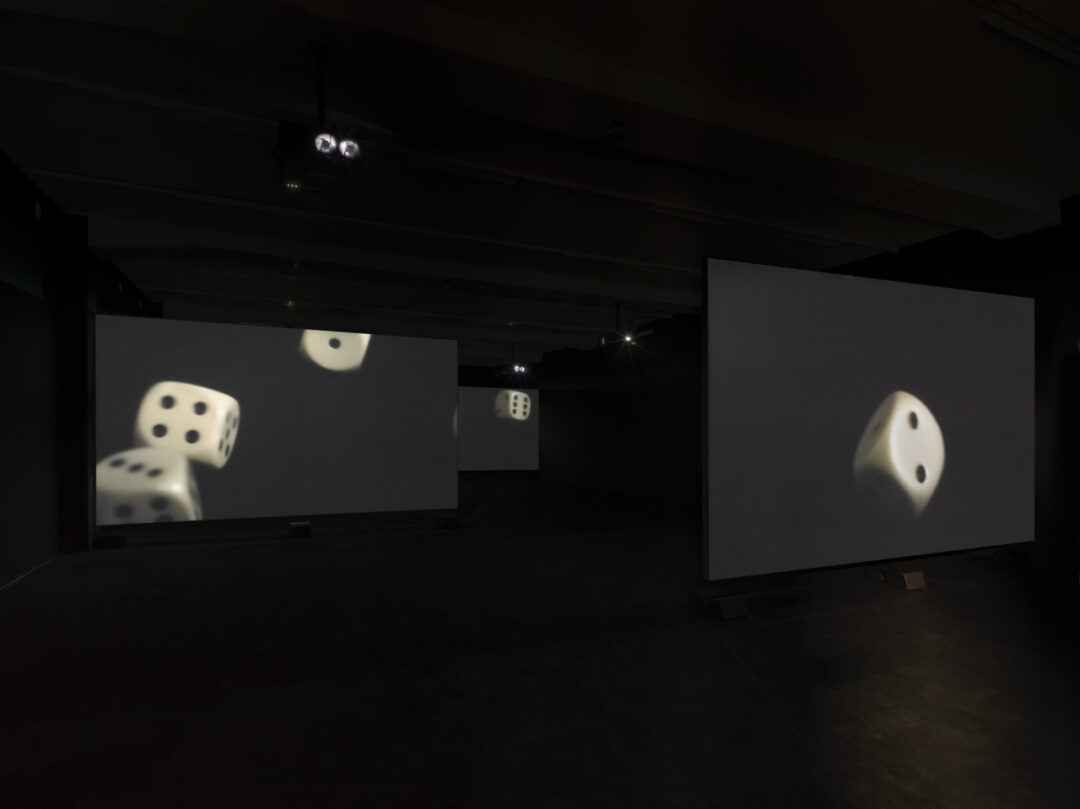
As an introduction, visitors enter the dark space of a large video installation, In Ewig den Zufall betrachtend (Contemplating Chance for Eternity), created in 2014 and displayed on a monumental scale. On several suspended screens, giant dice roll against a powerful sound backdrop: they are reminiscent of a cosmic game, as if the universe were governed by their throws. The work humorously alludes to Albert Einstein’s famous controversial statement about quantum physics, ‘God does not play dice2’, and more broadly to the fact that, as Sylvia Wenmackers, philosopher of science at KUL3, points out, research has continued to advance thanks to thought experiments and imaginary scenarios.
The most famous is undoubtedly Schrödinger’s cat, which is both dead and alive, but there are many others. This installation acts as a gateway, immersing us in this state of mind. Further along the route, other works take up the motif of suspension or falling in space. Very discreet, in a small corridor between two rooms, the work Wo Oben Zum Unten (2015) consists of a set of keys stuck to the ceiling, as if it had been sucked up by a reversal of the law of gravity. These are keys that the artist found on the ground over several years and which will now only open the doors to the imagination of the exhibition (there are quite a few!). A similar work, The Sun, a bronze sculpture painted yellow (2022), is also discreetly stuck to the ceiling, adding a touch of humour. In fact, the work does not directly represent the sun evoked by its title, but does so through the shape of a pumpkin. As a result, the situation is both logical and illogical, depending on whether we take the sun or the cucurbit as the reference point for the sculpture, with the sun being in the right place, above our heads, provided that the museum space is valid as space in general.
But often, the same motif is embodied more realistically by the situation of waiting caused by the presence of large stones, suspended in the air, about to fall or already fallen.
On the wall of one of the large rooms, a piece from the 2010s, 1417+(16.08.2013), deals with their observation. On a large sheet of paper, handwritten annotations list the potentially threatening meteorites in motion around the Earth, from the first studies in 1932 to the date of the work in 2013. However, there is a noticeable absence of occurrences at the start of the Second World War: no meteorites were spotted. This is not because there were none, but rather because they were not observed, as humans had other priorities at the time. This work can be linked to an analysis by Thomas Hertog, a physicist at KUL, according to whom, even “when it comes to the world, we only get answers to the questions we ask4. “ In other words, we only find what we are looking for, both in terms of common experience and science. These are the limits of human knowledge, which we must not lose sight of.
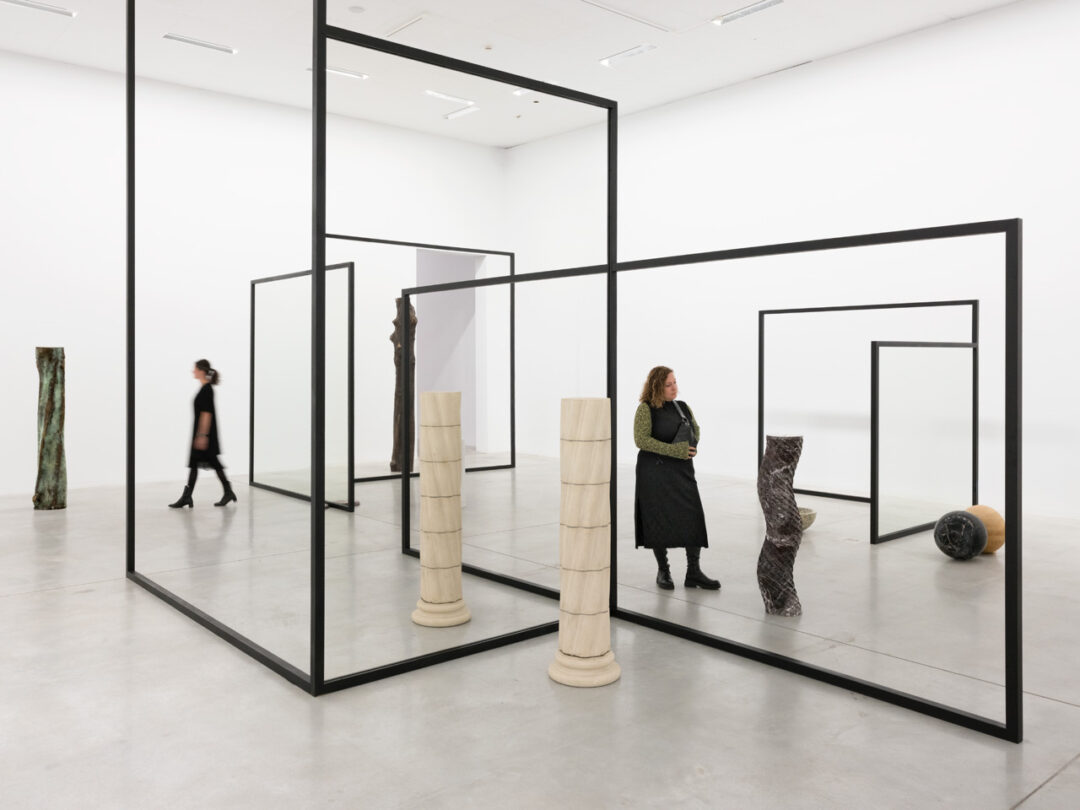
In the installation Paraposition (2024), the stones are held in space by a large metal structure that helps them defy gravity. But for how long? we wonder, as we sit on the bronze chair embedded in the structure, beneath the largest of the stones. Following the same pattern, in Superheavy Skies (2025), blocks of rock are suspended from rods, balanced according to the principle of mobiles above children’s beds. Are we, as earthlings gazing at the stars, in the same situation of wonder-filled contemplation, confident in the strength of the laws of physics as in the rods that ensure the solidity of the mobile Knowing that this type of balance can be what scientists call a ‘chaotic system’, a balance, certainly, but one that can be upset by the slightest thing. The artist’s work makes tangible this postulate of the stability of the world that we implicitly accept on a daily basis.
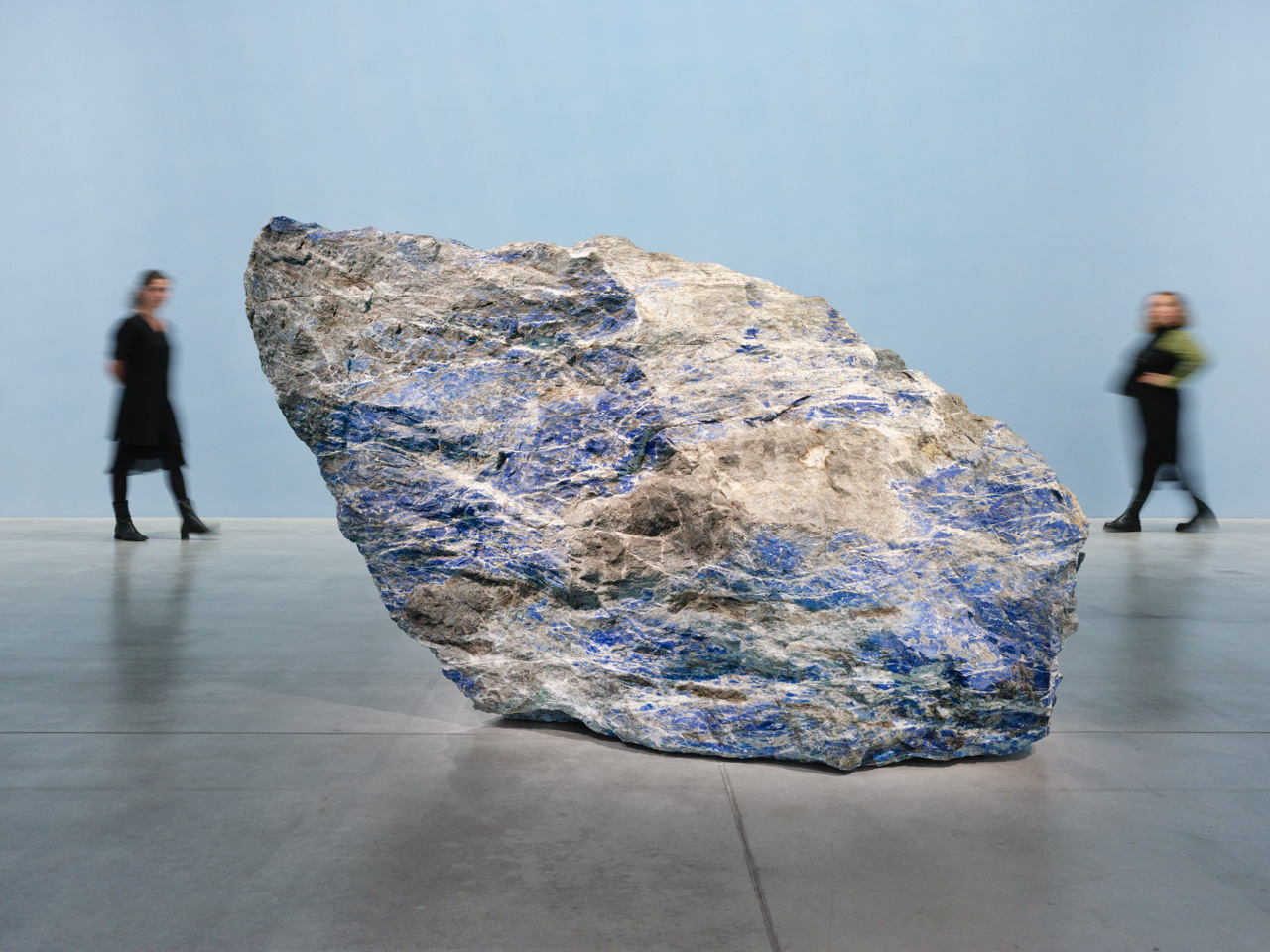
With the piece entitled Blue Days Dust (2025), the fall has taken place. In the middle of a large empty room with walls covered in blue paint lies a huge rock, also tinged with blue. Or rather, we should say: an enormous stone with lapis lazuli blue hues served as the raw material for painting the walls around it. We thus find ourselves in a room that is the opposite of the first one, contrasting the blue of the sky with the night, the dice in the air with the stone on the ground. But beyond this formal aspect, the installation links the history of art to that of the sky and astronomy, lapis lazuli being, in tradition, the source of the most beautiful and expensive ultramarine pigments used by the most renowned painters, such as Giotto, to represent space.
The theme of falling is also at the heart of Siège du monde (2025). A stone sphere resembling the Earth, thanks to its white and blue colours, is placed on an armchair, as if it had fallen from the cosmos. However, the situation is not disastrous; the planet has not crashed and is instead nestled on the shoulder of Atlas, which has become a chair. This leads us to wonder where we are to observe such a scene. Alicja Kwade’s works suggest changes in perspective where cosmic and human scales collide.
Chairs are definitely a recurring theme in her work. For the event, the KUL commissioned her to create a sculpture that is now permanently installed in Sint-Donatus Park, not far from the museum. It was created by reproducing a set of seats used at the university—stools, armchairs, classroom chairs—arranged in a circle. A large stone seems to have fallen in the middle, without any apparent impact. The seats support it, even welcome it, and with a little imagination, one could hear them welcoming it into our sublunary world. Following this impression, one comes to think that Alicja Kwade’s works call for a kind of appeasement in the face of the vertigo of the universe. Is it art rather than knowledge that allows this?
1. Successively, the university was called the University of Louvain, the Catholic University of Louvain, and today the Katholieke Universiteit Leuven (KUL) after a split with the Walloon branch in 1968.
2. The phrase was uttered in Brussels at the 1927 Solvay Conference in reference to quantum mechanics and Niels Bohr’s probabilistic theories.
Head image : Alicja Kwade, Blue Days Dust (II) (detail), 2025. © Alicja Kwade, courtesy of the artist. Photo : Roman März pour M Leuven.
- Share: ,
- By the same author: Lucas Arruda, Lou Masduraud, Diego Bianchi, Sean Scully, Peter Friedl,
Related articles
Julie Béna
by Anna Kerekes
David Claerbout
by Guillaume Lasserre
Jean-Charles de Quillacq
by Anne Bonnin