Red Herring in the Venetian Lagoon
61st International Art. La biennale di Venezia.
I will assume red herring is not native to the Venice lagoon, but during the 61st edition of the Venice Biennale directed by the late Koyo Kouoh I kept seeing them swimming in the canals surrounding the Giardini and the Arsenale. This edition was loud, contrary to what Koyo Kouoh envisioned when naming the theme In Minor Keys.
Yet the pounding noises seemed to bring our attention to topics that perpetuated the hypocrisy of the art world, attempting to use art to artwash dirty causes, and ultimately not allow valid methods of mending the broken situation we’re in. Peace is hard, because peace requires constant work, collaboration, forgiveness and acknowledgement of one’s own faults. Just like psychoanalysis, answers come from the minor keys.
The nomination of Koyo Kouoh as the curator of the biennale is itself supporting a contradictory cause which felt more like a temporary band-aid then a sincere position, as she herself apparently told Pietrangelo Buotafuocco, the biennale director appointed by Meloni in 2024: “I would never have expected to be called to Venice to lead the contemporary art exhibition by you.” As the biennale opened in 2026, a year after Kouoh’s death, Buotafuocco allowed Russia and Israel to open their pavilions. This led to the dramatic resignation of the first time all-women jury and to a new award mechanism granted this year by the popular vote of the visitors, effectively altering the prestige of the Golden Lion, from being awarded by elitist yet professional authorities, to becoming a form of an artistic Eurovision. The world seems to get bogged down in mud.
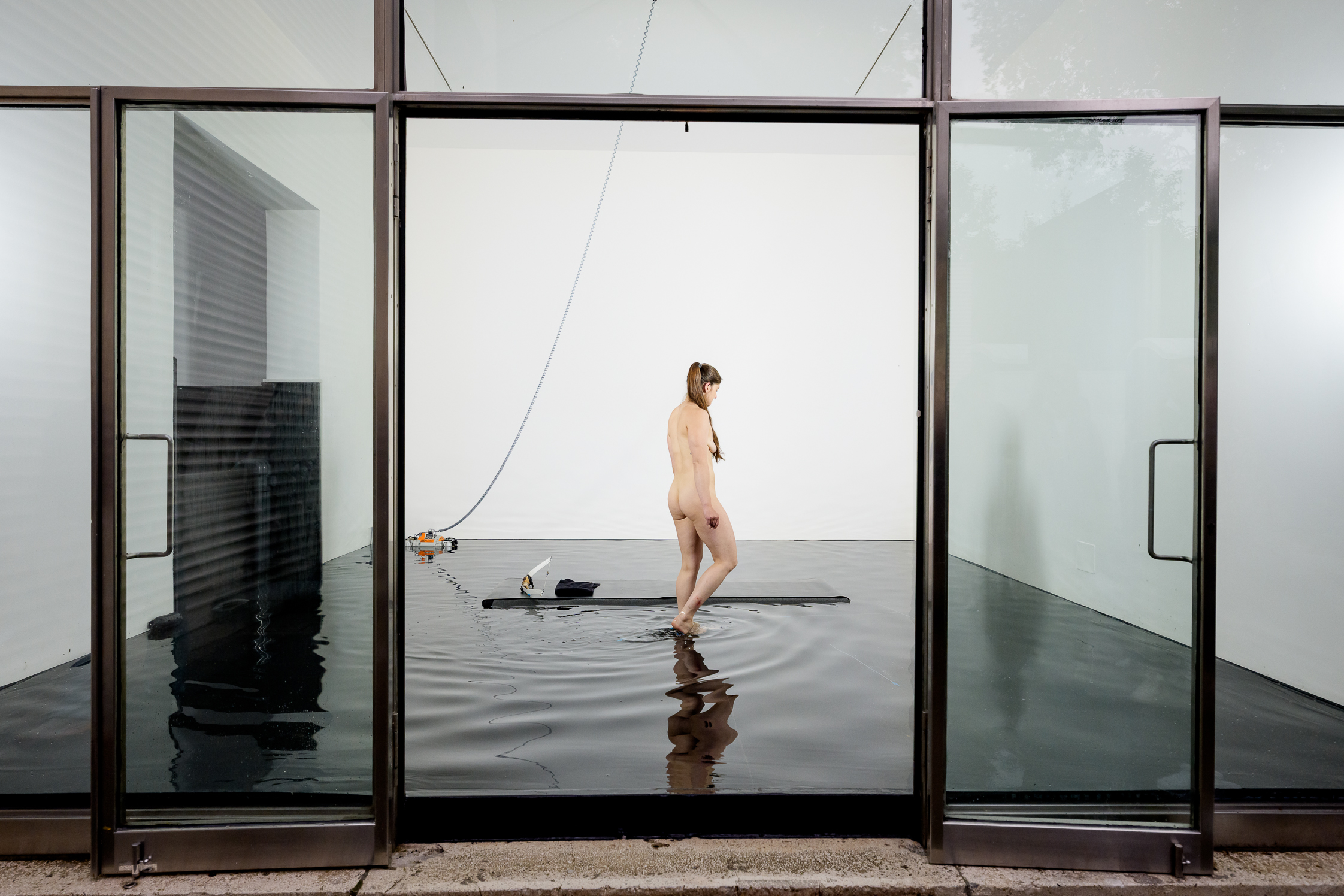
Contrary to a number of my colleagues in the art and journalistic segments, I have made a point of not only visiting the two problematic pavilions but also doing some background research. Let’s start with the very shunned Israeli pavilion, which upon entering I was taken by a feeling of deja-vu. Belu-Simion Fainaru is an established artist who previously represented Romania — and yet here he was again, working with the same visual language of black shallow basins of water. This year’s piece, Rose of Nothingness, was already produced in 2015 and presented at Art Basel’s Unlimited in 2019. It represents Paul Celan’s idea of black milk, borrowing from cabalistic elements as well as Israeli methods of land irrigation. The pavilion, curated by Avital Bar-Shay, the artist’s life partner, and Sorin Heller, felt hastily proposed and hastily accepted — not an intentional political provocation, at least from the side of the artist, but unmistakably opportunistic. The work was met with aggressive chanting by pro-Palestinian protestors on May 8th, leading to images of a frightened pavilion team, Israeli and Italian, hiding behind the glass entry door.
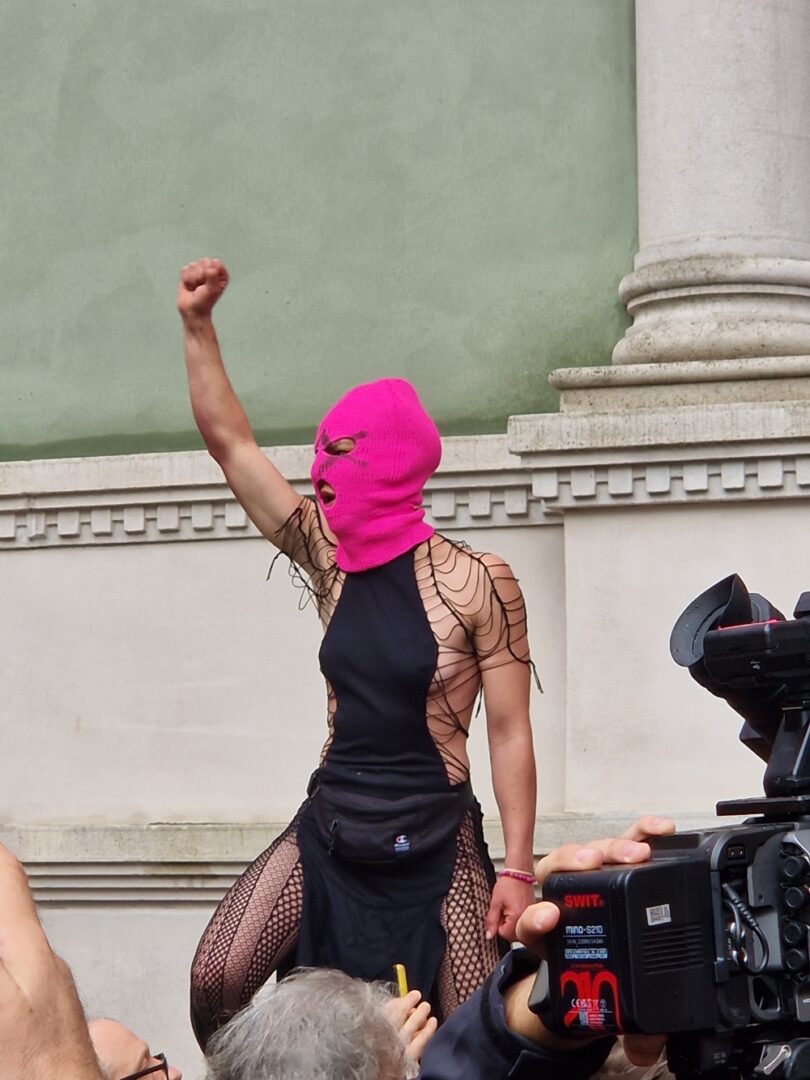
On the Russian side, the protest was short, colourful and, hélas, not impactful. On May 6th, Pussy Riot and the Ukrainian Femen, both feminist activist groups, joined voices for a surprise concert in front of the Russian Pavilion. They wore pink balaclavas, chanted anti-Russian and anti-war slogans and filled the air with first pink and later yellow and blue smoke. A crowd gathered and filmed the happening, and that was it. Some Russian sympathisers found abandoned balaclavas and wore them for the rest of the day while dancing inside the Russian pavilion. How do I know that? The pavilion’s Instagram account is not hiding it — on the contrary, they posted a video stating “They took to us”, placed next to another which had apparently edited out previously incorporated images of the actual protest. Pussy Riot had demanded their images be taken down, a request met with the comment “Apparently Pussy Riot was not happy with their own performance.” I cannot help but associate this attitude with the Russian government’s active gaslighting of their own citizens and the rest of the world. For the remainder of the preview days — the pavilion never opened to the general public — the place was full of techno-partying people sometimes wearing pink balaclavas. I understand this to be their way of standing their ground in the face of backlash. What to expect from a pavilion led by Anastasia Korneeva, daughter of Rosteh’s vice president and business partner of Katerina Vinokurova, daughter of Sergei Lavrov, the Minister of Foreign Affairs of Russia.
That said, despite the original indignation, the protest against the Russian pavilion had died out, no doubt overshadowed by the anti-Israel protest which led to the closing of 15 pavilions on May 8th. No indignation was shown at all about Iran’s intention to participate — no doubt because the actual pavilion has not yet opened, their ministry of culture stating that the organisers needed more time to prepare.
I am impatiently waiting for the next episode of the protest drama in 2028.
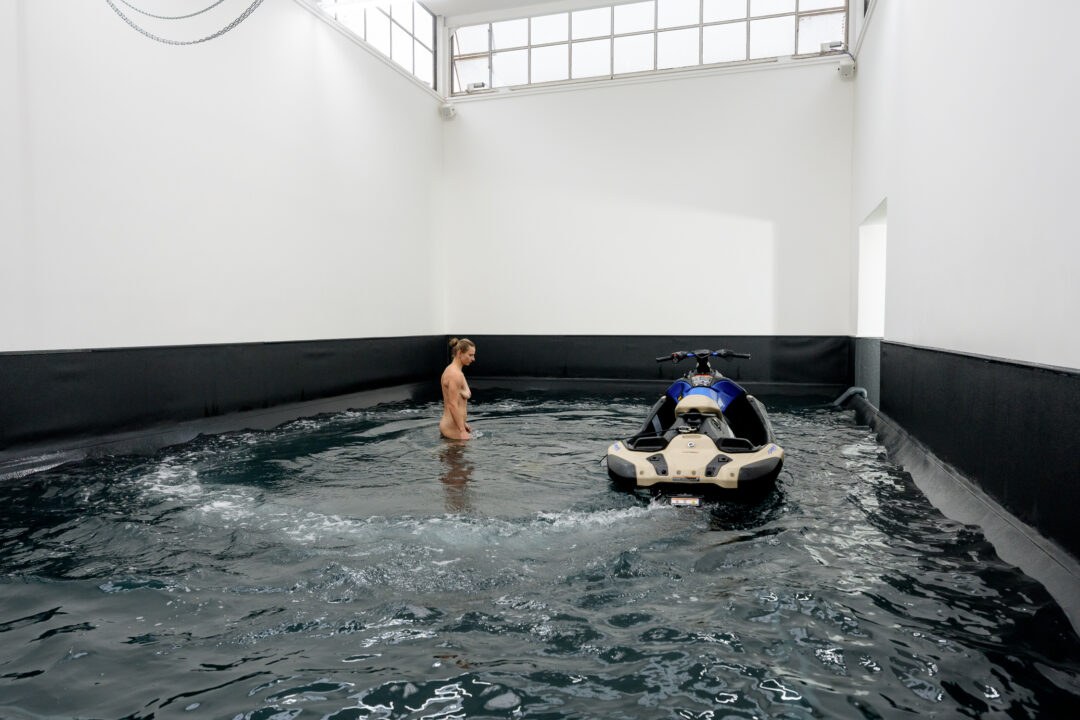
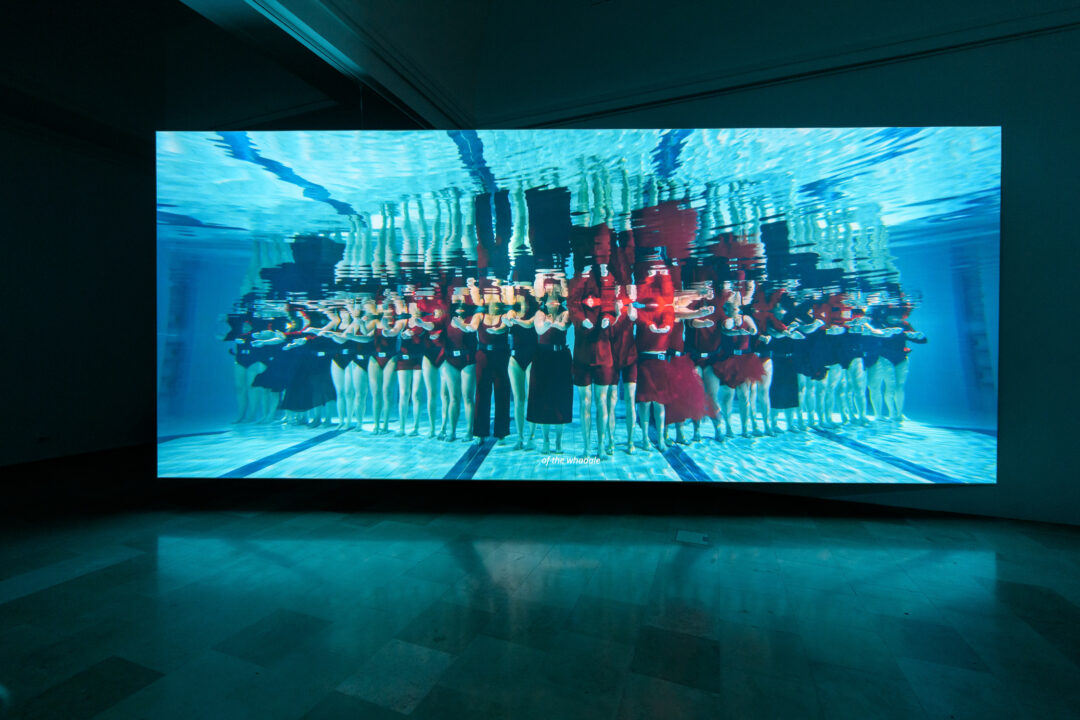
But how about the art? The aforementioned muddy metaphor seems to have unconsciously permeated the zeitgeist, as a number of pavilions took to water as their principal motif — not in its life-giving, fertile perspective, but in its cleaning, purifying qualities. Florentina Holzinger’s Seaworld at the Austrian Pavilion attempts to cleanse not only the mud but also your pee. In a highly theatrical setting made to shock the viewer, she dispatched an army of naked women carrying out various activities: ringing a bell with their hips at the entrance, making rounds on a water-scooter in an indoor pool, climbing a giant weathervane, and hanging out in a water tank filled with filtered waste water from two porta-potties installed on site. Possibly because I have been immersed in this topic for some time, this work seemed to me less shocking and more spectacular. Nonetheless, it remains the best piece at the Biennale, because Holzinger manages to bring us back to the normal through spectacle, allowing her characters to be both emancipated through their actions and their nudity, while making a commentary about the illusory and fragile aspect of women’s empowerment. Joining this tangent was Aline Bouvy’s film La Merde at the Luxembourg pavilion at the Arsenale, where excrement becomes a real character. Her film shows wide views of sewage cleaning stations, turning our voyeuristic gaze into a meditative experience. We are confronted with our waste — bodily but not only — and this confrontation hurts.
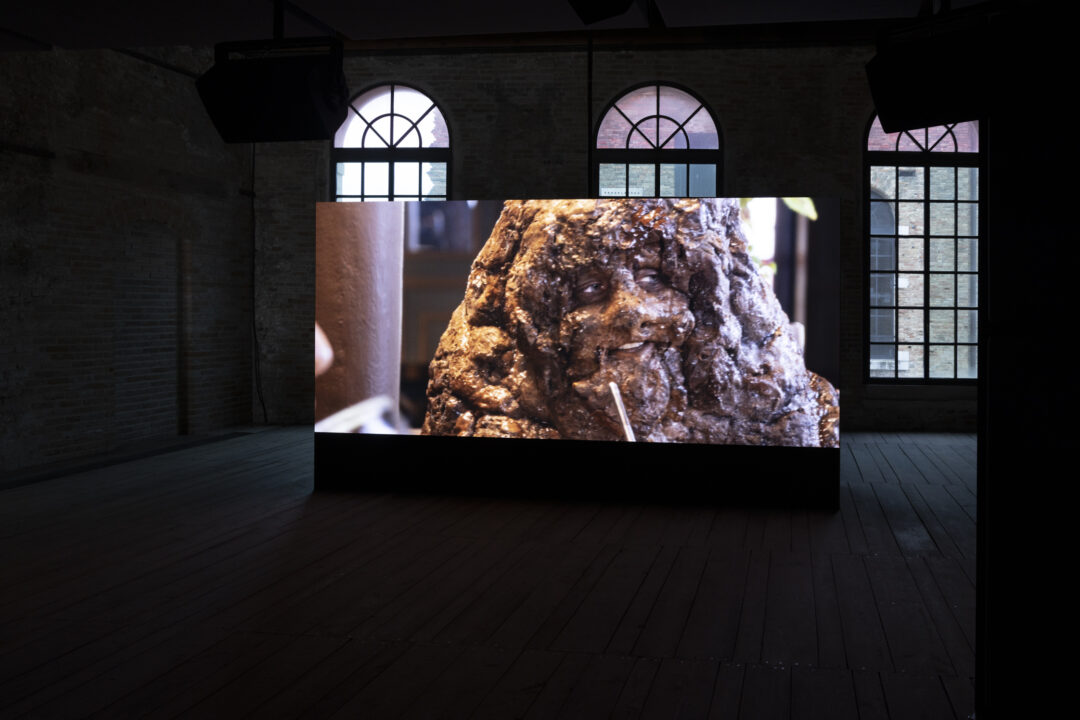
Aline Bouvy. La Merde 61st International Art Exhibition – La Biennale di Venezia, In Minor Keys. Photo by: Marco Zorzanello. Courtesy: La Biennale di Venezia
Water is incorporated in more subtle ways elsewhere. At the Polish pavilion, “Liquid Tongues” by Bogna Burska and Daniel Kotowski touches directly on the biennale theme by rendering interpretations of humpback whale communication codes and songs — a choir of deaf and hearing people standing in a pool of water, reverberating the sound. The Romanian pavilion attempts to answer the question “How to mend a broken sea?” through Black Seas, Scores for the Sonic Eye by Anca Benera and Arnold Estefan, submerging the viewer into a polyphonic system of moving images, sounds and sculptures, where discarded buoys lie in black pools and the sound inspires danger, unrest and claustrophobia. The Philippines pavilion at the Arsenale shows Jon Cuyson’s Sea Of Love, managing to immerse the viewer into the overarching symbolism the sea holds for an island country, taking mussel farming as an entry point and commenting on the manual labour this animal-becoming-product requires. In the curator’s words: the mussel, absorbing the toxins of its environment while building a life, becomes the ultimate metaphor for the overseas worker filtering the global economy.
61st International Art Exhibition – La Biennale di Venezia, In Minor Keys
PhotoAndrea Avezzù. Courtesy: La Biennale di Venezia
Other pavilions questioned the status quo through mythological and historical paradigms. The French Yto Barrada reinvented the myth of Saturn devouring his children through textile and textual works tinted in various pigments, while the Nordic Pavilion presented works rooted in northern mythology. Spain, represented by Oriol Vilanova, showed Los restos (The Remains), covering entire walls with postcards arranged by colour or subject, creating a pseudo-museum of memory, attitudes and past. As every year, some countries struggled with their fascist architectural legacy — this year Germany and Greece. Not to forget the dane Maja Malou Lysea who subverts the pornographic myth of the forbidden fruit into a necessity to increase fertility.
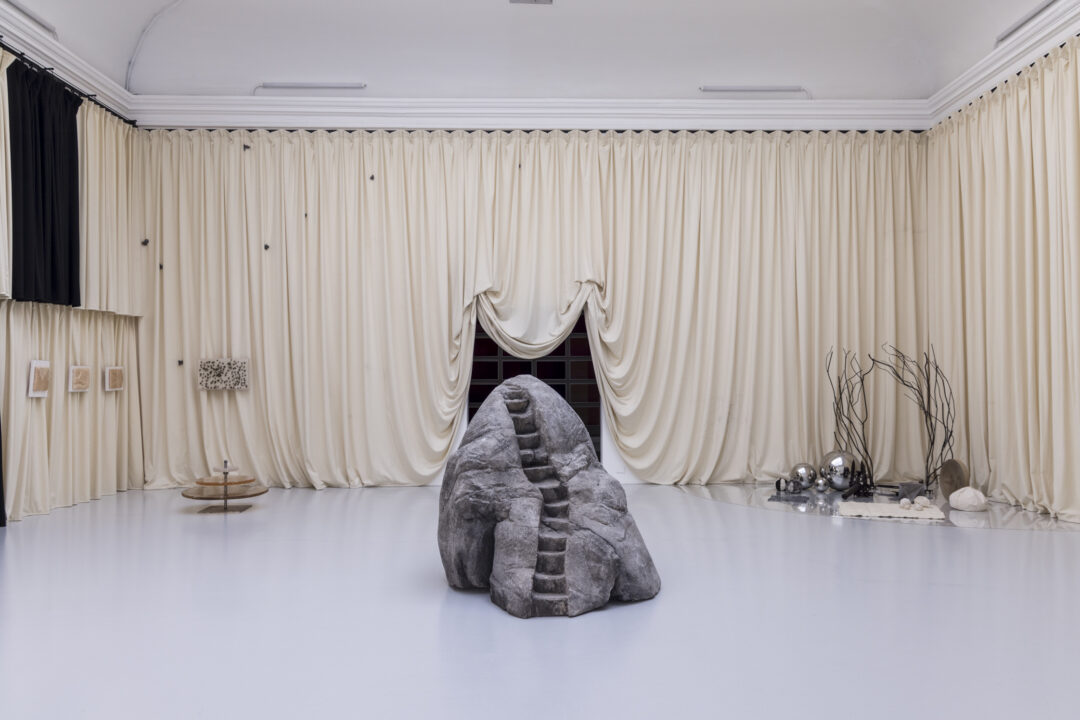
When visiting the two curated exhibitions, Koyo Kouoh’s presence was both felt and missed. The Giardini’s Central Pavilion felt especially hectic, drowned in hundreds of works, by repeating artists, confined into what felt like a series of tiny rooms — attention dispersed, meanings missed. We can imagine that had Kouoh been there, she would have let go of a number of works for the sake of the ensemble. The Arsenale, on the contrary, due to its sheer size and linear architecture, allowed works to breathe and created continuity in the discourse. My analytical mind was expecting to see a clear division of the five motives announced during the press conference in February: 1. shrines; 2. processional assemblies; 3. enchantment; 4. spiritual and physical rest opened up by the oases; and 5. Schools. However the sections had no borders and one was left wandering and guessing.
61st International Art Exhibition – La Biennale di Venezia, In Minor Keys
Photo Marco Zorzanello Courtesy: La Biennale di Venezia
I will reproach to this edition the same as to the last two: despite a noble intention to integrate overlooked artists onto the prestigious scene of contemporary art, the act of intentionally rejecting already established voices does not help the integration — rather, it deepens the gap between two worlds. When the goal is to send a message to a rigid audience, it is perhaps best to speak the language of those you want to be heard by, otherwise the works risk easy categorisation. Kouoh’s bet was on the opposite: to not concede and sing her own song. She shifted the lookout point from a euro-american centre towards one coming out of Africa, engaging in Pan-African relations within and outside the continent. Naturally, the focus was put on decolonisation, postcolonial solidarities, Black Atlantic histories, indigenous knowledge systems, Palestine–Africa affinities. Some works stood out: Seyni Awa Camara’s figurines evoking communities and motherhood, reminiscent of Artemis of Ephesus with her belts of countless children; Celia Vásquez Yui, a Peruvian ceramist sculpting a bestiary of characters covered in indigenous motifs; Vera Tamari’s Tale of a Tree, showing tiny clay trees documenting the destruction of olive trees in Palestine as a result of Israeli operations; and Sawangongse Yawnghwe’s People’s Desire, showing 2,400 clay pieces of humans praying, sleeping, standing, dying.
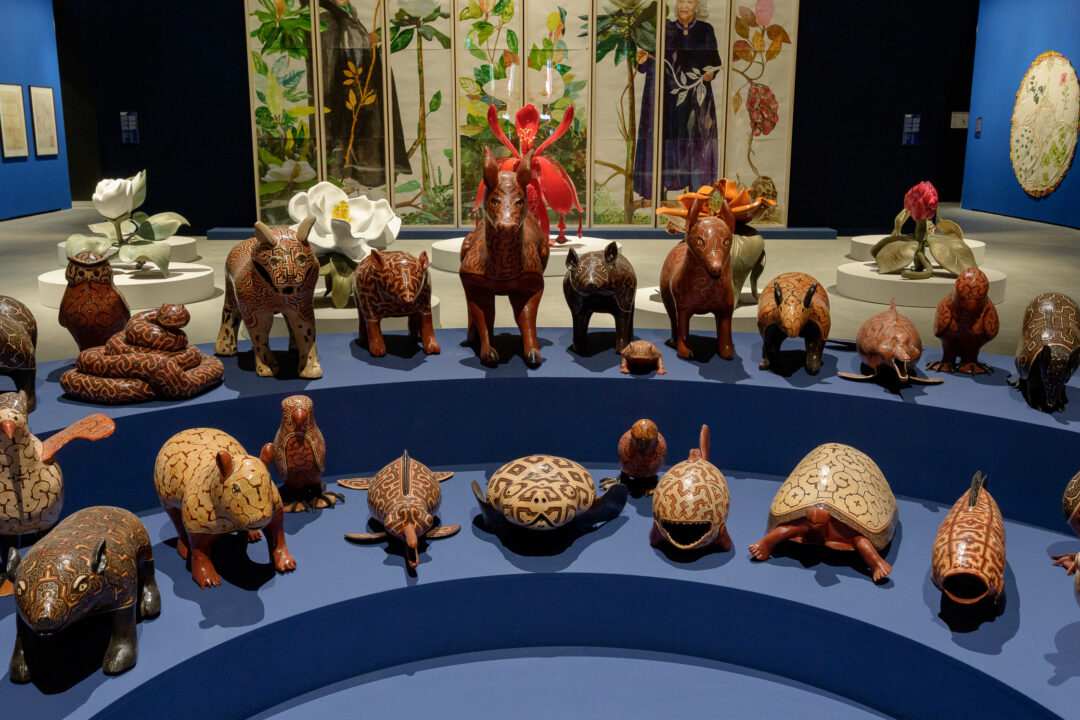
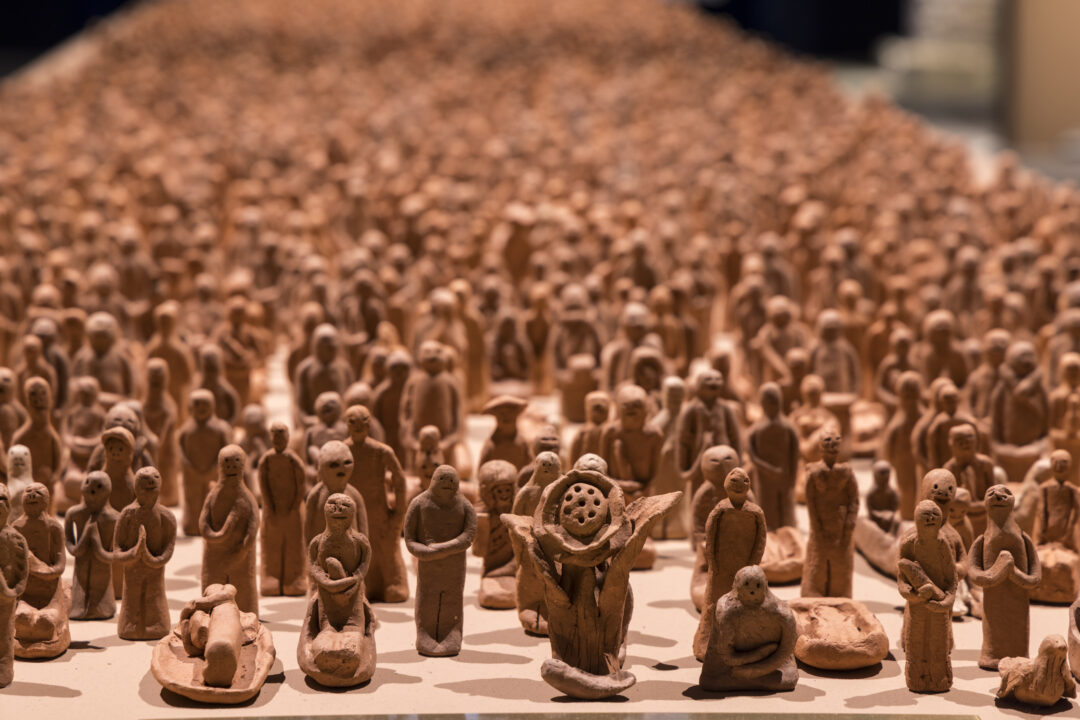
Thus, accumulations of small and larger objects was a leitmotif of both group shows, giving out the feeling of revolutionary power: a cause can be advanced by a united group no matter how small the individual force. More works responded to the same logic: Carrie Schneider’s First Living Woman, a one-kilometre-long photographic continuum of bent images of a woman’s face drawn from Chris Marker’s La Jetée; and Ebony G. Patterson’s installation composed on one side of hundreds of red rubber gloves symbolising consumerism’s detritus dispatched in the global south, and on the other an accumulation of colourful fabrics covered in glitter, pierced by black ceramic birds of paradise. Flowers were arch-present throughout, from the giant magnolias by Maria Magdalena Campos-Pons and Kamaal Malak as a tribute to Koyo Kouoh and Toni Morrison, to the multiple bronzes by Nick Cave populating the inner and outer grounds of the biennale, passing by Eric Baudelaire multi-screen installation shedding the light on the world’s exploitative flower market.
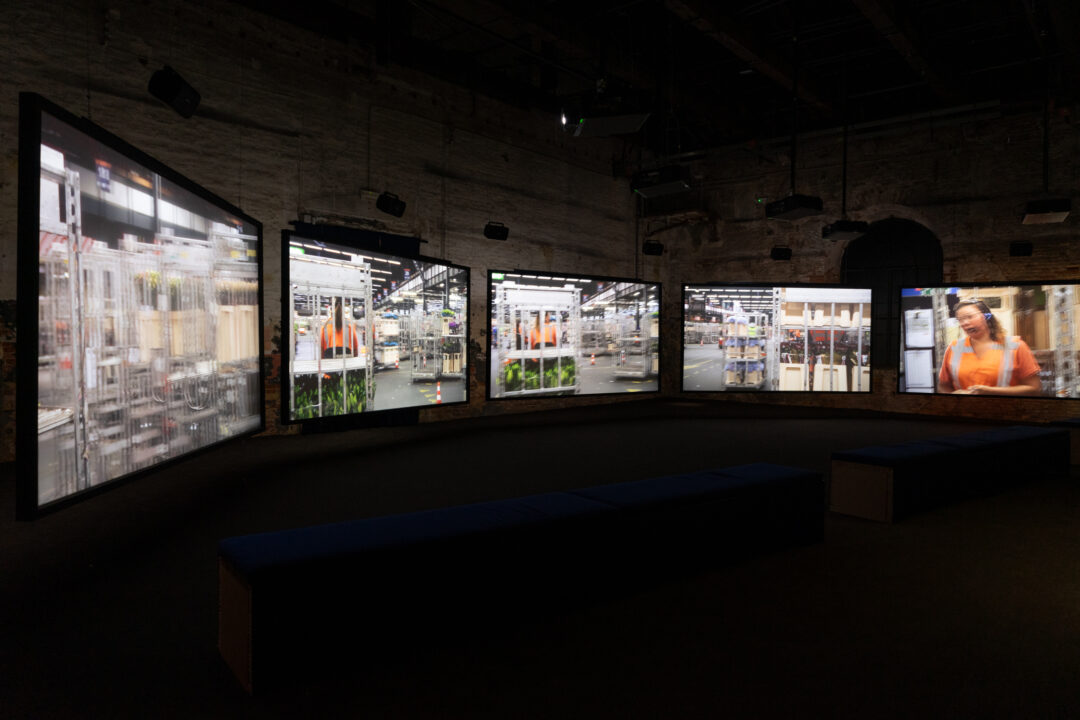
Audiovisual installation. Five-channel video with six-channel audio. 25 min 25 sec. Photo Luca Zambelli Bais. 61st International Art Exhibition – La Biennale di Venezia, In Minor Keys Courtesy: La Biennale di Venezia.
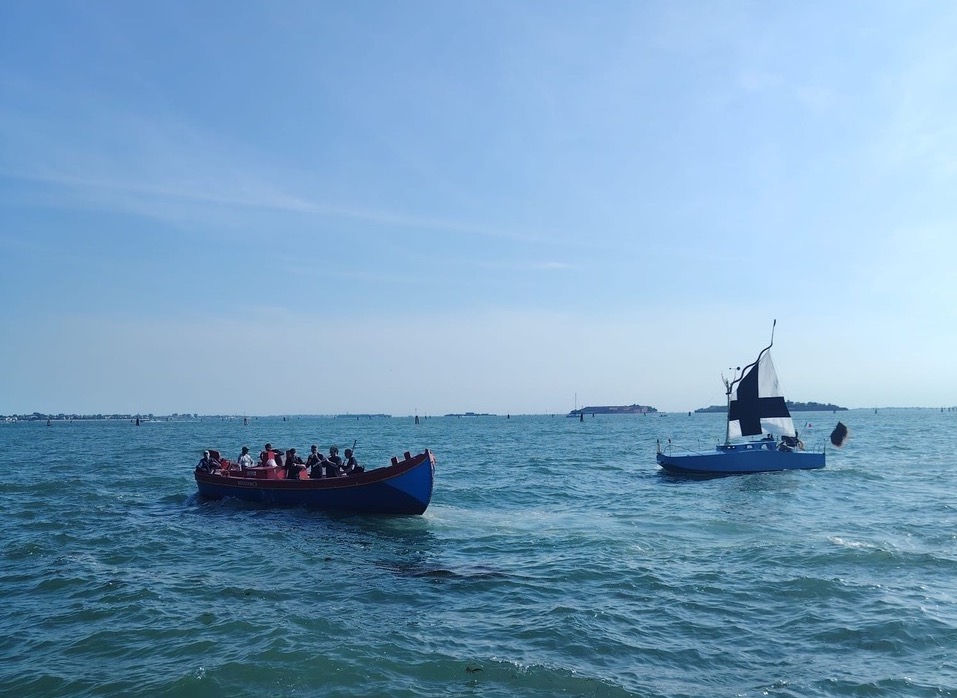
As such, despite all attempts to do differently, this entire edition was a mirror of the geo-political organisation of the world — where certain countries are boycotted, but where the boycott does not change by one inch the overall march of the grand machine. As red herrings, they charge our noses and make us feel like change has come, when in fact, business remained as usual. The world as it stands is run by money and power, two terms that are interchangeable and rarely characterise the cultural sphere, which is often the first to lose in times of war. The protests on the preview days, made by and for the intellectual class, provide some relief and self-lamentation. From May 9th, the VIPs were on their way to New York’s art week and life returned to normal. Protests were louder than art. Not as loud of course as the Breton Pavilion! A group native of the French region headed by artists Joachim Monvoisin and Morgane Tschiember and curated by Patrice Joly consisted in a boat slash artwork which sailed the Venetian lagoon during the preview days. They also organized blaring bagpipe performances.
Culture can shake, and this is where I salute Florentina Holzinger and Aline Bouvy. In a world of continuous information flux, one needs to stand out. I am well aware of the multitude of sensitivities to art and culture, and there undoubtably should be artists and projects to respond to all. But if we call for a time of change and want to stand a chance, we need to raise the volume. We are not yet loud enough.
head image : Pavillon of Austria. Florentina Holzinger, Seaworld Venice. 61st International Art Exhibition – La Biennale di Venezia, In Minor Keys. Photo : Andrea Avezzù. Courtesy: La Biennale di Venezia
- Share: ,
- By the same author: Streaming from our eyes, Déborah Bron & Camille Sevez, Sanam Khatibi, Ho Tzu Nyen, GESTE Paris,
Related articles
Art-O-Rama 2026
by Giorgia Basili
18th Lyon Biennale
by Sarah Ihler-Meyer
Bianca Bondi
by Agnès Violeau