Marcel Duchamp Prize 2025: alchemy and demiurgy, different perspectives on a changing world
Marcel Duchamp Prize 2025
Musée d’Art Moderne de Paris
September 26, 2025 – February 22, 2026
The works of the four artists nominated for the Marcel Duchamp Prize 2025, ultimately awarded to painter Xie Lei, will remain on display until February 22, 2026, at the Museum of Modern Art in Paris (MAM). While the focus has mainly been on what sets them apart, which is understandable in the context of a competition, very little attention has been paid to their significant commonalities.
Born between 1975 and 1986, their transition to adulthood coincided with a profound transformation of society, a change of era marked by the shift from analog to digital, the end of the Cold War, and the acceleration of globalization. This transformation has undeniably influenced their way of seeing and creating. In response to this world in the midst of dissolution—relational, material, ecological—two approaches have emerged: that of the alchemists on the one hand (Bianca Bondi and Lionel Sabatté) and that of the demiurges on the other (Xie Lei and Eva Nielsen).
Going against the grain of a world in dissolution: the alchemists
Lionel Sabatté is committed to reversing the course of events by reconstructing what the world alters and destroys, while Bianca Bondi seeks to suspend its effects. Like alchemists, they work with natural materials, or use them as agents, to transform degraded states into sustainable forms, in a logic of regeneration as described by Mircea Eliade in Forgerons et Alchimistes (1956).
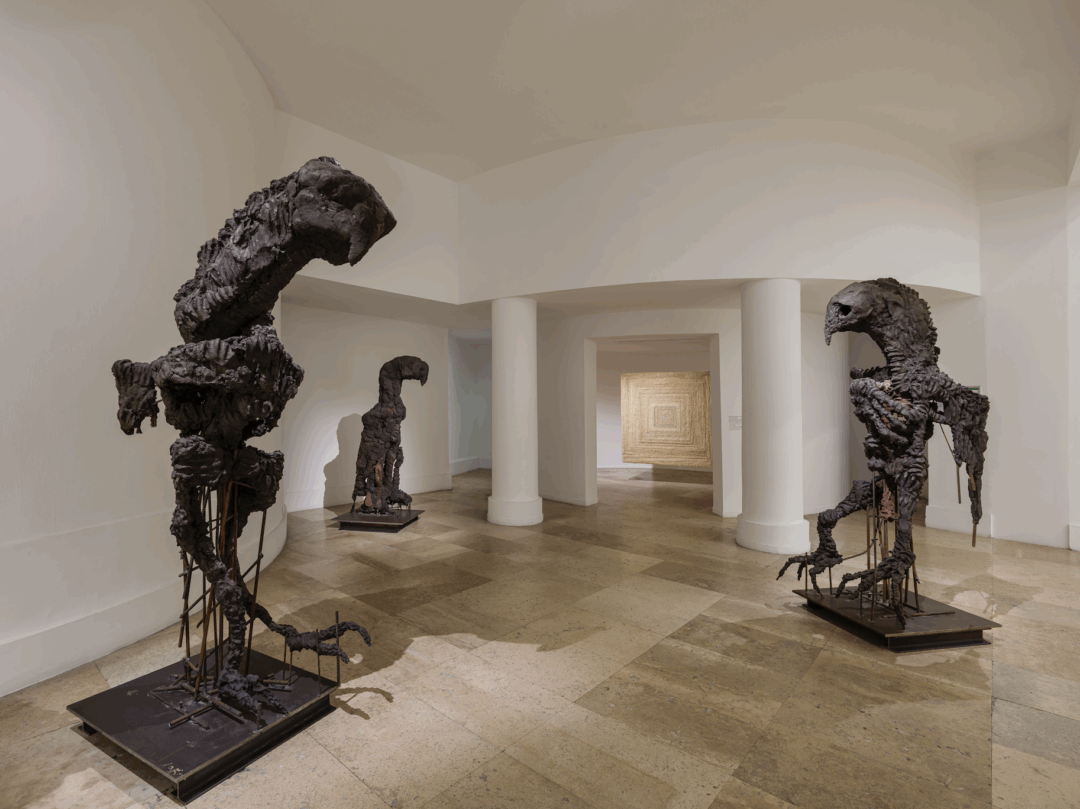
Lionel Sabatté (Galerie Ceysson & Bénétière) recomposes what is crumbling, uses what is neglected, and makes the invisible visible, going against a world that throws things away and abandons them. This attitude towards matter, this position towards the world, resonates powerfully in his work Interfaces mouvantes (Moving Interfaces), a glimpse into his vast universe, which occupies the last rooms of the exhibition. Large, massive, archaic birds, fashioned from pozzolan—a porous volcanic rock used in gardening—welcome us. They evoke both his grandfather’s hunting catches and the mythological creatures of fantastic epics. Born of this brittle but incombustible, rot-proof mineral, these birds move from “chaos to cosmos” (Eliade, Myth of the Eternal Return, 1949), or from disorder to order, from the ephemeral to the permanent. Phoenixes risen from the ashes, perched on rusted metal rods.
These beasts, resembling powerful, rough clay golems, lead, in a striking contrast, to a delicate treasure: a geometric, creamy white suspension, a mandala, fascinating and… repulsive. For while the previous work was made of poetic ashes, this one is composed of dead skin from human feet, collected from podiatrists and recomposed by the artist to form a masterful and esoteric piece. These skins are repulsive, certainly, but have they not supported, for years and with all their strength, noble and weary human bodies?
This dignity given to the tiny, to particles, to almost nothing, to waste, to disappearance, to collapse, to time that forges and slips away, is found in the tender portraits of children made from dust and hair collected within the museum itself. Lionel Sabatté goes against the grain of a world that both overproduces and tends towards immateriality, conferring eternity and majesty on forgotten everyday materials.
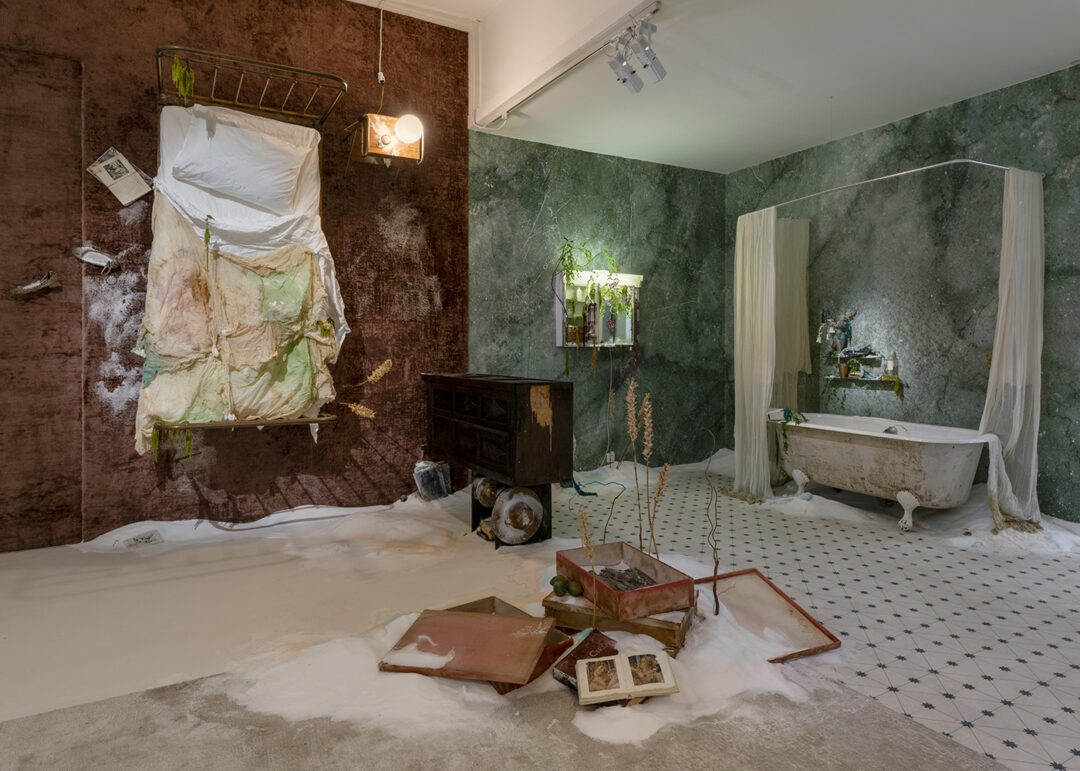
Where Lionel Sabatté attempts to recompose what the world undoes, Bianca Bondi (Galerie Mor Charpentier) chooses to suspend its effects. Her installation Silent House immerses us in a domestic space straight out of a fairy tale. Everything seems to be covered with a thick layer of snow, a white mold. We imagine Cinderella lying there. In reality, it is salt—omnipresent in the artist’s work—used since prehistoric times to preserve food. But here, there is no meat, no flesh, only objects, trinkets.
Between science and magic, the artist plays with the properties of salt, which dehydrates by osmosis and prevents the development of life, that of microorganisms—yeasts and bacteria. The artist thus suspends time, preserves memory, and sanctifies traces. Mixed with water, salt oxidizes and forms a crust that nibbles away at surfaces, covering and mummifying them. An alchemical transmutation takes place, giving the material the power of immortality.
However, the suspension of time is not devoid of history or movement. The hearth before our eyes has witnessed dramas, storms, and human tensions. The salt shaker is overturned: misfortune has struck. The bed, a place of rest, hung vertically, crushes rather than welcomes. The kitchen, a place of sharing, is turned upside down. The bathtub, a place of relaxation, becomes a murky, swampy pool. Noisy ghosts haunt the place. Could coarse salt be used as an exorcism?
Thus, salt does not merely freeze a state. It also stings, burns, and revives the pain of open wounds. With its whiteness, it highlights the violence of life while initiating healing. We imagine a spurt of blood. Plants, with their bright colors and extravagant chemically stabilized forms, come to dress and wrap themselves around the wounds, if not to inject poison into them. Bianca Bondi does not merely suspend the effects of time or offer a postcard aesthetic, as one might think at first glance; she actually keeps memories alive, strikes the imagination, and invites us to think beyond appearances and simple evidence.
Creating another world: the demiurges
Like alchemists, Bianca Bondi and Lionel Sabatté strive to preserve a real world in the process of disintegration (environmental, memorial, material, etc.), mobilizing the power of natural materials. Conversely, Xie Lei and Eva Nielsen adopt a demiurgic stance to give birth to other, alternative, parallel universes, as if to extract themselves from the present world, or to better question it. Painting is a meeting ground.
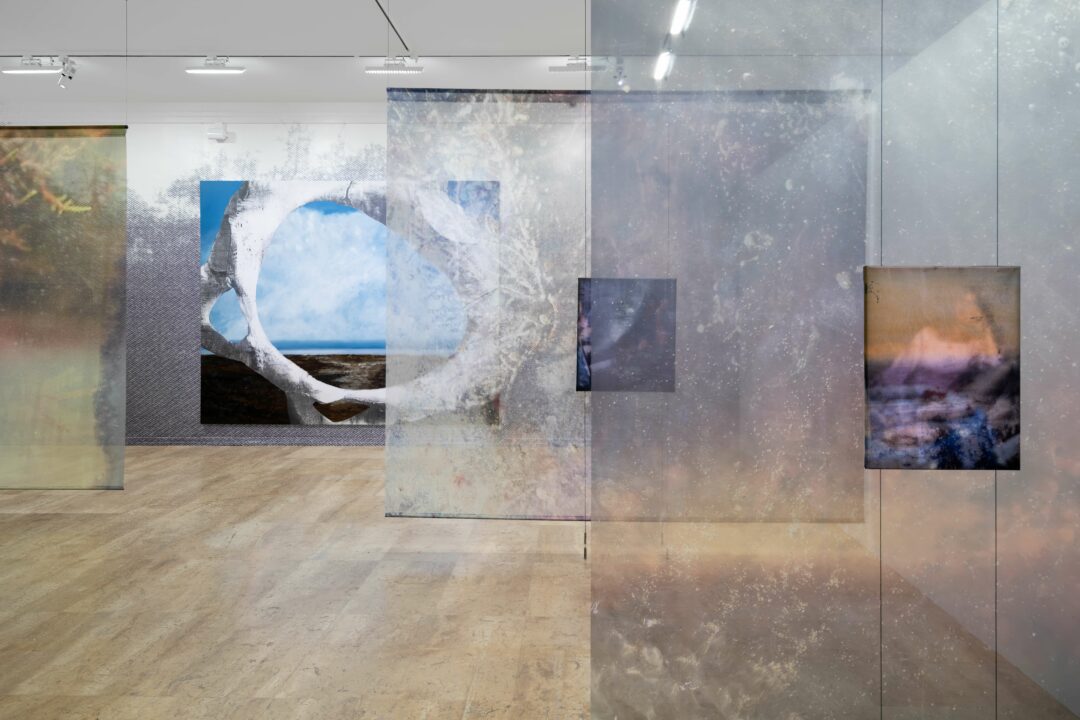
While Eva Nielsen’s work (Peter Kilchmann Gallery) is based on reality, it quickly detaches itself from it to open up to an enigmatic elsewhere, resembling the Platonic demiurge, who does not create ex nihilo but from what already exists. However, accessing this elsewhere requires a real effort of the gaze. For the artist’s proposal, RIFT, is complex. It unfolds in successive layers, echoing the processes of erosion of the lands and marshes that interest her. Erosion is not simply a motif, however, but a principle of image construction.
Through these layers of images, the artist invites the public to explore the superimpositions, to trace the compositions, to question the processes of montage and destruction. Everything remains deliberately blurred, hybrid, unstable. Human figures, architecture, and landscapes intertwine and mix as if in a cauldron. Eva Nielsen does not offer an immediate immersion into her universe, but rather encourages a gradual exploration of the gaps and cracks.
Architecture acts as a threshold, an outstretched hand: stairs, doors, and passageways in the foreground lead to primal landscapes and skies, close to the dawn of humanity. Photographs of eroding marshes are printed on large transparent sails. Suspended, they evoke sometimes a map of the sky, sometimes a microscopic observation, a world that transcends scales. The superimposition of scales from elsewhere—from the geological to the stellar, from small details to large fabrics—contributes to blurring the reading.
These veils, as in the theater, open onto a central tableau, where an enigmatic circular form appears, like a multidimensional portal opening onto a parallel world, a vision of origins, where the earth meets the sky. By creating this organized space, full of intertwined motifs and techniques, Eva Nielsen, rather than documenting the world, proposes a total reconfiguration of it.
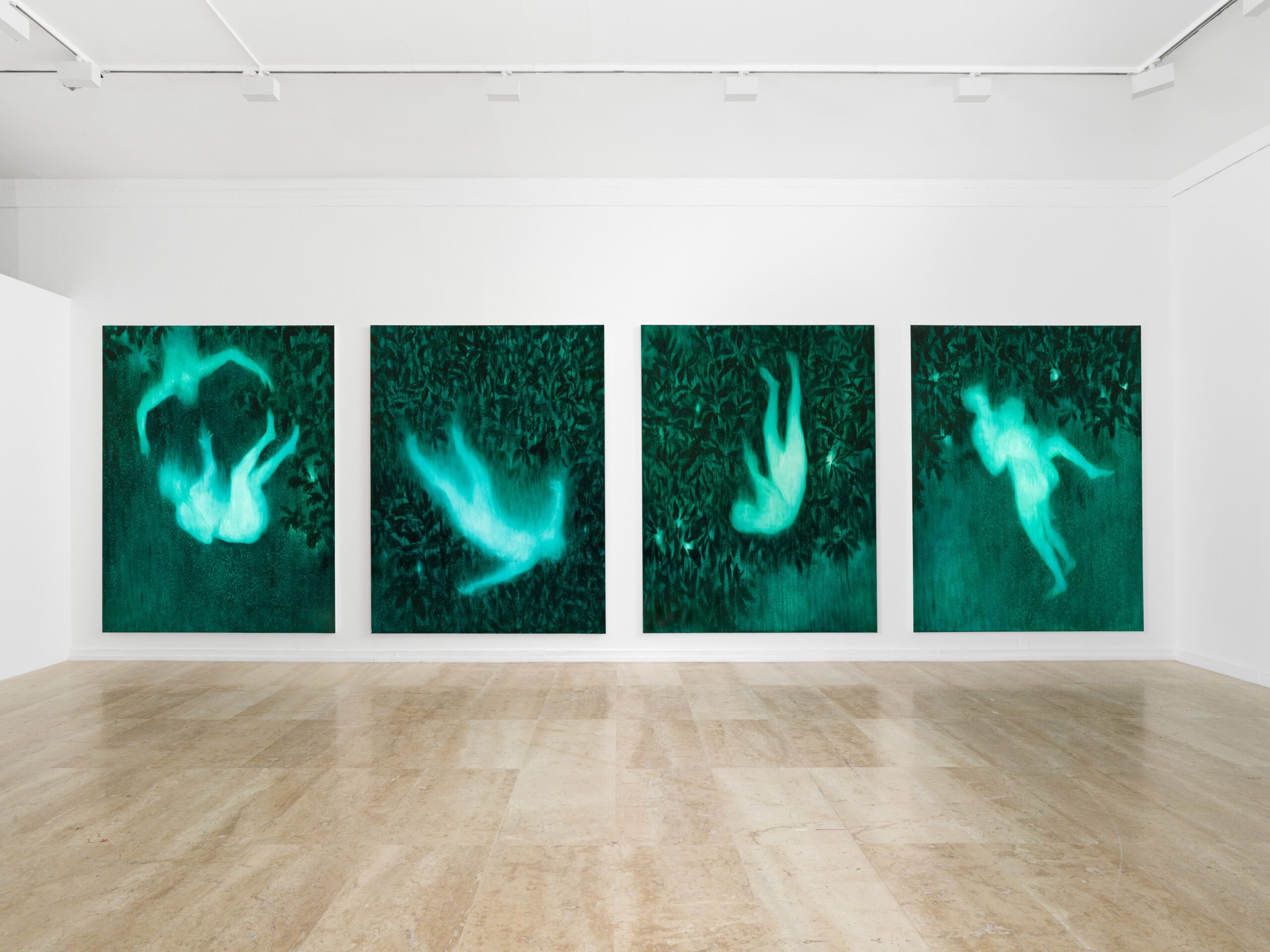
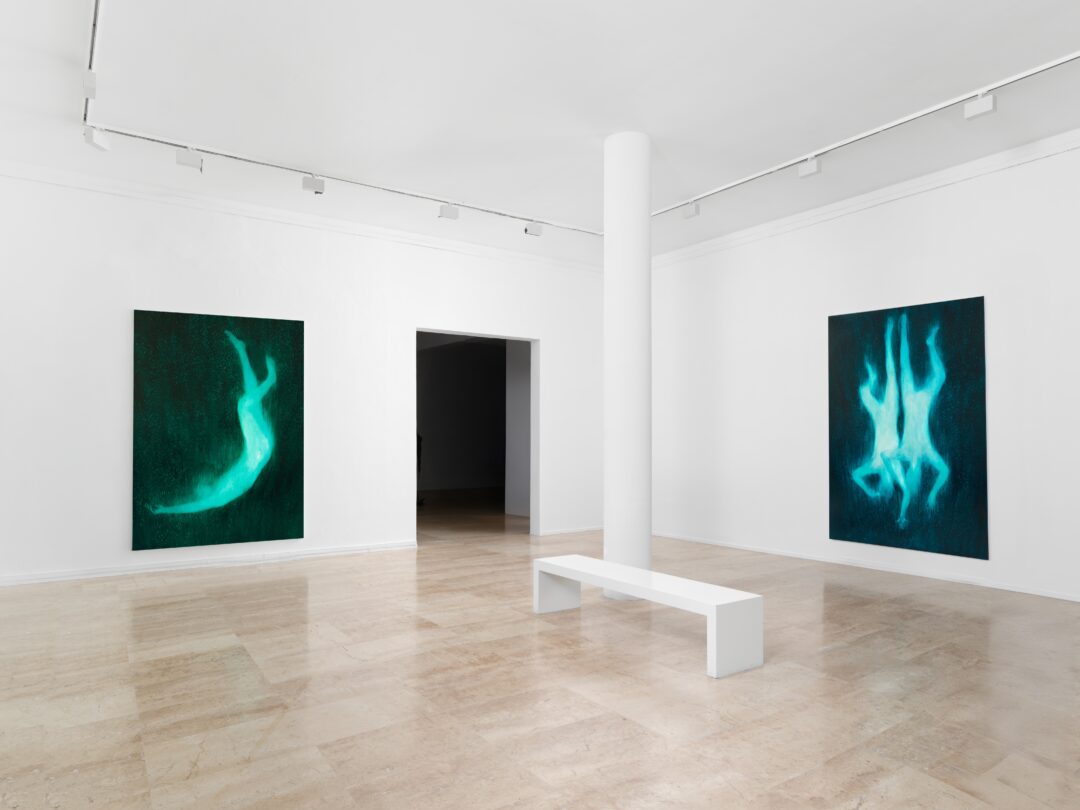
In Xie Lei’s work (Semiose Gallery), painting also asserts itself as a space for projection and immersion. Seven large emerald green paintings surround the audience. Floating, spectral, gaseous, luminescent figures fall in a dizzying gravity. The audience, through identification, also falls. It is physical. Benches welcome them happily. This apparent simplicity—universal silhouettes, genderless and faceless, caught in the act of falling, in an indeterminate landscape—deemed too classic by some, and the ability to engage the audience are precisely the strength of the Fall series.
Although the in-between—falling and levitating, water and air, life and death, bubbles and fleshy leaves—resonates strongly in this series, it is not the real subject. The question is broader and concerns the nature of the human soul, passions, and the earthly condition. What does the fall of Icarus and the rebel angels signify, if not blindness and a feeling of omnipotence in the face of forces greater than themselves? Xie Lei creates a meta-world, a pictorial space that is unreal yet close and familiar, because it is internal. The transfigured color palette (gold, blue, green) plays a major role in this. His universe, set in a natural space—the depths of a lake or a forest, we don’t know—acts as a zone of tension traversed by existential questions that concern both our individualities and humanity as a whole: what is man’s place in society and the cosmos? What is the deeper meaning of human relationships? Does love save us or does it only lead to ruin?
The fall painted by Xie Lei does not bode well: head first, the bodies will crash down with a bang, sinking into the abyss. Yet hope remains. In one of the paintings, a rise to the surface offers a luminous counterpoint. The pictorial world shaped by the artist, governed by autonomous laws, invites the public to contemplation as much as introspection, in vertigo and light.
In a world that has changed radically, two attitudes emerge: slowing down, holding back, preserving, as Bianca Bondi and Lionel Sabatté do; or extracting oneself, imagining, recomposing, as Xie Lei and Eva Nielsen do. But these positions are not mutually exclusive. Each, in their own way, is both alchemist and demiurge. Xie Lei and Eva Nielsen manipulate pigments, filters, and materials, while Bianca Bondi and Lionel Sabatté immerse us in poetic and sensory universes. The exhibition would have benefited from highlighting, even discreetly, these resonances and cross-references to the world, rather than proposing four isolated paths, no doubt so as not to influence public opinion.
Head image : Xie Lei, exhibition view, Marcel Duchamp Prize, 2025, MAM © A. Mole. Courtesy Semiose, Paris