Julie Béna
When Fiction Appears to Offer a Hypothetical Truth.
I pull back the red curtain. Yet Céline Kopp, the exhibition curator, spoke of raising the curtain on an artistic practice spanning the last ten years. I dreamed of theatre with the soft touch of fabric, but not tonight. Initial confusion, upon contact with the velvet, between my perception, my expectations and their encounters with the Magasin and Julie Béna’s works. My curiosity draws the curtain aside at the threshold of the exhibition. Will I have a good journey? I am surprised by the heaviness of the curtain and its ability to isolate worlds.
With a determined step, I enter the first room. Could it be a scene of intrigue? Nothing is ordinary in this setting. Will I have a mystery to solve? I step onto a wooden floor. A challenge for the artist and the spectator to take on importance? We will have roles to exchange under the spotlight. A journey in which we encounter our multiple identity assignments and ultimately emancipate ourselves from them. Personally, I would love to get rid of the comments about my slight accent, which I should definitely not lose. The perpetual confrontation with judgements, exclusion and discomfort. The artist’s mirror: Hungarian in France, French in the Czech Republic.
Entering the parquet floor, I feel like I’m in the ballroom of a castle. If I follow the intonation of the television commentator, whom I in turn assign to his North American accent, I am rather in the United States. Projected on the wall, he appears through a blue curtain. Change of scenery, landslide. The association with the immaculate floor takes effect: a bowling alley appears.
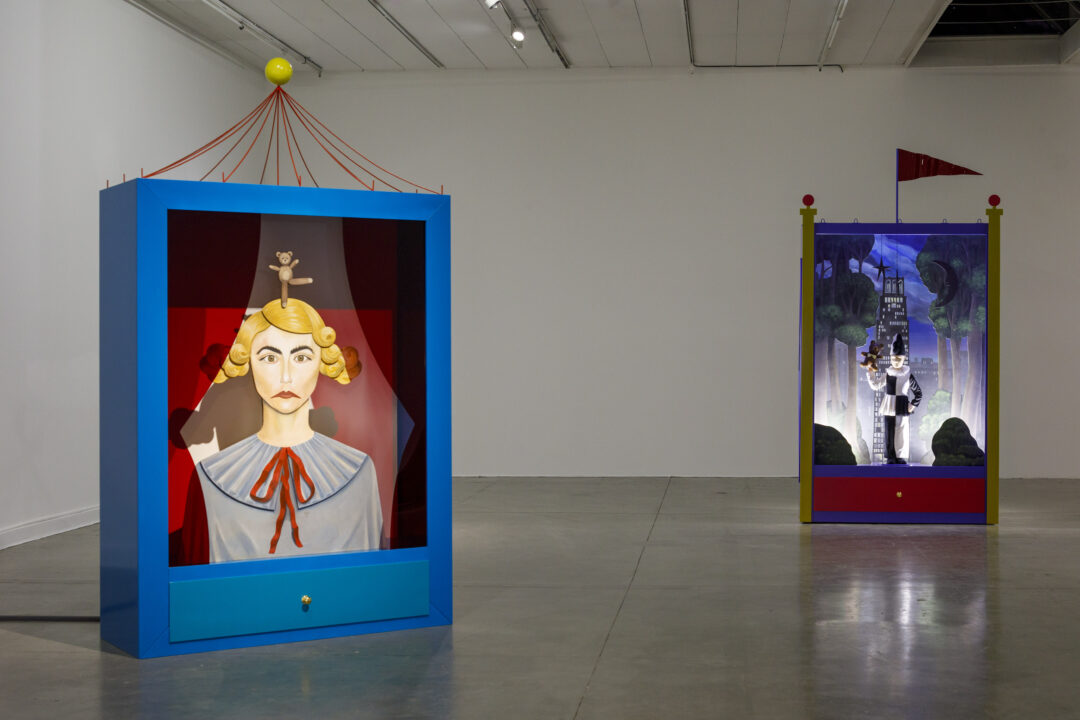
In the middle of the room, a transparent female character, the size of a small doll, lit from below, with curly hair, in a little dress. She is holding a teddy bear in one hand and a bowling ball in the other. She is slowly turning on top of a round red armchair. Images are projected onto the wall. No longer a television set, but a forest. There is a child dressed as Pierrot, hanging from the branches of a tree, then a character dressed as a brown bear climbing the trunk of a pine tree and another, hidden behind another trunk. This one resembles the doll. Is this a game of doubles? Transferred to the cinema, she has colours: a blonde wig, a touch of lipstick that spills onto her cheeks from time to time, a light blue collar, a thin red ribbon, a white dress with short, puffed sleeves, a short light blue skirt, white tights and little black ballet flats. She stomps around in the grass. Small, nervous jumps. Where is she going? Where is she taking me?
Everything is important: the set, but also the costumes. I’m not at the theatre, but I’m stepping onto a dance floor where I’m not going to dance, but am I going to perform? With these three: Pierrot, Teddy The Bear and the girl? Who is she? What’s my line? On set, the jury tries to answer that question. She just smiles, even though she’s uncomfortable. Is she happy? Should she like this without consent and shine despite everything? It turns from comedy to horror.
Suddenly, she becomes three people: she is as she was before, but she is also someone else, a man in disguise, and another person, a little girl. Shirley Temple, a child actress, American star of the 1930s? Julie Béna was also an actress as a child. But it’s not her or Shirley. The jury decides: it’s Dirty Shirley. Dirty because of a cocktail of the same name. Another coincidence with the artist’s world: days at the Villa Arson, obscene nights at work.
It makes your head spin, you need to sit down for a bit. I need some comfort with a twist, a cocktail would do the trick. The armchair is well designed: specially made for this space, a journey between fiction and reality, between them, Julie Béna, Shirley Temple, Dirty Shirley, Pierrote, the doll, between her and him, the male double disguised as Shirley or Teddy The Bear, between the viewer, her and him.
My gaze wanders over the walls, looking for something to hold on to. Still in the same room with the wooden floor. I spot a sculpture near the entrance with a series of characters: a spider, a fly, a candle flame, hair, a ruff. Where do they lead? You have to know how to read the clues. Tracking the artist: a changing character who is haunted and who in turn haunts visitors with his stories. There are characters who are present, but also absent. A ghost father? A child never born?
These are sordid, implausible, tormented, poignant stories that avoid pathos. Funny, but… just with a little twist that shifts them. The long-awaited twist. If it’s humour, then it’s black humour. Writing woven from multiple readings (systematically credited in her films). It’s a parody of a normal life. She is attracted to misfits. A great power in the topicality of flattened narratives.
I hear little voices, children’s whispers. The kids’ opening. When I visit exhibitions with my daughter, I enjoy it twice as much, both for her and for the little girl in me who didn’t have the opportunity to do so. I’ve been to many exhibitions, but not with a group of friends with whom we can make our new base at Le Magasin, in the setting of these ambiguous characters.
The journey through a succession of worlds creates a garland-like visit. Key figures punctuate the installations in the rooms where black metal sculptures, coloured lace, and videos projected or presented on screens complement each other. They are numerous and come from fairy tales, carnivals, theatre, and video games. They are allegories or alter egos, like the first Harlequin, after the first room. Life-size, he is seated on the benches, leaning on his knee with his golden face. He holds a clown puppet dressed in green in his hand.
Harlequin and Pierrot represented seasons and social classes in the commedia dell’arte. The king’s fool, the jester and the joker had the role of “carrying the voice of life”. The circus clown entertains his audience by distorting language, mainly non-verbal, with lots of facial expressions. Until now, when he spoke, it was to say silly things. Dirty Shirley made little sounds, laughs and cries. His silence was translated in an absurd way by the presenter. But there was no real dialogue.
A black metal sculpture hangs from the ceiling of the next room. The Hanged Man, number XII in the Marseille tarot? He is called Jester and is accompanied by lace eyes and a snail. He is black, but in the next room, on the screen, he appears in a green jumpsuit. On the three walls, three parts of a series of animated films about this character are on display.
I enter a stage again, on a carpet. The relationship to the imaginary and to sound is not the same. The office furniture in the middle suddenly appears in the animated film as a landscape, but also as transparent architecture. Landslide. Julie Béna catches up with me in the room. The real one. The artist in the flesh.
She is dressed in a magenta velvet suit, white shirt, jabot collar, lipstick, jacket with one visible button and another hidden, two visible rectangular pockets and beige trainers. Following my gaze, fixed on the image, she tells me that the Jester is not the wise one in this trilogy, it is his environment that is. I now understand the presence of the snail from earlier. There is also a foetus, a fly, insects, a dung beetle, mycelium, a matsutake mushroom, trees, a blob. There is communication here. Although incongruous, there is an exchange.
We go outside and sit on the bench in front of the art centre. She confides in me that she has been aware of the public since the birth of her daughter. She is fascinated by codes and different levels of understanding.
Travellers, spectators of her exhibitions, immediately understand what is at stake, she tells me. Indeed, she grew up in a travelling theatre and currently lives in Prague with her husband and daughter. Her worlds can also evoke this displacement, which can only be acquired by physically experiencing this gap. The humanism she tries to touch upon is what her work is about.
Three people greet us: her mother, her daughter and her husband. Then they join the guests at the opening. Suddenly, it becomes clear that they are the ones who appear in her films. People play themselves. There is also an economy of labour in the urgency. The family is close at hand. There is no time for rehearsals. No second chances. She constructs the characters she begins to embody well in advance. First, by imagining what they wear. This means visiting fabric shops, drawing, meeting the dressmaker. The cut of the garment dictates the posture. Taking on this second skin and observing, observing the people around her. It is constant work. Growing up with works in progress. What she doesn’t mention is the reading and writing that precedes her performances. The environment, the installation with sculptures and videos, comes later. She considers them to be layers of the same unfolding story, parallel worlds where connections are constantly being forged. Like a spider’s web or a snail’s slime in an interior still hidden from others.
She does this while chatting with me in the street. Her two gallery owners arrive, Longtermhandstand from Budapest and Nicoletti from London. She gets up to greet them. In a split second, her choice of interview flashes through my mind. What genius to put herself in the spotlight like this. Under the streetlights, the parade of people never stops. Is this a new masquerade, like all her works?
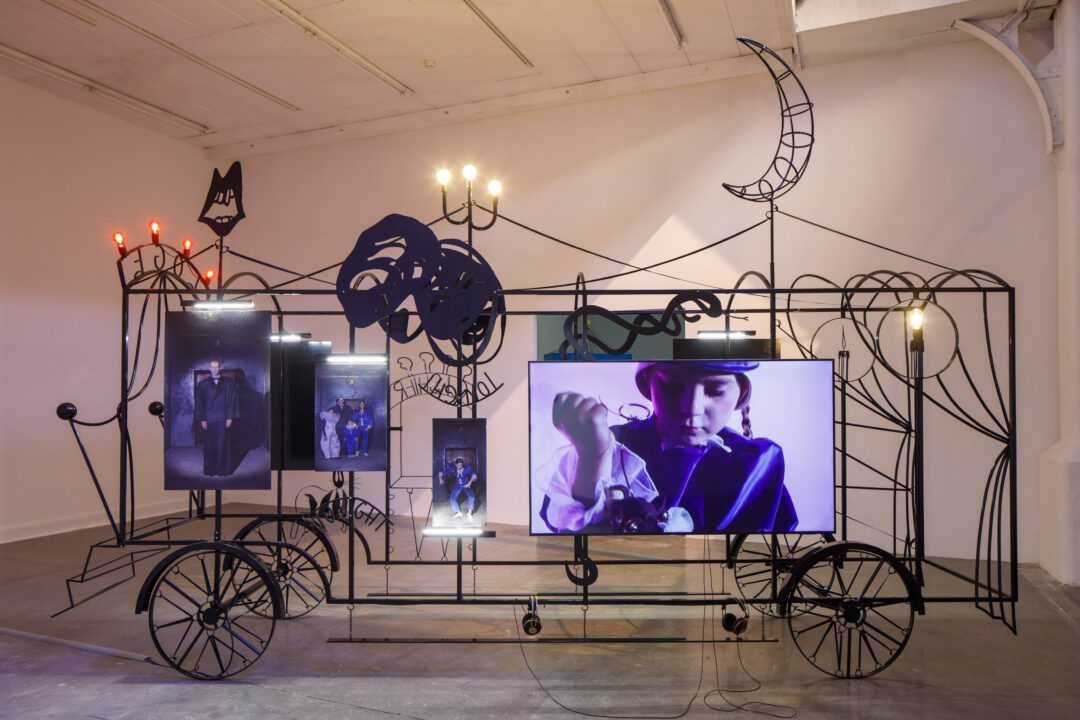
I continue my visit to Wonderland. Arriving at a metal structure shaped like a caravan with a few photos and two screens, they are all there: mother, husband, child and her (never the same). The family disguised as a nomadic theatre troupe. Her royal blue jumpsuit is close-fitting, with fanciful white cuffs and collar, shoulders raised upwards in an extension like wings, three white buttons on the torso, her straight hair loose, exaggerated eyebrows, hair protruding from her nostrils, lipstick spilling over in a thin line on her cheeks, flat white shoes. A magician disguised in a Pierrot costume turned blue and white. She asks in her French accent: ‘What do you believe in? Love or hate? What is truth? Maybe like magic.’ It is a perpetual theatre of navigating life, of deconstruction and reconstruction. Tensions, intimacy, conflicts of interest. Reversed roles. Play, care, seduction and, above all, fatigue. Non, rien de rien, non, je ne regrette rien. Neither motherhood as dispossession of the body through maternity nor ageing.
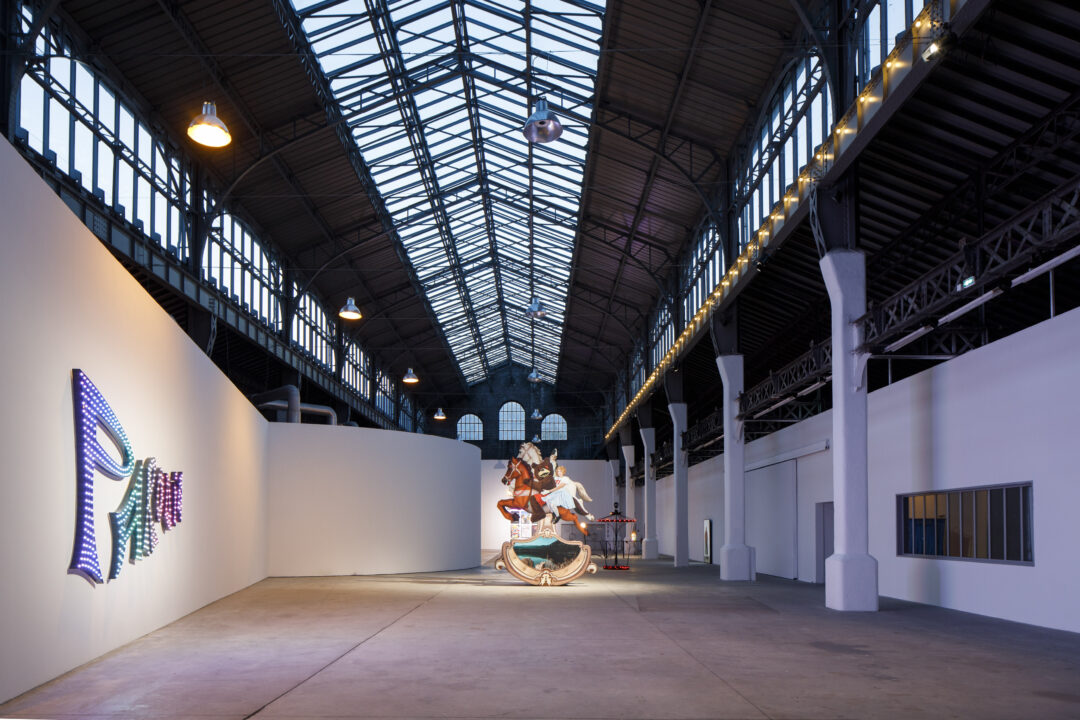
Amidst whirlwinds of laughter and tears, songs and dances, the rooms are filled with other ensembles. Everything coincides with the biography, but the stage, the lighting and the costumes shift the terrain. The final touch is under the large glass roof of the art centre, called the ‘street’. In this shared space, the place and moment of social transformation, there is hope for togetherness in our differences. The brightly lit fairground setting welcomes all the figures encountered in the previous environments. A large carousel of death, a wheel of fortune, a balustrade. There is also a final male alter ego of the artist. Jean is a kind of anti-hero. This outsider expresses himself with his mouth noises and facial expressions. He stares at the spectators. Ambiguity hangs in the air until the very last moments.
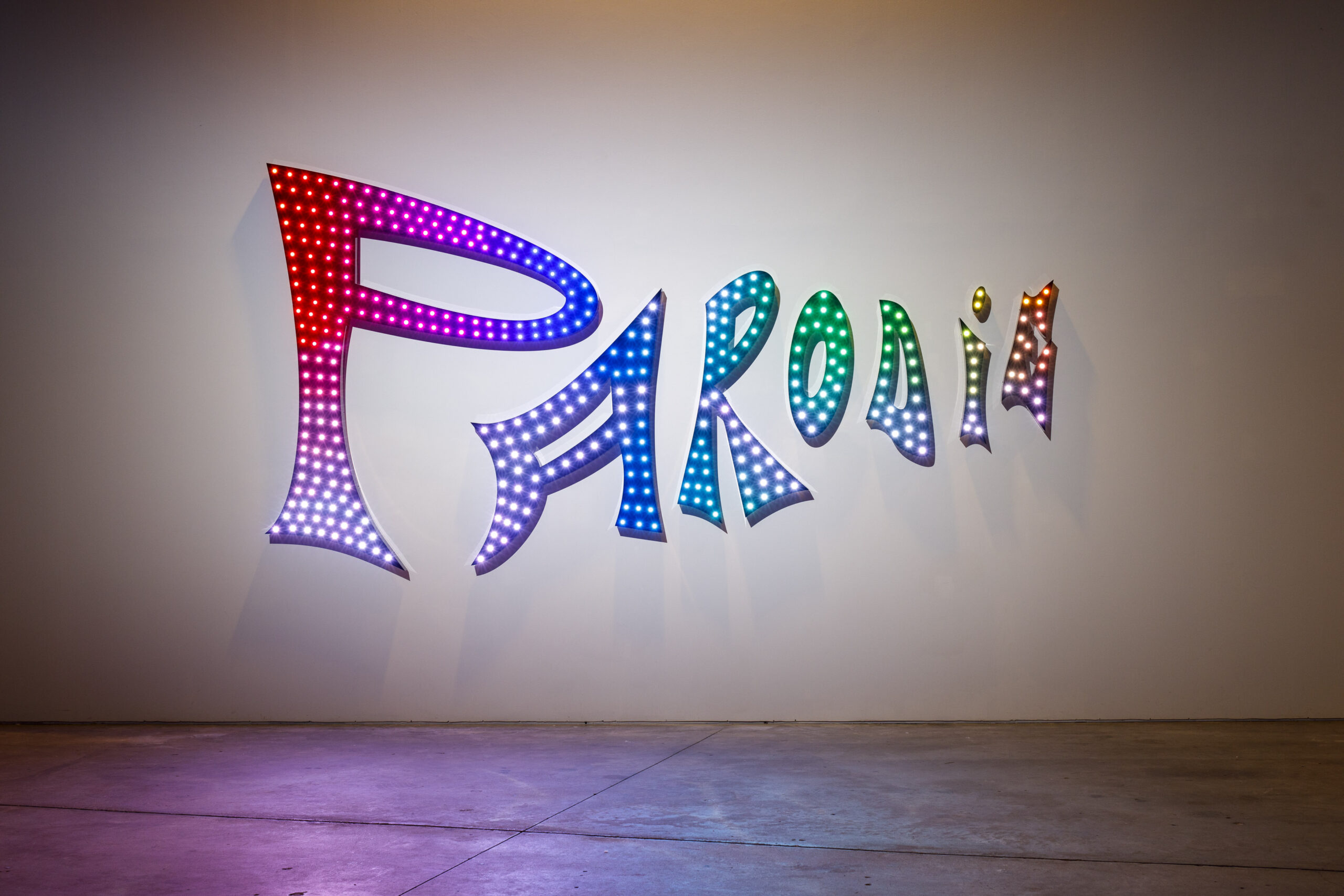
Head image : Julie Béna, « Parodie », vue de l’exposition au / exhibition view at Magasin CNAC, Grenoble, 04.10.2025 – 05.04.2026. © Magasin CNAC, Courtesy de l’artiste. Photo: Tomas Souček.Julie Béna, Parodie, 2025. Courtesy de l’artiste.
Related articles
Francisco Tropa
by Agnès Violeau
Nicolas Daubanes
by Guillaume Lasserre
Pauline Curnier Jardin
by Sarah Matia Pasqualetti