Performa Biennial, NYC
Performa Biennial, NYC
Celebrating 20 years
November 1 – 23, 2025
For its 11th edition, Performa celebrates its twentieth anniversary by reaffirming what makes it unique: a biennial without fixed walls, yet omnipresent in the city, transforming New York into a vast experimental playground for live forms. Founded by RoseLee Goldberg — whose seminal book Performance Art from Futurism to the Present has been regularly reissued since 1979 — Performa remains a very concrete utopia: creating a platform dedicated to performance where no permanent institution truly fulfills that role.
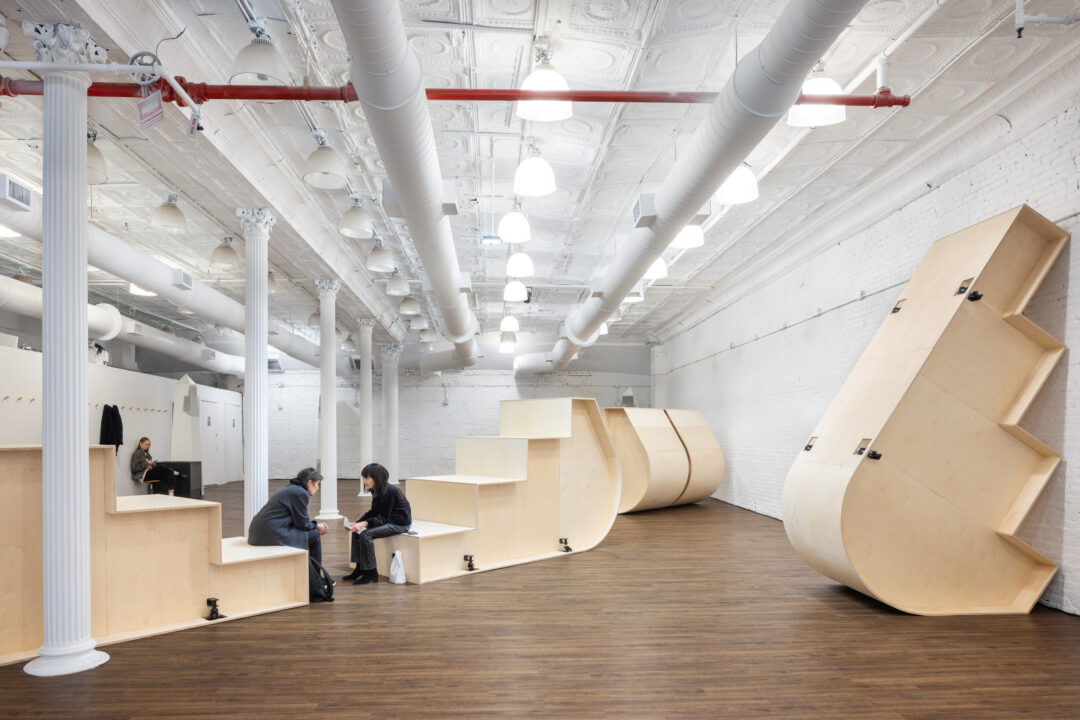
Once again this year, the biennial centers around a “hub” designed by Diller Scofidio + Renfro, serving as a gathering point and venue for key events, while most projects infiltrate the city. As Job Piston, curator at large, summarizes: “Performa allows a large number of New York institutions to coexist on a single platform for three weeks.”
Alongside RoseLee Goldberg is a curatorial team composed of Defne Ayas (director of the Van Abbemuseum in Eindhoven and curator at large), Kathy Noble (senior curator), Ikechúkwú Onyewuenyi (curator of cultural affairs), Job Piston (curator at large) and Madeleine Seidel (assistant curator).
Within this team effort, a guiding theme serving as a framework and point of reflection for the artists is defined each year by RoseLee Goldberg with Madeleine Seidel. A collection of texts and visuals around this central theme is then shared with the artists to serve as a basis for their research. This year, the chosen theme is “Art and Performance After Cinema,” invoking figures such as Virginia Woolf, Charlie Chaplin, Maya Deren, Bell Hooks, Jean-Luc Godard, and Yvonne Rainer.
One of Performa’s particularities is its invitation to visual artists to engage with this medium for the first time, although some collaborations have taken place over the years with choreographers such as Jérôme Bel. This year, artists invited to explore the live medium include Diane Severin Nguyen, Tau Lewis, Aria Dean, Ayoung Kim, Sylvie Fleury, and Camille Henrot (whose presentation has been postponed to 2026).
Another series, the Performa Projects, presents more eclectic or experimental works, such as Regina José Galindo’s project at the Americas Society or South Korean artist Sojung Jun’s work at the Asia Society. The latter, which we were able to see, draws inspiration from the erased history of the Koryo-saram, a Korean population deported by Stalin in 1937 to Central Asia. The project blends traditional music, the epic narrative singing of pansori, and an experimental film generated by the artist from archival and contemporary images connected through AI. Combining traditional singing and mutating visuals, the performance offers a powerful and poetic reflection on this forgotten historical episode. Notably, the film can be seen as an installation at the Showroom in London until January 2026 (the performative version will also soon be presented at Mudam Luxembourg).
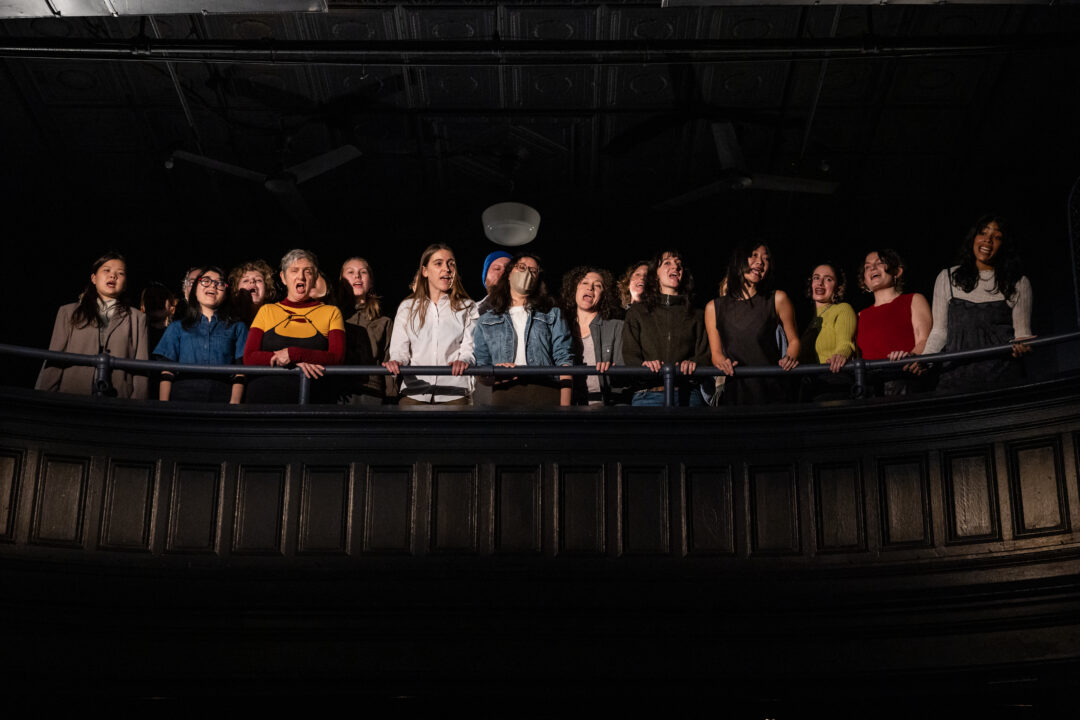
The rich and abundant program brings together 54 artists and collectives and includes a “pavilion without walls” dedicated to the “social, political, and artistic” discovery of a specific scene — this year, Lithuania. Lina Lapelyté presents The Speech (NYC), a new version of the performance first shown with other performers at the Bourse de Commerce in Paris in September 2024 for the Festival d’Automne. For this version, she worked with 200 children over several weeks during a residency at the Watermill Center. Curator Raimondas Malašauskas proposes two evenings of musical comedy inviting hypnosis and poetry, while the duo Pakui Hardware offers an evening combining singing, sculpture, and artificial intelligence. The pavilion is completed by in-situ and nomadic installations by Augustas Serapinas, who disperses parts of a wooden structure throughout the city, evoking ideas of memory and recurrence.
A new feature this year, the Performa Studio, offers workshops open to the public, encouraging participation and emphasizing research and experimentation, with guests Moriah Evans and Isabel Lewis. Curated walks, in partnership with Extra Extra, complement these workshops and guide visitors through the city, identifying iconic places where performances have emerged.
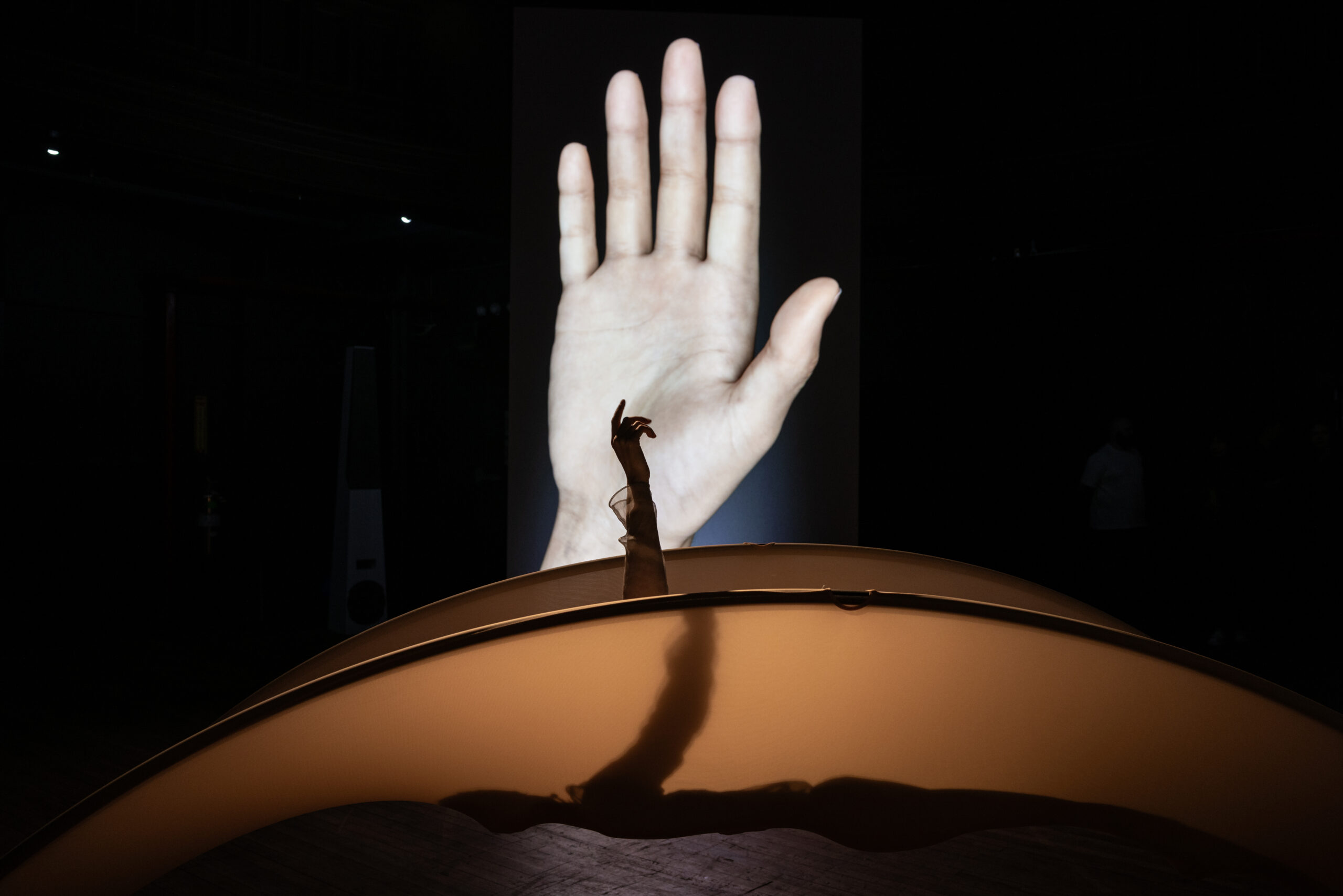
Among the major new commissions presented this year, Pakui Hardware (the duo representing Lithuania at the most recent Venice Biennale, composed of Neringa Černiauskaité and Ugnius Gelguda) addresses issues of mental health and artificial intelligence through the structure of a classical Greek drama. Once again, we observe the recurrent presence of singing (often found in Lithuanian artists’ work), beautifully performed by soprano Justina Mykolaityté, admired in The Sun and the Sea at the Venice Biennale in 2019*. In Spores, the duo’s organic sculptural forms reappear as set elements, along with a film that interacts with the singer and her chorus, simulating an exchange with a therapist/artificial intelligence during a “live” session. Filled with emotion, the performance addresses issues of contemporary anxiety and environmental crisis.
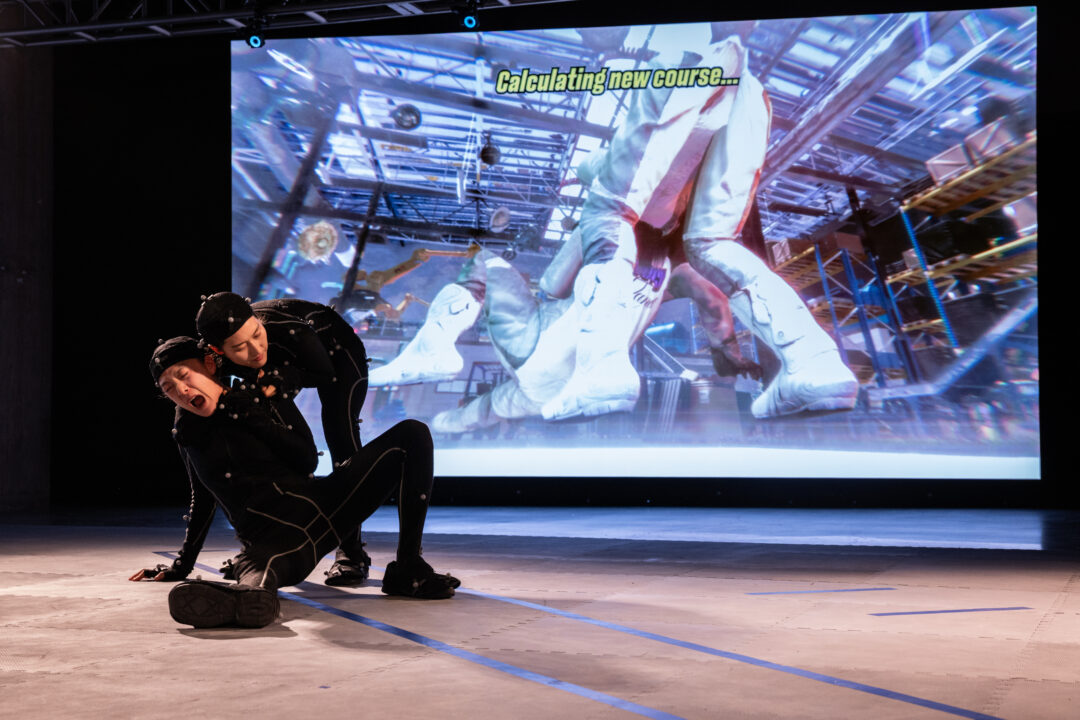
Also using AI and speculative fiction, South Korean artist Ayoung Kim — who had just opened her exhibition at MoMA PS1 — presented her first live performance at Canyon, derived from the exhibition. Body^n revisits the story explored at PS1: a motorcycle courier, the ultimate symbol of capitalism’s obsession with performance monitoring, working for the Deliver Dancer Company, a platform run by AI, confronted by her doppelgänger. Time becomes cyclical rather than linear, and the protagonist traverses the boundaries of multiple possible realities while managing (or failing) to make deliveries at the speed of light. The performers, some of whom are film stuntwomen and martial arts fighters, stage combat sequences within the augmented reality of this futuristic, deserted Seoul. The relationship between the courier and her double — who reveals truths about parallel worlds — is ambiguous, conflictual, yet also more sensual. From fights to body-to-body encounters captured through motion-capture technology, the choreography evolves into gentler embraces symbolizing the strange bond between these alienated characters.
Some Performa events are more discreet yet no less compelling, such as a conversation led by author Fiona Alison Duncan in the form of a performative discussion with artists Dozie Kanu, Matt Hilvers, and Chukwumaa. Through an ironic shift introduced by direct questions like “Do you believe in God?”, the format broke away with irreverence from traditional panel structures, proposing an alternative search for meaning in artistic creation.
Performa continues to be an exciting platform for live forms, often succeeding in reinventing the medium or shifting it off its usual paths — such as the Instagram account war_s0ngs, an open research notebook created by Diane Severin Nguyen, questioning how artists share their material.
Twenty years after its creation, and on its anniversary, Performa asserts its singular place in New York’s artistic landscape as a laboratory and active space for critical reflection, continuing to envision performance as a fluid medium and a tool to interpret the present.
*Created by Lina Lapelyté, Vaiva Grainyté, and Rugilė Barzdžiukaitė. This pavilion won the Golden Lion at the 2019 Venice Biennale.
Head image : Pakui Hardware, Spores, 2025. Photo by Walter Wlodarczyk, courtesy of Performa.
- Share: ,
- By the same author: 1+1. The Relational Years, Thomias Radin, Ralph Lemon,