Camille Llobet
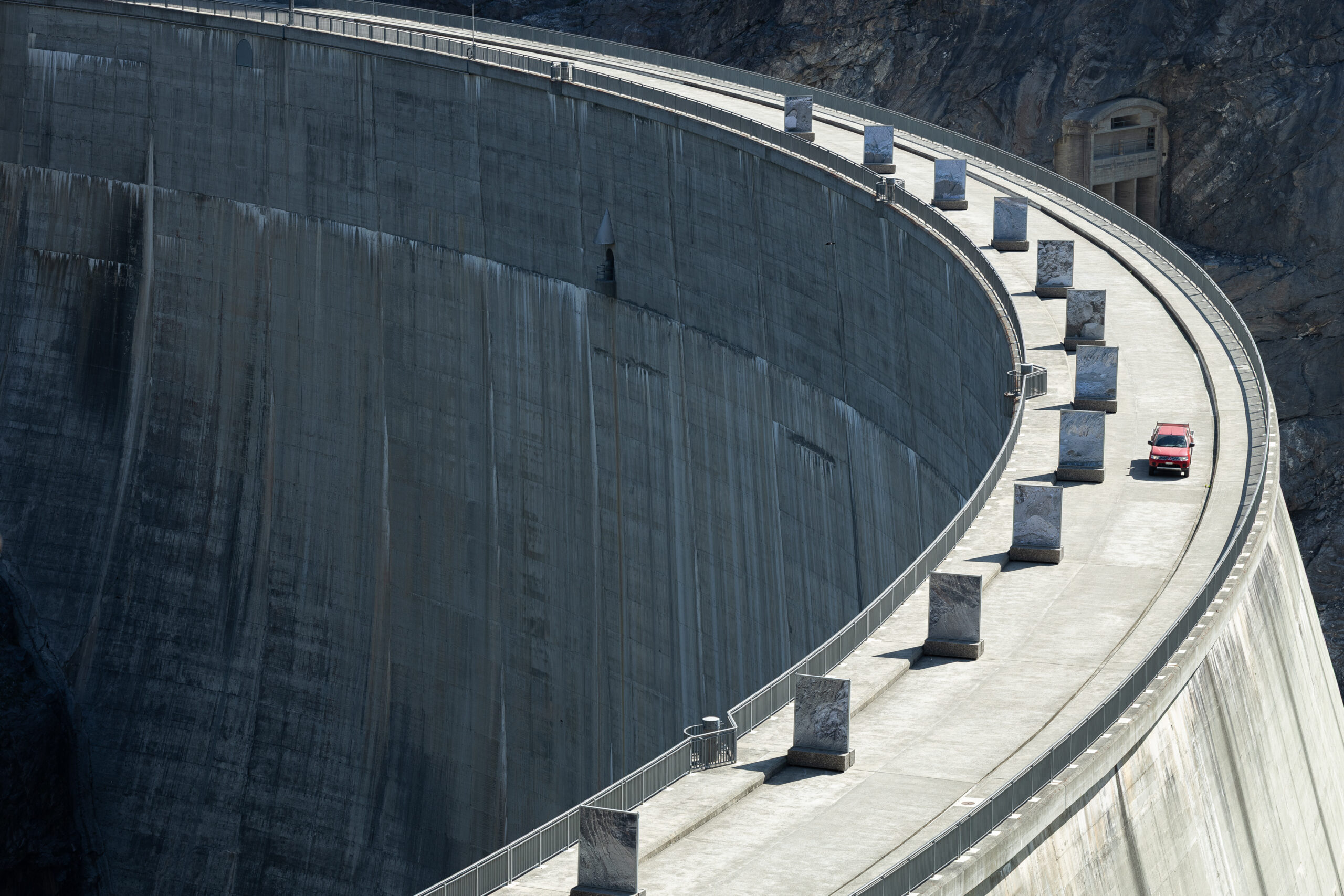
Camille Llobet, Glacier noir
Mauvoisin Dam (Switzerland), Musée de Bagnes
Le Châble, in partnership with the Valais Sound Biennial
Curator: Jean-Paul Felley, director of EDHEA
June 22 — October 5, 2025
Installed on the crest of the Mauvoisin Dam in the canton of Valais in southern Switzerland, as part of the Musée de Bagnes’ eleventh summer exhibition and in resonance with the second edition of the Sound Biennial, Camille Llobet’s “Black Glacier” unfolds with tremendous sensory and conceptual power. The artist transforms the glacial retreat into a visual and auditory meditation, questioning the relationships between nature, memory, and representation in the unique context of Valais. A concrete colossus 250 meters high and 520 meters long, built between 1948 and 1958, the Mauvoisin Dam is much more than a simple backdrop here, imposing itself as a full-fledged participant in “Glacier noir.” On its crest, Camille Llobet displays thirty large-format, double-sided photographs that capture the moraines of the Mer de Glace, the iconic glacier of the Mont Blanc massif, which is now in full retreat. These images, oscillating between macroscopic and panoramic framing, reveal an austere mineral landscape in which sandy strata, erratic blocks, and rare traces of plant or human life sketch out a veritable “language of disappearance.” The light chosen by the artist—the soft light of summer dawn or the pale light of autumn—gives the photographs an almost tactile texture in which the grain of the rocks and the fractured lines invite the viewer to touch with their eyes.
At the Musée de Bagnes, a place dedicated to the cultural and natural memory of the Val de Bagnes, the video installation Glacière (9’57“, binaural sound with headphones) transports visitors to a cave of “fossil ice” more than 1,500 years old, explored alongside high-mountain guides Laurent Bibollet and Victor Lapras. This work, somewhere between a scientific documentary and a perceptual experience, uses listening as a tool for knowledge and wonder, capturing water droplets and cavernous echoes like poetic laments for a world that is disappearing. As a counterpoint, Moraine, presented at La Centrale de Chandoline in Sion, offers a kinesthetic and sonic reading of the same glacial landscape, in which the guides’ movements in the moraine debris are transformed into a slow and meditative choreography. These three components—photography, video, and sound—form a coherent triptych in which the artist explores the tensions between permanence and transience, materiality and abstraction.
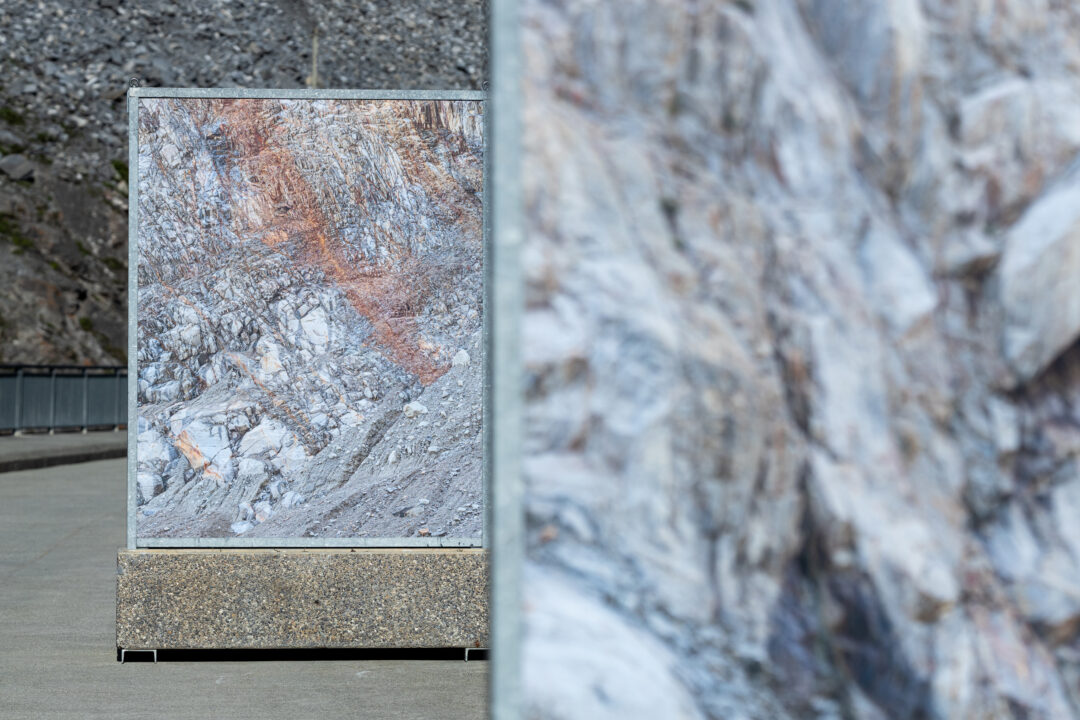
Born in 1982 in Sallanches and a graduate of the École supérieure d’art Annecy Alpes (ESAAA), Camille Llobet works at the crossroads of contemporary art, experimental cinema, and perceptual research. She made a name for herself in the contemporary art world with Fond d’air, her fascinating monograph presented at the Institut d’art contemporain (IAC) in Villeurbanne in 2023. In Glacier noir, she continues her research on gesture, language, and perception, rooted in a collaboration with geomorphologists and alpine guides. Her photographs, devoid of scale references, disturb perception, transforming moraines into abstract landscapes in which the visitor hesitates between the infinitely large and the infinitely small. This visual ambiguity, reinforced by variations in light, evokes an unexpected tenderness for these glacial debris, often perceived as arid remnants. The film installation Glacière takes this approach further by incorporating binaural sound, which envelops the viewer in a paradoxical intimacy with the fossil ice. The sounds of the cave—drops, creaks, silences—become a metaphor for geological memory, while the images of guides exploring this hostile environment remind us of the fragility of human interactions with the high mountains. Moraine, meanwhile, translates this dialogue into a visual performance in which the moraine landscape becomes a space for almost choreographic movements, highlighting Camille Llobet’s ability to transcend mediums to create a multisensory experience.
The inclusion of “Glacier noir” in Valais, a region marked by the history of glaciers and hydroelectric infrastructure, gives the exhibition a particular resonance. The Mauvoisin dam, built to harness natural forces, contrasts with the disappearance of the glaciers it overlooks, embodying a tension between human control and ecological collapse. The artist exploits this paradox with finesse, using concrete as a backdrop for images that speak of loss and change. The urban echo of the exhibition, via the “Art au centre” display space made available to the School of Design and Art (EDHEA) by the Payot bookstore in Sion, reinforces this link between the Alpine region and its cultural extensions. However, the complicated access to the dam limits the accessibility of the exhibition to an audience willing to undertake a hike or a mountain bike ride. While this constraint reinforces the idea of an immersive experience, it risks excluding a large proportion of visitors, confining the work to an informed or determined audience.
“Glacier Noir” excels in its ability to combine scientific rigor with sensitive poetry. By collaborating with experts such as Bibollet and Lapras, Camille Llobet anchors her work in a tangible reality while transcending it through a radical formal approach. In this impressively dense work, the artist transforms glacial retreat into an aesthetic and existential experience. In dialogue with the Valais, her photographs, videos, and sound pieces compose an elegy for a changing world in which geological memory meets human questioning. While the artist’s ability to make the silences of the mountains resonate is undeniable, it further accentuates the regret that limited accessibility slows down the universal momentum of her message. “Glacier noir” remains a wonderful invitation to listen and see differently, in a territory where time, like ice, flows inexorably.
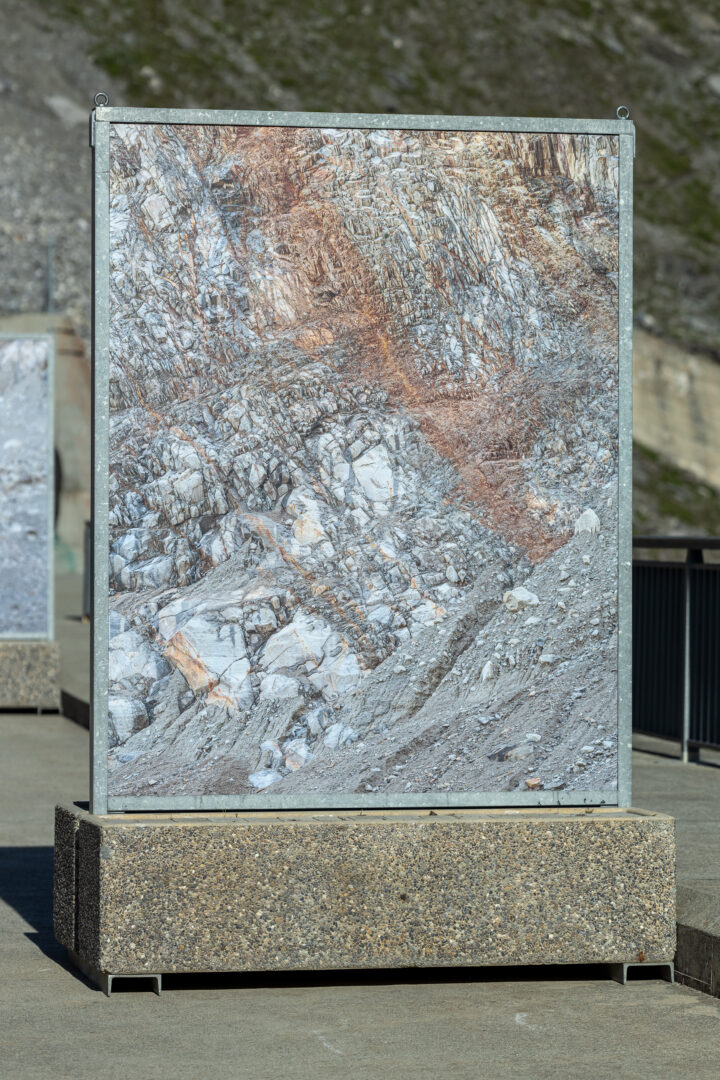
Head image : Vue de l’exposition / Exhibition view of Camille Llobet, « Glacier noir » (détails), barrage de Mauvoisin, Musée de Bagnes, 2025. © Studio Bonnardot.
- Share: ,
- By the same author: Biennale Son, After the End. Maps for Another Future, Wolfgang Tillmans, Bergen Assembly, Aline Bouvy,