Amy Sillman
Amy Sillman
Oh, Clock!
Ludwig Forum, Aachen
March 22 – August 31, 2025
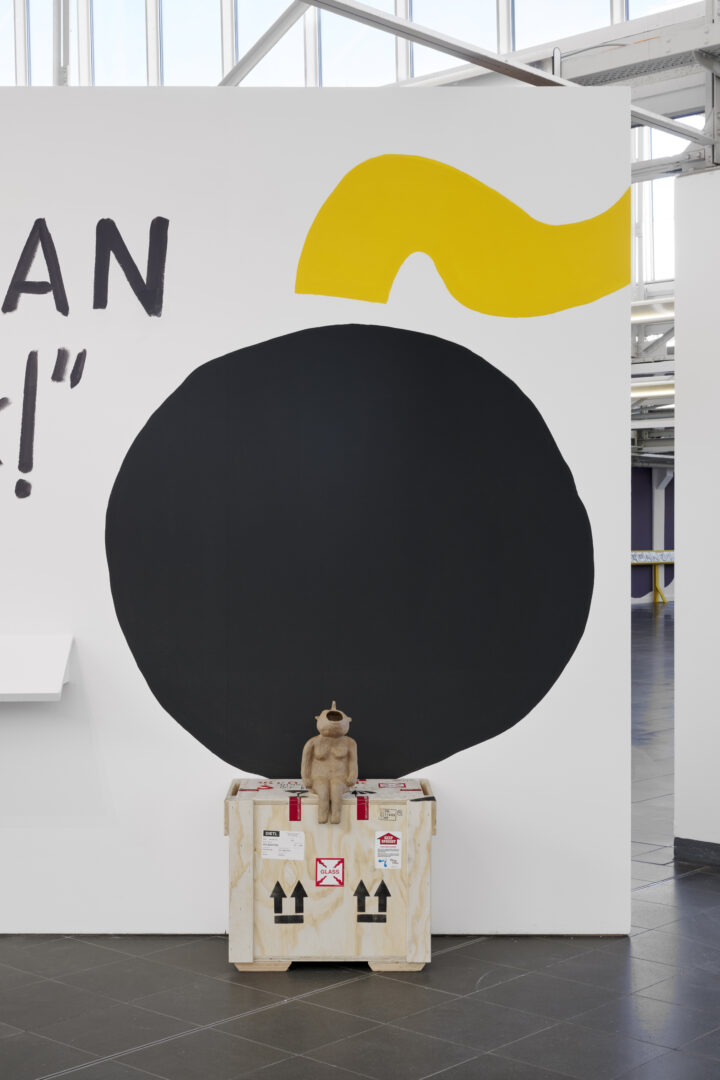
Upon entering the vast hall of the Ludwig Forum in Aachen—a former umbrella factory with impersonal dimensions—you are confronted with large yellow shapes: sculptures by Gabriel Kuri that resemble oversized Meccano pieces. We walk around these Items in Care of Items to discover, painted on an architectural element in the middle of the hall, a large black circle with rough contours and a cartoonish arrow in the same yellow as the sculptures, inviting us to head towards the entrance to a gallery. But as we follow the sign, glancing down at the epoxy and leather spindles created by Nairy Baghramian, we hesitate to drift to one side of the entrance to linger in front of an installation by Peter Brüning—an assembly of electric lights and pop shapes that catch the eye like the animation of a street— or to the other, to follow a display case where Temporary Object, a series of prints on aluminum by Amy Sillman, stretches out, seeming to draw us away from the threshold of the exhibition… Unless we decide to start again on the other side of the hall, succumbing to the unsettling charm of a painting by Galina Neledva, a group scene somewhere between a family reunion and a slightly sinister opening reception, to venture into the museum’s other galleries.
From the moment you enter, Amy Sillman’s exhibition “Oh, Clock!” plunges the viewer into uncertainty and challenges their curiosity. The works scattered throughout the hall set the parameters for the aesthetic experience: shapes and colors in space, obstacles and passages, the movement of bodies and the orientation of the eye, effects of reality and trompe-l’oeil. In this exhibition, which combines a presentation of paintings, drawings, and animated films created by Sillman over the last ten years with a selection of works she has chosen from the Ludwig Collection, nothing is taken for granted, and everything is in motion. Now recognized for her work reinterpreting—or “queerizing” “—the legacy of abstract expressionism and action painting, the New York artist continues to explore and expand the field of painting in a manner that is as generous as it is demanding, attentive to creating contexts for understanding works that undermine the solemnity of the white cube.
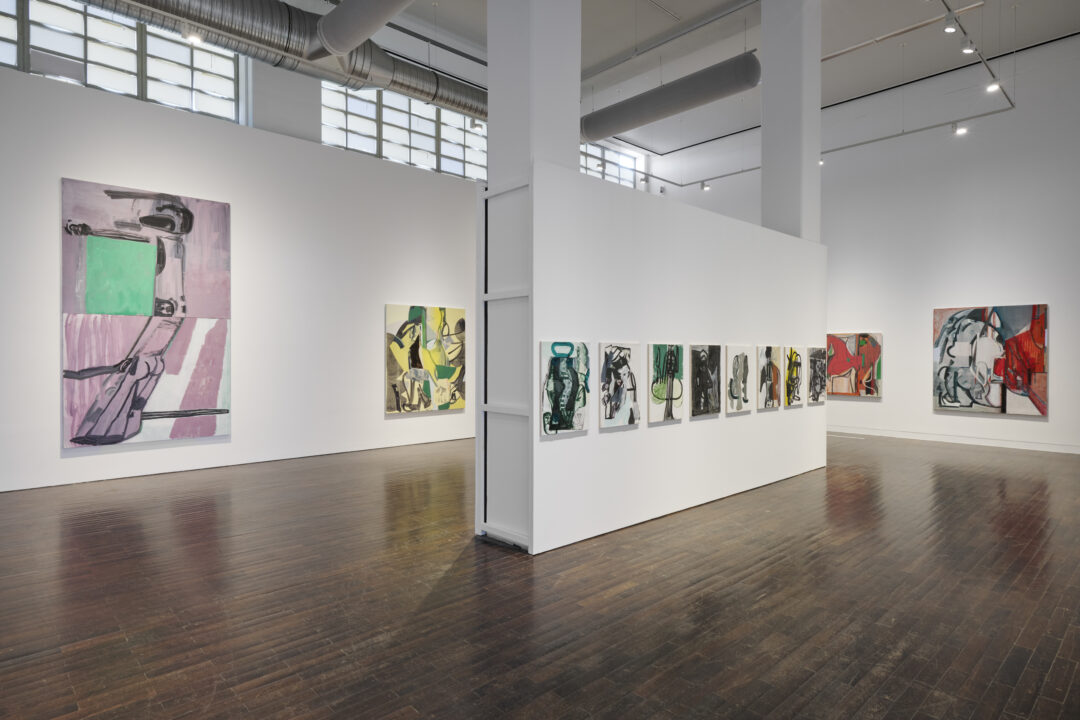
Let’s start with the suite of four rooms where Sillman’s works are displayed. Large-format paintings alternate with smaller canvases, while several series of drawings cover the walls and animated videos shown on screens provide a counterpoint. What is striking is the complexity of the interplay of forms and colors at work, the way each canvas presents itself as an accumulation of gestures, maneuvers, passages, and repetitions—rather than as a simple work of pigments. The chromatic density suggests the decisions and processes that produced the work of forms as much as it masks and obscures them: we lose ourselves in the layers of color and brushstrokes, the transparencies, the overlays, the erasures—while being struck by the singularity of the artist’s palette itself; an exuberance of broken tones, yellows, pinks, oranges, greens, and indefinable blues, sometimes enhanced with sparkling metallic pigments.
The movement at work is particularly noticeable in the series of drawings that unfold explicitly like musical scores—such as May (score) Series (2022)—or in the installation Untitled (Frieze for Venice), which reproduces, in a new configuration, on the four walls of a room structured by a deep blue banner, the set of drawings and silkscreen prints created by Sillman for the 2021 Venice Biennale: the repetition of figures evokes cartoons and emphasizes the way in which printed patterns and hand-drawn lines, masses and strokes interact. A black disc—sun, coin, or hole—a rider galloping, on the verge of falling—the coat of his mount dotted with black spots: on the edge of myth and mystery, the drawings weave an epic narrative, punctuated in space, where symbol and writing seem to arise in concert. The presence of the painting Mouth (2011), where a mouth opens in a geometric shape to spew forth an almost pornographic line, accentuates the ejaculatory and embodied dynamic of the whole.
These are works that refuse to be reduced to images, to be grasped quickly and immediately, encouraging a deeper perception; less a deciphering, however, than a listening, in an attempt to rediscover the sequences, moments, and movements that may have inspired the artist. Montage, the art of precision suggested by the exhibition title, is also the method that regulates and disrupts the composition of the paintings: the interplay of the organic and the mechanical, the figure and the line, the sign and the trace, explicit in the artist’s animated films, is key here. Everything often begins—or ends—with an element on the borderline of the identifiable, a piece of a body, a modernist grid, a spindle reminiscent of a clock hand, a zany protuberance, an improbable sign on which we can rely in an attempt to respond to the work.
In the small booklet accompanying the exhibition, Sillman explains how her painting practice is rooted in improvisation: “Improvisation does not mean doing anything. It has nothing to do with free expression—in fact, improvisation implies that you are perfectly aware of both composition and construction, that you know the rules of a formal game, but that you respond instinctively to the conditions at hand, opening your eyes, ears, mind, and hands. And you have to act and edit, move and think, speak and listen simultaneously, take stock of the moment, respond without thinking—and sometimes the result is clumsy, horrible, awkward, embarrassing—and these are qualities I cherish in art.” By evoking music and her own gestures, Sillman articulates in a stimulating way a conceptual approach to painting—it is indeed a matter of being aware of a story—and a physical engagement with her medium—it is neither a question of retreating into ironic distance nor of seeking the comfort of virtuoso control—to affirm the political potential of a processual, autonomous practice.
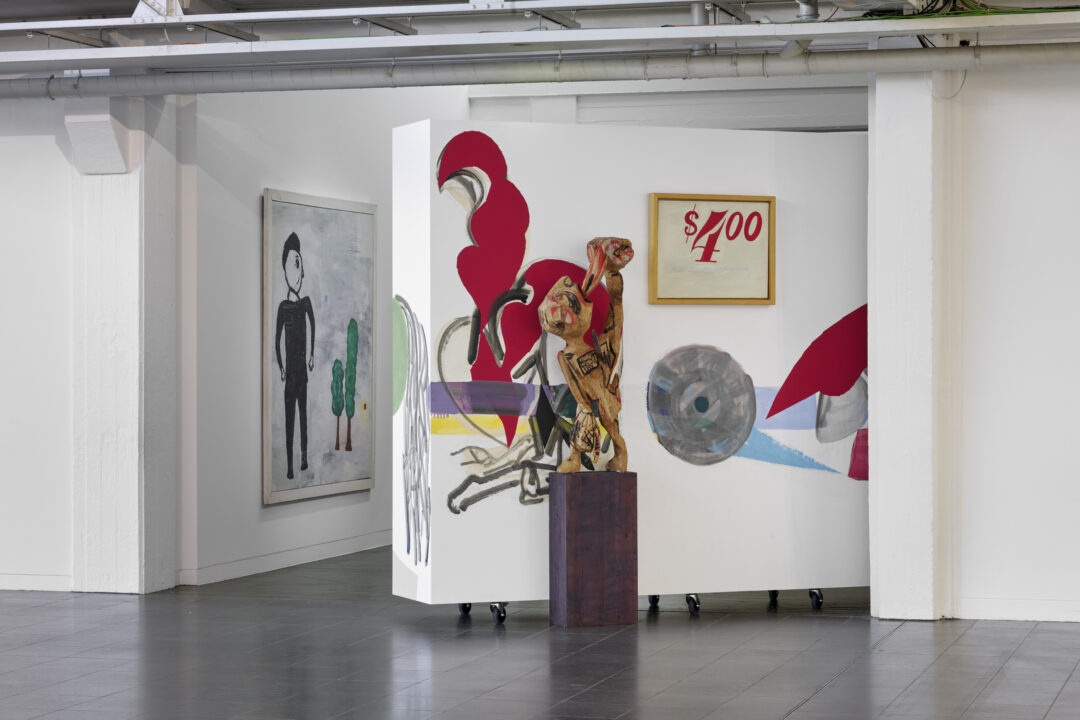
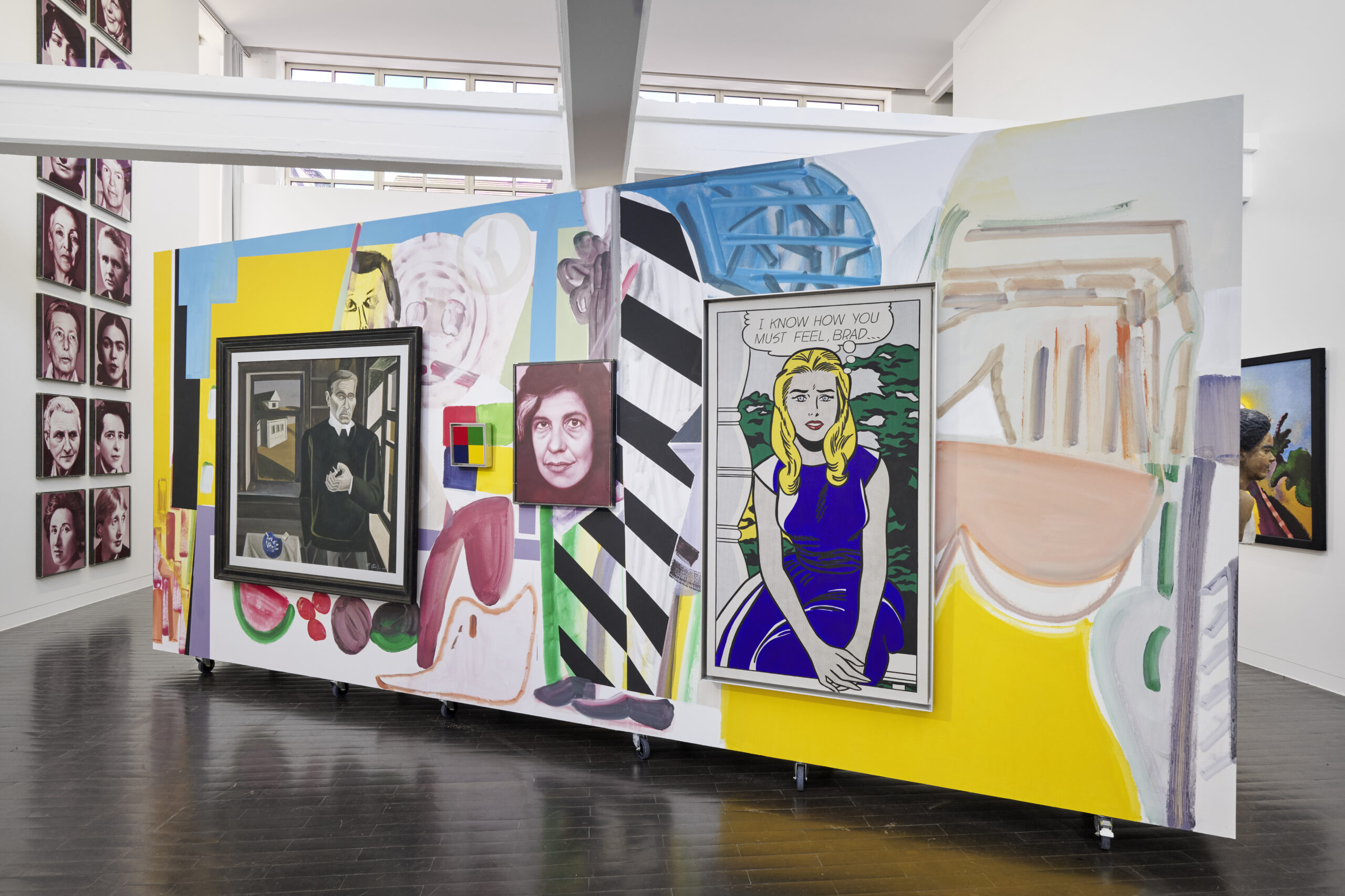
This improvisational work can be found in the second set of rooms at the Ludwig Forum, where the artist has placed temporary picture rails diagonally across the exhibition spaces, displaying large colorful frescoes combining signs, abstract forms, and motifs of ordinary objects such as flowers and light bulbs. These in situ paintings, improvised during the installation of the exhibition and destined to disappear at the end of it, serve as an unconventional backdrop for the display of a selection of pieces from the Ludwig collection that gives pride of place to curiosities: Eastern European painters who escape historical patterns (such as a peasant scene by Augustinas Savickas from 1979 evoking the avant-garde of the early 20th century, or a painted wooden bust by Inga Savranskaja from 1974), little-known German pop artists (Fettprobe, a surprising canvas by Rissa from 1967 depicting a finger sinking into a lump of butter), and, among the more famous artists, works that are often unconventional (such as a Robert Rauschenberg piece that echoes the structure of a tarpaulin).
In contrast to the first part of the exhibition, this collection can be understood intuitively, with the numerous echoes between the pieces creating a thread that is as flexible as it is precise, playing on the polysemy of motifs and color combinations. The artist herself explains that she chose the “unknowable” as her starting point for selecting works from the Ludwigs’ collection, a way of bypassing the collection system by focusing on the works themselves, favoring, for example, figures that are “fragmented, or that face the viewer” and pieces that convey “a sense of ruin, nothingness, emptiness, or destruction.” Sillman, who in 2019 seized the opportunity of an invitation from MoMA to propose, with The Shape of Shape, an alternative history of forms favoring the ”personal genealogies” of artists over the institution’s teleological schemes, continues this approach in Aachen. The result is as disorienting—with no context other than dates—as it is stimulating: the “montage” from one work to another encourages their appreciation and forces us to reconsider the very idea of “contemporaneity.” It is less a matter of setting the record straight than of paying attention to time differences in order to shift our perspective: and over there, what was the avant-garde?
Uncertainty, mobility, staging: by continuing her own experiments as well as immersing herself with energy and sagacity in the history of her medium, Sillman not only leads us to redefine the vocabulary with which we talk about painting—she also reaffirms the reflexive richness of the exhibition form. What temporalities does an exhibition propose or impose? What does it mean to engage with a gallery? Should a painting always be viewed head-on? Can an exhibition tour be as exciting as an escape game? How can we set a body or a gaze in motion—how can we “mobilize” them, with all the political implications that this may have? With its unparalleled tempo, “Oh, Clock!” explodes the time/space/body equation of the visit—as in a cartoon—so that it can be reassembled without any pre-established meaning.
Head image : Amy Sillman. Oh, Clock!, Ausstellungsansicht/exhibition view Ludwig Forum Aachen, 2025, Foto/photo: Mareike Tocha.