Aline Bouvy

Aline Bouvy
Hot Flashes
Casino Luxembourg – Forum d’art contemporain
June 21 to October 12, 2025
Curated by Stilbé Schroeder
At Casino Luxembourg, Aline Bouvy unfurls a universe in which childhood, bodies, and social norms intertwine within a scenography that is both playful and disturbing, transforming the art center’s space into a subversive playground in an exhibition entitled “Hot Flashes.” For this first monograph in a Luxembourg institution, the future representative of the Grand Duchy at the Venice Biennale in 2026 has a way with words and a good dose of self-mockery with this ambiguous title, these “hot flashes” with an American accent, symptoms of menopause in women, which, it should be noted here, while covering a biological reality, is also a social construct[1]assimilating female bodies to chemical bodies, “subjected” to their “moods” as their reproductive capacity fades. But the title is not the subject of the exhibition, just a self-confrontation, the dysfunction of the senses referring here rather to childhood and the norms to be challenged. The Belgian-Luxembourgish artist plays with true-false leads like boxes she has always overflowed. Born in 1974 in Brussels, Aline Bouvy was four years old when her parents moved to Luxembourg and sixteen when she returned to Belgium, where she studied from 1995 to 1999 at the École de Recherche Graphique (ERG), an art and design school in Brussels, then at the Jan Van Eyck Academie in Maastricht, the Netherlands, until 2001. Although she has no preferred medium, she sees the exhibition as a place for questioning, and defines it as a medium in its own right.
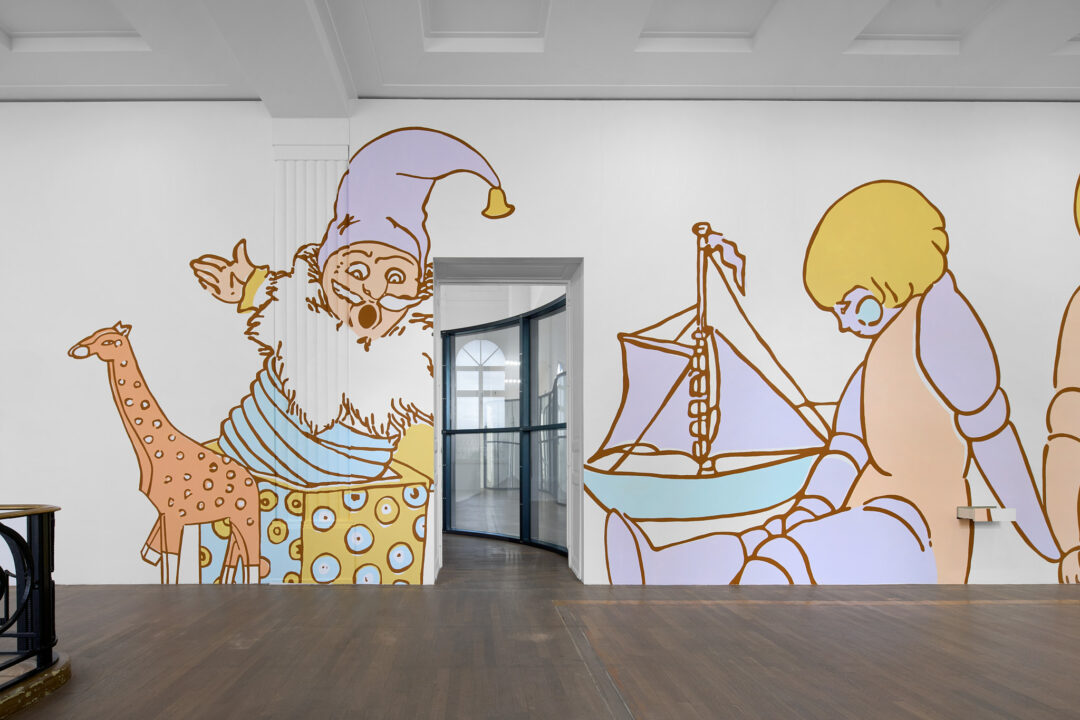
“Hot Flashes” opens on the first floor of the institution with a monumental fresco entitled “The Same Room (After Julie Becker)”, inspired by the work of American artist Julie Becker (1972-2016) and amusement parks, which sets the tone from the outset. Populated with dolls, ballerinas from jewelry boxes, and boxed devils, the work, painted in situ with unapologetic freedom, evokes the colorful motifs of children’s bedrooms in the 1970s, but on a disproportionate scale that disrupts the ordinary to the point of becoming disturbing. Aline Bouvy, who claims a return to the pictorial gesture here, transforms these figures into a “parallel psychological world” with macabre overtones, she says. Inspired by Lee Edelman’s book “No Future[2],” she views childhood not as a space of innocence, but as a social construct traversed by political and cultural tensions. A powerful inaugural gesture, this fresco evokes nostalgia in order to better divert it and reveal the conditioning buried in everyday objects. The artist’s practice questions the social constructs that compartmentalize and restrain us as we form society.
The one who is seen and the one who looks
The heart of the exhibition lies in its central installation: “Wall” (2025), a glass and metal structure covered with a two-way mirror film that divides the art center’s large hall into a space that is both open and closed. This installation, both visual and architectural, plays on the interplay of gazes and asymmetries. The mirror reflects the bodies of visitors, while exposing them to potentially invisible observation. Here, the artist explores the relationship between body and space, questioning how our perceptions are conditioned by external gazes. Her work “revisits the utopian trajectory of a culture moving away from the dominant models of patriarchy and heteronormativity,” writes Marianne Derrien in the presentation text. This installation, echoing earlier pieces such as “Enclosure” (2020), in which the artist sowed belladonna in a structure evoking a “megera’s bridle,” reflects her fascination with bodies as places of resistance and subversion. In “E.T. The Excremential” (2025), a sculpture made of polyurethane foam and resin, she humorously appropriates a line from Spielberg’s film – “He’s from Uranus! Your anus?!” – to explore our relationship with the body, its taboos, and its scatological dimensions.
“Hot Flashes” focuses on childhood as the moment when individuals are shaped by educational, family, and political norms. Aline Bouvy, who grew up in Luxembourg, makes the Casino an ideal space for this reflection, as an “artistic playground” that conceals an “urgent, burning” vision of the world. Her works, such as giant hamburgers housing miniature scenes depicting consumer society, or the installation “La Fame,” conceived as a “hallucinatory kitchen,” revisit the domestic space and patriarchal dictates. Although some of these pieces already existed, they form part of a coherent dialogue with new creations designed for the exhibition. The strength of this multidisciplinary approach is that it turns the exhibition itself into a field of experimentation. The scenography, conceived as a revisited amusement park, plays on the effects of scale and perspective. The monochrome walls of the Casino, contrasting with the colorful fresco and the reflections of the two-way mirror, create a tension between immersion and unease. The partial monochrome, which evokes the problematic “neutrality” of white in other exhibitions by the artist, such as “Le Prix du ticket” [The Price of the Ticket][4], is less pronounced here, in favor of a more playful palette. This choice, although consistent, perhaps represents too great a concession to accessibility, to the detriment of formal radicalism.
“Hot Flashes” is a dense exhibition that combines humor, social criticism, and aesthetic reflection. With her polymorphous practice, Aline Bouvy asserts herself as a major figure in contemporary art, capable of questioning norms with disconcerting freedom. Her feminist commitment, her exploration of bodily taboos, and her rejection of conventions make her an artist at the crossroads between provocation and poetry. The subversive power of “Hot Flashes” succeeds in transforming the Casino into a space of confrontation in which humor and pop references do not contradict a deeper exploration of the tensions it raises. By playing with scale and perspective, Aline Bouvy invites us to rethink our place in the world, but it is in the silences of her work, where unease sets in, that her voice resonates most strongly.
[1] See in particular Cécile Charlap, La fabrique de la ménopause, Paris, CNRS Éditions, coll. Corps, 2019, 265 p.
[2] Lee Edelman, No Future: Queer Theory and the Death Drive, Duke University Press, 2004, 277 p.
[3] Scold’s Bridle: a device used in 16th-century England to publicly humiliate women who “talk too much” and “disturb the peace.”
[4] Solo exhibition by Aline Bouvy at La Friche la Belle de Mai, Marseille, February 3 to September 1, 2024, curated by Thomas Conchou, Marie de Gaulejac, and Victorine Grataloup. Co-production with the Conservatoire Pierre Barbizet – INSEAMM, and Jean-Emmanuel Jacquet’s choir. A proposal by Triangle-Astérides, co-designed and co-produced with the contemporary art center La Ferme du Buisson.
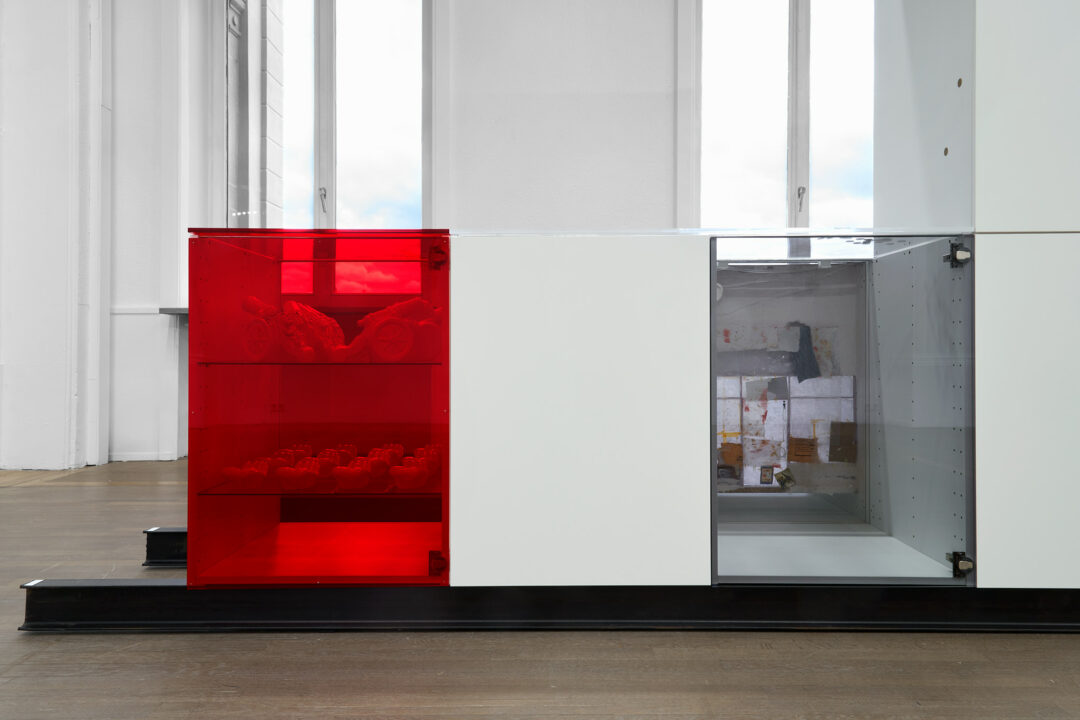
Sculpture et installation sonore, en collaboration avec Léo Cohen et Clyde Arcalis, détail.
Head image : Aline Bouvy, vue de l’exposition Hot Flashes, 2025.
- Share: ,
- By the same author: Biennale Son, Camille Llobet, After the End. Maps for Another Future, Wolfgang Tillmans, Bergen Assembly,